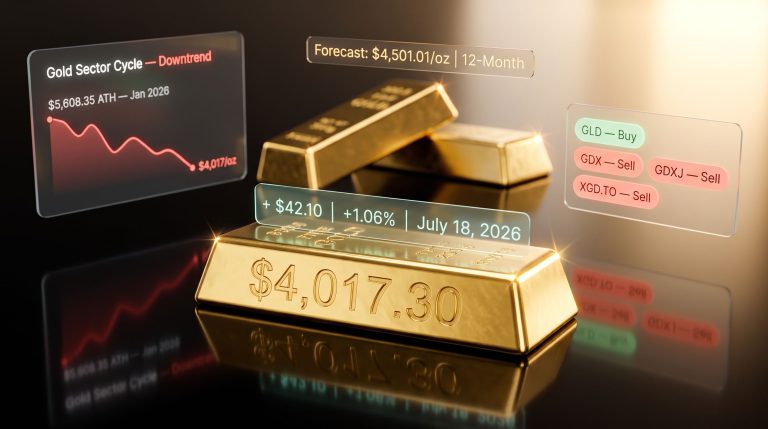
July 19, 2026
The Federal Reserve's Return as Gold's Dominant Force
Monetary policy cycles, not headlines, have historically produced the most durable moves in precious metals. While war, trade friction, and supply disruptions periodically seize control of gold pricing, the underlying gravitational field always traces back to one institution: the Federal Reserve. The relationship between Kevin Warsh Fed and gold prices has become the defining question for precious metals investors in 2026, and understanding this dynamic is not just academically useful — it is the difference between reacting to noise and positioning ahead of signal.
After a turbulent stretch in which geopolitical forces, tariff regimes, and extraordinary physical demand drove gold and silver markets with unusual independence from the Fed, that era has closed. Central bank policy has re-established itself as the dominant pricing variable, and a new figure at its helm is forcing investors to completely reassess their assumptions.
When big ASX news breaks, our subscribers know first
Gold Price Drivers Have Shifted: Understanding the New Hierarchy
From Geopolitics Back to Monetary Policy
Not every driver of gold prices carries equal weight at every moment. Analysts broadly recognise three forces that compete for influence over precious metals pricing: monetary policy, geopolitical risk, and speculative momentum. Their relative dominance shifts across market cycles.
| Period | Primary Driver | Secondary Driver | Gold Trend |
|---|---|---|---|
| 2023 to Early 2024 | Fed rate expectations | Real yield compression | Bullish |
| Mid 2024 to 2025 | Geopolitical risk and tariff regimes | Physical demand and stockpiling | Volatile and Bullish |
| 2026 (present) | Fed Chair transition and monetary stance | Dollar strength | Bearish correction |
Between 2024 and 2025, supply chain disruptions, cross-border gold stockpiling, and questions around physical asset custody redirected trader attention away from Fed signals. Retail participation surged. Leverage compounded. Silver, in particular, reached price levels without modern precedent as industrial demand intersected with speculative positioning and logistical shortages.
That environment produced powerful but ultimately short-lived momentum. Momentum, by its nature, has a finite lifespan. As those distortions faded, monetary policy reclaimed the seat it never truly vacated. Furthermore, the gold price forecast heading into this period had already signalled upward momentum that was increasingly dependent on the Fed's directional lean.
The Signal That Started the Bull Market
To understand where gold stands today, it is worth revisiting where the current bull cycle actually originated. Following a prolonged period of elevated interest rates designed to suppress post-pandemic inflation, markets began to shift their expectations well before any formal policy adjustment was announced.
The catalytic moment came when Fed Governor Chris Waller indicated in a press conference that rate reductions were being considered. Markets responded immediately. Gold caught that forward signal and entered a sustained uptrend that predated any actual policy change by months.
Core Insight: Precious metals function as forward-pricing mechanisms. They respond to expectations, not events. The most profitable positioning in that cycle came from identifying the Fed's directional lean and aligning with it before rate decisions were formalised.
That lesson is directly relevant today. The question is no longer what the Fed has done, but what Kevin Warsh is likely to do — and whether markets have correctly priced his actual philosophy.
Who Is Kevin Warsh and Why Does His Appointment Reshape the Gold Outlook?
A Philosophical Departure from the Powell Era
When President Trump nominated Kevin Warsh to replace Jerome Powell as Federal Reserve Chair in early 2026, prevailing market consensus coalesced around a specific expectation: that Warsh would function as a politically aligned, rate-accommodative steward of the economy. The logic was straightforward. Trump had been openly critical of Powell's approach, and the assumption was that his chosen successor would be more willing to keep financial conditions loose.
That consensus proved costly for those who held it. According to reporting from Forbes, Warsh's nomination triggered the worst single day for gold and silver since the 1980s — a stark illustration of how dramatically the market had mispriced his appointment.
Warsh's opening posture on inflation was aggressive, his language on institutional reform was pointed, and his overall stance diverged sharply from the accommodative trajectory the market had priced in. Rate cut expectations that were embedded in gold pricing before the appointment quickly reversed. Within weeks, market participants had shifted from anticipating one to two rate cuts in 2026 to pricing in the possibility of one to two rate hikes before year-end.
Key Insight: Markets priced in a dovish loyalist. What arrived was an institutionally aggressive inflation hawk. That mispricing created one of the sharpest gold corrections in recent memory.
Warsh's Intellectual Framework on Monetary Policy
Warsh's views on how central banks should operate are not new. He has long argued that the Fed's practice of telegraphing its rate intentions through forward guidance created a form of market dependency that reduced policy flexibility, distorted asset pricing, and ultimately undermined the credibility of monetary institutions.
His position is that price stability is not a flexible target to be balanced against other considerations — it is a foundational institutional commitment. This contrasts with the Powell-era framework of data-dependent gradualism, in which the Fed consistently signalled its intentions far in advance and adjusted course incrementally based on incoming data.
For gold investors, this distinction is significant. A Fed that communicates openly and predictably creates identifiable windows for accumulation and distribution. A Fed that withholds guidance generates structural uncertainty that reshapes how precious metals must be traded.
The Mechanics of the Warsh Fed: What Has Actually Changed?
The Dismantling of Forward Guidance
Forward guidance refers to the practice of central banks communicating their future policy intentions to financial markets. Introduced as a standard tool after the Global Financial Crisis, it became central to how bond markets, currency markets, and commodity markets — including gold — were priced through the 2010s and beyond. The relationship between gold and bond markets is particularly sensitive to this kind of guidance, as rate signals feed directly into real yield calculations that underpin gold valuations.
What is the FOMC Dot Plot?
The dot plot is a chart published by the Federal Reserve showing each policymaker's individual projection for where interest rates will be over coming years. First used in 2012, it became one of the most closely watched forward guidance instruments in global finance, effectively giving markets a visual map of rate expectations across the Committee.
Warsh's decision to withhold his own rate projection from the most recent FOMC dot plot was not a procedural footnote. It was a deliberate signal of institutional philosophy. Credible reports suggest the dot plot itself may be phased out entirely.
The practical consequences of removing this tool are meaningful:
- Rate path uncertainty increases, expanding the volatility premium across interest rate-sensitive asset classes
- Gold and silver pricing shifts from anticipatory to reactive, compressing the forward-looking edge that had previously rewarded disciplined positioning
- Bid-ask spreads widen and short-term price behaviour becomes more erratic as market participants work with less directional information
- The analytical gap between well-resourced institutional traders and retail participants widens
Internal Fed Restructuring and Data Modernisation
Beyond the guidance question, Warsh has initiated a structural review of the Fed's internal operations, standing up committees focused on tools, systems, and the data infrastructure that underpins monetary decision-making. The stated rationale is that the Fed has historically relied on analytical frameworks and datasets built for a different economic era.
Replacing legacy data systems with real-time analytical infrastructure could, over time, make the Fed's inflation and employment responses faster and more precise. For gold investors, this matters because a more responsive Fed is one that can act earlier in an inflationary cycle, reducing the extended windows of real negative rates that have historically been gold's most fertile environment.
The Quantitative Easing Contradiction
One of the most analytically interesting tensions inside the Warsh Fed involves quantitative easing. Warsh has been explicit that QE should be a last-resort emergency instrument, not a routine policy lever. His philosophical position is that money supply expansion and inflation are directly linked, and that QE deployed outside genuine crises is inherently inflationary.
However, the Fed's balance sheet expanded by approximately $10 billion in treasuries in the most recent reporting period. Open-market treasury purchases are, by functional definition, quantitative easing regardless of the label applied to them.
This contradiction raises a question that gold investors cannot yet answer: Is Warsh genuinely hawkish, or is the current posture a transitional communication strategy designed to anchor inflation expectations before a gradual pivot toward the administration's growth agenda?
Gold and Silver's Price Response: The Numbers Behind the Correction
Mapping the 2026 Correction
The market's repricing of Fed expectations under Kevin Warsh Fed and gold prices has been swift and measurable:
| Event | Gold Price Level | Change |
|---|---|---|
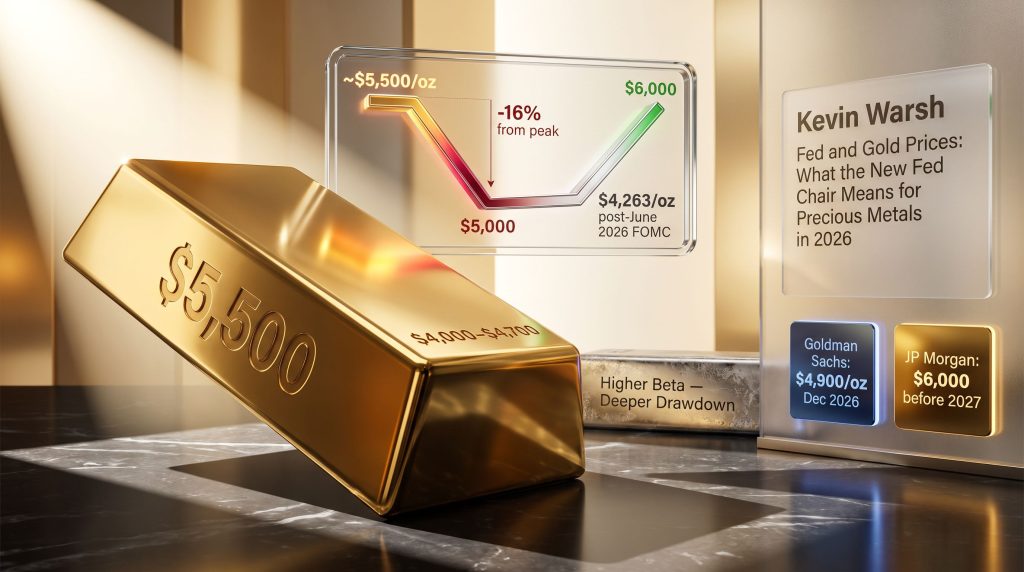
| Pre-nomination peak | ~$5,500/oz | Baseline |
| Post-nomination (Trump announcement, January 2026) | ~$5,136/oz | -10% |
| Intraday post-announcement low | Below $5,000/oz | -16% from peak |
| Post-June 2026 FOMC (rate hike signal) | ~$4,263/oz | -1.6% single session |
| Mid-2026 trading range | $4,000 to $4,700/oz | Stabilising |
Silver's response amplified the moves seen in gold, consistent with its historically higher volatility coefficient and dual sensitivity to both monetary conditions and industrial demand. This behaviour reflects a well-established pattern: when Fed uncertainty is elevated, silver's beta to risk sentiment accelerates drawdowns relative to gold. Consequently, the gold-silver ratio widened notably during this period, reinforcing the divergence between the two metals under conditions of elevated monetary uncertainty.
Current rate hike probability data offers a real-time sentiment gauge for traders. As of mid-2026, July hike odds remain remote, while September has climbed toward 50%. These probabilities function as live pricing signals rather than predictions, and their directional shifts correlate closely with short-term gold price movements.
Two Scenarios and a Framework for Navigating Them
Scenario A: The Hawk Is Genuine
If Warsh's stated philosophy reflects his actual policy trajectory, the following conditions would likely confirm it:
- No further balance sheet expansion in subsequent reporting periods
- A rate hike materialises by Q3 or Q4 2026
- Inflation data continues softening under tighter conditions
In this scenario, gold faces sustained headwinds, with the $4,000 support level subject to meaningful pressure and potential tests of the $3,700 to $3,800 range. Silver would experience deeper percentage drawdowns given its higher sensitivity to risk sentiment.
Scenario B: The Posture Is Transitional
If Warsh is managing a political balancing act between institutional credibility and administration preferences, the signposts would look different:
- Balance sheet growth continues despite hawkish language
- Rate hikes fail to materialise through H2 2026
- Subsequent FOMC communications soften around the inflation narrative
Under this trajectory, gold would likely recover toward the $5,000 level and beyond. JP Morgan's base case places gold at $6,000 per ounce before 2027, while Goldman Sachs projects $4,900 per ounce by December 2026.
Analyst Divergence: The more than $1,100 gap between Goldman Sachs and JP Morgan's 2026 to 2027 gold price targets is not analytical noise. It reflects genuine uncertainty around Warsh's policy trajectory and underscores why scenario monitoring is more valuable than committing to a point forecast.
The Signpost Monitoring Framework
Rather than predicting which scenario unfolds, a more disciplined approach involves tracking the indicators that will resolve the uncertainty:
- Fed balance sheet trajectory: continued expansion suggests latent accommodative bias regardless of public rhetoric
- Dot plot survival: if retained, the distribution of projections across Committee members reveals internal consensus or fracture
- CPI and PCE trends: the data inputs Warsh will be forced to respond to publicly
- Dollar Index (DXY) direction: the most direct transmission mechanism between Fed policy and gold pricing
- FOMC dissent patterns: internal disagreement often precedes policy shifts and can serve as an early pivot signal
- CME FedWatch rate hike probabilities: live market-implied probability shifts as a sentiment indicator
The next major ASX story will hit our subscribers first
The Structural Implications of an Opaque Fed for Gold Investors
Volatility as a Long-Run Bullish Variable
The decade of Fed transparency that forward guidance enabled effectively suppressed gold's volatility premium. Predictable policy windows allowed sophisticated investors to time entries and exits with greater precision, which paradoxically dampened the safe-haven premium that makes gold valuable in the first place.
An opaque Fed that withholds guidance and restructures its communication frameworks changes this dynamic. Higher structural volatility in rate expectations expands gold's safe-haven premium over multi-year timeframes. In addition, central bank gold demand continues to provide a structural floor beneath prices, even as short-term volatility intensifies under the Warsh regime. Investors seeking portfolio insurance against policy uncertainty are willing to pay more for that insurance when uncertainty is genuinely elevated.
The Inflation Mandate Paradox
There is a scenario worth examining that receives less attention than the straightforward hawkish-is-bearish-for-gold narrative. Aggressive rate hikes that slow economic growth can trigger recessionary fears, which historically redirect capital into gold as a defensive asset. The relationship between Fed hawkishness and gold pricing is not always inverse or linear.
During the Volcker-era tightening cycle of the early 1980s, gold experienced significant volatility but ultimately remained a critical portfolio allocation for investors navigating stagflationary and recessionary uncertainty. The mechanism was different from the inflation-hedge narrative: gold was performing a pure safe-haven function as growth fears overtook inflation concerns.
If Warsh's hawkishness is sufficiently aggressive to generate growth anxiety, a similar dynamic could emerge even within a tightening cycle. The bond market effects of this uncertainty are already visible, with yield curve behaviour reflecting genuine disagreement about the growth outlook under tighter monetary conditions.
Frequently Asked Questions
What did Kevin Warsh do to gold prices in 2026?
Warsh's nomination and subsequent hawkish policy signals triggered a correction of approximately 10 to 16 percent from peak levels near $5,500 per ounce. By mid-2026, prices had stabilised in the $4,000 to $4,700 range, representing a substantial repricing of the Fed accommodation that had previously been embedded in gold valuations.
Why does the Fed Chair matter so much to gold prices?
Gold is a non-yielding asset. Its opportunity cost relative to interest-bearing alternatives rises when rates increase and falls when rates decrease. The Fed Chair controls the policy rate trajectory, which feeds directly into real interest rates and US dollar strength — the two most reliable transmission mechanisms to gold pricing.
What is Kevin Warsh's stance on quantitative easing?
Warsh has publicly positioned QE as an emergency instrument of last resort, opposing its use as a routine policy tool. However, the observed expansion of the Fed's balance sheet through treasury purchases creates a measurable tension between stated philosophy and institutional behaviour.
Will gold recover if the Fed pivots in late 2026?
Recovery scenarios are supported by both JP Morgan's $6,000 projection before 2027 and Goldman Sachs' $4,900 target by December 2026. The conditions under which recovery becomes the base case centre on balance sheet behaviour, the materialisation or absence of rate hikes, and shifts in FOMC communication tone. CNBC's analysis of the initial market reaction provides useful context for understanding how quickly sentiment can shift around Fed Chair transitions.
What happened to silver when Warsh became Fed Chair?
Silver sold off faster and more deeply than gold following Warsh's nomination and hawkish positioning. This is consistent with silver's historically higher volatility and its dual exposure to both monetary conditions and industrial demand sentiment. When Fed uncertainty rises, silver's amplified response requires investors to apply a higher risk premium to positioning decisions.
A Practical Framework for Positioning in the Warsh Era
The most important discipline for precious metals investors navigating the current environment is the separation of Fed language from Fed action. The dynamics underpinning Kevin Warsh Fed and gold prices remain unresolved: Warsh's verbal posture is hawkish, but the balance sheet data tells a more ambiguous story. Until those two signals converge or one definitively overrides the other, committing to a single directional thesis carries unnecessary risk.
The long-term structural case for gold has not changed. Fiscal deficits across major economies remain elevated. Global central bank gold accumulation continues at historically significant rates. De-dollarisation trends, while gradual, are directionally intact. None of these forces have reversed under the Warsh Fed.
What has changed is the short-to-medium-term volatility regime. An opaque Fed that withholds guidance, restructures its internal operations, and sends mixed signals through the gap between rhetoric and balance sheet behaviour is a Fed that demands more disciplined monitoring and more flexible positioning.
Final Framework: Watch the Fed's balance sheet monthly. Track real yields via 10-year TIPS. Monitor DXY direction as the most direct pricing signal. Follow CME FedWatch probability shifts for real-time sentiment. Let the data resolve the scenario uncertainty before committing to directional exposure.
The precious metals market has re-entered an era where monetary policy is the primary variable. That is familiar territory. What is unfamiliar is navigating it without the forward guidance that made Fed positioning legible for the better part of a decade. That is the defining challenge of the Warsh era for gold and silver investors.
This article is intended for informational and educational purposes only and does not constitute financial or investment advice. Precious metals markets carry significant risk and price forecasts referenced from third-party analysts reflect their independent views at the time of publication. Past performance is not indicative of future results. Always conduct independent research before making investment decisions.
Want to Know When the Next Major ASX Mineral Discovery Hits the Market?
While macro forces like the Warsh Fed reshape gold valuations, Discovery Alert's proprietary Discovery IQ model scans ASX announcements in real time, delivering instant alerts on significant mineral discoveries so subscribers can identify actionable opportunities ahead of the broader market — explore historic discovery returns to understand what early positioning can mean, then begin a 14-day free trial at Discovery Alert to secure your market-leading edge.