
June 18, 2026
From Idle to Producing: How La Parrilla's Restart Reframes Mexico's Silver Mining Narrative
Commodity cycles have a way of rewriting the fortunes of entire mining districts. When silver, lead, and zinc prices collapsed heading into 2019, dozens of operations across Mexico's historically prolific silver belt were forced into temporary hibernation. Processing plants fell quiet, underground development stalled, and stockpiles sat untouched. Yet within those care-and-maintenance assets lay something valuable: existing infrastructure, permitted ground, and established resource bases waiting for the economics to improve. La Parrilla Silver Mine Complex in Durango, Mexico, is now demonstrating what a well-executed restart looks like when those conditions shift in favour of the producer.
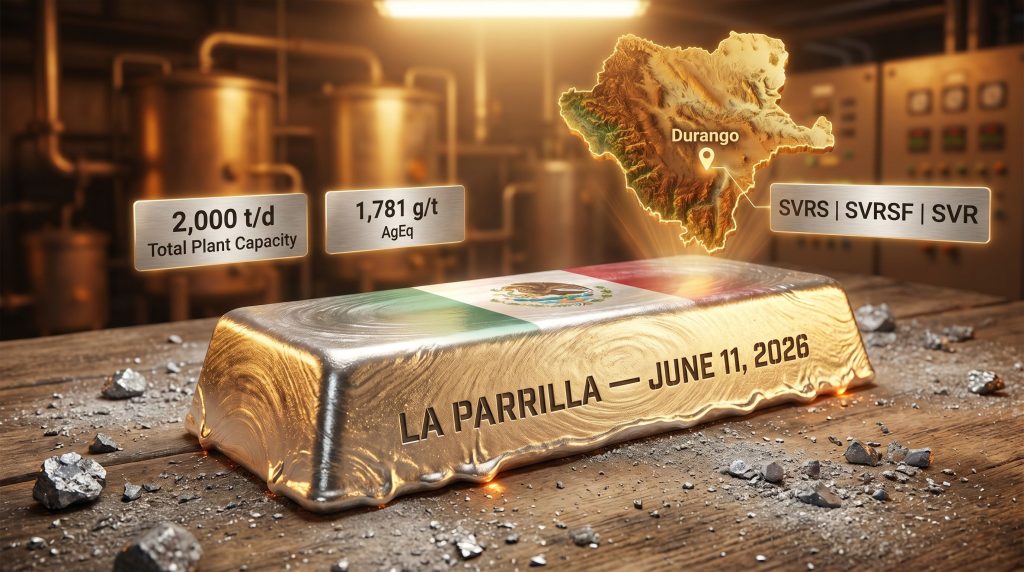
The Silver Storm La Parrilla first doré pour, achieved on June 11, 2026, represents more than a single operational milestone. It marks the formal re-entry of a significant processing facility into Mexico's silver production chain, delivered in under three years from the date of acquisition and nearly seven years after the mine was shuttered.
When big ASX news breaks, our subscribers know first
What a Doré Pour Actually Confirms About an Operation
For investors unfamiliar with mine-site metallurgy, the term doré can obscure the significance of what has actually been accomplished. A doré bar is a semi-refined alloy of gold and silver cast at the mine site itself, prior to being transported to an external refinery for final processing into commercially pure metals. Producing a doré bar requires not just the presence of ore, but the successful integration of crushing, milling, leaching, and precipitation circuits operating in sequence.
"A first doré pour is the mining industry's equivalent of a factory producing its first sellable unit. It confirms that the entire upstream processing chain is functional, calibrated, and capable of generating a saleable product."
At La Parrilla, the oxide processing circuit uses cyanide leaching to extract silver and gold values from oxide ore. In this process, a dilute cyanide solution is applied to crushed ore, selectively dissolving precious metals into solution. That metal-rich solution then undergoes a series of precipitation steps to recover the gold and silver as a solid, which is subsequently smelted into doré bars.
The process is well-understood and widely used across Mexico's silver-producing regions. However, its successful execution at La Parrilla confirms the circuit has been properly rehabilitated following nearly seven years of inactivity. Furthermore, coverage from Mining Weekly confirmed the significance of this achievement for the broader sector.
The Oxide and Sulphide Split: Why Two Circuits Matter
La Parrilla's design is more complex than a single-circuit operation. The plant is configured to handle fundamentally different ore types through separate processing pathways — a design choice that both expands the mine's addressable resource base and diversifies its revenue streams. Consequently, silver's dual demand characteristics, spanning both precious metal and industrial applications, make multi-metal operations like this particularly well-positioned.
| Circuit | Capacity | Processing Method | Primary Output |
|---|---|---|---|
| Oxide Circuit | ~750 t/d (est.) | Cyanide leaching | Silver-gold doré |
| Sulphide Circuit | 1,250 t/d | Differential flotation | Silver-lead concentrate and zinc concentrate |
| Total Plant | 2,000 t/d | Combined | Multiple payable metals |
The sulphide circuit employs differential flotation, a process that uses reagent chemistry and air bubbling to selectively attach mineral particles to froth, separating silver-rich lead sulphide minerals from zinc sulphide minerals in sequential flotation stages. The result is two distinct concentrates, each carrying payable silver alongside their base metal component.
This dual output structure means La Parrilla generates revenue from silver, gold, lead, and zinc simultaneously once both circuits are operating at capacity. Commissioning of the 1,250 t/d sulphide circuit was scheduled to begin in June 2026, with the company estimating a ramp-up period of approximately one month to reach operational capacity.
La Parrilla's Operational History and the Acquisition Chain
Understanding why this restart matters requires tracing the mine's history through a series of ownership transitions shaped by commodity price volatility.
La Parrilla began production in 2004 and operated continuously for fifteen years. During that period, First Majestic Silver expanded the milling facility in 2012 through a parallel circuit build-out, adding a 1,000 t/d flotation circuit alongside an existing 1,000 t/d cyanidation circuit to reach the current 2,000 t/d total capacity. This expansion created the dual-circuit infrastructure that Silver Storm later inherited.
In September 2019, depressed silver, lead, and zinc prices made continued operations uneconomic, and First Majestic placed the mine under care and maintenance. This decision, while operationally rational at the time, preserved the physical plant in a state that could theoretically be reactivated when market conditions improved.
First Majestic subsequently sold the property to Golden Tag Resources, which was later rebranded as Silver Storm Mining. The 2023 transfer received clearance from COFECE, Mexico's Federal Economic Competition Commission, with the mine's permits reported as current and in order at the time of the transaction. Silver Storm then held 100% ownership of an asset with established infrastructure, a known resource base, and a processing facility with a fifteen-year operational track record.
The Phased Restart Strategy Silver Storm Executed
Rather than attempting a simultaneous restart of all circuits, Silver Storm adopted a sequenced approach that allowed the team to prove each system before advancing to the next:
- Phase 1: Commissioning of the oxide circuit using ore drawn from the existing open-pit oxide stockpile accumulated at surface during and after the First Majestic operating period.
- Phase 2: Underground development in the San Marcos area to establish a run-of-mine feed source, reducing dependence on finite surface stockpile material and transitioning to fresh ore production.
- Phase 3: Commissioning of the sulphide circuit, scheduled for June 2026, with an estimated one-month ramp-up to full capacity.
This sequencing carries a specific operational logic. Processing stockpile material first allows the team to commission, calibrate, and troubleshoot the oxide circuit without the added complexity of simultaneous underground production pressures. It also generates early cash flow or near-cash inventory in the form of doré bars, which can support operational funding during the more capital-intensive sulphide ramp-up phase.
Underground development contractors MINPRO and Mexgeo were mobilised as part of the pre-restart preparation program. MINPRO, founded in 2008 and headquartered in Chihuahua, brings specialist expertise across underground and open-pit development, drilling, blasting, and haulage across Mexico's principal mining regions. Their involvement reflects the scale and technical complexity of bringing a multi-area underground mine back to productive status.
Drilling Results That Underpin Confidence in the Resource
Restarting a mine that has been idle for nearly seven years carries inherent geological risk. Resource confidence, particularly in the areas scheduled for near-term underground production, is therefore critical to the investment case. Silver Storm addressed this through a 6,000-metre underground drilling program targeting the Quebradillas, San Marcos, and Rosarios mine areas within the complex.
The results from that program provided meaningful support for the restart decision:
| Drill Result | Width | Zone | Context |
|---|---|---|---|
| 1,781 g/t AgEq | 1.03m | C460 Zone, Quebradillas | High-grade narrow vein confirmation |
| 1,335 g/t AgEq | 3.68m | C460 Zone, Quebradillas | Broader high-grade intercept |
These intercepts are notable not just for their grade but for their location within a historically productive zone. Furthermore, Red Cloud Research highlighted the significance of these results in the context of the broader restart program. Interpreting drill results of this nature requires understanding both the grade and the structural context, particularly when assessing vertical continuity below previously mined levels.
The high-grade results at this depth suggest vertical continuity of mineralisation below previously mined levels, which is an important indicator for underground mine life extension. The distinction between step-out and infill drilling is worth understanding in this context.
- Infill drilling tightens the spacing between known intercepts to increase resource classification confidence, converting inferred resources toward higher confidence categories.
- Step-out drilling tests mineralisation beyond the known resource boundary, with the goal of expanding the total resource envelope.
Both approaches were employed in Silver Storm's program, meaning the company was simultaneously validating existing resources and testing for potential extensions.
Three Mine Areas, One Complex: The Structural Advantage
La Parrilla's multi-area structure — encompassing the Quebradillas, San Marcos, and Rosarios mines within a single processing complex — provides operational flexibility that single-vein underground mines cannot replicate. When one area encounters ground conditions or grade variability that affects production, operators can blend feed from other areas or redirect development effort.
This built-in redundancy is a lesser-appreciated aspect of multi-area mine complexes and contributes to throughput consistency at the mill level.
Durango's Silver Sector: A Region With Structural Advantages
La Parrilla sits within Durango State, Mexico's third-largest silver-producing region, located approximately 65 kilometres southeast of Durango city within the municipality of Nombre de Dios. The region's mining infrastructure — including road access, power connectivity, and a deep pool of experienced mining labour — provides a lower-cost operating environment compared to greenfield jurisdictions.
Mexico's position in global silver production is historically unrivalled. The country has held the top ranking among the world's silver producers during approximately 80% of the past 120 years, according to industry figures. Durango's contribution to national output has reached approximately 11.7% during peak production periods, making it a material component of Mexico's overall silver industry.
Several factors are currently drawing increased capital from junior and mid-tier mining companies into Durango specifically:
- Established processing infrastructure that reduces capital intensity for restart and brownfield development projects.
- A workforce with generational experience in silver, lead, and zinc mining across the Sierra Madre Occidental belt.
- Proximity to concentrate shipping routes and smelting facilities that support sulphide production economics.
- A recoverable resource base across multiple historical mines placed on care and maintenance rather than permanently closed during the 2015 to 2020 price downturn.
The broader silver price environment has also shifted meaningfully. Improved precious metal pricing has changed the economic calculus for assets that were marginal at sub-$15 silver but become compelling at higher sustained price levels, drawing investor attention toward projects with demonstrated geology and existing processing plants.
Beyond La Parrilla: The San Diego Project and Portfolio Depth
Silver Storm's asset base extends beyond La Parrilla. The company holds a 100% interest in the San Diego Project, considered one of the largest undeveloped silver projects in Mexico by resource scale. This asset provides a longer-dated development pipeline that distinguishes Silver Storm from single-asset junior miners. In addition, the strategic approach echoes broader patterns seen with Endeavour Silver expansion into Latin American silver assets.
For investors evaluating the company, the combination of a near-term producing asset in La Parrilla and a large-scale development-stage asset in San Diego creates a two-horizon investment structure. La Parrilla generates operational experience, revenue, and near-term cash flow potential, while San Diego represents optionality on a larger, longer-term resource base that could attract development capital as silver prices evolve.
The 100% ownership position in both assets means Silver Storm retains full capital allocation flexibility. There are no joint venture partners to negotiate with or royalty obligations to manage at the asset level, which simplifies operational decision-making and preserves the full economic benefit of both resource bases for shareholders.
How Feasibility and Drilling Frameworks Apply Here
As Silver Storm advances its development pipeline, the pathway from drill results to production decisions becomes increasingly important. For instance, definitive feasibility studies serve as the formal mechanism by which resource confidence is translated into bankable project economics. Likewise, investors who are interpreting drill results from Silver Storm's ongoing programs will benefit from understanding both grade continuity and structural context.
Mexico's role in global silver production underscores why projects like La Parrilla attract sustained investor attention. Furthermore, the nuanced interplay between precious metal demand and industrial consumption — capturing silver's dual demand nature — continues to underpin the long-term investment case for well-positioned Mexican silver producers.
The next major ASX story will hit our subscribers first
How Silver Storm Is Structured for Market Access
Silver Storm Mining trades across three exchanges, providing access for a broad range of investor categories:
| Exchange | Ticker Symbol |
|---|---|
| TSX Venture Exchange | SVRS |
| OTCQX | SVRSF |
| Frankfurt Stock Exchange | SVR |
Technical disclosures are reviewed and approved by Shane Ghouralal, P.Eng., Director of Technical Services, serving as a Qualified Person under National Instrument 43-101. This regulatory framework requires that all material technical information reported by Canadian-listed mining companies be verified by a credentialed geoscientist or engineer with relevant expertise, providing an additional layer of disclosure integrity for investors assessing reported resource estimates and operational data.
The Silver Storm La Parrilla first doré pour consequently stands as a clear inflection point — one that transitions the asset from a care-and-maintenance liability into a functioning, revenue-generating operation with meaningful exploration and expansion potential still ahead.
Disclaimer: This article is intended for informational purposes only and does not constitute financial advice or a recommendation to buy or sell securities. Mineral resource estimates, production forecasts, and operational timelines involve inherent uncertainty and should not be relied upon as guarantees of future performance. Readers should conduct their own due diligence and consult a qualified financial adviser before making any investment decisions.
Want to Track the Next Major Silver Discovery Before the Broader Market Does?
Discovery Alert's proprietary Discovery IQ model scans ASX announcements in real time, instantly identifying significant mineral discoveries across silver, gold, and base metals — converting complex data into clear, actionable insights for investors at every experience level. Explore how historic discoveries have generated substantial returns and begin your 14-day free trial today to position yourself ahead of the market.