
May 20, 2026
Understanding the Regulatory Spectrum in LATAM Mining
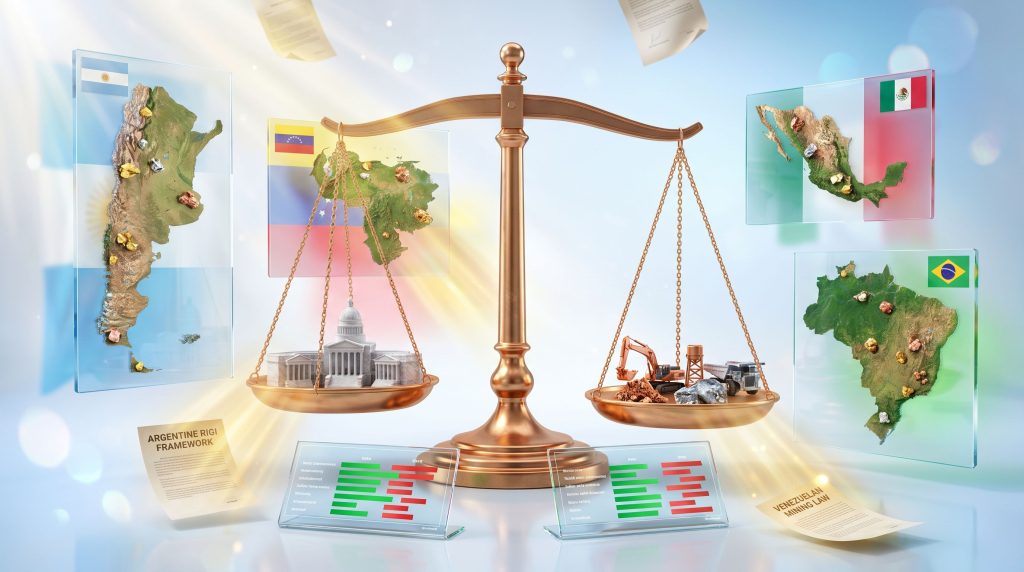
The fundamental architecture of Latin American mining governance reflects a tension between resource nationalism and market-driven development strategies. This regulatory divide shapes how nations balance strategic asset control against foreign investment attraction, creating distinct operational frameworks that determine mining laws state presence private models LATAM across the region.
When big ASX news breaks, our subscribers know first
The Fundamental Choice Between State Ownership and Market Mechanisms
Mining laws across LATAM operate within two primary frameworks that define state presence in mineral resource management. The regalien system, derived from colonial Spanish legal traditions, maintains governmental ownership of subsurface mineral rights while granting exploitation concessions to private models under specific terms. This contrasts sharply with market-oriented frameworks where mineral rights transfer more directly to private entities with reduced governmental oversight.
The practical implications of these systems extend beyond legal technicalities into operational control mechanisms. Under state ownership models, mining companies typically receive exploitation rights spanning 20-50 years, subject to production quotas, community consultation requirements, and environmental compliance standards that serve as governmental control instruments. Market-oriented jurisdictions generally reduce these administrative barriers whilst implementing alternative oversight through taxation, royalty structures, and export regulations.
| Regulatory Model | Mineral Title Ownership | Concession Period | Operational Control | Investment Requirements |
|---|---|---|---|---|
| State Ownership (Regalien) | Government retains title | 20-30 years typical | High state oversight | Extensive compliance documentation |
| Market-Oriented | Private rights acquisition | Variable, often renewable | Reduced state intervention | Tax-based rather than administrative |
| Hybrid Models | Joint state-private structure | 30-50 years | Shared operational control | Partnership requirements |
Critical Minerals Reserved for State Control
Hydrocarbon exclusions represent the most consistent pattern across LATAM mining jurisdictions, with oil and gas remaining under state control even in otherwise liberalised regulatory environments. This reflects strategic energy security considerations that transcend general mining permitting essentials approaches. Construction materials frequently fall under separate regulatory categories, often governed by landowner rights rather than state concession systems.
Strategic mineral classification serves dual purposes: ensuring domestic value capture from critical resources whilst maintaining governmental leverage over supply chain decisions during geopolitical disruptions.
Venezuela's 2026 Organic Mining Law exemplifies evolving approaches to critical mineral governance. The legislation establishes 30-year exploitation rights for private and foreign firms whilst requiring 55% Venezuelan ownership in joint ventures, demonstrating hybrid models that balance strategic control with private sector operational expertise and capital access.
What Drives Countries Toward Private Mining Models?
Economic competitiveness pressures and capital access constraints drive several LATAM nations toward regulatory frameworks that enhance private models participation in mining sector development. These shifts reflect recognition that state-controlled mining operations often lack the technological innovation, risk capital, and operational efficiency required for complex mineral extraction projects in competitive global markets.
Argentina's RIGI Framework as a Market Incentive Case Study
Argentina's Large Investment Incentive Regime represents a comprehensive regulatory response to regional competition for mining investment capital. Furthermore, the framework addresses traditional barriers that deterred foreign mining companies from committing to long-term development projects in uncertain regulatory environments.
Key RIGI framework components include:
• Tax stability guarantees protecting investors from increased rates during project implementation phases
• Foreign exchange provisions enabling capital repatriation under specified conditions
• Sectoral incentives designed specifically for mining operations and associated infrastructure development
• Administrative streamlining reducing bureaucratic requirements for qualified large-scale projects
These measures position Argentina as a regional alternative to jurisdictions with heightened state presence in mining operations, targeting portfolio capital seeking predictable investment environments with guaranteed returns on committed resources.
Venezuela's Surprising Pivot to Private Partnership Models
The 2026 Organic Mining Law represents Venezuela's most significant departure from nationalisation policies toward collaborative mining development models. In addition, this regulatory transformation acknowledges competitive disadvantages inherent in exclusive state-run mining operations whilst maintaining governmental economic participation through ownership requirements.
The 55% Venezuelan ownership threshold creates structured partnerships that combine local stakeholder participation with foreign operational expertise and capital resources. These joint venture arrangements enable technology transfer, processing infrastructure development, and international market access whilst preserving state economic benefit-sharing from mineral extraction activities.
Thirty-year contract periods provide multi-decade operational certainty compared to shorter-term renewable concessions common in other jurisdictions. This temporal framework supports complex mining project development requiring substantial upfront capital investment and extended payback periods typical of large-scale mineral extraction operations.
Mexico's Regulatory Uncertainty and Investment Implications
Following the 2023 Mining Laws reform, Mexico implemented changes to environmental impact assessment procedures, community consultation requirements, and concession holder qualification standards. However, implementing regulations defining specific operational compliance procedures remain under development, creating operational ambiguity for exploration-stage mining companies.
Thomas Lamb, CEO of J2 Metals, detailed how the company advances the Sierra Plata silver-antimony project in Mexico's Zacualpan district through partnership with Impact Silver, demonstrating private models adaptation to evolving regulatory requirements. The project capitalises on rising silver prices whilst navigating uncertain compliance frameworks that affect development timelines and financing decisions.
This regulatory gap potentially delays feasibility studies and project financing decisions as companies await clarification on specific operational requirements. Silverco Mining's announcement of a Preliminary Economic Assessment for the Cusi Mine restart in Chihuahua, projecting a 9-year mine life at 1,200 tonnes per day throughput, represents continued private-sector capital deployment despite regulatory uncertainty.
Why Are Some Nations Tightening State Control Over Mining?
Strategic resource nationalism and geopolitical supply chain considerations drive several LATAM governments toward enhanced state presence in mining operations. These policy shifts reflect recognition that critical minerals represent strategic assets comparable to hydrocarbon resources, requiring domestic value capture and operational sovereignty during supply chain disruptions.
Brazil's Foreign Investment Restrictions in Strategic Minerals
Brazil's Constitutional Article 176 establishes comprehensive restrictions on foreign mining company operations, requiring Brazilian majority ownership or partnership structures for mineral extraction activities. These provisions prioritise domestic stakeholder participation in strategic resource development whilst limiting foreign operational control over critical mineral assets.
The constitutional framework mandates:
-
Brazilian legal entity ownership or control for all mining operations
-
Technical and financial capacity verification through domestic regulatory agencies
-
Environmental compliance certification meeting federal and state requirements
-
Community consultation procedures ensuring local stakeholder engagement
Foreign companies must establish Brazilian subsidiaries with Brazilian nationals holding controlling interest, creating mandatory partnership structures that enhance domestic economic participation in mining industry evolution development. This regulatory approach contrasts sharply with market-oriented jurisdictions that permit direct foreign ownership of mineral assets.
Community Acceptance as a New Regulatory Gatekeeper
Social licence requirements have evolved from voluntary corporate social responsibility practices to mandatory regulatory requirements across multiple LATAM jurisdictions. Mining laws increasingly integrate community acceptance criteria into licence renewal processes, creating subjective evaluation standards that enhance governmental gatekeeping authority over mining operations.
Modern regulatory frameworks commonly mandate:
• Pre-project Indigenous consultation procedures following informed consent standards
• Public hearings with adjacent community stakeholders during development phases
• Licence renewal conditions dependent on ongoing community support documentation
• Community complaint escalation mechanisms to government regulatory agencies
• Restoration bonding or financial assurance mechanisms ensuring environmental rehabilitation
These requirements create compliance costs that disproportionately affect smaller operators whilst favouring state-controlled enterprises with subsidised compliance infrastructure and established community relations networks.
Environmental Compliance as State Control Mechanism
Rising environmental standards serve dual regulatory purposes: genuine environmental protection and de facto investment barriers that limit foreign operator participation in strategic mineral sectors. Regulatory complexity creates administrative requirements that enhance state presence in mining operations through oversight mechanisms.
Environmental compliance frameworks now typically require:
• Baseline environmental impact assessments conducted pre-extraction
• Quarterly and annual environmental monitoring reports submitted to regulatory agencies
• Climate impact declarations and carbon offset commitments aligning with national environmental policy
• Water usage permits and waste management certifications meeting federal environmental standards
These expanding requirements create regulatory leverage enabling governments to influence operational decisions, production schedules, and technology choices through environmental compliance conditions rather than direct operational control mandates. Furthermore, mine reclamation innovation becomes increasingly important in meeting these enhanced environmental standards.
How Do Geopolitical Factors Influence Mining Law Development?
Global supply chain reconfiguration and critical mineral security considerations increasingly shape LATAM mining regulatory development. The United States and allied nations actively pursue regulatory reforms in Latin American mining jurisdictions to ensure access to critical minerals outside Chinese-controlled supply chains, creating geopolitical pressure on domestic mining laws formulation.
US-China Decoupling and Critical Mineral Security
The U.S. Department of Energy's 2024 Critical Materials Strategy identifies over 50 minerals as essential for national security and energy transition applications. This designation influences LATAM mining policy development through bilateral pressure, trade agreement conditions, and development financing incentives targeting supply chain diversification objectives.
Critical minerals designation enables governments to:
• Restrict export volumes to maintain domestic processing capacity
• Require processing or value-added manufacturing within national boundaries
• Impose export licensing requirements for strategic mineral shipments
• Establish strategic reserves or production quotas serving national security objectives
China historically controlled significant shares of global processing capacity for rare earth elements, lithium, and other critical minerals essential for renewable energy technology manufacturing. Recent US initiatives target supply chain diversification through private models development in politically aligned jurisdictions, particularly as US-China trade impact continues to reshape global commodity flows.
USMCA Trade Agreement Pressures on Mining Regulations
USMCA provisions impose constraints on Mexico's sovereign mining policy authority through sectoral review mechanisms. Mexico's state lithium monopoly directly conflicts with US trade negotiator objectives favouring private models mineral extraction and export frameworks, creating leverage for regulatory alignment through dispute resolution procedures.
The July 2026 USMCA review specifically addresses Mexico's lithium and energy monopolies, according to Legislative Observatory on Global Affairs analysis. US trade negotiators explicitly targeted Mexico's lithium monopoly managed by state-owned Petróleos Mexicanos during sectoral negotiations, demonstrating how trade agreements constrain domestic state presence in strategic mineral sectors.
Trade agreement enforcement mechanisms create leverage for regulatory alignment by enabling formal challenges of mining policies deemed trade-restrictive under international commercial law frameworks.
These negotiations demonstrate how international trade agreements can override domestic resource sovereignty preferences, forcing LATAM nations to balance strategic resource control against market access commitments required for broader economic integration.
Strategic Mineral Classification and Supply Chain Leverage
LATAM governments increasingly recognise critical minerals as strategic assets providing geopolitical positioning advantages. Venezuela mining reforms represent a significant pivot toward private models participation within the context of US-Venezuela geopolitical tensions and US critical minerals supply chain diversification strategy.
The legislation positions Venezuela as a potential alternative to Chinese mineral sources whilst maintaining state economic benefit participation through ownership requirements. This approach demonstrates how geopolitical considerations can drive regulatory frameworks toward hybrid models that balance strategic control with international market integration objectives.
Robert Friedland of Ivanhoe Mines noted that extended Strait of Hormuz shutdowns would severely disrupt global supply networks, placing copper producers under mounting pressure as sulfur and sulfuric acid costs climb. Such geopolitical supply chain vulnerabilities drive LATAM regulatory development toward frameworks that enhance regional supply chain resilience through diversified production and processing capacity.
What Are the Investment Implications of This Regulatory Divide?
The fundamental split between state-controlled and market-oriented mining laws across LATAM creates distinct investment risk profiles and return expectations that shape capital allocation decisions in regional mining sector development. Regulatory uncertainty affects project financing, development timelines, and operational control structures in ways that influence long-term investment viability assessments.
Risk Assessment Framework for Mining Investment Decisions
Private models development requires comprehensive evaluation of regulatory stability, governmental policy consistency, and administrative predictability across different jurisdictional frameworks. Countries implementing enhanced state presence create additional compliance requirements that affect operational costs and development schedules.
| Jurisdiction | Regulatory Stability | Foreign Ownership | Environmental Requirements | Community Consultation | Investment Risk Level |
|---|---|---|---|---|---|
| Argentina (RIGI) | High – tax guarantees | Unrestricted | Moderate | Standard procedures | Low-Medium |
| Brazil | Medium – constitutional limits | Restricted – majority local | High compliance costs | Mandatory Indigenous rights | Medium-High |
| Mexico | Low – regulatory gap | Unrestricted | Increasing requirements | Enhanced social licence | Medium |
| Venezuela | Unknown – recent reform | 55% local ownership required | Under development | Community participation required | High |
| Chile | High – established framework | Unrestricted | Comprehensive standards | Established procedures | Low |
Sonoro Gold's acquisition of the Diana mineral concession in Sonora, expanding its Cerro Caliche project by 51 hectares to 26 contiguous concessions, demonstrates ongoing private models concession acquisition under current Mexican frameworks despite regulatory uncertainty.
Political Risk Mitigation and Insurance Strategies
Mining companies operating across the LATAM regulatory spectrum employ diverse risk mitigation approaches adapted to specific jurisdictional characteristics. Enhanced state presence in mining operations creates political risk exposures requiring specialised insurance coverage and contractual protections.
Standard risk mitigation strategies include:
• Political risk insurance covering expropriation, currency inconvertibility, and political violence
• Bilateral investment treaties providing international arbitration protections
• Local partnership structures ensuring domestic stakeholder alignment with project success
• Operational flexibility maintaining multiple jurisdiction development options
• Community engagement programmes building social licence sustainability beyond regulatory minimums
Development financing availability varies significantly based on regulatory framework predictability and governmental policy stability. International project finance institutions typically require enhanced due diligence and political risk assessments for jurisdictions implementing increased state presence in mining operations.
Future Regulatory Trends and Investment Opportunities
Predicted evolution of LATAM mining laws state presence private models LATAM frameworks through 2030 suggests continued divergence between market-oriented and state-controlled approaches rather than regional convergence toward unified frameworks. This regulatory diversity creates both investment risks and arbitrage opportunities for companies capable of navigating multiple jurisdictional requirements.
Emerging trends indicate:
• Critical mineral strategic designation expanding across jurisdictions
• Environmental compliance requirements increasing complexity and costs
• Community consultation standards becoming mandatory rather than voluntary
• Technology transfer requirements accompanying foreign investment approvals
• Processing and value-added manufacturing incentives encouraging domestic mineral processing capacity
China's planned halt of sulfuric acid exports from May creates supply chain pressures that may accelerate LATAM domestic processing capacity development, particularly affecting copper smelting operations. These supply chain disruptions demonstrate how global trade tensions influence domestic mining policy development toward greater supply chain independence.
The next major ASX story will hit our subscribers first
FAQ: Understanding LATAM Mining Regulatory Complexity
Which Latin American Countries Offer the Most Favourable Mining Investment Climates?
Argentina's RIGI framework and Chile's established regulatory environment currently provide the most predictable frameworks for private models mining development. Argentina offers tax stability guarantees and foreign exchange protections specifically designed to attract large-scale mining investment, whilst Chile maintains comprehensive but stable environmental and operational requirements developed over decades of mining sector experience.
How Do Mining Companies Navigate Conflicting State and Federal Regulations?
Successful navigation requires legal expertise in both federal constitutional law and state-level administrative procedures. Companies typically establish local legal entities in each operational jurisdiction whilst maintaining compliance teams familiar with specific regional requirements. Brazil's constitutional restrictions on foreign ownership necessitate Brazilian subsidiary establishment, whilst Mexico's evolving regulatory framework requires ongoing monitoring of implementing regulation development.
What Role Do Indigenous Rights Play in Modern Mining Law Development?
Indigenous consultation requirements have evolved from recommended practices to mandatory legal requirements across multiple LATAM jurisdictions. These frameworks require informed consent procedures, benefit-sharing arrangements, and ongoing consultation throughout project development phases. Venezuela's 2026 mining law includes Indigenous rights provisions, establishing social licence as formal regulatory requirement rather than voluntary corporate practice.
How Are Critical Mineral Classifications Changing Mining Regulations?
Strategic mineral designation enables enhanced governmental control over production, processing, and export decisions regardless of general mining policy orientations. Lithium, cobalt, rare earth elements, and copper increasingly receive special regulatory treatment due to energy transition strategic importance. These classifications create additional compliance requirements and potential export restrictions even in otherwise market-oriented jurisdictions.
Navigating the Future of LATAM Mining Governance
The fundamental divide between state presence and private models in LATAM mining laws reflects broader tensions between resource sovereignty and economic integration that will continue shaping regional mining governance frameworks. Successful investment strategies require understanding these regulatory dynamics rather than expecting convergence toward unified approaches.
Strategic Considerations for Mining Companies and Investors
Regulatory divergence across LATAM creates both challenges and opportunities for mining sector participants. Companies capable of operating effectively under different governmental frameworks gain competitive advantages through geographic diversification and regulatory arbitrage opportunities.
Key factors to monitor when evaluating LATAM mining opportunities include:
• Constitutional stability affecting long-term regulatory predictability
• Administrative implementation capacity determining regulatory enforcement effectiveness
• Geopolitical alignment influencing trade relationship stability and market access
• Community acceptance sustainability beyond initial consultation requirements
• Environmental standard evolution affecting operational costs and compliance complexity
• Currency stability and repatriation mechanisms protecting foreign investment returns
The importance of local partnership strategies becomes paramount in state-controlled jurisdictions where domestic stakeholder alignment often determines project success beyond regulatory compliance. Venezuela's 55% ownership requirement exemplifies how joint venture structures can provide market access whilst maintaining governmental economic participation.
Furthermore, recent developments in mining regulations and exploration challenges demonstrate the ongoing complexity facing companies operating across multiple jurisdictions. These regulatory challenges underscore the importance of comprehensive risk assessment and adaptable operational strategies.
This analysis is based on current regulatory frameworks and public information available as of April 2026. Mining law development remains subject to political changes, trade agreement modifications, and evolving geopolitical circumstances that may affect investment conditions. Readers should conduct comprehensive due diligence and seek specialised legal counsel before making mining investment decisions in any LATAM jurisdiction.
Looking to Capitalise on LATAM Mining Opportunities?
Discovery Alert's proprietary Discovery IQ model delivers instant notifications on significant ASX mineral discoveries, helping investors identify actionable opportunities as regulatory shifts across Latin America influence global commodity markets. With enhanced compliance requirements and evolving investment frameworks creating market volatility, subscribers gain the critical advantage of real-time discovery alerts to position themselves ahead of broader market movements in mining sector developments.