July 18, 2026
The Structural Forces Rewriting Global Capital Allocation in 2026
Every generation or so, a region reaches a tipping point where geography, geology, policy maturity, and macro demand converge in a way that fundamentally repositions it within global capital markets. Latin America is experiencing precisely that convergence right now. The forces at work are not cyclical commodity price movements or short-term speculative flows. They are structural, multi-decade in nature, and rooted in the physical reality that the planet's energy transition cannot be completed without what lies beneath the soils of the Andes, the Pampas, and the Brazilian shield.
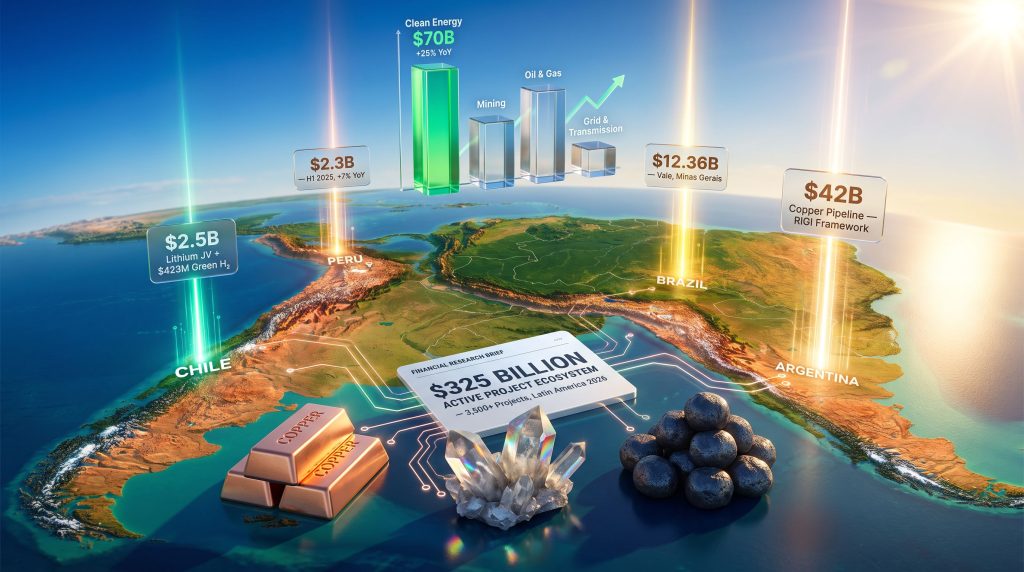
Understanding the week in latam mining energy and infrastructure investment flows requires stepping back from individual deal announcements and recognising a broader pattern: a regional investment ecosystem that has grown to encompass more than 3,500 active projects valued at a combined $325 billion, with $77 billion in capital committed to over 1,300 projects scheduled to break ground in 2026 alone. This is not a commodity supercycle story. It is a structural realignment of where the world's most consequential industrial capital is being deployed.
When big ASX news breaks, our subscribers know first
Mining Capital Flows: Copper, Lithium, and the Race for Critical Minerals
Argentina's Copper Ambition and the RIGI Effect
No single country illustrates the scale of Latin America's mining investment surge more dramatically than Argentina. The nation has accumulated $42 billion in copper-focused investment commitments, representing approximately 62.7% of its total mining pipeline. The engine behind this concentration is the RIGI framework, formally known as the Régimen de Incentivo a las Grandes Inversiones, which offers qualifying projects a 30-year tax stability guarantee, preferential foreign exchange treatment, and repatriation rights for a defined portion of export revenues.
Critically, RIGI does not merely attract capital on paper. It has already approved $50.7 billion in mining projects, with a significant queue of applications still under regulatory review. For investors accustomed to Argentina's historical volatility, the framework represents something genuinely novel: a contractual firewall between sovereign policy risk and project-level economics. Whether that firewall holds through political transitions remains the central question for anyone underwriting Argentina copper projects.
Peru, Chile, and Brazil: The Diversified Capital Stack
Beyond Argentina, the region's mining investment picture is notably diversified across commodity types and jurisdictions.
Peru recorded $2.3 billion in mining investment in the first half of 2025, a 7% year-on-year increase, with 134 new projects worth $6 billion currently under active evaluation. Peru's strength lies in its operational track record: the country has produced copper at scale for decades and its geological endowment in polymetallic deposits remains one of the world's most prolific. Political noise at the national level has historically proven less disruptive to project-level operations than investor sentiment might suggest, though permitting bottlenecks persist as a structural constraint.
Chile is executing a dual-track strategy that is arguably the most sophisticated in the region. On one side, it approved its largest-ever green hydrogen project, the $423 million Susterra initiative, which pairs Chile's exceptional solar and wind resources with water electrolysis technology to produce export-grade hydrogen. On the other, Chile's lithium strategy led to the finalisation of a $2.5 billion lithium joint venture with an Australian partner, deepening its position in the battery materials supply chain at a time when lithium carbonate and lithium hydroxide demand projections continue to be revised upward.
Brazil's mining investment story is anchored by long-cycle capital confidence. Vale's commitment of $12.36 billion to Minas Gerais operations through 2030 is a particularly meaningful signal: at that investment scale and duration, Vale is essentially betting on stable iron ore and transition metals demand through the remainder of the decade, regardless of near-term commodity price volatility.
| Country | Key Investment Commitment | Primary Commodity | Strategic Driver |
|---|---|---|---|
| Argentina | $42B (copper pipeline) | Copper | RIGI incentive framework |
| Brazil | $12.36B (Vale, Minas Gerais) | Iron ore / transition metals | Long-cycle capex strategy |
| Chile | $2.5B (lithium JV) + $423M (green H₂) | Lithium / hydrogen | Energy transition alignment |
| Peru | $2.3B H1 2025 (+7% YoY) | Copper / polymetallics | 134 new projects under evaluation |
| USA-LatAm bilateral | $1B+ since January 2025 | Lithium / rare earths / copper | Critical minerals diplomacy |
The Critical Minerals Diplomacy Layer
One dimension of Latin America's mining investment surge that receives insufficient analytical attention is the role of bilateral diplomacy in shaping capital flows. The United States has directed more than $1 billion in targeted lithium, copper, and rare earth investments into the region since January 2025, channelled through a combination of export credit agencies, development finance institutions, and strategic partnership frameworks. Furthermore, this is not philanthropic development finance. It is supply chain architecture, designed to reduce dependence on single-source mineral suppliers for technologies underpinning the clean energy and defence sectors. The critical minerals demand signal driving these flows shows no sign of easing.
"The shift toward bilateral critical minerals frameworks is quietly reshaping which projects get financed and on what terms, creating a two-tier investment environment where geopolitically aligned projects access cheaper capital than purely commercially motivated ones."
Energy Investment: The Historic Crossover and Its Implications
Latin America's Clean Energy Inflection Point
Latin America's clean energy investment reached $70 billion in 2025, a 25% year-on-year increase that represents the largest single-year growth rate in the region's energy history. More significantly, this figure surpasses the region's total oil and gas capital expenditure for the same period, marking the first time in recorded history that clean energy investment has exceeded hydrocarbons investment at a regional level. This is not a symbolic milestone. It carries genuine implications for grid architecture, project financing structures, and the industrial base required to support both sectors simultaneously. According to Infrastructure Investor, Latin America still has considerable runway for further expansion across these sectors.
Iberdrola's €4.5 billion grid modernisation programme in Bahia, Brazil and Energisa's BRL 7 billion (approximately $1.3 billion) commitment to Brazil's electricity distribution network are the anchor investments in this transformation. Both programmes address the same underlying constraint: Brazil's existing grid infrastructure was not designed to accommodate the distributed, variable-output generation profile of large-scale solar and wind capacity. Transmission bottlenecks, not generation capacity, are increasingly the binding constraint on Brazil's clean energy ambitions.
Vaca Muerta: Hydrocarbon Investment at Structural Scale
Argentina's Vaca Muerta shale formation occupies a unique position in the regional energy investment landscape. YPF has committed $6 billion in capital deployment through 2026, with production targets that would materially increase Argentina's hydrocarbon export capacity. Pluspetrol has submitted a $12 billion application under the RIGI framework, a deal whose approval would push the basin's committed investment to levels that begin to rival major producing basins globally.
What makes Vaca Muerta analytically interesting is the intersection of shale geology and export infrastructure. The formation's productive intervals, primarily the Vaca Muerta shale member of the Neuquén Basin, are characterised by relatively high organic carbon content and favourable thermal maturity windows for both oil and gas production. The challenge is not the rock. It is the pipeline and LNG infrastructure needed to convert upstream production into export revenue. President Milei's deregulation agenda has unlocked $12 to $18 billion in single-company investment commitments that were previously stalled by policy uncertainty, but the export infrastructure gap remains the formation's medium-term production ceiling.
Mexico's Industrial Energy Equation
Mexico's energy investment narrative in 2026 is inseparable from the nearshoring story. The country recorded $21.4 billion in foreign direct investment in Q1 2025 alone, and the industrial facilities accompanying that capital require reliable, high-capacity electrical infrastructure. The $2 billion substation programme for Tijuana's manufacturing corridor is a direct response to this demand signal, designed to support the semiconductor assembly, automotive electronics, and medical device manufacturing operations that have relocated to northern Mexico's border zone.
Mexico's position as a natural gas bridge between North American energy markets and Latin American industrial demand adds another dimension to its investment case. LNG import capacity, combined cycle gas turbine generation, and pipeline interconnection with the United States create an energy market structure that is simultaneously exposed to North American price dynamics and capable of serving as a pricing anchor for industrial power consumers in central and southern Mexico.
Infrastructure: The Enabling Layer for Everything Else
Grid Transmission as the Binding Constraint
Brazil's $3.3 billion transmission line auction is more strategically significant than its headline figure suggests. Transmission infrastructure is the enabling layer that determines whether renewable generation capacity can actually reach industrial and residential consumers. Without it, solar and wind additions simply create localised surpluses that cannot be monetised. For institutional investors, long-duration transmission contracts with regulated return structures represent one of the most bankable asset classes in the region, combining infrastructure-grade cash flow visibility with exposure to the clean energy buildout.
Chile's Green Hydrogen First-Mover Position
The $423 million Susterra green hydrogen project warrants detailed examination because it represents the first commercial-scale proof of concept for an export-oriented green hydrogen industry in Latin America. Chile's combination of the world's highest solar irradiance in the Atacama Desert, consistent wind resources in Patagonia, and reasonable port access to Asian and European markets creates a geographic and resource endowment that few other locations can match.
Green hydrogen economics remain sensitive to electrolyser capital costs and renewable electricity prices. Chile's advantage is that its renewable electricity cost curve is already among the lowest globally in the relevant production zones, meaning the project's production cost trajectory is more favourable than comparable initiatives in Brazil or Colombia, where either resource quality or grid connection costs impose a structural premium.
Social and Transport Infrastructure
-
The $250 million IDB environmental infrastructure loan for Guatemala addresses water and sanitation gaps that constrain both public health outcomes and industrial investment attraction in Central America.
-
Mexico's $612 million wellbeing hub programme across Tlaxcala and Puebla signals the federal government's recognition that social infrastructure in industrial corridor communities is a prerequisite for sustained FDI attraction, not a discretionary expenditure.
-
Airport terminal expansions, freight rail corridor upgrades, and maritime port modernisation across the region function as force multipliers for all other investment categories, reducing logistics costs and improving supply chain reliability for export-oriented industries.
| Project | Value | Country | Sector |
|---|---|---|---|
| Iberdrola Bahia Grid Upgrade | €4.5B | Brazil | Electricity transmission |
| Brazil Transmission Line Auction | $3.3B | Brazil | Grid infrastructure |
| Tijuana Substation Programme | $2.0B | Mexico | Industrial power |
| Susterra Green Hydrogen | $423M | Chile | Green hydrogen |
| IDB Guatemala Environmental Loan | $250M | Guatemala | Environmental infrastructure |
| Mexico Wellbeing Hubs | $612M | Mexico | Social infrastructure |
Regulatory Architecture and Risk Vectors
What RIGI Has Proven and What It Has Not
Argentina's RIGI programme is, at this point, an empirical case study in investment incentive design rather than a theoretical construct. The $50.7 billion in approved mining projects demonstrates that investors are willing to commit long-cycle capital to a jurisdiction with Argentina's sovereign history, provided the contractual architecture is sufficiently robust. The framework's tax stabilisation provisions, which lock in fiscal treatment for 30 years regardless of subsequent legislative changes, are the critical innovation.
What RIGI has not proven is durability through a full political cycle. The framework was designed and enacted under the current administration, and its enforceability under a future government with different fiscal priorities remains an open question. Sophisticated investors are pricing this risk explicitly, rather than assuming RIGI's protections are unconditional. In addition, the interplay between Argentina lithium brines and RIGI approvals adds yet another layer of complexity to the country's investment calculus.
Country-Level Investment Attractiveness
-
Chile offers the strongest rule-of-law credentials and the most predictable permitting environment, making it the preferred destination for ESG-constrained institutional capital.
-
Brazil provides the largest absolute market depth, the most diversified sector exposure, and the deepest domestic capital markets, positioning it as the anchor destination for long-cycle infrastructure investment.
-
Peru delivers consistent mining investment growth and a proven operational track record, with political volatility concentrated at the national level rather than the project level.
-
Argentina presents the highest potential returns alongside the highest regulatory volatility, attracting more opportunistic, return-seeking capital flows than long-cycle institutional mandates.
-
Mexico is capturing the nearshoring dividend but faces energy reliability as the primary constraint on converting FDI announcements into operational industrial capacity.
The Three-Scenario Outlook Through 2027
Disclaimer: The following scenario analysis involves forward-looking projections based on current investment commitments, policy frameworks, and commodity market assumptions. These are not forecasts or investment recommendations. Actual outcomes may differ materially from any scenario described.
Scenario A: Accelerated Transition (Base Case). Critical mineral prices remain elevated, RIGI-style frameworks are adopted in Peru and Brazil, and clean energy investment sustains above 20% annual growth. Under this trajectory, the region approaches a $100 billion annual investment run rate by 2027.
Scenario B: Regulatory Friction (Moderate Downside). Political transitions in Peru and Mexico introduce permitting delays, and Argentina's macroeconomic instability constrains RIGI's practical effectiveness despite its legal protections. Investment growth moderates to 8 to 12% annually, and project timelines extend by 12 to 18 months on average.
Scenario C: Global Demand Shock (Tail Risk). A recession in major economies suppresses commodity prices, and clean energy subsidy rollbacks in the United States and European Union reduce offtake certainty for hydrogen and critical mineral projects. Investment flows contract by 15 to 25%, early-stage projects are deferred, and capital concentrates in producing assets with established cash flows.
The next major ASX story will hit our subscribers first
Five Sectors Commanding Attention in the Next 18 Months
-
Copper in Argentina and Peru, where project sanctioning decisions over the next 18 months will determine the region's medium-term contribution to the global copper supply outlook.
-
Green hydrogen in Chile, where the Susterra project serves as the proof-of-concept that will either accelerate or temper the multi-billion-dollar export industry ambitions.
-
Grid transmission across Brazil and Mexico, which functions as the infrastructure backbone enabling every other sector's investment case.
-
Vaca Muerta LNG export infrastructure, which will determine whether Argentina's upstream investment converts into durable export revenue rather than domestic consumption supply.
-
Critical minerals bilateral frameworks, where the pace of translation from diplomatic agreement to bankable project financing will define the region's integration into global supply chain architecture. The IDB's approach to minerals financing in Latin America and the Caribbean is shaping how multilateral capital complements private investment in this space.
The breadth and simultaneity of capital activation across mining, energy, and infrastructure in Latin America in 2026 is without modern precedent for the region. Whether the structural forces driving this moment prove durable through the end of the decade will depend as much on the regulatory architectures that governments maintain as on the commodity prices that markets determine. What is already clear, from the week in latam mining energy and infrastructure investment flows data to the long-cycle capex commitments of global majors, is that the world's largest capital allocators have made their assessment, and they are betting heavily on Latin America.
Want to Track the Next Major Mineral Discovery Before the Market Does?
Discovery Alert's proprietary Discovery IQ model delivers real-time ASX alerts on significant copper, lithium, and critical mineral discoveries — turning complex geological data into clear, actionable investment insights the moment they hit the exchange. Explore Discovery Alert's dedicated discoveries page to see how historic finds have generated substantial returns, and begin your 14-day free trial today to position yourself ahead of the market.