
July 15, 2026
The Hidden Economics of Metal Warehousing That Most Investors Never See
Most commodity price movements are explained through the familiar lens of supply and demand. Mines produce too much, prices fall. Demand surges, prices rise. But inside the world of exchange-traded metals, a more intricate game operates beneath the surface, one where physical storage infrastructure becomes a profit engine in its own right, and where a single trader's warehousing strategy can reshape the price of a globally traded metal overnight.
The Trafigura lead delivery into LME warehouses on July 14, 2026 offers a masterclass in how sophisticated commodity trading houses extract value not just from price movements, but from the mechanics of storage itself. What happened that day was not simply a large trade. It was the visible output of a multi-layered financial strategy years in the making, and it sent lead prices to their lowest level in more than twelve months while every other major industrial metal on the exchange moved higher.
When big ASX news breaks, our subscribers know first
Why Lead Sits in a Category of Its Own Among Industrial Metals
To understand the scale of what occurred, it helps to first appreciate why lead behaves so differently from copper, zinc, tin, or aluminium. Lead's market structure is almost unique among base metals in that its primary supply chain is dominated not by mining, but by recycling.
Globally, more than half of all lead production comes from the processing of spent lead-acid batteries, the rectangular cells that power the starter motors of internal combustion engine vehicles. This secondary supply pipeline operates largely independently of price signals. Battery scrap accumulates continuously as the world's fleet of petrol and diesel vehicles ages, and recyclers process that scrap regardless of whether lead is trading at $1,800 or $2,500 per tonne.
This stands in sharp contrast to mined supply. Lead is overwhelmingly extracted as a by-product of zinc mining rather than as a primary target. When zinc economics deteriorate and zinc mines curtail output, lead supply falls with it. Conversely, when zinc prices justify expansion, lead flows as an almost unavoidable companion. This structural reality means the lead market has very limited ability to balance itself through supply-side adjustments in response to weak prices.
The demand side is experiencing its own transformation. As electric vehicle penetration accelerates across major automotive markets, the new-vehicle segment's appetite for lead-acid starter batteries is shrinking structurally. EVs do not use conventional lead-acid batteries for propulsion, and while they may use small auxiliary lead batteries for ancillary functions, the volumes are a fraction of those required in combustion-engine vehicles.
The result is a commodity caught in a structural vice: secondary supply grows autonomously while primary demand stagnates. It is precisely this imbalance that has made lead the only industrial metal on the LME to record losses in 2026, down nearly 8% year-to-date at the time of the July delivery, while tin surged 33% over the same period. Furthermore, industrial metals demand across broader base metals categories has been reshaping market expectations throughout this period.
What the July 14 Delivery Actually Represents in Historical Context
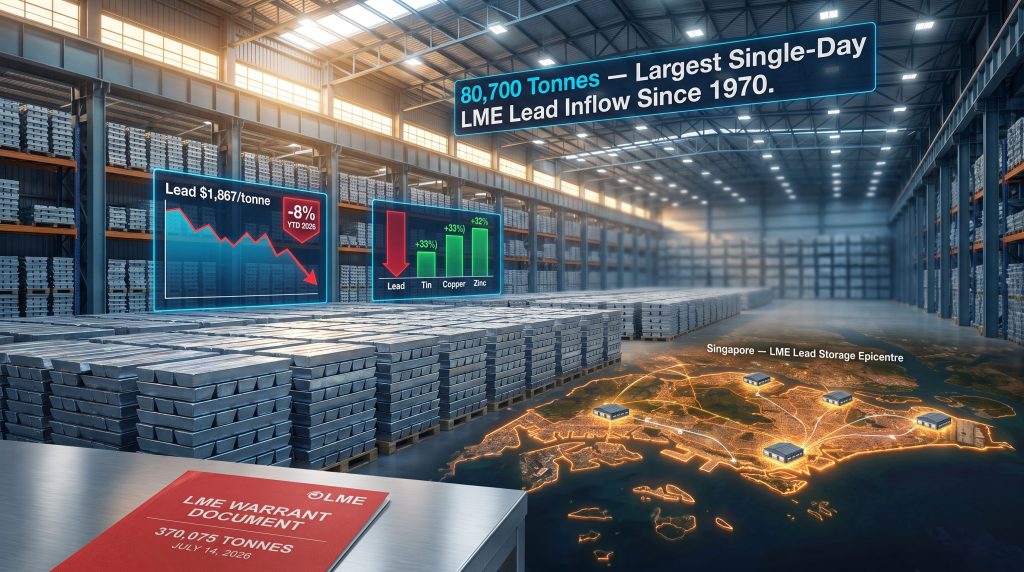
The numbers involved in the Trafigura lead delivery into LME warehouses deserve careful examination. On a single trading day, LME-tracked lead inventories rose by 80,700 tonnes, the largest single-day inflow recorded in data extending back to 1970. Total stockpiles reached 370,075 tonnes, a figure not seen since 2012, making this a 14-year high in visible lead inventory.
| Event | Date | Volume Added | Total Inventory Post-Event | Historical Significance |
|---|---|---|---|---|
| November 2024 Delivery | Nov 2024 | ~90,000+ tonnes | 276,250 tonnes | Highest in 11+ years at the time |
| July 2026 Delivery | July 14, 2026 | 80,700 tonnes | 370,075 tonnes | Highest since 2012 (14-year high) |
This was not Trafigura's first foray into large-scale lead deposits in Singapore. A comparable delivery in November 2024 had already pushed inventories to levels not seen in more than a decade at the time, establishing a pattern that the July 2026 event extended further. The deliveries were executed through multiple warehousing companies, reflecting the distributed nature of the storage infrastructure involved.
Singapore's Rise as the World's Lead Inventory Capital
The geographic dimension of this story is as striking as the volume data. Singapore now holds more than 90% of all LME-tracked lead stocks globally, a level of concentration that has no obvious parallel in other major base metals.
This did not happen by accident. Singapore offers a combination of advantages that make it attractive for large-scale metal storage: well-developed port logistics, a stable regulatory environment, strong financial infrastructure, and proximity to the major Asian markets that both produce and consume significant quantities of lead. Over several years, surplus metal has gravitated toward the city-state as the path of least resistance for traders seeking to warehouse excess supply.
Trafigura moved to deepen its structural position in this ecosystem by acquiring Grafton Logistics Services' Singapore warehouse operations, comprising six facilities that hold the vast majority of LME lead stocks. This acquisition marked the firm's re-entry into the LME warehousing sector and positioned it to capture rent-sharing income streams directly, rather than paying those fees to third-party operators.
The consequences of this geographic concentration extended into physical market dynamics. By October 2025, the queue to withdraw lead from Singapore LME facilities had stretched to 95 days. Extended withdrawal queues of this kind are a known symptom of rent-cycle accumulation strategies, and they carry secondary effects that market participants often overlook:
- Prolonged queues create artificial tightness in the physical spot market, even when visible inventory is large
- They distort the nearby futures curve, sometimes generating localised backwardation in prompt contracts even as overall supply appears abundant
- Withdrawal queue lengths serve as a real-time indicator of how aggressively rent-sharing dynamics are being exploited at any given moment
The 95-day withdrawal queue recorded in October 2025 is not simply a logistical inconvenience. It is a structural signal that the volume of metal locked into rent-cycle strategies substantially exceeds normal physical throughput demand at the storage location.
The Financial Architecture Behind Warehousing as a Profit Centre
For observers accustomed to thinking of commodity traders as entities that profit from buying low and selling high, the rent-sharing model introduces a fundamentally different logic. Under this framework, the return on stored metal is generated not from price appreciation but from the income produced by the storage arrangement itself.
Here is how the mechanics typically unfold in practice:
- Surplus metal is identified in the physical market, often available at a discount to LME benchmarks
- Metal is delivered into LME-approved warehouses under the trader's name, generating official LME warrants
- A rent-sharing agreement activates, under which the warehouse operator returns a portion of the daily storage fees to the depositing party
- LME warrants are issued, creating tradeable title documents that can be used for futures settlement or repo-style financing
- The position is held for as long as the rent income stream and any contango profit (where forward prices exceed spot) exceed the cost of capital tied up in the metal
- Warrant cancellation signals the beginning of the withdrawal process, which markets typically interpret as a bullish event since it reduces visible supply
The contango dimension deserves specific attention. When futures markets are in contango, meaning forward-dated contracts trade at a premium to spot, the spread between nearby and forward prices can be captured by simultaneously selling forward while holding physical metal in storage. This carry trade amplifies the returns available from the warehousing position and makes accumulation strategies more financially compelling during periods of oversupply. Indeed, LME trading volumes have reflected heightened activity around precisely these kinds of structured positions.
Under rent-sharing arrangements, a commodity trader can generate ongoing income from stored metal without retaining price exposure to the underlying commodity, effectively monetising the physical storage infrastructure itself rather than speculating on price appreciation.
How the Record Inventory Surge Transmitted Into Price
The price impact of the July 14 delivery was immediate and asymmetric. Lead fell to $1,867 per tonne by late afternoon in London, its lowest level in more than a year, while the rest of the base metals complex moved broadly higher on the same session.
| Metal | Price Movement (July 14, 2026) | Direction |
|---|---|---|
| Lead | Fell to $1,867/tonne (12+ month low) | ▼ |
| Copper | Climbed | ▲ |
| Zinc | Climbed | ▲ |
| Tin | Climbed | ▲ |
| Aluminium | Largely unchanged | → |
| Nickel | Largely unchanged | → |
The divergence is instructive. A sudden, large increase in visible inventory communicates a single clear message to algorithmic systems and human traders alike: physical demand is insufficient to absorb available supply. In a market already carrying the weight of structural demand headwinds from the EV transition, the psychological impact of a record inventory print compounded an already bearish narrative.
What is particularly notable is the cross-metal isolation of the move. Lead's decline on a day when copper, zinc, and tin all advanced underscores that the market correctly identified the event as lead-specific rather than as a broad industrial metals signal. This kind of precise price transmission reflects the sophistication of modern commodity markets in parsing inventory data in real time. However, broader commodity market volatility continues to create overlapping pressures that traders must navigate simultaneously.
The next major ASX story will hit our subscribers first
Understanding LME Warrant Mechanics and the Role of Cancelled Warrants
The LME warehouse system operates through a warrant-based title structure that is worth understanding in depth, particularly for investors who monitor inventory data as a price signal.
| Concept | Definition | Market Impact |
|---|---|---|
| LME Warrant | A document of title for metal stored in an approved warehouse | Enables physical settlement of futures contracts |
| Rent-Sharing Agreement | Arrangement where warehouse operators share rental income with the depositing party | Creates financial incentive to deposit metal regardless of immediate sale intent |
| Inventory Surge | Rapid single-day increase in reported LME stocks | Signals oversupply, typically triggers price declines |
| Cancelled Warrant | A warrant flagged for withdrawal from LME storage | Signals intent to remove metal, typically interpreted as bullish |
When warrants are cancelled in significant volumes, the market reads this as an imminent reduction in visible supply. Historically, large-scale warrant cancellations have preceded sharp short-covering rallies, particularly when short positions have built up in anticipation of prolonged inventory pressure. This creates a sequencing dynamic where the same trader who depresses prices through delivery can, in theory, benefit from a subsequent price recovery when warrants are eventually cancelled and withdrawn.
Regulatory Precedents and the Scrutiny That Follows Concentration
The current situation in Singapore's lead warehousing sector carries echoes of a well-documented episode in the aluminium market during the early 2010s. Extended withdrawal queues at LME-approved aluminium warehouses in Detroit and Vlissingen drew intense scrutiny from regulators, industrial consumers, and legislators, ultimately prompting the LME to implement load-out rate reforms designed to reduce queue lengths and improve physical market access.
The lead market's current dynamics share structural similarities with that episode: a single geographic location holds a dominant share of global visible inventory, withdrawal queues have extended to extraordinary lengths, and a small number of sophisticated traders hold concentrated positions in both the metal and the storage infrastructure. Consequently, metal pricing dynamics across related markets have been influenced as participants reassess the implications of such concentrated storage arrangements.
Whether the LME or relevant regulatory bodies will assess the current lead storage concentration in Singapore with similar scrutiny remains an open question. What the aluminium precedent demonstrates is that warehouse strategies operating at this scale do eventually attract institutional attention, particularly when physical market participants report difficulty accessing metal at transparent prices.
Three Structural Forces Reshaping Lead's Long-Term Market Balance
Stepping back from the immediate trading event, the fundamental forces acting on the lead market point toward a sustained period of structural surplus that no single warehouse strategy can indefinitely absorb.
- EV penetration growth is progressively reducing new lead-acid battery demand in the passenger vehicle segment, the largest single end-use market for primary lead consumption
- Battery recycling volumes are expanding as the global fleet of combustion-engine vehicles continues to age and turn over, generating growing quantities of scrap cells that feed secondary smelters independent of price signals
- By-product supply inelasticity means that primary lead mine output responds to zinc market economics rather than lead-specific pricing, removing a key self-correcting mechanism that operates in most other commodity markets
Unlike most commodities where producers can throttle output in response to falling prices, lead's status as a by-product of zinc mining means its primary mine supply is largely insensitive to lead-specific price weakness. This structural rigidity amplifies the market's vulnerability to demand-side shocks.
Three Forward-Looking Scenarios for Lead Market Participants
Given the structural dynamics described above, three distinct pathways are plausible for the lead market over the medium term.
- Continued Accumulation: If contango structures remain sufficient to support carry trade economics and rent-sharing income stays attractive, further inventory builds in Singapore could push prices toward multi-year lows, potentially testing support levels not seen since the pandemic-era demand collapse
- Coordinated Withdrawal: A significant wave of warrant cancellations, whether driven by financing requirements, a shift in carry economics, or strategic repositioning, could trigger a sharp short-covering rally as the market rapidly reprices the reduction in visible supply
- Structural Demand Collapse: If EV adoption accelerates beyond current mainstream projections in key markets such as China and Europe, the demand-side deterioration for lead-acid batteries could become self-reinforcing, entrenching lead's underperformance as a secular rather than cyclical condition
In addition, the commodity price impacts flowing from such prolonged structural surpluses are likely to weigh on the performance of mining companies with material lead exposure over this same horizon.
Key Data Summary
| Metric | Value |
|---|---|
| Single-day inventory increase (July 14, 2026) | 80,700 tonnes |
| Total LME lead stocks post-delivery | 370,075 tonnes |
| Last time inventories were this high | 2012 (14-year high) |
| Lead price post-delivery | $1,867/tonne |
| Lead's year-to-date performance in 2026 | -8% |
| Singapore's share of LME lead stocks | >90% |
| LME lead withdrawal queue (Oct 2025) | 95 days |
| November 2024 delivery volume | ~90,000+ tonnes |
Frequently Asked Questions
What is an LME Warrant and Why Does It Matter?
An LME warrant is a document of title for metal physically stored in an LME-approved warehouse. It is the mechanism through which futures contracts can be settled with actual metal rather than cash, and it forms the basis of the exchange's visible inventory reporting. When warrants are issued, stocks rise. When they are cancelled, the market anticipates imminent withdrawal.
Why Did Lead Fall While Other Metals Rose on the Same Day?
The 80,700-tonne single-day inventory addition was a lead-specific event that communicated oversupply conditions directly to the market. Algorithms and traders processed the data as a bearish signal for lead alone, while other metals responded to their own separate supply-demand drivers on the same session, producing the striking divergence visible in the July 14 price table above.
Is the Concentration of Lead in Singapore a Systemic Risk?
Geographic concentration of more than 90% of global LME lead stocks in a single city introduces meaningful systemic risk. Any disruption to Singapore's warehousing infrastructure, an unexpected large-scale warrant cancellation, or regulatory intervention could generate price volatility that is disproportionate to the underlying fundamentals. The aluminium warehouse episode of the early 2010s offers a documented precedent for how concentrated storage arrangements can attract intervention.
How Does the EV Transition Affect Lead Over the Next Decade?
The relationship is asymmetric and negative for lead demand. Electric vehicles eliminate the primary use case for lead-acid starter batteries in new passenger cars, while simultaneously adding to the pool of ageing combustion-engine vehicles that will eventually generate scrap battery supply. The net effect is a market where secondary supply grows while primary demand contracts, structurally favouring a surplus environment over the medium to long term.
This article is intended for informational purposes only and does not constitute financial or investment advice. Commodity markets involve significant risk, and past price behaviour is not indicative of future outcomes. Readers should conduct their own due diligence before making any investment decisions. For additional context on the lead inventory event and broader base metals market developments, readers can explore supplementary reporting at mining.com.
Want to Stay Ahead of the Next Major Commodity Market Move?
Discovery Alert's proprietary Discovery IQ model scans ASX announcements in real time, instantly identifying significant mineral discoveries across more than 30 commodities — transforming complex data into clear, actionable opportunities for both short-term traders and long-term investors. Explore historic discoveries and their exceptional market returns, then begin your 14-day free trial to ensure you're positioned before the broader market catches on.