July 15, 2026

The Atlantic Basin Advantage: Why Geography Is Becoming Nigeria's Most Valuable Oil Asset
For most of the past decade, the global oil market has penalised Nigeria. Infrastructure theft, pipeline sabotage, and the steady withdrawal of international capital combined to strip Africa's largest crude producer of its competitive position. Yet the architecture of global oil trade has always contained a structural reality that no amount of domestic dysfunction could permanently erase: Nigeria sits in the Atlantic Basin, geographically insulated from the chokepoints that periodically destabilise Gulf supply chains.
That geographic fact has rarely mattered more than it does in mid-2026. Furthermore, it is arriving at precisely the moment when Nigeria's domestic production has reached its highest sustained level since April 2020, creating a convergence of volume, pricing, and market positioning that the country has not experienced in years.
When big ASX news breaks, our subscribers know first
Nigeria Oil Output Six-Year High: What the June 2026 Numbers Actually Mean
Nigeria's crude oil production averaged 1.56 million barrels per day (bpd) in June 2026, according to data released by the Nigerian Upstream Petroleum Regulatory Commission (NUPRC). When condensate volumes are included, total output reached 1.735 million bpd, marking the fourth consecutive month of production growth and representing a 17% increase from the February 2026 baseline of 1.483 million bpd.
The scale of the recovery becomes clearer when placed in historical context. According to Nigeria's oil production hitting a six-year high, this milestone arrives alongside returning Middle East risks that are reshaping buyer preferences across global markets.
| Period | Approximate Output (bpd) | Key Context |
|---|---|---|
| Peak era (~2005-2010) | 2.0-2.4 million | Pre-militancy, minimal infrastructure loss |
| Militancy/theft trough (~2016) | Below 1.0 million | Pipeline sabotage, IOC divestment pressure |
| COVID-19 demand collapse (~April 2020) | ~1.56 million | OPEC+ cuts, demand shock |
| February 2026 | 1.483 million | Recovery phase commencement |
| June 2026 | 1.735 million (incl. condensates) | Nigeria oil output six-year high confirmed |
| July 2026 YTD peak | 1.78 million | Continued upward trajectory |
The peak single-day combined output of 1.89 million bpd recorded in June illustrates the operational headroom that now exists within Nigeria's producing infrastructure. The NUPRC formally cited stable asset operations and the absence of significant pipeline disruptions as the primary drivers, attributing the performance to consistent throughput across onshore and shallow-water producing basins.
Bonny Light, Nigeria's most internationally recognised export stream, loaded 318,000 bpd in June, up from 294,000 bpd in May. For traders and refinery procurement teams, this improvement in loading reliability is arguably as significant as the headline production figure itself. Volume without delivery consistency has limited commercial value in a market where long-term supply contracts increasingly reward predictability over raw output capacity.
Structural reality check: Nigeria's current recovery is not a simple cyclical rebound driven by price incentives. It reflects a genuine operational reset following years of physical infrastructure degradation, chronic theft-related losses that at their worst exceeded several hundred thousand barrels per day, and a fundamental reshaping of asset ownership across the upstream sector.
The Investment Wave That Made This Possible
The production milestone did not emerge from a vacuum. Nigeria's upstream sector attracted approximately $5.3 billion in committed investment during 2025, a figure reported by the Financial Times as roughly equivalent to the cumulative total from the preceding eight years combined. This capital influx followed a structural transformation in asset ownership that has significant long-term implications for how Nigerian production is managed and financed.
International oil majors including Shell, ExxonMobil, Eni, and Equinor progressively divested onshore and shallow-water Nigerian assets over the preceding decade, driven by a combination of ESG pressure, risk recalculation, and strategic portfolio rebalancing toward deepwater and LNG operations. Indigenous Nigerian companies absorbed much of this acreage, and 2026 represents their first major operational examination at sustaining production volumes, funding development drilling, and managing ageing pipeline infrastructure.
This transition introduces a dynamic that is less visible in headline production data but critically important for long-term sustainability. Local operators typically face higher financing costs than international majors, have less access to proprietary technical services, and may carry heavier political obligations regarding community relations and local content.
The question of whether indigenous operatorship can maintain the discipline required to hold production above 1.5 million bpd across multiple quarters — not just peak months — will define how durable this recovery proves to be. Analysing the crude oil market dynamics at play suggests that broader structural forces are simultaneously reshaping the competitive landscape for producers at every level.
NNPC, Nigeria's state oil company, has stated a target of reaching 2 million bpd within two years, a level the country last consistently achieved approximately two decades ago. The upstream executive vice president Udy Ntia articulated this ambition in November 2025, framing it as an operational goal grounded in the investment commitments that had already been secured.
OPEC+ Quota Dynamics: Overproduction as Both Opportunity and Liability
Nigeria's June crude output of 1.56 million bpd exceeded its formal OPEC+ allocation of 1.5 million bpd, placing the country at approximately 104% of its quota ceiling. This overproduction dynamic sits at the intersection of commercial opportunity and diplomatic sensitivity.
Within OPEC+, Nigeria has historically been among the bloc's least compliant members on quota adherence. This pattern is rooted partly in the difficulty of controlling output across a fragmented landscape of operators and partly in the fiscal pressure of a federal budget written assuming higher production assumptions. Producing above quota generates immediate revenue but risks creating friction within the cartel at a time when OPEC's market influence is already under strain from multiple member states.
The compliance tension becomes more acute as Nigeria targets 2 million bpd. Reaching that level would require either a successful quota renegotiation within OPEC+ or a sustained willingness to operate in formal non-compliance. Both paths carry consequences: the first requires diplomatic capital and the cooperation of other members, while the second risks undermining the broader price management framework that benefits all producers.
How the Strait of Hormuz Rewrites Nigeria's Market Position
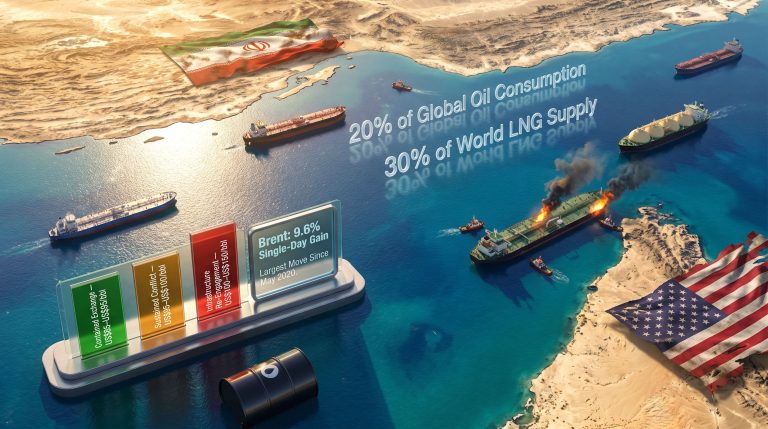
The geopolitical context amplifying Nigeria's production milestone cannot be separated from the analysis. Brent crude surged approximately 8% in a single trading session, reaching near $86 per barrel, following U.S. announcements regarding the reimposition of a blockade on Iranian vessels transiting the Strait of Hormuz. The Strait handles roughly one-fifth of global oil supply under normal operating conditions, and any credible disruption to tanker traffic immediately reprices Atlantic Basin alternatives.
This dynamic is further compounded by the broader oil price shock that has been reverberating across energy markets, reshaping investment calculations for producers and buyers alike. Nigerian grades carry specific physical characteristics that make them particularly attractive in this environment:
- Bonny Light, Qua Iboe, and Forcados are all classified as light, sweet crudes with low sulfur content
- Their high API gravity makes them easier and cheaper to refine into high-value products including gasoline, diesel, and jet fuel
- Atlantic Basin loading points place Nigerian cargoes entirely outside the risk perimeter created by Hormuz disruptions
- European refineries, predominantly configured for light sweet crude processing, can accommodate Nigerian grades with minimal operational adjustment
The revenue mathematics of this convergence are striking. At $80 per barrel, every sustained addition of 100,000 bpd to Nigerian output generates approximately $2.9 billion in gross annual production value before accounting for operator shares, royalties, production costs, and government taxation. The incremental production gain between February and June 2026 of approximately 252,000 bpd, sustained at near-$86 pricing, represents a gross annualised production value potentially exceeding $7.9 billion from that increment alone.
The critical qualifier is sustainability. Converting theoretical production value into verifiable treasury receipts and foreign exchange reserve accumulation has historically been Nigeria's most persistent challenge, separate from the question of raw output levels.
Investor consideration: The gap between Nigeria's gross production value and its actual treasury receipts has historically been wide, reflecting production cost structures, transfer pricing complexity within joint ventures, and leakage through various points in the value chain. Production growth figures must always be read alongside foreign exchange reserve data and NNPC-to-treasury transfer records to assess their macroeconomic significance.
The Risks That Could Unwind the Recovery
Three distinct risk categories threaten to reverse Nigeria's production momentum, and understanding their interaction is essential for any serious assessment of the country's medium-term oil sector trajectory.
Risk 1: The Hormuz window is temporary by nature
OPEC revised its 2026 global oil demand growth forecast downward to approximately 800,000 bpd, signalling a softening macro demand environment independent of supply-side disruptions. A normalisation of tanker traffic through the Strait of Hormuz would eliminate Nigeria's current geopolitical pricing premium and return the country to a more competitive Atlantic Basin market. In that environment, delivery reliability and contract consistency become the decisive competitive factors rather than resource volume or grade quality.
Risk 2: Infrastructure vulnerability remains the sector's structural weakness
Nigeria's production collapsed to below 1 million bpd at its worst point not because of geological depletion but because of pipeline theft, sabotage, and infrastructure neglect. The same vulnerabilities remain. Indigenous operators who acquired assets from departing international majors are simultaneously managing existing production, funding rehabilitation of degraded pipeline systems, and financing new drilling programmes. Capital access constraints and technical capacity gaps make this a genuinely demanding operational challenge.
Risk 3: OPEC+ quota ceiling constrains the growth pathway
Reaching the 2 million bpd target while remaining within OPEC+ quota parameters is mathematically impossible at current allocation levels. Nigeria must choose between staying within the cartel's framework and accepting a production ceiling, or pursuing its stated production ambitions and managing the diplomatic consequences of sustained non-compliance. The trade war impact on oil markets adds yet another layer of complexity to this already delicate balancing act.
The next major ASX story will hit our subscribers first
The Dangote Refinery: Domestic Demand as a Strategic Variable
Any analysis of Nigeria's crude export strategy must account for a new and rapidly growing domestic claim on barrels. The Dangote refinery, Africa's largest processing facility with a nameplate capacity of 650,000 bpd, reached full operational rates in February 2026. If supplied entirely with Nigerian crude, it would absorb more than 40% of the country's current total output.
A planned capacity expansion to 1.4 million bpd by 2028 creates an even more pronounced tension. At that throughput level, the Dangote refinery would theoretically rival Nigeria's entire current production base, forcing a fundamental resource allocation decision between export volumes that generate immediate foreign exchange earnings and domestic supply obligations that deliver longer-term energy security and import bill reduction.
| Allocation Scenario | Export Revenue Impact | Domestic Energy Security Impact |
|---|---|---|
| Prioritise crude exports | Maximum near-term FX earnings | Continued fuel import dependency |
| Full Dangote supply commitment | Reduced export volumes short-term | Domestic fuel self-sufficiency |
| Balanced allocation strategy | Moderate export revenue | Partial domestic supply coverage |
The government in Abuja must arbitrate this tension against a fiscal backdrop that has historically prioritised immediate dollar earnings over structural economic development. The mathematically elegant resolution is production growth that outpaces both export commitments and domestic refining demand simultaneously, which is precisely why the 2 million bpd target is not merely aspirational but structurally necessary for Nigeria to avoid being forced into a zero-sum allocation choice.
What Sustained Recovery Actually Looks Like: The Three-Quarter Test
A single month of strong production is an encouraging data point. It is not, however, a structural transformation. The indicators that would genuinely confirm whether Nigeria's oil sector has undergone a lasting recovery are more demanding:
- Crude output sustained above 1.5 million bpd through Q3 2026 would demonstrate that June's performance was not a temporary alignment of favourable operational conditions
- Verifiable NNPC-to-treasury transfers would confirm that production gains are translating into government revenue rather than being absorbed by cost structures or leakage
- Foreign exchange reserve growth would provide the most tangible macroeconomic evidence that the upstream recovery is benefiting Nigeria's broader fiscal position
- Multi-year drilling programme commitments from indigenous operators would signal that investment is being structured for long-cycle production growth rather than short-term extraction
The distinction between cyclical and structural recovery matters enormously for how external capital, refinery procurement teams, and sovereign credit analysts interpret Nigeria's current trajectory. A cyclical spike attracts spot cargo buyers. A structural transformation, in contrast, attracts long-term supply contracts, project financing, and the kind of institutional capital that rebuilds sectors over decades rather than quarters.
Furthermore, the sanctions on oil trading affecting Russian barrels in global markets continue to redirect demand toward reliable alternative suppliers, a shift that structurally benefits Nigeria if its production reliability can be demonstrated over multiple consecutive quarters.
The longer view: Nigeria's oil sector history teaches that production peaks without institutional reinforcement tend to be temporary. The country pumped over 2 million bpd two decades ago and subsequently lost nearly half that capacity to a combination of violence, neglect, and misaligned incentives. The current recovery is meaningful, but its ultimate significance depends on whether the operational, financial, and regulatory conditions that produced June's Nigeria oil output six-year high can be maintained and extended across a multi-year horizon.
FAQ: Nigeria Oil Output Six-Year High
What was Nigeria's crude oil output in June 2026?
Nigeria averaged 1.56 million bpd of crude oil in June 2026, with total production including condensates reaching 1.735 million bpd, the highest combined figure since April 2020.
Why did Nigerian output reach a six-year high?
The NUPRC attributed the surge to stable operations across producing assets and the absence of major pipeline disruptions, supported by approximately $5.3 billion in upstream investment committed during 2025. Analysts at Ecofina Agency have noted, however, that sustaining the recovery remains the real test for Nigeria's upstream sector.
Is Nigeria exceeding its OPEC+ quota?
Yes. Nigeria's June crude output of 1.56 million bpd exceeded its formal OPEC+ allocation of 1.5 million bpd, placing it at approximately 104% of its quota ceiling.
Why does the Strait of Hormuz situation benefit Nigerian crude?
Disruption risk in the Strait increases the cost and uncertainty of sourcing Gulf crude, making Nigeria's light, sweet Atlantic Basin grades more commercially attractive to European and Asian refiners seeking supply alternatives outside the chokepoint risk perimeter.
What is Nigeria's stated production target?
NNPC has publicly targeted 2 million bpd within two years, a level Nigeria last consistently achieved approximately two decades ago.
How does the Dangote refinery affect Nigeria's export strategy?
The refinery's current 650,000 bpd capacity, expanding to a planned 1.4 million bpd by 2028, creates growing domestic competition for Nigerian crude that directly competes with export volumes, forcing a strategic allocation decision between foreign exchange earnings and domestic energy security.
This article contains forward-looking statements and production forecasts based on publicly available regulatory data and reported investment figures. Actual production outcomes, oil prices, and geopolitical developments may differ materially from projections. This content is informational and does not constitute financial or investment advice.
Want to Track the Next Major Resource Discovery Before the Market Does?
While Nigeria's Atlantic Basin advantage reshapes global crude supply chains, the same convergence of geology, timing, and capital flows drives extraordinary returns in mineral exploration — and Discovery Alert's proprietary Discovery IQ model scans ASX announcements in real time, instantly identifying significant mineral discoveries and turning complex data into actionable opportunities for both short-term traders and long-term investors. Explore how historic discoveries have generated substantial returns on Discovery Alert's dedicated discoveries page, and start your 14-day free trial today to position yourself ahead of the market.