
June 15, 2026
Africa's Energy Infrastructure Moment: Why the Continent's Power Gap Is Finally Attracting Transformative Capital
Across Sub-Saharan Africa, a structural tension has defined energy policy for decades. Nations rich in natural resources, whether water, geothermal potential, or solar irradiance, have remained trapped in cycles of import dependency, unable to convert geographic advantage into reliable domestic power supply. That dynamic is now shifting, driven by the convergence of large-scale foreign direct investment, the global demand for AI compute infrastructure, and a growing recognition that Africa's untapped hydropower resources represent some of the most valuable undeveloped energy assets on earth.
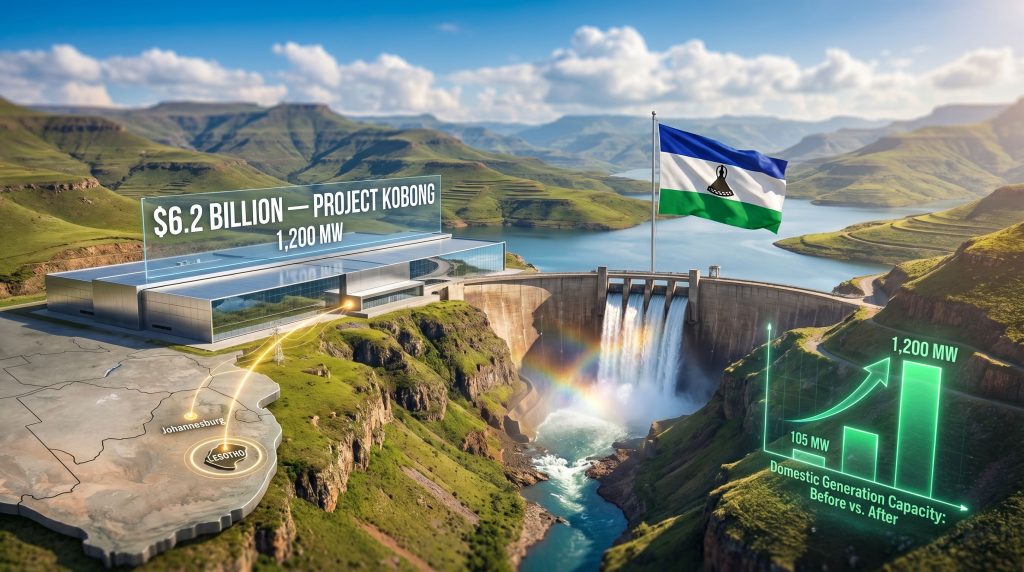
Few cases illustrate this inflection point more sharply than the Lesotho Convalt Energy hydropower and AI data centre deal, a $6.2 billion agreement that, if fully executed, would fundamentally reorder one of Southern Africa's most intriguing bilateral resource relationships.
When big ASX news breaks, our subscribers know first
Lesotho's Electricity Problem: Understanding the Structural Deficit
To appreciate the scale of what Project Kobong proposes, it helps to first understand the gap it is attempting to close.
Lesotho's current domestic electricity generation capacity sits at approximately 105 megawatts, drawn from two primary sources:
- The 72 MW Muela hydropower plant, the country's largest single generation asset
- The 30 MW Ramarothole solar facility, a more recent addition to the generation mix
Against this backdrop, national electricity demand is estimated at roughly 209 megawatts, according to World Bank project documentation. The arithmetic is unambiguous: domestic supply covers barely half of what the country actually needs.
To fill this gap, Lesotho draws power through the Southern African Power Pool (SAPP), primarily sourcing imports from South Africa's Eskom and Mozambique's Electricidade de Moçambique. In 2024, those imports totalled 438 gigawatt-hours out of total national consumption of 970 gigawatt-hours, representing approximately 45% of all electricity consumed in the country that year.
This import dependency is not merely a fiscal inconvenience. It exposes Lesotho to the generation instability of its neighbours, most notably Eskom, which spent years delivering rotational load-shedding across South Africa due to ageing infrastructure and chronic maintenance backlogs.
While Eskom's reliability has shown some improvement more recently, major urban centres including Johannesburg continue to experience localised outages tied to municipal distribution failures, meaning Lesotho's reliance on that grid carries residual supply risk.
The combination of volatile import pricing, cross-border supply uncertainty, and structural fiscal drag from recurring electricity purchase costs creates a compelling case for domestic generation expansion. Project Kobong is the most ambitious attempt yet to address that case directly. Furthermore, the African mining finance trends emerging across the continent suggest that this kind of transformative capital deployment is becoming more common.
What Is the Lesotho Convalt Energy Hydropower and AI Data Centre Deal?
Deal Structure and Core Parameters
The agreement at the centre of this analysis was formally signed on 4 June 2026 between Convalt Energy, a U.S.-based energy development company, and Lesotho's Ministry of Energy. The binding Memorandum of Agreement carries a total value of $6.2 billion, equivalent to 98 billion Lesotho maloti, and is widely described as the largest foreign direct investment in Lesotho's recorded history.
| Component | Details |
|---|---|
| Project Name | Project Kobong |
| Hydropower Capacity | 1,200 megawatts |
| Integrated Facility | AI data centre (specifications undisclosed) |
| Total Deal Value | $6.2 billion / 98 billion maloti |
| Agreement Type | Binding Memorandum of Agreement |
| Signing Date | 4 June 2026 |
| U.S. Export Value | Expected to exceed $2 billion |
| FDI Classification | Largest in Lesotho's history |
The diplomatic groundwork for the deal was established through discussions between King Letsie III of Lesotho and Richard Gephardt, a Convalt Energy board member and shareholder, focused on Lesotho's ambitions to become a regional hub for both energy generation and digital infrastructure. The U.S. Embassy in Maseru has publicly acknowledged the project's strategic significance, noting its potential to eliminate costly electricity imports and position Lesotho as a net power exporter.
American-manufactured equipment and technology components associated with the project are expected to generate more than $2 billion in U.S. export value, providing a commercial dimension to the deal that extends well beyond Lesotho's borders.
How 1,200 Megawatts Changes Everything: A Capacity Analysis
Placing the Numbers in Context
The proposed 1,200 MW output of Project Kobong is not incrementally larger than Lesotho's current generation base. It is transformatively larger.
- At 1,200 MW, the project would produce output more than eleven times Lesotho's existing installed capacity of roughly 105 MW
- It would exceed current national peak demand of approximately 209 MW by a factor of nearly five and a half
- The resulting surplus would be substantial enough to support significant regional power export arrangements
This arithmetic points toward a three-phase transition pathway:
Phase 1: Eliminating Import Dependency
- Domestic generation scaled to fully meet and exceed the ~209 MW demand baseline
- Annual electricity imports (438 GWh in 2024) reduced progressively toward zero
- Fiscal resources previously allocated to import costs redirected toward infrastructure and development
Phase 2: Surplus Generation and Regional Export Positioning
- Surplus capacity fed into the Southern African Power Pool grid
- Lesotho repositioned as a net electricity exporter to South Africa and neighbouring states
- Long-term power purchase agreements potentially negotiated with regional utilities
Phase 3: Digital Infrastructure Activation
- AI data centre brought online, underpinned by consistent, dispatchable hydropower supply
- Lesotho enters Africa's emerging digital economy as a compute infrastructure host with a renewable energy advantage
- Downstream technology sector development and skilled employment creation catalysed
The transition from net electricity importer to regional exporter would not merely improve Lesotho's current account position. It would structurally alter the country's fiscal architecture, replacing recurring import expenditure with recurring export revenue.
The Water-for-Electricity Paradox: Lesotho's Bilateral Dynamic With South Africa
One of the less frequently analysed dimensions of the Lesotho Convalt Energy hydropower and AI data centre deal is the geopolitical context it sits within. The relationship between Lesotho and South Africa is defined by a deeply asymmetric resource interdependency that Project Kobong could meaningfully rebalance.
Currently, Lesotho sells water to South Africa while buying electricity from it. This peculiar bilateral arrangement is underpinned by the Lesotho Highlands Water Project (LHWP), through which Lesotho transfers highland water to Gauteng Province, meeting an estimated 60% of Johannesburg's municipal water needs. Current annual water transfers under Phase I of the LHWP stand at approximately 780 million cubic metres.
Under Phase II, those transfers are projected to rise to roughly 1.27 billion cubic metres per year, deepening South Africa's dependence on Lesotho's water resources even further. In addition, the energy transition in mining and broader industrial sectors across Southern Africa means regional electricity demand is set to grow substantially in coming decades.
| Resource Flow | Current Position | Projected Post-Project Kobong |
|---|---|---|
| Water (Lesotho to South Africa) | ~780M m³/year | ~1.27B m³/year (Phase II) |
| Electricity (South Africa to Lesotho) | 438 GWh imported (2024) | Potentially zero imports |
| Electricity (Lesotho to South Africa) | None | Potential surplus export |
| Lesotho energy sovereignty | Low | Materially higher |
Project Kobong does not disrupt the water transfer relationship. Instead, it dissolves the energy dependency that has historically kept that relationship asymmetric in South Africa's favour. If completed, Lesotho could continue supplying water to Johannesburg while simultaneously exporting electricity back to South Africa's grid, converting what was once a one-directional dependency into a more balanced bilateral exchange.
This is not simply an energy story. It is a shift in regional geopolitical leverage for a small, landlocked kingdom that has long operated in the shadow of its much larger neighbour.
Why Build an AI Data Centre Next to a Hydropower Plant?
The Energy-Compute Logic
The inclusion of an AI data centre alongside the hydropower facility is not incidental. It reflects a global infrastructure trend that has gained significant momentum over the past several years.
AI data centres are among the most electricity-intensive infrastructure assets in the modern economy. A large-scale facility can consume hundreds of megawatts continuously, making reliable, affordable, and ideally renewable power supply the single most critical factor in site selection. Hydropower is particularly well-suited to this application because of its baseload characteristics: unlike solar or wind, it can deliver consistent, dispatchable output around the clock, matching the continuous uptime requirements of compute infrastructure.
This pairing is already well established in energy-rich regions globally. Nordic countries, for instance, have attracted substantial data centre investment precisely because of their access to abundant hydroelectric and geothermal power, combined with cool ambient temperatures that reduce cooling costs. Lesotho's highland geography and hydropower potential position it to replicate elements of this model within the African context.
Africa's Data Infrastructure Demand Gap
The broader market context matters here. Data centre capacity across Africa is expanding rapidly as cloud adoption, mobile-first digital services, and AI deployment accelerate across the continent. However, energy constraints remain the dominant barrier to hosting compute-intensive workloads across much of Sub-Saharan Africa.
Countries with unreliable grids or insufficient generation capacity simply cannot support the power quality and continuity that large-scale AI infrastructure demands. Lesotho's combination of a potential renewable generation surplus and geographic proximity to South Africa's technology economy addresses both of those constraints simultaneously.
The country could, in theory, offer data centre tenants something that most African markets cannot: guaranteed access to large volumes of clean, dispatchable hydroelectric power at competitive cost. Consequently, renewable energy solutions of this nature are increasingly recognised as the foundation of competitive digital infrastructure investment across emerging markets.
What Remains Unknown About the Data Centre Component
It is important to be transparent about the limits of current public disclosure. As of the deal signing in June 2026, the following details have not been publicly confirmed:
- Specific computing capacity, including GPU or CPU rack density
- Customer or tenancy arrangements
- Construction sequencing relative to the hydropower build timeline
- Data sovereignty frameworks and cross-border data flow regulations governing the facility's operation
These are not trivial unknowns. The commercial viability of the data centre component will depend heavily on attracting anchor tenants at scale, and that process has not yet been made public.
The next major ASX story will hit our subscribers first
Project Kobong Risk Assessment: What Could Go Wrong?
Key Risk Categories
No analysis of the Lesotho Convalt Energy hydropower and AI data centre deal would be complete without an honest appraisal of execution risk. The project is ambitious by any measure, and several material uncertainties remain.
Financial Execution Risk
- $6.2 billion represents a capital commitment of extraordinary scale relative to Lesotho's economy
- The financing structure, including equity-to-debt ratios and potential development finance institution involvement, has not been publicly confirmed
- Currency risk between USD-denominated commitments and maloti-denominated local costs will require active hedging frameworks
Construction and Technical Risk
- Developing 1,200 MW of hydropower capacity in mountainous highland terrain involves significant civil engineering complexity
- Project timelines, phased construction milestones, and commissioning schedules have not been publicly disclosed
- Environmental impact assessments for large-scale highland hydropower development will be legally required before construction can proceed
Regulatory and Governance Risk
- The current binding Memorandum of Agreement must still be translated into full project development agreements, a process that carries its own legal and political complexity
- Lesotho's regulatory institutions will face real capacity tests in overseeing a project of this scale
- Cross-border power export agreements with South Africa and other SAPP members require separate and potentially protracted negotiation
Geopolitical and Diplomatic Risk
- U.S.-Africa investment dynamics are evolving under shifting trade and foreign policy frameworks
- Regional energy market politics within the SAPP could influence export pricing and grid access terms over the long term
How Project Kobong Compares to Other Major African Energy Deals
| Project | Country | Capacity | Estimated Value | Status |
|---|---|---|---|---|
| Project Kobong (Convalt Energy) | Lesotho | 1,200 MW hydro + AI data centre | $6.2 billion | MOA signed, June 2026 |
| Grand Inga (proposed) | DRC | Up to 40,000 MW hydro | $80+ billion | Stalled/planning phase |
| Batoka Gorge | Zambia/Zimbabwe | 2,400 MW hydro | ~$5 billion | Development phase |
| Nachtigal | Cameroon | 420 MW hydro | ~$1.3 billion | Operational (2024) |
| Lake Turkana Wind | Kenya | 310 MW wind | ~$860 million | Operational |
Positioned within this landscape, Project Kobong occupies a meaningful middle ground: ambitious enough to be genuinely transformative at the national level, yet more bounded in scope than the continent's repeatedly stalled megaprojects. The Nachtigal hydropower plant in Cameroon offers perhaps the most instructive recent precedent, demonstrating that large-scale African hydropower can move from agreement to operation with the right project structure and financing mix. Furthermore, pumped hydro investment globally is reinforcing the case for large-scale water-based energy infrastructure as a long-term strategic asset.
Lesotho's Economic Transformation Potential: Beyond Electricity
Diversifying the Economic Base
Lesotho's economy has historically rested on three pillars: water royalties from the LHWP, textile manufacturing, and remittances from Basotho workers employed in South Africa's mining sector. None of these pillars offers meaningful growth scalability.
Project Kobong introduces two structurally new economic engines:
- Energy export revenues, which could replace recurring import costs with recurring export income
- Digital infrastructure services, which could attract technology sector investment and create skilled employment opportunities not available in Lesotho's current economic mix
The FDI signal effect should also not be underestimated. Securing what is reportedly the largest foreign direct investment in national history sends a credibility signal to other international capital allocators, demonstrating that Lesotho's natural resource endowments can attract institutional-scale commitments. In addition, the growing critical minerals demand across the region means that energy-abundant nations like a transformed Lesotho could become increasingly attractive to resource-intensive industries.
Illustrative Scenario: Full Project Completion
Disclaimer: The following scenario is illustrative only, based on publicly available capacity and pricing benchmarks. Actual outcomes will depend entirely on financing, construction timelines, regulatory approvals, and regional market conditions. This is not a financial forecast.
Assuming Project Kobong reaches full 1,200 MW operational capacity within approximately six years of the 2026 agreement:
- Lesotho's domestic demand of ~209 MW would be fully satisfied by domestic generation
- Approximately 991 MW of surplus capacity would become available for regional export
- At a conservative regional power export price of $0.06 per kilowatt-hour, annual export revenues could approach $500 million or more
- Elimination of electricity import costs would improve Lesotho's current account position materially
- A functional AI data centre operating at scale could catalyse further technology investment into the country
The gap between this scenario and current reality is large. However, the directional logic — converting untapped highland water resources into exportable electricity and digital infrastructure capacity — is coherent and grounded in Lesotho's genuine geographic endowments.
Frequently Asked Questions: Lesotho Convalt Energy Hydropower and AI Data Centre Deal
What is Project Kobong?
Project Kobong is a $6.2 billion energy and digital infrastructure agreement signed between Lesotho's Ministry of Energy and U.S.-based Convalt Energy on 4 June 2026. It encompasses a 1,200 MW hydropower facility and an integrated AI data centre, collectively described as the largest foreign direct investment in Lesotho's history.
Why is the Lesotho Convalt Energy deal historically significant?
If completed, the project would transform Lesotho from a net electricity importer sourcing approximately 45% of its national consumption from neighbouring countries into a regional power exporter with a meaningful digital infrastructure presence.
How much electricity does Lesotho currently import?
In 2024, Lesotho imported 438 gigawatt-hours out of total national electricity consumption of 970 gigawatt-hours, primarily from South Africa's Eskom and Mozambique's Electricidade de Moçambique via the Southern African Power Pool.
What is the connection between Lesotho's water and South Africa's electricity?
Through the Lesotho Highlands Water Project, Lesotho supplies an estimated 60% of Johannesburg's water requirements, while simultaneously importing electricity from South Africa. Project Kobong could allow Lesotho to continue water exports while ending its electricity import dependency and potentially beginning electricity exports to South Africa.
Has the AI data centre component been fully detailed?
No. As of the deal signing in June 2026, specific details regarding computing capacity, customer arrangements, construction sequencing, and data sovereignty frameworks have not been publicly disclosed.
What are the main risks associated with Project Kobong?
Key risks include financing structure uncertainty, civil engineering complexity in highland terrain, the requirement to translate the Memorandum of Agreement into full project development agreements, and the need for separate negotiations on cross-border power export arrangements with SAPP members.
A Blueprint for Resource-Rich Small Nations
What Project Kobong ultimately represents, at its most conceptual level, is a test case for whether small, landlocked nations with significant natural resource endowments can convert those assets into transformative economic capital through targeted foreign direct investment.
The Lesotho Convalt Energy hydropower and AI data centre deal does not merely address an electricity shortfall. It proposes to dissolve a structural bilateral dependency, introduce two entirely new economic pillars, and position a kingdom of roughly two million people as a meaningful node in Africa's emerging digital infrastructure network.
Substantial execution risk remains. The distance between a signed Memorandum of Agreement and 1,200 megawatts of operational hydropower capacity is considerable, measured not just in years and dollars but in regulatory approvals, engineering challenges, and financing structures that have yet to be publicly confirmed.
However, the underlying logic is sound, the resource base is real, and the scale of capital commitment on the table is unlike anything Lesotho has seen before. How this project unfolds will be watched closely by development economists, infrastructure investors, and energy policymakers across the African continent.
Want to Stay Ahead of the Next Major Resource Discovery Driving Africa's Energy Transformation?
As large-scale capital continues to flow into Africa's resource and infrastructure sectors, the mineral discoveries underpinning this transformation are creating significant investment opportunities on the ASX. Discovery Alert's proprietary Discovery IQ model delivers real-time alerts the moment significant mineral discoveries are announced, turning complex data across 30+ commodities into clear, actionable insights — explore historic examples of exceptional discovery returns and begin your 14-day free trial today to position yourself ahead of the broader market.