June 4, 2026
The Structural Fault Line Running Through America's Battery Supply Chain
Every industrial transition carries within it a hidden dependency, a single point of failure that only becomes visible once demand accelerates beyond what existing supply chains can absorb. For the United States, that vulnerability sits squarely within the cathode active material layer of the lithium-ion battery stack. Specifically, the country has arrived at a critical juncture with almost no domestic production capacity for lithium iron phosphate cathode material, the chemistry that now underpins the majority of new stationary energy storage deployments and a rapidly growing share of global electric vehicle production.
The implications of this gap extend well beyond commercial markets. LFP cathode material is increasingly integral to military electrification platforms, autonomous drone systems, and forward-deployed energy storage, applications where supply chain sovereignty carries national security weight that commercial procurement timelines simply cannot accommodate.
It is within this context that the Wildcat EnergyX LFP cathode facility in Texas deserves careful examination, not merely as a manufacturing announcement, but as a structural intervention in one of the most consequential supply chain gaps in U.S. industrial policy.
When big ASX news breaks, our subscribers know first
Understanding LFP Chemistry: Why This Cathode Chemistry Won
Lithium iron phosphate is a cathode chemistry built around an olivine crystal structure, using iron and phosphate rather than the cobalt, nickel, or manganese compounds that define competing NMC and NCA formulations. This distinction carries profound practical consequences across the battery value chain. Furthermore, the global lithium market has increasingly recognised LFP as the chemistry of choice for cost-sensitive, high-volume applications.
The key performance characteristics of LFP relative to alternatives include:
- Thermal stability: LFP does not undergo the exothermic decomposition reactions that make NMC cathodes prone to thermal runaway, making it significantly safer in high-temperature or physically stressed environments
- Cycle life: LFP batteries routinely achieve 3,000 to 5,000 charge-discharge cycles before meaningful capacity degradation, compared to 1,000 to 2,000 cycles for many NMC formulations
- Cost per kWh: The absence of cobalt and reduced nickel content translates directly into lower raw material costs, a critical advantage as grid-scale energy storage economics are evaluated over multi-decade project lifespans
- Energy density trade-off: LFP delivers lower gravimetric energy density than high-nickel NMC, which limits its appeal in applications where weight and volume are severely constrained
For stationary energy storage, military field applications, drones, and mass-market EVs where range anxiety is less acute, the safety, longevity, and cost profile of LFP consistently outweighs its energy density limitation. This explains why LFP has captured the dominant share of grid-scale battery deployments globally and why its strategic importance continues to grow alongside battery storage expansion.
The absence of cobalt is not merely a cost advantage. It eliminates exposure to one of the most geopolitically concentrated and ethically scrutinised supply chains in the entire battery materials ecosystem, according to industry analysts tracking critical mineral dependencies.
Project Architecture: The Wildcat EnergyX LFP Cathode Facility in Texas
Facility Specifications and Site Selection
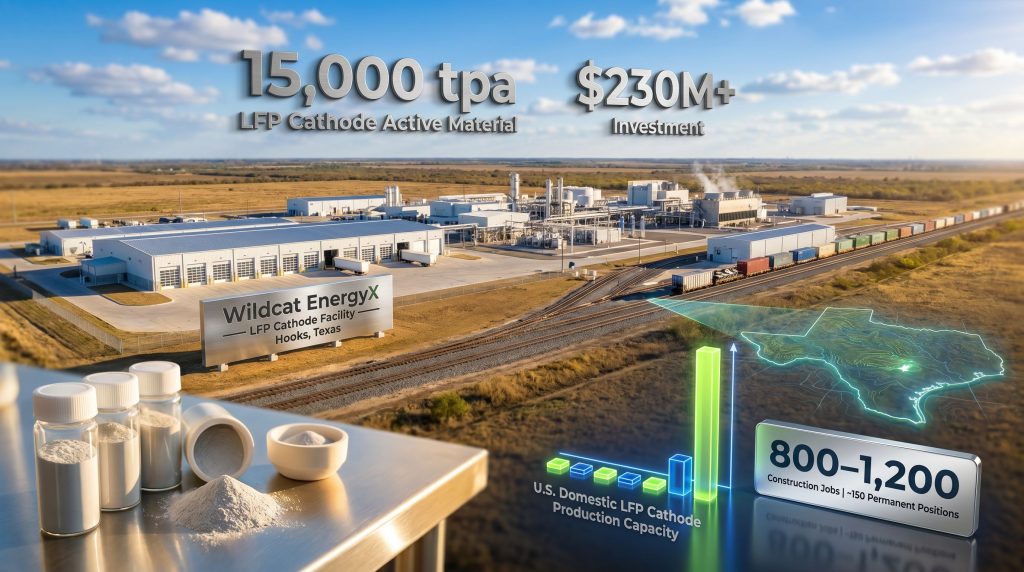
The joint venture between Wildcat Discovery Technologies, a subsidiary of the Holyvolt Group, and Energy Exploration Technologies (EnergyX) centres on a proposed manufacturing facility at the TexAmericas Centre in Hooks, Texas. The planned specifications represent a serious commitment to domestic cathode production at meaningful scale.
| Parameter | Detail |
|---|---|
| Facility Location | Hooks, Texas, TexAmericas Centre |
| Site Area | 330 acres |
| Initial Production Capacity | 15,000 tonnes per annum (LFP CAM) |
| Total Projected Investment | Exceeds $230 million |
| Permanent Operational Jobs | Approximately 150 |
| Construction and Indirect Jobs | 800 to 1,200 |
| Adjacent Facility | EnergyX Project Lonestar lithium plant |
| Nearby Infrastructure | Red River Army Depot |
The TexAmericas Centre offers industrial-grade utility infrastructure and direct rail access, both of which matter considerably for a facility that will handle substantial inbound flows of lithium carbonate and outbound distribution of finished cathode material. Rail connectivity reduces trucking dependency, lowers logistics costs, and improves the resilience of the supply chain on both ends of the production process.
The Co-Location Advantage and Its Supply Chain Logic
Perhaps the single most strategically significant feature of this project is the deliberate co-location of cathode manufacturing directly adjacent to EnergyX's Project Lonestar lithium carbonate plant. In conventional battery material supply chains, lithium carbonate is extracted or refined in one geography, shipped to a separate cathode manufacturing facility often in a different country, and then distributed to cell manufacturers in yet another location. Each transfer point introduces cost, lead time, and supply risk.
The Hooks, Texas configuration collapses two of these stages into a single industrial campus. Lithium carbonate produced at Project Lonestar moves directly into cathode production without crossing international borders or navigating multi-week shipping logistics. This spatial integration is a genuine competitive differentiator that most announced domestic cathode projects cannot replicate.
EnergyX also controls lithium mining rights across approximately 50,000 acres beneath and surrounding the planned cathode facility and the neighbouring Lonestar plant, extending the potential vertical integration from subsurface resource through to finished cathode material.
The Joint Venture Structure and Lithium Supply Economics
Technology and Infrastructure Contributions
The partnership divides responsibilities along lines of comparative advantage. Wildcat Discovery Technologies contributes its proprietary LFP cathode materials technology and a high-throughput development platform that significantly accelerates formulation optimisation. EnergyX brings domestic lithium carbonate supply capacity, the Texas project footprint, and site development infrastructure.
Both partners already operate at demonstration scale. Wildcat produces LFP cathode material at a facility in San Diego, California, while EnergyX operates lithium carbonate production at its Hooks, Texas site. This existing operational experience reduces the technology and process risk that typically accompanies first-of-kind manufacturing investments.
The Lithium Supply Agreement: Price Stability as a Structural Moat
One of the least-discussed but most consequential aspects of this joint venture is the structure of its lithium carbonate supply arrangement. EnergyX is expected to supply most or all of the lithium carbonate required by the cathode facility, under terms that include both a price floor and a price ceiling, as well as a negotiated discount relative to prevailing market rates.
This contractual price banding mechanism addresses what has historically been one of the most destabilising forces in LFP producer economics. Lithium carbonate spot prices swung from below $10,000 per tonne in 2020 to above $80,000 per tonne at the 2022 peak before collapsing back toward $10,000 to $15,000 per tonne by 2024, according to data tracked by S&P Global Commodity Insights. Producers operating on open-market input costs through that cycle faced margin compression severe enough to threaten project viability regardless of operational efficiency.
Vertically integrated lithium-to-cathode supply chains with contractual price stabilisation represent one of the most effective structural hedges against commodity cycle risk, a risk that has destabilised multiple battery material ventures over the past four years.
By locking in both a ceiling and a floor with a built-in market discount, the joint venture insulates its unit economics from the worst outcomes of lithium price volatility in either direction. This is not a minor operational detail. It is a foundational element of the business model's resilience.
Wildcat's Technology Platform: High-Throughput Development as a Competitive Edge
Accelerating Cathode Formulation at Industrial Speed
Wildcat Discovery Technologies has built its reputation on a high-throughput experimentation methodology originally developed for pharmaceutical and semiconductor research, then adapted for battery materials discovery. The platform enables parallel synthesis and testing of hundreds of cathode formulations simultaneously, compressing development cycles that would conventionally take years into months.
In the context of cathode manufacturing, this capability matters for two distinct reasons. First, it allows the facility to optimise LFP formulation parameters, particle size distribution, carbon coating uniformity, and calcination profiles continuously rather than relying on static recipes established at pilot scale. Second, it creates a technology pipeline that extends well beyond standard LFP.
The Product Roadmap Beyond Standard LFP
The joint venture's stated product portfolio encompasses a range of chemistries and applications that position it for evolution alongside the battery technology landscape. In addition, direct lithium extraction techniques being refined across the industry could further enhance the input supply chain supporting such facilities:
- LMFP (Lithium Manganese Iron Phosphate): An enhanced LFP variant that incorporates manganese to increase voltage and energy density while retaining most of the safety and cycle-life advantages of standard LFP. LMFP is widely considered the next generation of phosphate-based cathodes.
- Cobalt-free and nickel-free cathode development: Formulations that eliminate the two most supply-chain-constrained and geopolitically sensitive cathode metals
- Lithium metal anode research: Relevant to next-generation solid-state and high-energy-density cell architectures that are expected to enter commercial production later this decade
- Lithium isotope production for nuclear applications: An emerging and strategically distinct revenue stream with entirely different demand drivers than the commercial battery market
This multi-chemistry roadmap means the Texas facility is designed not merely as a fixed-output LFP plant but as a manufacturing platform capable of adapting its product mix as the technology landscape evolves.
Economic Impact and the Federal Funding Variable
Regional Employment and Investment Multipliers
A capital deployment of more than $230 million in Hooks, Texas and the surrounding region carries employment and economic multiplier effects that extend considerably beyond the facility fence line. The projected direct workforce of approximately 150 permanent positions represents well-paying technical manufacturing roles, while the 800 to 1,200 construction and indirect positions reflect the broader economic activation that large industrial projects generate during development phases.
Cathode manufacturing roles require specialised technical training in materials handling, calcination process control, quality assurance chemistry, and electrochemical testing, creating workforce development requirements that typically involve community college and technical institute partnerships in the host region.
Federal Support: What It Would Mean and What It Does Not Yet Guarantee
As of the announcement, the U.S. Department of Energy has not committed funding to the project. This is a material distinction that investors and policymakers should not elide. The $230 million investment reflects private sector commitment, not a federally underwritten project.
DOE support, if secured, could compress the construction and commissioning timeline meaningfully. Relevant federal mechanisms that domestic cathode projects have previously accessed include:
- The Advanced Manufacturing Production Credit (45X) under the Inflation Reduction Act, which provides per-kilogram tax credits for domestically produced battery components including cathode active material
- Section 48C Advanced Energy Manufacturing Tax Credits, which support investment in clean energy manufacturing facilities
- DOE Loan Programs Office financing for large-scale manufacturing projects with demonstrated technology readiness
Important Note for Investors and Stakeholders: The project's development timeline remains conditional on private capital deployment and potential, though not confirmed, federal acceleration funding. Announced intent and fully committed construction milestones are not equivalent. All forward-looking statements regarding timelines and employment outcomes are subject to material uncertainty.
The next major ASX story will hit our subscribers first
Positioning Within the Domestic Battery Materials Race
Mapping the U.S. LFP Cathode Production Gap
The scale of the supply gap this project is attempting to address is worth quantifying. Global LFP cathode production is overwhelmingly concentrated in China, where producers benefit from decades of manufacturing scale, integrated precursor supply chains, and significant policy support. Consequently, the battery raw materials market faces significant structural imbalances that projects of this nature are specifically designed to correct.
| Metric | Context |
|---|---|
| U.S. LFP cathode production (current) | Negligible relative to global output |
| Global LFP production dominance | Primarily concentrated in Asia |
| Phase 1 target production capacity | 15,000 tonnes per annum |
| EnergyX lithium acreage (Texas) | Approximately 50,000 acres |
| End-market applications | EVs, grid storage, defence, drones, nuclear |
A facility producing 15,000 tonnes per annum of LFP cathode material would represent a meaningful incremental addition to U.S. domestic supply, though the broader industrial policy objective of genuine supply chain independence will require multiple projects of similar or greater scale operating simultaneously.
The Defence Adjacency Factor: A Dimension Most Analysis Overlooks
The proximity of the Hooks, Texas site to the Red River Army Depot introduces a dimension that purely commercial analysis tends to underweight. The U.S. military's accelerating electrification programme, spanning ground vehicles, unmanned systems, forward operating base power, and portable electronics, creates sustained and non-cyclical demand for domestically sourced LFP cathode material that is structurally different from commercial EV or grid storage procurement.
Defence procurement requirements increasingly emphasise domestic origin provisions, supply chain traceability, and geographic proximity to military logistics infrastructure. A cathode facility located adjacent to a major Army installation and connected by rail to national distribution networks carries attributes that are difficult to replicate through purely commercially sited alternatives. However, the critical minerals demand picture across both civilian and defence sectors continues to intensify, reinforcing the strategic case for projects like this one.
This defence-adjacent positioning does not guarantee military contracts and no such procurement has been announced. However, it meaningfully expands the addressable market profile of the facility beyond purely commercial applications.
Frequently Asked Questions
What is the Wildcat EnergyX LFP cathode facility in Texas?
It is a proposed joint venture manufacturing plant in Hooks, Texas, designed to produce 15,000 tonnes per year of lithium iron phosphate cathode active material, representing a combined private investment exceeding $230 million.
Who are the partners behind the Texas LFP cathode plant?
Wildcat Discovery Technologies, a subsidiary of Holyvolt Group, and Energy Exploration Technologies (EnergyX), which operates existing lithium carbonate production through its Project Lonestar facility also located in Hooks, Texas. Further details on the venture are available for those seeking a deeper technical overview of the partners' capabilities.
What will the facility produce?
LFP cathode active material for use in electric vehicle batteries, grid-scale energy storage systems, military electrification platforms, drone power systems, and other advanced energy applications. The product roadmap also encompasses LMFP, cobalt-free cathodes, and lithium isotopes for nuclear use.
Has construction started?
As of the announcement date, the project is in the planning and agreement phase. Department of Energy funding has not been secured, though private investment commitments exceeding $230 million have been indicated.
How many jobs will the facility create?
Approximately 150 permanent operational positions, alongside 800 to 1,200 construction-phase and indirect employment opportunities.
The Bigger Picture: Vertical Integration as Industrial Strategy
What distinguishes this project from many other announced domestic battery material investments is not simply its scale or location, but the degree of vertical integration it embodies. From subsurface lithium rights through carbonate production to cathode manufacturing, the Hooks, Texas ecosystem is being constructed as an end-to-end platform rather than a standalone processing node.
The Battery Mecca concept articulated by EnergyX reflects a recognition that isolated facilities remain vulnerable to external supply shocks regardless of their technical sophistication. True supply chain resilience requires not just domestic processing capacity but domestic input supply, contractual price stability, and proximity to end-use demand.
Whether the project delivers on its full potential will depend on execution, federal funding outcomes, construction timelines, and the evolution of domestic LFP demand across commercial and defence channels. What is already clear is that the structural logic underpinning the Wildcat EnergyX LFP cathode facility in Texas addresses the right problem with a more complete set of solutions than most comparable initiatives have managed to assemble.
This article contains forward-looking statements and projections based on publicly available information. Timelines, employment figures, and investment outcomes are subject to material uncertainty. Nothing in this article constitutes financial or investment advice. Readers should conduct independent due diligence before making investment decisions.
Want To Stay Ahead of the Next Major Battery Minerals Discovery on the ASX?
Discovery Alert's proprietary Discovery IQ model delivers real-time alerts the moment significant mineral discoveries — including lithium and other battery-critical commodities — are announced on the ASX, turning complex data into actionable investment insights before the broader market reacts. Explore how historic discoveries have generated extraordinary returns on Discovery Alert's dedicated discoveries page, and begin your 14-day free trial today to position yourself at the forefront of the next major find.