June 12, 2026
The Fragile Architecture of Australia's Only Manganese Alloy Smelter
When industrial policy meets financial distress, the results rarely follow a neat script. Across advanced economies, the tension between strategic asset preservation and market-driven capital allocation has repeatedly exposed a fundamental weakness: downstream processing infrastructure, once lost, is extraordinarily difficult to rebuild. Australia is now confronting precisely this dynamic at the Liberty Bell Bay smelter funding crisis in northern Tasmania, where a collapsed consortium bid and an accelerating funding clock have brought the country's entire domestic manganese alloy processing capability to the edge of permanent closure.
Understanding why this matters requires stepping back from the immediate drama of a Monday deadline and examining the deeper structural forces that created a single-point-of-failure in one of Australia's most strategically important industrial supply chains.
When big ASX news breaks, our subscribers know first
Why Manganese Alloy Smelting Is More Complex Than It Appears
Manganese alloys, particularly ferromanganese and silicomanganese, are not optional additives in steel production. They are chemically essential. Manganese acts as a deoxidiser and desulfuriser during the steelmaking process, removing impurities that would otherwise weaken the final product. It also dramatically improves steel's hardness, tensile strength, and wear resistance, making it indispensable for structural steel, rail, automotive components, and mining equipment.
The smelting process itself is energy-intensive and technically demanding. It involves reducing manganese ore in submerged arc furnaces at temperatures exceeding 1,400 degrees Celsius, combining the ore with carbon reductants such as coke or coal to strip oxygen from the manganese oxide and produce usable alloy. The Bell Bay facility, situated on Tasmania's Tamar River near George Town, was historically well-positioned for this process given the region's access to hydroelectric power, port infrastructure, and proximity to both domestic and imported ore sources.
Does Australia Have a Raw Material Advantage?
Australia is one of the world's largest producers of manganese ore, with the Groote Eylandt deposit in the Northern Territory representing one of the highest-grade manganese ore bodies on Earth. Yet despite this raw material advantage, the country has historically underinvested in downstream metals processing capacity. Liberty Bell Bay became the sole domestic smelter not because of strategic planning, but through decades of market attrition that eliminated competing facilities.
The result is a structural fragility that few policymakers anticipated: a nation that exports manganese ore globally but depends on a single ageing smelter to convert that ore into the alloy form that domestic steelmakers actually require.
From GFG Alliance to Voluntary Administration: A Timeline of Deterioration
The ownership history of Liberty Bell Bay is inseparable from the broader collapse of Sanjeev Gupta's GFG Alliance, a sprawling industrial conglomerate that acquired steel and metals assets across the UK, Europe, and Australia during a period of aggressive expansion funded largely by supply chain finance from Greensill Capital. When Greensill Capital collapsed in March 2021, the financial architecture underpinning GFG Alliance began unravelling across multiple jurisdictions simultaneously.
Liberty Bell Bay's deterioration followed a slower trajectory, but the destination was the same. The facility had been operating under financial stress for an extended period before formal insolvency proceedings began. The sequence of events that followed is outlined below:
| Date | Event |
|---|---|
| January 2026 | Liberty Bell Bay enters receivership |
| March 2026 | Voluntary administration commences; EY Parthenon appointed as administrator |
| April 2026 | ASIC drops regulatory action against the facility as sale process progresses |
| Late May 2026 | Preferred bidder consortium announced: Adroit Capital, OM Holdings, White Oak |
| June 12, 2026 | Adroit Capital effectively withdraws; funding crisis becomes public |
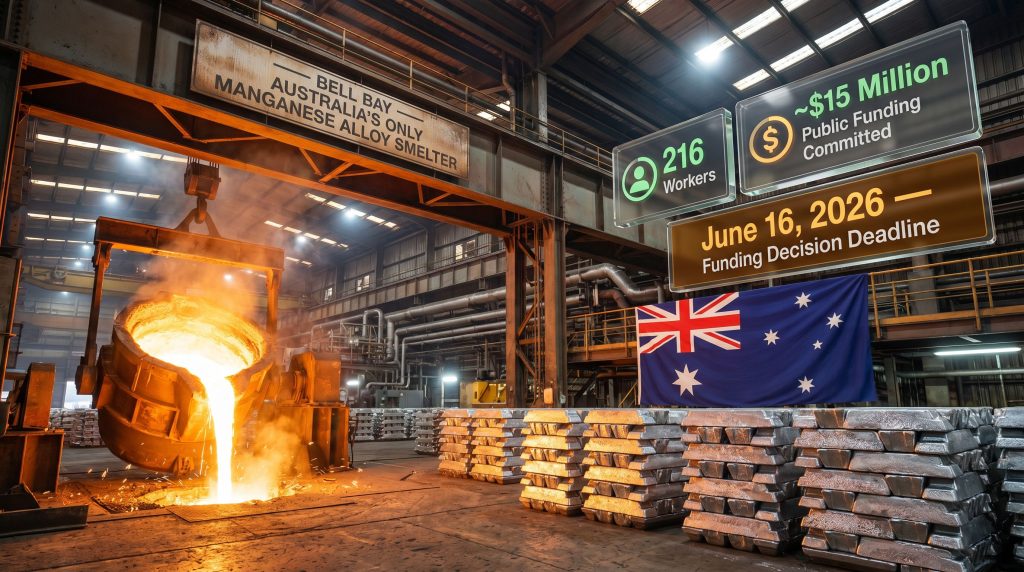
| June 16, 2026 | Administrator deadline for alternative funding decision |
A critical detail that is often overlooked: the smelter has been under care and maintenance for more than twelve months. This is not an idle state. Care and maintenance at a submerged arc furnace facility involves continuous expenditure on equipment preservation, safety monitoring, workforce retention, environmental compliance, and utility connections. These costs accumulate without generating any revenue, steadily eroding the financial viability of any future restart.
The role of White Oak, a US-based private equity firm, is particularly significant. White Oak had been a secured lender to GFG Alliance, meaning it held a priority claim over the facility's assets. Its inclusion in the preferred bidder consortium was therefore not purely strategic; it reflected the reality that any viable transaction needed to address White Oak's secured position, making it a participant in both the debt restructuring and the equity acquisition simultaneously.
The Consortium Structure That Couldn't Hold
Multi-party consortium bids for distressed industrial assets have a well-documented failure rate. The fundamental problem is one of coordination under uncertainty: each consortium member must commit capital based on due diligence that is, by definition, incomplete in a distressed scenario. When one party's assessment of risk diverges from the others, or when a party simply cannot source the capital it committed to contribute, the entire structure can collapse even if the underlying asset remains viable.
This is precisely what appears to have occurred at Liberty Bell Bay. The preferred bidder group brought together three very different entities:
- Adroit Capital (Perth-based): The lead equity contributor and primary acquirer in the transaction structure
- OM Holdings (ASX-listed): A manganese producer with operational expertise in the sector, providing strategic fit and potential synergies with the smelter's core business
- White Oak (US private equity): The existing secured lender, whose participation was essential to restructuring the debt that had encumbered the asset
EY Parthenon confirmed publicly that difficulties had emerged across financing, supplier, and government arrangements simultaneously, suggesting the problems extended beyond a simple capital shortfall. In distressed acquisitions, supplier relationships are often as critical as equity funding: a smelter cannot restart without committed supply agreements for manganese ore, carbon reductants, and power, and suppliers are understandably reluctant to commit to a facility whose ownership remains uncertain.
When a distressed industrial asset requires simultaneous resolution of equity funding, debt restructuring, supplier commitments, and government support arrangements, the probability that all four elements align before an administrative deadline is structurally low.
Adroit Capital's inability to contribute its allocated capital portion was the visible trigger. However, the broader picture suggests a transaction that was already under significant stress across multiple dimensions before the consortium formally fractured.
The Public Funding Dimension: $15 Million and Climbing
Government intervention in the Liberty Bell Bay administration has been substantial and cumulative. The following table summarises the publicly reported funding contributions:
| Funding Round | Approximate Amount | Purpose |
|---|---|---|
| Initial Tasmanian government support | Reported at approximately $20 million (pre-administration period) | Operational continuity |
| Federal-state joint contribution (May 2026) | $5 million | Workforce retention during preferred bidder due diligence |
| Most recent federal-state bridge funding | Reported at approximately $3 million | Wages while alternative buyer is sought |
| Total during administration period | Approximately $15 million | Multiple tranches |
Note: Figures reflect publicly reported data as at June 2026. Total government exposure may differ depending on the classification of individual instruments as loans or grants, and whether pre-administration support is included in cumulative calculations.
The industrial policy logic driving this intervention is not difficult to understand. Losing the country's only manganese alloy processing facility would force Australian steelmakers to source processed alloys from overseas suppliers, predominantly in China, South Africa, and Norway, exposing domestic supply chains to geopolitical risk, currency volatility, and logistical complexity. Furthermore, for an industry already navigating significant structural pressures, these energy security implications add considerable strain to an already fragile equation.
Federal Labor member for Bass, Jess Teesdale, has been actively advocating for continued wage support funding, reflecting the electoral and community stakes involved. The Bell Bay industrial precinct directly employs 216 workers, and the downstream economic effects on George Town and northern Tasmania extend considerably further.
The harder policy question is whether ongoing bridge funding without a secured buyer represents sound use of public resources. Each tranche of government money buys time, but time alone does not resolve the structural problems that brought the facility into administration in the first place.
Four Scenarios: What Happens After Monday
The June 16 deadline is not a negotiating artifice. It reflects the hard operational reality that a smelter under care and maintenance cannot absorb indefinite costs without committed funding on the other side. The realistic pathways from here fall into four broad scenarios:
Scenario 1: A Replacement Investor Joins the Consortium
EY Parthenon confirmed it was returning to parties who had previously expressed interest in the facility. If one of those parties can commit capital quickly enough to meet the administrator's requirements, and if the existing consortium members remain willing to proceed, a transaction could still be structured. The timeline is extremely compressed, and EY Parthenon's administrator Morgan Kelly was described by those present at the George Town town hall as offering notably cautious language about the prospect, signalling that optimism at this stage would be premature.
Scenario 2: The Remaining Consortium Members Absorb the Shortfall
OM Holdings, as an ASX-listed manganese producer, has a genuine strategic interest in the smelter's survival. Integrating downstream smelting capacity with upstream manganese production is a commercially logical proposition. However, any material increase in OM Holdings' financial exposure to a distressed asset would require careful consideration of its shareholder obligations and ASX disclosure requirements. White Oak, as the secured lender, may have less flexibility to absorb additional equity risk without restructuring its own position.
Scenario 3: A New Bidder Emerges from Secondary Interest
This is the most optimistic scenario and, realistically, the least probable within the available timeframe. Acquiring a distressed smelter that has been idle for over a year requires thorough technical due diligence, environmental assessment, and supply chain planning. None of these can be completed meaningfully in seventy-two hours.
Scenario 4: Closure and Workforce Consultation
If no funding is secured, EY Parthenon's statement that the company is already consulting with employees about their future employment points clearly toward this outcome. The Australian Workers Union has been vocal in supporting workers through this process, with Tasmanian assistant secretary Robert Flanagan acknowledging the workforce was deeply concerned, noting the news of the consortium's difficulties had come as a significant shock following what had appeared to be a credible path to resuming operations.
Closure would trigger redundancy obligations for 216 workers, with entitlement calculations depending on each employee's length of service and the financial resources available within the administration. The Australian Workers Union's leverage at this stage lies primarily in its ability to advocate for full entitlement payment and to apply political pressure through the federal member for Bass.
The next major ASX story will hit our subscribers first
What This Crisis Reveals About Australia's Critical Minerals Ambitions
Australia has positioned itself publicly as a nation seeking to move up the critical minerals value chain, capturing more of the economic value from its extraordinary resource endowment by processing raw materials domestically rather than exporting them as ore. Consequently, the Liberty Bell Bay smelter funding crisis exposes the gap between that ambition and the structural reality on the ground, and indeed reflects broader patterns seen in Australia's resource export challenges.
Downstream processing facilities face a fundamentally different economic profile from mining operations. They are capital-intensive, energy-intensive, and operationally complex. They require stable, long-term customer relationships to justify the investment. And they are acutely sensitive to energy costs, which is precisely why Bell Bay's location adjacent to Tasmanian hydropower was historically a competitive advantage, though one that has been eroded over time by rising costs and market changes.
Is Australia's Single-Facility Model Sustainable?
The single-facility problem is a systemic risk that extends beyond manganese. Australia has limited domestic processing capacity across multiple critical mineral categories, meaning that the loss of any individual facility can eliminate an entire domestic industrial capability overnight. In addition, rebuilding that capability, once lost, typically requires years of investment and sustained policy commitment.
The manganese alloy processing knowledge embedded in Bell Bay's workforce, its operational procedures, and its supplier relationships cannot be replicated quickly. Indeed, the critical minerals demand surge anticipated over the coming decade makes the preservation of existing processing infrastructure even more pressing.
International comparisons are instructive here. Norway has built a globally competitive ferromanganese smelting industry through consistent long-term policy support and integration with domestic hydropower. South Africa has protected its smelting sector through structured domestic beneficiation requirements linked to mining rights. Australia, however, has relied predominantly on market forces to sustain downstream processing, with intermittent crisis-driven intervention substituting for coherent structural policy.
Furthermore, Australia's critical minerals strategy will require far more than reactive funding if the nation is to credibly compete with these established processing nations over the long term.
Frequently Asked Questions: The Liberty Bell Bay Smelter Crisis
What is Liberty Bell Bay and why does it matter to Australian industry?
Liberty Bell Bay is Australia's only manganese alloy smelter, located in the Bell Bay industrial precinct near George Town in northern Tasmania. It matters because without it, Australian steelmakers have no domestic source of processed manganese alloys and must rely entirely on imported material, primarily from overseas producers in China, South Africa, and Norway.
Why did Liberty Bell Bay enter voluntary administration?
The facility's financial difficulties trace directly to the collapse of its former parent company structure under GFG Alliance, which faced severe financial distress following the implosion of Greensill Capital in 2021. Accumulated operating losses, care and maintenance costs during an extended idle period, and inability to service debt obligations ultimately triggered the administration process beginning in early 2026.
How much public money has been committed to Liberty Bell Bay?
Total government funding during the administration period reached approximately $15 million across multiple tranches from both the Tasmanian and federal governments, according to publicly available reporting as at June 2026.
Who were the preferred bidders and what went wrong?
The preferred bidder consortium comprised Perth-based Adroit Capital as the lead equity contributor, ASX-listed manganese producer OM Holdings, and US private equity firm White Oak. The consortium collapsed after Adroit Capital was unable to contribute its allocated portion of the required capital, triggering a broader review of the transaction's viability.
What happens to workers if the smelter closes permanently?
The 216 directly employed workers would be entitled to redundancy payments under Australian employment law, with the Australian Workers Union representing their interests through the administration process. The downstream economic impact on the George Town region and northern Tasmania would extend well beyond direct employment figures.
Could the smelter restart under new ownership in the future?
Technically, a restart is possible but would require substantial capital investment, recommissioning of equipment that has been idle for over a year, re-establishment of supply chain relationships, and a credible power supply arrangement. The longer the facility remains idle, the more complex and costly a restart becomes.
Key Takeaways
- Single-facility dependency in critical industrial processing creates systemic national risk that market forces alone are demonstrably unable to manage
- Multi-party consortium acquisitions of distressed assets carry structural fragility that neither administrators nor governments can fully insure against through bridge funding alone
- Care and maintenance costs at idle smelting facilities accumulate rapidly, narrowing the window for viable transaction completion with each passing week
- The Monday deadline reflects operational reality, not negotiating strategy, and permanent closure is the default outcome if alternative funding cannot be secured
- Australia's critical minerals processing ambitions require structural policy frameworks, not crisis-by-crisis intervention, if they are to be credibly sustained over the long term
Disclaimer: This article is intended for informational purposes only and does not constitute financial or investment advice. The situation at Liberty Bell Bay remains fluid, and outcomes may change materially before or after the June 16, 2026 deadline. Readers should consult independent sources for the latest developments. For ongoing coverage, ABC News is reporting actively on the Liberty Bell Bay administration at abc.net.au.
Want to Track the Next Major ASX Minerals Discovery Before the Broader Market?
The Liberty Bell Bay crisis underscores just how critical downstream processing and raw material supply chains are to Australia's industrial future — and for investors, staying ahead of significant ASX mineral discoveries in sectors like manganese and other critical commodities has never been more important. Discovery Alert's proprietary Discovery IQ model delivers real-time alerts on significant ASX mineral discoveries, transforming complex mineral data into actionable insights, so subscribers can identify emerging opportunities the moment they are announced — explore historic discovery returns on Discovery Alert's discoveries page and begin a 14-day free trial to position yourself ahead of the market.