June 12, 2026
Boardroom Battles in the World's Biggest Iron Ore Sector
When institutional investors shift from passive capital allocators to active governance agents, the consequences ripple well beyond a single company's boardroom. This transformation has been unfolding across global resource markets for several years, driven by the growing recognition that board composition directly shapes long-term capital discipline, risk management culture, and stakeholder accountability at major mining companies. In Brazil, this trend is taking on a particularly distinctive character.
State-linked pension funds with deep roots in the country's industrial heritage are increasingly willing to deploy formal governance mechanisms against the very companies they have long held as anchor investments. The Vale chairman removal meeting request sits squarely within this broader institutional shift, raising fundamental questions about how governance power is exercised at one of the world's three largest iron ore producers.
When big ASX news breaks, our subscribers know first
Previ's Position in Vale's Ownership Structure
Previ, the pension fund responsible for managing retirement assets on behalf of employees at Banco do Brasil, Brazil's state-owned bank, holds approximately 7% of Vale's shares, making it the company's single largest shareholder according to regulatory filings disclosed by Vale. This stake, while substantial in isolation, is not sufficient on its own to pass governance resolutions under Brazilian corporate law, which typically requires a simple majority of votes present at a meeting.
Why Previ's Influence Extends Beyond Its Stake
The significance of Previ's position extends beyond raw voting arithmetic. Brazilian state-linked pension funds, including Previ alongside peers such as Petros and Funcef, have historically maintained the ability to coordinate voting behaviour at strategic resource companies. They draw on shared institutional priorities and informal communication channels developed over decades of overlapping portfolio exposure. When one of these funds moves formally, others pay close attention.
Previ's recent internal leadership transition adds an important layer of context. In May 2026, Marcio Antonio Chiumento was named Previ's chief executive after Joao Luiz Fukunaga resigned from the position. Chiumento had already joined Vale's board earlier in 2026, a dual positioning that is not coincidental. New institutional leadership at major pension funds almost invariably triggers a structured review of major portfolio company governance arrangements.
"When a major pension fund installs new leadership and immediately moves to reshape the board of its most significant mining investment, the sequencing of those events tells investors more than any formal governance statement can."
What the Vale Chairman Removal Meeting Is Formally Requesting
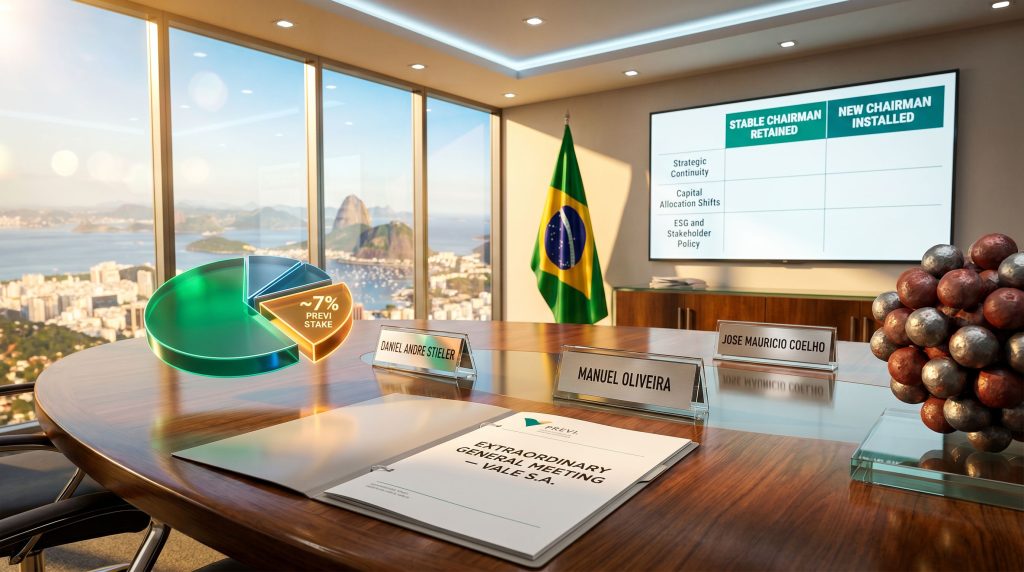
Vale confirmed in a regulatory filing that it received a formal request from Previ to convene an extraordinary shareholder meeting to vote on the removal of sitting chairman Daniel Andre Stieler. Alongside this removal motion, Previ proposed two additional board changes:
- The elevation of current Vale board member Manuel Oliveira to the chairmanship
- The appointment of Jose Mauricio Coelho as a new Vale board director
Previ's stated rationale centres on governance quality improvement. The pension fund has argued that Oliveira's chairmanship would contribute to stronger governance practices, improved strategic management, and better alignment with the interests of both shareholders and the broader stakeholder base. This framing is deliberate and strategically sophisticated: positioning the intervention as a structural enhancement rather than a punitive response to financial underperformance typically attracts wider institutional support.
Vale's board has confirmed it is assessing the procedural requirements to convene the meeting. Notably, Vale chose not to release the full Previ document, a decision that governance observers often interpret as reflecting ongoing deliberation rather than concluded agreement on how to proceed. Furthermore, mining governance pressures of this nature are increasingly common across the global resources sector.
How the Extraordinary General Meeting Process Works
Understanding how the Vale chairman removal meeting would actually unfold requires working through the mechanics of Brazil's corporate governance framework.
Under Brazilian Corporate Law (Lei das Sociedades por Ações, Law No. 6,404/76), shareholders representing at least 5% of voting capital are entitled to formally request the convocation of an extraordinary general meeting, specifying the proposed agenda items. With approximately 7% of Vale's shares, Previ clearly meets this threshold. The procedural sequence from formal request to vote typically follows these stages:
- Formal request submission by a qualifying shareholder with specified agenda items
- Board assessment phase to evaluate procedural and legal compliance of the request
- Meeting convocation issued by the company within the legally required timeframe once the request is validated
- Shareholder notification distributed to all registered holders with agenda details and voting instructions
- Proxy voting period during which institutional and retail shareholders submit voting intentions
- Vote execution at the extraordinary general meeting with results determined by the applicable threshold
- Regulatory disclosure to Brazil's securities regulator, the Comissão de Valores Mobiliários (CVM), and the broader market
Brazilian law mandates that validated extraordinary meeting requests be acted upon within defined timeframes. Consequently, this would position any meeting within approximately 30 days of Vale confirming the request meets procedural requirements. Given Vale's disclosure on June 11, 2026, a meeting could theoretically occur by mid-July 2026 if the board concludes the threshold conditions are satisfied.
The Voting Mathematics Behind the Proposal
The core challenge for Previ is a numerical one. Removal of a sitting chairman under Brazilian corporate law and standard company bylaw structures typically requires a simple majority of votes cast at the meeting. Historical voter turnout at Brazilian extraordinary shareholder meetings has ranged broadly, but institutional participation rates at large-cap B3-listed companies often reach 65–80% of eligible voting shares.
This means Previ's 7% stake, while making it Vale's largest single holder, represents only a fraction of the coalition it would need to assemble. To pass the motion, Previ would likely need to secure active support from shareholders representing a combined 43% or more of total voting shares, depending on meeting participation levels.
The Strategic Stakes for Vale's Direction
Governance transitions at mining companies of Vale's scale carry operational consequences that extend well beyond board composition changes. The table below illustrates how different outcomes might affect key strategic dimensions of Vale's business:
| Strategic Factor | Stieler Retains Chairmanship | Oliveira Assumes Chairmanship |
|---|---|---|
| Capital allocation continuity | High probability | Subject to early review |
| CEO and management relationships | Unchanged | Reassessment likely |
| ESG and stakeholder commitments | Incremental evolution | Potential acceleration |
| Investor sentiment near-term | Neutral to cautiously positive | Volatile pending nominee clarity |
| Strategic review likelihood | Low | Elevated within 12–18 months |
| Brumadinho rehabilitation posture | Continuity | Possible priority realignment |
Vale is navigating a period of considerable complexity. The company continues managing legacy litigation and reputational rehabilitation efforts following the January 2019 Brumadinho tailings dam collapse, which resulted in over 270 deaths and generated legal and financial obligations that remain ongoing. Simultaneously, Vale is managing large capital expenditure cycles across its iron ore, nickel, and copper operations, all of which require consistent board oversight and stable management direction.
The chairman's role in this environment is not ceremonial. Board chairs at major mining companies serve as the primary mediator between executive management and the shareholder base, set the tone for board culture and risk tolerance, and often serve as the primary point of contact for major institutional investors navigating concerns outside formal annual meeting cycles. In addition, the commodity price impact on Vale's earnings further amplifies why leadership stability matters to the investment community following this commodity price impact.
"Board instability at a company with Vale's exposure to Chinese iron ore demand cycles, ongoing legal obligations, and major capital programs introduces uncertainty that can weigh on institutional positioning independent of operational fundamentals."
Pension Fund Activism in Brazilian Mining: Not an Isolated Event
The Vale chairman removal meeting request should be understood within a well-established pattern of state-linked pension fund influence over Brazil's major resource and industrial companies. Previ, Petros, and Funcef have collectively exercised board-level influence at companies including Petrobras and Eletrobras during periods of strategic transition. They typically frame their interventions around governance quality, stakeholder alignment, or long-term value creation rather than short-term financial metrics.
Vale's complex ownership history makes this dynamic particularly layered. The company underwent partial privatisation in 1997, but state-linked funds retained significant positions throughout, creating a governance architecture where no single shareholder holds controlling interest yet state-affiliated institutions collectively wield substantial influence.
How Global Mining Peers Have Faced Similar Pressure
Comparable dynamics have emerged at other global mining majors. Rio Tinto faced coordinated institutional pressure following the 2020 Juukan Gorge cultural heritage destruction, ultimately replacing senior leadership after institutional holders representing meaningful combined stakes coordinated their concerns. Glencore has faced repeated shareholder-driven governance challenges on both emissions policy and executive compensation.
The common thread across these cases is that institutional shareholders have grown more willing to move from private engagement to formal governance mechanisms when internal deliberations fail to produce the desired outcomes. Furthermore, Vale's position within global iron ore leadership means that any governance disruption carries outsized implications for global supply dynamics. According to reports from Reuters, Vale's board has previously emphasised its commitment to avoiding market disruption during leadership transitions, which may shape how it responds to the current challenge.
The next major ASX story will hit our subscribers first
Three Scenarios for the Vale Shareholder Vote
The ultimate resolution of Previ's challenge could follow several distinct paths, each with different implications for Vale's governance trajectory and investor positioning:
Scenario 1: Motion passes, Oliveira assumes the chairmanship. Previ successfully assembles a voting coalition among other institutional shareholders. Stieler steps down, Oliveira assumes the chair, and Coelho joins the board. Near-term market reaction would likely be muted if framed as governance quality improvement, though a strategic review of capital allocation and ESG priorities within 12 months becomes probable.
Scenario 2: Motion fails, Stieler retains the chairmanship. Previ is unable to secure sufficient shareholder support beyond its own 7% stake. Stieler remains in position but with a visibly weakened mandate. Previ retains its board presence through Chiumento and is likely to maintain governance pressure through future annual meeting cycles or targeted engagement with management.
Scenario 3: Negotiated transition before the meeting is held. Behind-the-scenes discussions between Previ, Vale's board, and potentially other major shareholders produce a voluntary leadership transition or board restructuring agreement. This scenario, which has precedent at several contested mining company governance disputes globally, would represent the most favourable outcome for Vale's share price stability and management team continuity.
Historically, pre-meeting resolution is more common than contested votes at this level of institutional sophistication, as both parties are aware of the reputational costs of a public governance battle at a company of Vale's global profile.
What This Dispute Signals for Mining Sector Investors
The Vale chairman removal meeting episode carries implications that reach beyond a single Brazilian company's boardroom. However, understanding those implications requires positioning this dispute within the broader context of China iron ore demand cycles and the China steel outlook, both of which shape the strategic priorities that Vale's board must oversee. Several broader patterns are visible:
- Institutional shareholder activism is maturing in emerging market resource companies, with pension funds demonstrating increasing willingness to use formal governance mechanisms rather than relying solely on private engagement
- The framing of boardroom interventions around governance quality rather than financial underperformance reflects a deliberate and increasingly standardised institutional strategy that tends to attract broader shareholder coalitions
- The sequencing of Previ's internal leadership transition followed by a Vale governance intervention within weeks illustrates the direct link between institutional leadership changes and portfolio company governance reviews
- Vale's response to this challenge, whether it proceeds to a contested vote or resolves through negotiated transition, will establish a governance precedent for other major Brazilian resource companies facing similar institutional shareholder dynamics
- For international investors, the episode underscores the importance of understanding state-linked pension fund positioning not just as passive ownership stakes but as active governance influences capable of driving material board-level change
The iron ore sector's dependence on consistent, long-term capital discipline makes governance stability a material investment consideration rather than a peripheral concern. How Vale navigates the coming weeks of institutional deliberation will tell investors a great deal about both the depth of Previ's resolve and the resilience of Vale's current leadership structure.
This article contains forward-looking analysis and scenario modelling based on publicly available information. It does not constitute financial advice. Investors should conduct their own independent research before making investment decisions related to Vale SA or any other securities mentioned.
Want to Stay Ahead of Major Mining Discoveries Before the Broader Market Does?
While governance battles at iron ore giants like Vale capture headlines, the most transformative wealth-creation events in mining often emerge from significant new mineral discoveries on the ASX — and Discovery Alert's proprietary Discovery IQ model ensures subscribers receive real-time alerts the moment those discoveries are announced, turning complex data across more than 30 commodities into clear, actionable insights. Explore how historic ASX mineral discoveries have generated exceptional returns and begin your 14-day free trial today to position yourself ahead of the market.