August 23, 2026
Mexico Simplifies 42 Mining and Extractive Procedures: A Sector at an Inflection Point
Regulatory architecture rarely makes headlines until its absence becomes the problem. Across Latin America's mining corridor, a quiet but consequential reality has taken hold: the difference between a viable project and a stranded asset increasingly comes down not to ore grade or commodity price, but to how efficiently a country processes its own paperwork. Mexico simplifies 42 mining and extractive procedures in a move that directly addresses this dynamic, compressing administrative delay that compounds silently across permitting queues and erodes returns on capital before a single tonne of rock is moved.
This dynamic sits at the centre of Mexico's mid-2026 mining policy evolution, a moment defined not by a single dramatic shift, but by a series of overlapping developments that collectively reshape the operational calculus for anyone with exposure to the sector.
When big ASX news breaks, our subscribers know first
Why Mexico's Administrative Framework Needed Restructuring
Mexico's mining sector has long operated within a layered federal compliance architecture where multiple agencies, divergent timelines, and duplicated documentation requirements created friction at every stage of project development. For operators moving through concession applications, environmental reporting, and activity notifications, the system demanded parallel engagement with overlapping regulatory bodies, each with its own procedural logic.
This wasn't merely an inconvenience. Administrative complexity of this nature generates measurable cost drag. Legal counsel, regulatory consultants, and extended timelines each consume capital that would otherwise flow into exploration or production. Understanding mining permitting basics helps illustrate why procedural inefficiency can be the marginal factor that determines whether a project advances or stalls indefinitely, particularly for junior miners and mid-tier developers operating on tighter balance sheets.
The 2023 Mining Law reform addressed substantive policy concerns, introducing more rigorous concession conditions, expanded water-use oversight, and strengthened Indigenous consultation requirements. However, that reform deliberately left the administrative processing infrastructure largely untouched. The result was a gap between legislative intent and operational reality: stronger rules on paper, but the same cumbersome machinery required to implement them.
What Mexico's Ministry of Economy Actually Changed in 2026
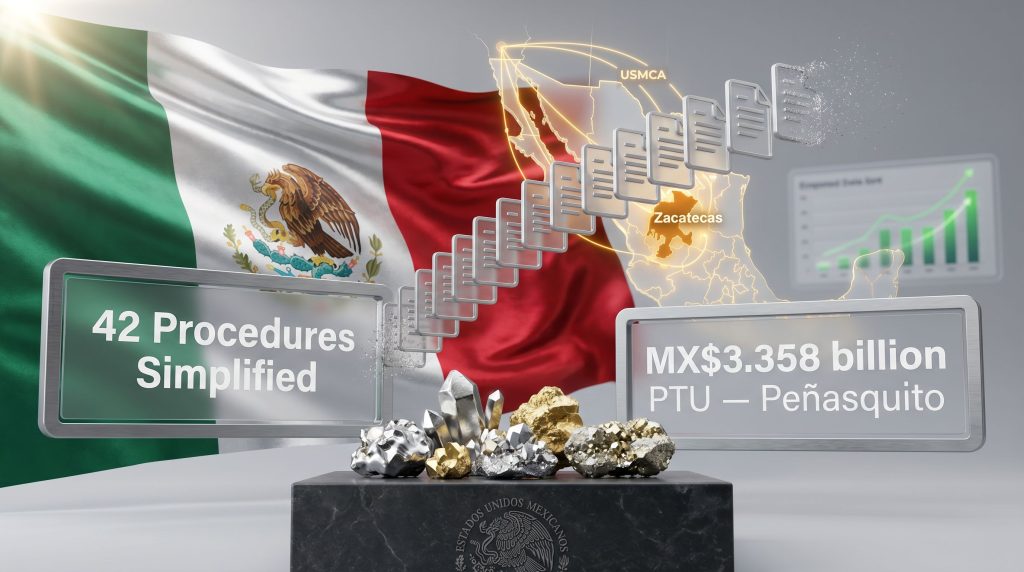
On May 11, 2026, Minister of Economy Marcelo Ebrard signed an administrative reform agreement that effectively modernised the operational layer of Mexico's mining regulatory system. The agreement, formally published in Mexico's Federal Official Gazette (the DOF), took effect the following business day and targeted 42 administrative procedures across mining and extractive activities for streamlining, while eliminating one procedure entirely on grounds of redundancy.
This represents the most extensive operational modification to Mexico's mining administrative framework since the 2023 Mining Law reform. Furthermore, Mexico easing its mining burden without touching its key reform provisions signals a deliberate policy choice to improve operational efficiency while preserving substantive oversight.
What Simplification Actually Means (and What It Doesn't)
A critical distinction often lost in discussions of regulatory reform is the difference between simplification and deregulation. These are not interchangeable concepts.
- Simplification reduces the number of steps, documents, or processing time required to achieve compliance with an existing rule.
- Deregulation removes the substantive rule itself, eliminating oversight or accountability.
Mexico's 2026 reform is firmly in the first category. The environmental, water-use, and Indigenous consultation requirements that formed the backbone of the 2023 reform remain fully intact. What changes is the machinery used to meet them: consolidated submission formats, reduced inter-agency duplication, and faster processing timelines for operators already navigating a substantively demanding compliance environment.
The elimination of one procedure outright reflects a redundancy review within Mexico's federal architecture, where certain reporting obligations had accumulated over successive regulatory cycles without serving a distinct accountability function.
Procedures Streamlined Across Key Categories
| Procedure Category | Expected Impact |
|---|---|
| Concession applications and renewals | Faster processing timelines |
| Environmental reporting requirements | Consolidated submission formats |
| Extractive activity notifications | Reduced duplication across agencies |
| Worker safety and operational permits | Unified compliance pathways |
| Export and trade documentation | Streamlined cross-agency coordination |
Note: Specific procedure categories are aligned with the scope of the DOF agreement and known Ministry of Economy reform priorities.
The Geopolitical Engine Behind Regulatory Efficiency
The timing of Mexico's simplification push is not incidental. Global competition for critical mineral supply chains has intensified considerably, with friendshoring strategies redirecting investment flows toward jurisdictions that combine geological endowment with political stability and operational predictability. In this context, Australia's own critical minerals strategy offers a useful parallel for understanding how nations are competing to attract long-term extractive investment.
Mexico's integration within the USMCA trade framework positions it as a structurally important node in North American critical mineral supply chains. However, USMCA membership alone does not guarantee investment. Regulatory predictability has emerged as a primary investment criterion across Latin America, ranked by industry professionals as a more decisive factor than simple geological potential when evaluating project jurisdictions.
This perspective reflects a broader shift in how mining capital allocates globally. When commodity price volatility and inflationary pressures compress project margins, every avoidable cost becomes a viable lever for improving project economics. Reducing administrative overhead is one of the few efficiency gains available to operators before a project enters production.
"Geopolitical tensions and international competition for critical minerals have elevated regulatory predictability to a primary investment consideration across Latin America, often outweighing geological endowment in project jurisdiction assessments." (Elio Cespedes Bravo, Executive General Manager Hispanic Latam, Datamine, as reported by Mexico Business News)
The ICSID Ruling: Strengthening Mexico's Legal Credibility
Running parallel to the administrative reform is a legal development with significant implications for Mexico's investment climate. The International Centre for Settlement of Investment Disputes (ICSID), operating under the World Bank Group, ruled in favour of the Mexican government in an arbitration case brought by Silver Bull Resources.
Silver Bull filed its claim in June 2023, seeking damages exceeding US$315 million under the investor-state dispute settlement framework established by NAFTA and carried forward through USMCA. The panel's dismissal of the claim carries multi-layered significance:
- It confirms that Mexico's sovereign regulatory decisions in the mining sector, including those embedded in the 2023 Mining Law reform, can withstand the highest available level of international legal scrutiny.
- It removes a portion of the legal risk premium that some investors had attached to Mexico-focused mining assets following the 2023 reform's stricter concession provisions.
- It signals to future potential claimants that treaty-based arbitration is not a reliable mechanism for reversing Mexico's domestic regulatory choices.
For investors and project developers, the ICSID outcome reduces the perceived risk of operating in a jurisdiction that has undergone significant legislative reform, provided that reform is applied transparently and consistently.
Labor Economics: The Peñasquito PTU Distribution
While policy reform captures analytical attention, the operational reality at Mexico's major mines tells its own story about the sector's underlying performance. Newmont Corporation's Peñasquito operation in Zacatecas is distributing a total of MX$3.358 billion in profit-sharing payments (known as PTU, or Participación de los Trabajadores en las Utilidades) to approximately 2,000 workers.
Individual payments reach up to MX$1.5 million (approximately US$85,988) per worker, the highest reported per-worker PTU payment in Mexico's mining sector on record.
Understanding PTU: A Mechanism Most Investors Overlook
PTU is a statutory profit-sharing obligation under Mexican labor law requiring companies to distribute 10% of annual profits directly to their workforce. It is not discretionary and applies uniformly across the sector. Key characteristics include:
- The distribution is calculated on declared annual profits, making it a direct function of operational performance and commodity price cycles.
- It is negotiated in conjunction with collective bargaining agreements, meaning union relationships directly influence distribution mechanics.
- At major operations with large workforces, PTU obligations can represent a material line item in operational cost structures.
Peñasquito's MX$3.358 billion distribution, fulfilling the full 10% statutory obligation, reflects strong underlying commodity performance at one of Mexico's largest polymetallic mines. The operation produces gold, silver, zinc, and lead, giving it a diversified revenue base that cushions against single-commodity price weakness.
"The Peñasquito PTU distribution followed a collective bargaining agreement between Newmont Corporation and the National Union of Mining, Metallurgical, Iron, Steel and Similar Workers of the Mexican Republic (SNTMMSSRM)." (Mexico Business News)
The scale of this distribution also sets a visible benchmark for labour relations expectations across Zacatecas, a state with a documented history of mining labour disputes, including the 2023 strike at Peñasquito itself which disrupted operations for several months.
The next major ASX story will hit our subscribers first
Operational Risk in Focus: Camino Rojo and El Coronel
Administrative reform and favourable legal rulings do not eliminate the ground-level operational risks that define Mexico's mining environment. Two events from early June 2026 illustrate this clearly.
Camino Rojo, Orla Mining: Operations at the gold and silver mine in Zacatecas resumed on June 5, 2026, following a four-day illegal work stoppage and blockade by unionised workers. Orla Mining reaffirmed its 2026 production guidance of 110,000 to 120,000 ounces of gold for the operation, signalling that the disruption, while meaningful, did not alter the full-year production outlook.
El Coronel, Minera Frisco: A worker fatality occurred on June 1, 2026, at the El Coronel mining unit in Ojocaliente, Zacatecas, during routine heavy-load tire maintenance at the facility's workshop. Industry safety frameworks have long classified this category of maintenance task as high-risk, requiring strict pressure-release and lockout/tagout procedures. The incident reinforces a persistent accountability gap: administrative simplification must not be allowed to erode the rigour of safety oversight protocols.
These events highlight a structural reality: regulatory efficiency reforms address one dimension of operational risk, but labour relations volatility and workplace safety culture operate on separate tracks that policy reform cannot directly resolve.
Section 232 Tariff Modifications and Cross-Border Exposure
On June 1, 2026, the US administration signed a proclamation modifying Section 232 national security tariffs on steel, aluminium, and copper imports. The changes, effective June 8 and running through December 31, 2027, include rate reductions on select products alongside the addition of new tariff categories. Broader context around steel and aluminium tariffs illustrates how these measures reverberate well beyond US borders, affecting export-oriented mining jurisdictions including Mexico. In addition, copper tariff impacts present a further layer of exposure for operators with significant base metal production and cross-border supply arrangements.
| Metal | Tariff Change Direction | Key Exposure for Mexico |
|---|---|---|
| Steel | Mixed (reductions plus new categories) | Integrated steel and iron ore operations |
| Aluminium | Selective rate adjustments | Downstream smelting and processing |
| Copper | New categories added | Critical mineral export competitiveness |
Mexico's USMCA status provides some degree of tariff insulation, but Section 232 invocations on national security grounds can and do override standard trade agreement preferences in specific product categories. Operators with cross-border supply chains should actively model tariff scenarios into cost structures through at least end of 2027.
What the Reform Convergence Means for Investors
Taken together, the developments of mid-2026 present a more nuanced picture than any single headline suggests. Mexico simplifies 42 mining and extractive procedures while simultaneously defending its legislative choices at international arbitration, distributing record labour payments from a high-performing flagship mine, and managing the persistent operational risks that characterise any large-scale extractive environment.
A Multi-Horizon Investment Framework
| Time Horizon | Key Driver | Investment Implication |
|---|---|---|
| Short-term | 42-procedure simplification | Improved permitting timelines and reduced compliance costs |
| Medium-term | ICSID ruling | Lower country risk premium in Mexico-focused valuations |
| Long-term | USMCA critical mineral positioning | Sustained regulatory modernisation required to capture supply chain capital |
Risks That Remain Unresolved
- Labour relations volatility at Zacatecas operations remains structurally elevated and cannot be addressed through administrative reform alone.
- Workplace safety enforcement requires active investment alongside procedural streamlining.
- Section 232 tariff uncertainty introduces revenue variability for base metal exporters through at least end of 2027.
- The 2023 Mining Law's stricter concession and consultation requirements continue to extend development timelines for greenfield projects.
Consequently, investors should treat Mexico's regulatory progress as one signal within a broader risk framework, rather than a standalone indicator of reduced exposure.
Frequently Asked Questions
What is the significance of Mexico simplifying 42 mining and extractive procedures?
The simplification of 42 administrative procedures, alongside the elimination of one redundant process, represents the most extensive operational reform to Mexico's mining regulatory framework since the 2023 Mining Law reform. It reduces compliance costs, shortens processing timelines, and signals a pro-investment policy direction without dismantling substantive environmental or social safeguards.
Does administrative simplification weaken environmental protections?
No. The reform targets procedural efficiency rather than substantive oversight. The environmental, water-use, and Indigenous consultation requirements embedded in the 2023 Mining Law remain fully in force. Furthermore, comparable mining permit reforms in other jurisdictions demonstrate that streamlining processes need not compromise regulatory integrity.
Why is the Peñasquito PTU distribution significant?
The total distribution of MX$3.358 billion, with individual payments reaching MX$1.5 million, represents the highest reported per-worker profit-sharing payment in Mexico's mining sector. It reflects strong commodity performance and sets a visible benchmark for labour expectations across Zacatecas.
How does the ICSID ruling affect Mexico's investment climate?
The dismissal of Silver Bull Resources' US$315 million claim under NAFTA/USMCA frameworks confirms that Mexico's regulatory decisions can withstand international legal scrutiny, reducing the risk premium some investors had attached to the post-2023 reform environment.
What should operators know about Section 232 tariff changes?
Rate modifications and new tariff categories on steel, aluminium, and copper take effect June 8, 2026, and run through December 31, 2027. While USMCA status offers some protection, national security carve-outs can override trade agreement preferences in specific product categories. Operators should review Mexico's evolving regulatory landscape for the latest guidance on how these changes interact with domestic compliance obligations.
This article is for informational purposes only and does not constitute financial or investment advice. All statistics, figures, and regulatory details are sourced from publicly available reporting. Readers should conduct independent due diligence before making investment decisions.
Want To Stay Ahead of Major ASX Mineral Discoveries as Global Mining Jurisdictions Evolve?
As regulatory shifts across Latin America reshape the operational landscape for mining investors, Discovery Alert's proprietary Discovery IQ model cuts through the complexity by delivering real-time alerts on significant ASX mineral discoveries — transforming raw data across 30+ commodities into clear, actionable opportunities. Explore how historic discoveries have generated substantial returns on Discovery Alert's dedicated discoveries page, and begin your 14-day free trial today to position yourself ahead of the market.