June 12, 2026
When Geopolitics Rewrites the Energy Playbook
Every few years, a single geographic chokepoint reminds global markets just how fragile the world's energy supply chains truly are. The Strait of Hormuz, a narrow passage barely 33 kilometres wide at its tightest point, channels roughly one-fifth of all petroleum liquids consumed globally. When that corridor faces disruption, the consequences ripple outward through commodity markets, corporate earnings, and share prices on exchanges as far removed as the ASX. Understanding this transmission mechanism is the starting point for any serious analysis of ASX energy shares and rising oil prices in 2026.
The current oil price environment is not simply a product of Middle East tension. It reflects a convergence of supply constraints, geopolitical risk premiums, and project-level catalysts that collectively create one of the most consequential backdrops for Australian upstream energy producers in recent memory. For investors evaluating exposure to ASX energy shares and rising oil prices, the ability to decode these dynamics — rather than react to daily headlines — is what separates informed positioning from noise-driven trading.
When big ASX news breaks, our subscribers know first
The 2026 Crude Price Cycle: Volatility With a Structural Bid
Brent crude, the global benchmark that drives revenue calculations for the majority of ASX-listed oil and gas producers, has followed an unusually dramatic trajectory in 2026. The escalation of the US-Iran conflict pushed Brent to US$114 per barrel by late April, a level that immediately repriced forward earnings expectations across the entire ASX energy sector.
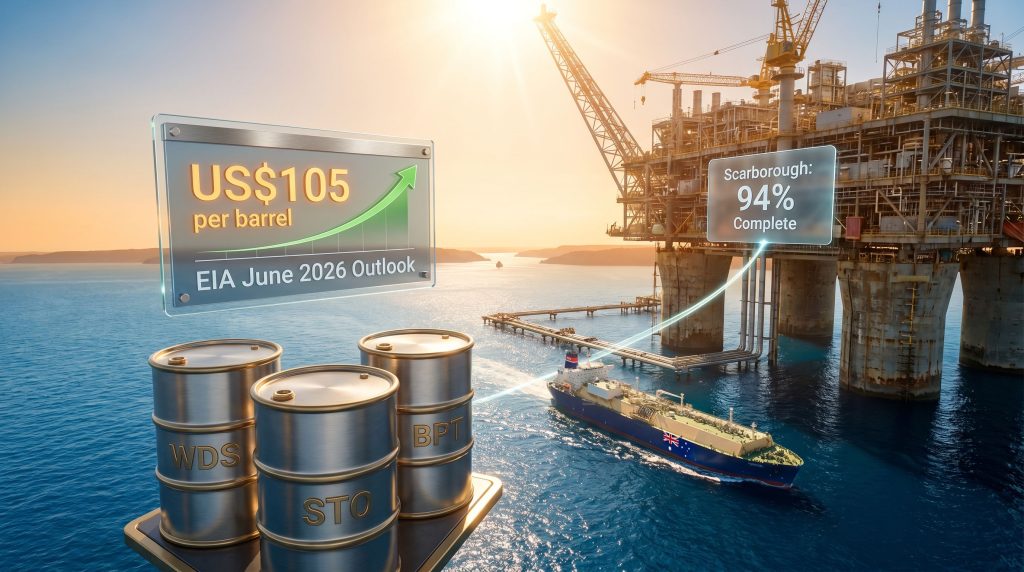
A sharp correction followed in May as ceasefire negotiations introduced the possibility of restored shipping access through the Strait of Hormuz, compressing the geopolitical risk premium embedded in crude prices. That compression was short-lived. By June 2026, oil was climbing again as tensions re-intensified, and the US Energy Information Administration's June 2026 Short-Term Energy Outlook offered a concrete forward reference point: Brent averaging US$105 per barrel across June and July 2026.
The EIA's projection carries an important conditional assumption: that the Strait of Hormuz remains closed to the majority of commercial shipping. This is not a trivial qualifier. Furthermore, as noted in recent analysis of ASX energy stocks, the broader sector has responded decisively to these elevated benchmarks.
"The Strait of Hormuz represents the world's most consequential oil chokepoint. Approximately 20% of global petroleum liquids transit through it annually, meaning any sustained closure structurally tightens supply in a way that cannot be quickly offset by alternative routes or reserve releases."
For context, redirecting supertankers around the southern tip of Africa adds approximately 15 to 20 days of sailing time and meaningfully increases freight costs, effectively acting as a secondary tax on global oil supply even for volumes that successfully bypass the chokepoint.
What the Oil Price Transmission Mechanism Looks Like in Practice
The pathway from a Brent crude price move to ASX energy share performance is more nuanced than a simple correlation. Several transmission layers determine how much of a commodity price uplift reaches reported earnings:
- Hedging ratios: Producers that have locked in future production at fixed prices via derivatives contracts will not capture the full benefit of spot price appreciation until those hedges roll off.
- LNG contract indexation: A substantial portion of LNG is sold under long-term contracts with pricing formulas partially indexed to crude oil benchmarks, often with a lag of one to two quarters. This means the earnings benefit of a crude price spike can take time to materialise in reported revenues.
- Production cost structures: Upstream producers with largely fixed operating cost bases capture a disproportionately high share of incremental revenue as profit. This operating leverage is the core reason energy shares amplify oil price movements.
- Currency exposure: ASX producers sell oil and LNG in US dollars but report in Australian dollars. A strengthening AUD reduces the translated value of USD revenues, partially offsetting crude price gains.
Understanding these layers helps explain why two companies with similar production volumes can report very different earnings outcomes from the same oil price environment.
ASX Energy Shares: A Sector-Wide Sensitivity Map
Not every company classified within the ASX energy sector benefits from rising crude prices. The direction and magnitude of impact depends heavily on where a company sits within the energy value chain.
| Company Type | Oil Price Sensitivity | Primary Mechanism |
|---|---|---|
| Large-cap upstream producers | High | Revenue uplift on fixed cost base |
| Mid-cap oil and gas explorers | Very High | Scale amplifies percentage earnings leverage |
| LNG-focused producers | Moderate to High | Contract indexation with lag effect |
| Downstream refiners | Negative to Neutral | Input cost pressure compresses margins |
| Fuel retailers and distributors | Negative | Inventory cost increases, demand softening |
| Diversified energy companies | Mixed | Depends on upstream versus downstream revenue split |
This asymmetry is a critical point that is frequently overlooked in broad-brush discussions about rising oil prices being uniformly positive for the energy sector. Investors targeting genuine crude price exposure need to concentrate on pure upstream producers with low hedging ratios and production-weighted revenue structures. However, market volatility risks remain a significant consideration regardless of company type.
Woodside Energy Group (ASX: WDS): Australia's Most Direct Large-Cap Oil Price Lever
The Scarborough Transition: From Capital Consumption to Cash Generation
Woodside Energy occupies a structurally distinct position within the ASX energy universe. As Australia's largest listed energy company, it operates across LNG, oil, and natural gas with a production cost base that is largely fixed regardless of commodity prices. This creates the operating leverage that makes Woodside so sensitive to Brent crude movements.
The most significant near-term catalyst for Woodside is the Scarborough LNG project reaching 94% completion as of mid-2026, with first cargo targeted in the fourth quarter of 2026. This milestone matters enormously from an investment analysis perspective: Scarborough marks the transition point from capital-intensive construction, where the project consumes cash, to production-stage operations, where it generates it. The timing of this transition, coinciding with an elevated oil price environment, creates a compounding earnings uplift effect.
Woodside shares reflected this dynamic in real time, touching a three-month high of $25.88 during the week of June 9 to 13, 2026, as crude prices recovered on fresh Middle East escalation.
Dividend Forecasts and the US$100 Threshold
UBS has projected Woodside's FY2026 dividend at approximately 109 US cents per share, with broker commentary indicating that further upside to this estimate depends on oil prices holding above the US$100 per barrel threshold through the second half of the fiscal year. This creates an identifiable price level that investors can monitor as a key variable in the dividend forecast.
The relationship between oil prices and Woodside dividends is not coincidental. Woodside's policy of paying dividends as a percentage of underlying net profit after tax means that sustained revenue uplift from higher crude flows through directly to shareholder returns, with relatively little friction from balance sheet constraints given the company's financial position.
Santos Ltd (ASX: STO): Diversified Growth Across Multiple Production Streams
Barossa, Pikka, and the Multi-Project Growth Story
Santos operates one of the more geographically and operationally diversified production profiles among ASX-listed energy companies, spanning Australian LNG, Papua New Guinea, and now North American conventional oil through its Alaskan operations.
The Barossa LNG project is operating at 75% of its planned 2026 production rate, with plateau production targeted before year-end. Importantly, the incremental volumes coming online as Barossa ramps toward capacity represent production added at the higher end of the current oil price cycle, maximising the revenue captured per unit of new output.
Santos delivered its first oil from the Pikka Phase 1 development in Alaska during late May 2026. The timing of this new production stream entering service during a period of elevated crude prices is a fortuitous alignment of project execution and market conditions, adding volumes that were not present in prior-period comparatives.
In Q1 FY2026, Santos reported sales revenue of $1.27 billion, representing a 3% quarter-on-quarter increase driven by stronger crude realised prices and improved LNG volumes. A sustained oil price above US$100 per barrel through the second half of 2026 would materially improve Santos's free cash flow relative to current consensus estimates. Consequently, this would enhance both dividend capacity and the potential for capital returns.
Why Santos Stands Out as a 2026 Sector Performer
The combination of LNG exposure through Barossa and conventional oil production through Pikka gives Santos a revenue profile that captures crude price upside from multiple directions simultaneously. LNG contract pricing, partially indexed to oil benchmarks with a lag, will reflect the April-June crude spike in reported revenues across Q3 and Q4 2026.
Pikka's spot-exposed oil volumes, meanwhile, capture current prices without the indexation delay. This dual-exposure structure is a less commonly appreciated feature of Santos's earnings architecture that differentiates it from peers whose production mix leans more heavily toward a single commodity stream. In addition, the China demand outlook for LNG remains a key variable in Santos's longer-term revenue projections.
Beach Energy Ltd (ASX: BPT): High-Leverage Mid-Cap Exposure
Production Growth and a Strengthened Financial Foundation
Beach Energy occupies a different position in the ASX energy landscape: smaller in market capitalisation than Woodside or Santos, but offering a higher percentage earnings sensitivity to oil price movements as a result. In Q3 FY2026, Beach reported a 7% quarter-on-quarter production increase to 4.8 million barrels of oil equivalent, demonstrating operational momentum that amplifies the impact of a supportive pricing environment.
The company's balance sheet has been substantially reinforced, with available liquidity reaching $974 million and net gearing declining to just 11%. This financial position provides meaningful resilience against commodity price volatility, a critical consideration given that higher-leverage names tend to experience sharper share price corrections when crude prices pull back.
The Waitsia Gas Plant in Western Australia continues to progress toward full operational capacity, adding domestic gas production that partially diversifies Beach's revenue away from global crude benchmarks.
The Leverage Paradox: Higher Sensitivity, More Complexity
Beach Energy's smaller scale creates what might be called a leverage paradox for investors. On one hand, a given percentage movement in oil prices translates to a proportionally larger earnings impact than it would for Woodside or Santos. On the other hand, Beach's domestic gas exposure in Western Australia operates under contract structures that are not fully indexed to international oil benchmarks.
This partially insulates those revenue streams from global crude movements but also limits the full benefit capture. Furthermore, OPEC's market influence on broader price settings adds another layer of complexity for mid-cap producers navigating the current cycle.
Bell Potter maintains a Hold rating on Beach Energy with a $1.15 price target, with broker analysis noting that production growth is expected to accelerate in FY2027 as capital expenditure commitments ease and free cash flow conversion improves.
The next major ASX story will hit our subscribers first
Side-by-Side: Comparing the Three Major ASX Energy Plays
| Metric | Woodside (WDS) | Santos (STO) | Beach Energy (BPT) |
|---|---|---|---|
| Market Position | Large-cap | Large-cap | Mid-cap |
| Core Exposure | LNG and Oil | LNG, Oil, and Gas | Oil and Domestic Gas |
| Primary 2026 Catalyst | Scarborough first cargo Q4 2026 | Barossa plateau and Pikka oil | Waitsia ramp-up and FY2027 capex easing |
| Q1/Q3 FY2026 Revenue Metric | Share price: 3-month high $25.88 | $1.27B sales revenue, up 3% QoQ | 4.8M BOE production, up 7% QoQ |
| Analyst Stance | Positive, UBS dividend upgrade | Standout 2026 performer | Hold, Bell Potter $1.15 PT |
| Oil Price Leverage | High | High | Very High at smaller scale |
| Balance Sheet | Strong | Strong | $974M liquidity, 11% net gearing |
| Key Risk | Project execution timeline | Barossa ramp-up timing | Domestic gas limits global oil upside |
The Four-Phase Oil Price Impact Cycle for ASX Energy Investors
Understanding where the current environment sits within the broader oil price cycle helps investors calibrate expectations more precisely than reacting to individual price moves.
- Geopolitical Shock Phase: A rapid crude price spike driven by supply disruption fears, typically preceding any confirmation of actual supply impact. ASX energy shares frequently surge ahead of earnings confirmation during this phase as investors price in expected revenue uplift.
- Earnings Confirmation Phase: Higher realised prices begin appearing in quarterly revenue and production reports. Analyst consensus estimates are revised upward, providing a second catalyst for share price appreciation after the initial shock-driven move.
- Sustained Elevation Phase: The market transitions from pricing a temporary shock to incorporating higher oil prices into longer-term earnings models. Forward dividend forecasts increase, valuation multiples can expand, and institutional investors adjust sector weightings.
- Correction or Normalisation Phase: Ceasefire developments, OPEC+ production decisions, demand concerns, or strategic reserve releases can rapidly reverse gains. Higher-leverage, smaller-scale names typically correct more sharply than large-cap producers with diversified portfolios.
The June 2026 environment appears to be transitioning from Phase 1 into Phase 2, with the EIA's US$105 forecast providing a reference point for analyst earnings revisions. Whether Phase 3 materialises depends critically on the geopolitical assumptions underpinning the EIA projection.
Macro Risks That Could Reshape the ASX Energy Outlook
Supply-Side Variables Beyond the Strait of Hormuz
The EIA's US$105 forecast is not a guarantee. Several supply-side variables have the potential to erode the price floor that the Hormuz closure has established:
- OPEC's market influence remains a persistent wildcard. A coordinated output increase from member nations, even a modest one, could rapidly compress the supply premium embedded in current prices.
- The US shale supply response time is shorter than many investors appreciate. At sustained prices above US$90 per barrel, the economic incentive to deploy additional drilling rigs increases substantially, and incremental shale supply can reach markets within six to twelve months of investment decisions.
- Strategic petroleum reserve releases by the United States or International Energy Agency member nations can temporarily suppress spot prices without addressing the underlying supply disruption.
Demand-Side Considerations
On the demand side, the picture is equally complex:
- The China demand outlook is a critical variable, given that it is among the world's largest importers of both LNG and crude oil. Any meaningful slowdown in Chinese industrial activity or property sector activity reduces demand growth projections.
- The Australian dollar's performance against the US dollar directly affects the AUD-denominated revenue that ASX-listed producers report. A strengthening AUD erodes the translated value of USD oil revenues, reducing the domestic earnings benefit of higher crude prices.
- Accelerating energy transition investment in major economies creates a structural question about the ceiling on long-term oil demand, even if near-term fundamentals remain tight.
"Risk Disclosure: Commodity price forecasts, including the EIA's US$105 per barrel projection, are conditional estimates based on specific geopolitical and supply assumptions that can change rapidly and without warning. This article contains general information only and does not constitute personalised financial advice. Investors should consider their individual risk tolerance and financial circumstances before making any investment decisions related to ASX energy shares."
Frequently Asked Questions: ASX Energy Shares and Oil Prices
Why do ASX energy shares typically move in the same direction as oil prices?
ASX-listed upstream producers generate revenue by selling oil, LNG, and natural gas at prices linked to international benchmarks including Brent crude. Because production costs are largely fixed in the short term, revenue increases from higher oil prices flow disproportionately into earnings. This operating leverage is the fundamental mechanism connecting crude price movements to ASX energy share performance.
What is the Strait of Hormuz and why is it so important for Australian energy investors?
The Strait of Hormuz is a narrow waterway between Iran and Oman through which approximately one-fifth of the world's oil supply passes annually. When this chokepoint faces disruption or closure, the resulting supply tightness pushes global crude prices higher in a way that cannot be quickly resolved through alternative shipping routes, given the significant additional distance and cost involved. For ASX energy producers selling oil and LNG at prices benchmarked against Brent crude, sustained Hormuz disruption translates directly into higher realised revenues.
How quickly does a crude price movement appear in ASX energy company earnings?
The timing depends on contract structures and hedging positions. Companies selling oil on spot markets reflect price changes almost immediately in realised revenues. LNG producers with oil-indexed contracts typically experience a one to two quarter lag before higher crude flows through to reported revenues. Companies with significant hedge positions may not capture spot price upside until those contracts expire.
Do all ASX energy shares benefit from higher oil prices?
No. The benefit is concentrated among upstream producers that extract and sell oil and gas. Downstream businesses including refiners, fuel retailers, and transport-heavy operators can face margin compression when crude prices rise. Even within upstream producers, the degree of benefit varies based on hedging coverage, contract structures, production mix, and currency exposure. For instance, market volatility risks can further distort the relationship between crude benchmarks and individual share performance.
What distinguishes Woodside, Santos, and Beach Energy as investment options in a high oil price environment?
Woodside offers large-cap stability combined with a near-term production catalyst through Scarborough's first cargo in Q4 2026, making it the most direct large-cap vehicle for Brent crude exposure on the ASX. Santos provides a more geographically diversified production base spanning Australian LNG and Alaskan oil, with multiple simultaneous growth catalysts. Beach Energy delivers the highest percentage leverage to oil price movements given its smaller scale, but its domestic gas mix limits the full capture of global crude price upside. Analysts tracking ASX energy sector stocks have highlighted all three names as sector standouts in the current cycle.
Key Takeaways for Investors Evaluating ASX Energy Shares and Rising Oil Prices
- The EIA's June 2026 Brent crude forecast of US$105 per barrel for June and July represents a materially supportive pricing environment for ASX upstream energy producers, conditional on Strait of Hormuz closure assumptions holding.
- Woodside, Santos, and Beach Energy each present distinct risk-return profiles differentiated by scale, production mix, hedging exposure, and project timing.
- The Scarborough first cargo (Q4 2026) and Barossa plateau production represent the two most significant near-term earnings catalysts for the sector's two largest names.
- Beach Energy's 7% quarterly production growth and fortified balance sheet position it as a higher-leverage mid-cap option, with meaningful FY2027 free cash flow improvement expected as capital commitments moderate.
- The investment thesis across all three names remains conditional on geopolitical assumptions, particularly Strait of Hormuz dynamics, remaining consistent with the EIA's modelling.
- Currency exposure, LNG contract indexation lags, hedging ratios, and broader ASX market sentiment all modulate the real-world impact of crude price movements on individual share performance.
Investors seeking ongoing analysis of the ASX energy sector can explore additional energy stocks coverage tracking the latest sector developments and company-specific data.
Want to Capitalise on the Next Major ASX Energy or Resource Discovery Before the Broader Market?
Discovery Alert's proprietary Discovery IQ model delivers real-time alerts on significant ASX mineral discoveries, instantly translating complex data into actionable investment opportunities — whether you're a short-term trader or a long-term investor seeking a market-leading edge. Explore how historic discoveries have generated extraordinary returns on Discovery Alert's dedicated discoveries page, and begin your 14-day free trial today to position yourself ahead of the market.