August 14, 2026
Libya's upstream petroleum sector is experiencing unprecedented transformation through comprehensive institutional restructuring designed to capture international investment flows while optimising resource development timelines. The convergence of reformed fiscal terms, substantial geological potential, and major operator interest creates unique market dynamics within Libya's 2025 bid round, which represents a strategic inflection point for continental African energy development.
Furthermore, this initiative occurs alongside broader global market shifts, including oil price dynamics and evolving energy transition challenges that are reshaping international investment priorities across the energy sector.
Libya's National Oil Corporation Strategic Repositioning
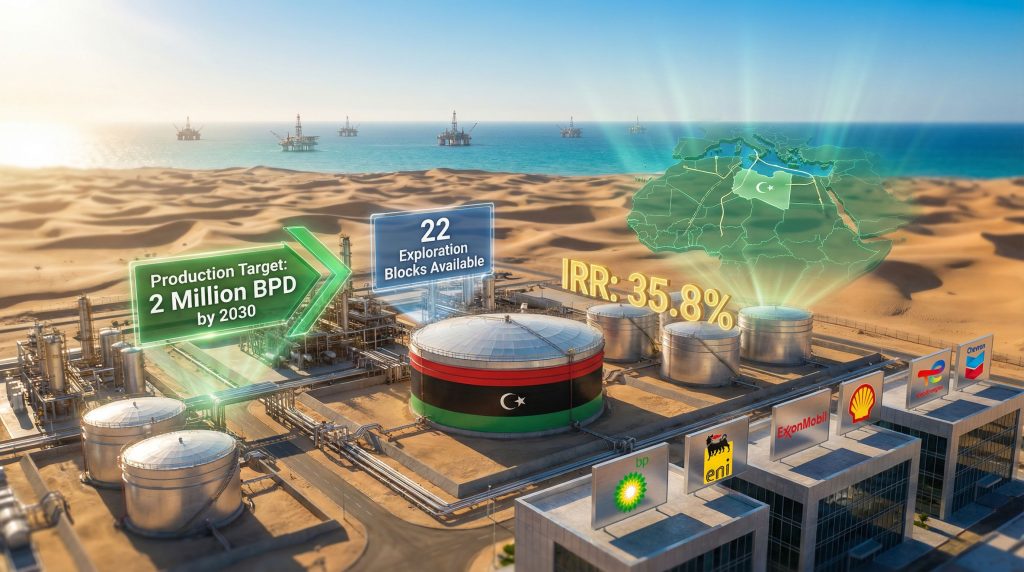
The National Oil Corporation has engineered a comprehensive market re-entry framework targeting production capacity expansion from current 1.4 million barrels per day to 2 million bpd by 2030, representing a 40% increase from existing operational levels. This ambitious growth trajectory requires substantial capital deployment and operational scaling across multiple geological provinces.
Investment requirements for achieving near-term capacity additions are estimated between $3-4 billion, focusing primarily on exploration acceleration and infrastructure optimisation. The strategy necessitates increasing exploration activity to 4-6 times historical drilling pace observed over the past decade, indicating significant operational transformation requirements.
Moreover, these expansion plans must navigate the same oil production challenges facing other major producers globally. The repositioning strategy leverages Libya's proven reserves base of 48 billion barrels and advantageous geographic positioning for Mediterranean market access.
Light, sweet crude oil specifications provide quality premiums supporting competitive pricing against alternative supply sources. This positioning becomes particularly relevant given European energy security diversification requirements and ongoing geopolitical considerations.
Technical infrastructure advantages include established export terminal facilities and existing production systems requiring optimisation rather than complete reconstruction. This operational foundation supports accelerated development timelines compared to greenfield development scenarios in less-established basins.
When big ASX news breaks, our subscribers know first
Fiscal Framework Analysis: EPSA V Competitive Positioning
Libya's revised Exploration and Production Sharing Agreement (EPSA V) framework represents a strategic recalibration toward international operator expectations. The reformed fiscal structure features a 66% state take, positioning Libya competitively within African production sharing regimes while ensuring government revenue security.
Internal Rate of Return Optimisation
Modeled internal rates of return approach 20% under EPSA V terms, representing approximately 8x improvement from previous levels of 2.5%. This substantial enhancement reflects the NOC's acknowledgment that attracting international capital requires risk-adjusted returns comparable to alternative upstream investment opportunities globally.
The fiscal mechanism incorporates standard production sharing agreement components including cost recovery allowances and profit oil split structures. Operators retain approximately 34% of project revenues for cost recovery, reinvestment, and shareholder returns after government take calculations.
Additionally, global tariff market impacts are influencing investment flow patterns worldwide, making competitive fiscal terms increasingly important for attracting international capital.
Global Competitive Analysis
| Jurisdiction | State Take (%) | Typical IRR Range | Risk Profile |
|---|---|---|---|
| Libya (EPSA V) | 66% | 18-22% | High political risk |
| Nigeria | 70-85% | 15-25% | Medium-high risk |
| Angola | 75-90% | 12-20% | Medium risk |
| Kazakhstan | 60-80% | 18-30% | Medium risk |
| Equatorial Guinea | 65-75% | 16-24% | Medium risk |
Risk-adjusted return analysis demonstrates Libya's positioning within competitive parameters, though political risk premiums require careful consideration in investment decision frameworks. Currency devaluation risk and above-ground operational challenges necessitate enhanced due diligence compared to more stable jurisdictions.
Resource Potential Assessment: Libya's 2025 Bid Round
Block Portfolio Composition
Libya's 2025 bid round offers 22 exploration blocks distributed evenly between onshore and offshore acreage. The 50%-50% geographic split provides operators with diverse development options reflecting varying risk-return profiles and technical requirements.
Onshore Blocks (11 total):
- Lower development costs through established infrastructure proximity
- Accelerated time-to-production potential (typically 3-5 years)
- Proven geological formations with established recovery technologies
- Reduced capital intensity compared to offshore alternatives
Offshore Blocks (11 total):
- Higher resource concentration potential in deepwater formations
- Advanced technology requirements for subsea infrastructure
- Extended development timelines (5-8 years for commercial production)
- Capital intensity ranging $500 million to $2+ billion depending on field characteristics
Geological Resource Base
The offered blocks contain an estimated 10 billion barrels of oil in place representing the total resource base across all 22 exploration areas. Additional discovery potential reaches 18 billion barrels, creating a combined resource base of 28 billion barrels for long-term development consideration.
Basin coverage spans three primary geological provinces:
Sirte Basin: Libya's historically largest producing region featuring established infrastructure including pipelines and export terminals at Es Sider and Ras Lanuf. Existing field developments include Sarir, Messla, and Intisar accumulations providing operational benchmarks for new exploration activities.
Ghadames Basin: Cross-border geological formation extending into Tunisia and Algeria, featuring mixed oil and associated gas reserves. Multinational operator presence provides technical expertise and established working relationships with regional authorities.
Murzuq Basin: Less developed geological province with significant exploration upside potential, though remote location creates elevated development costs and infrastructure requirements.
International Operator Positioning Matrix
Tier-1 Company Commitments
Major international operators have demonstrated concrete engagement through formal agreements and operational commitments, validating Libya's improved investment attractiveness. These developments mirror broader trends in exploration licenses impact across global markets.
BP: Signed memorandum of understanding in July 2025 focusing on Sarir and Messla field optimisation combined with exploration opportunities. Portfolio diversification strategy targets Mediterranean market access while leveraging existing African upstream expertise.
ExxonMobil: Secured development rights in August 2025 with strategic focus on offshore gas development potential. LNG export positioning aligns with integrated gas-to-power strategy and Mediterranean regional expansion objectives.
Eni: Maintains operational presence through Ghadames Basin drilling programmes, leveraging historical relationships and technical familiarity with local operational environments.
Shell: Currently evaluating participation opportunities with focus on Atshan field development potential and multi-basin exploration positioning.
TotalEnergies: Pre-qualified bidder status enables formal bid submission for 2025 licensing round, supporting African portfolio expansion strategy.
Chevron: Expressed strategic interest while maintaining evaluation phase status, preserving option value pending political risk assessment completion.
Strategic Rationale Analysis
Tier-1 operator participation signals market confidence that political risks are manageable within current risk-reward parameters. However, operators maintain cautious positioning with pilot project approaches and limited initial investment commitments pending governance clarity improvements.
Risk mitigation strategies include enhanced political risk insurance coverage, local partnership structures with regional entities, and phased development approaches. Consequently, these allow incremental commitment scaling based on operational experience and political stability progress.
Geopolitical Risk Assessment Framework
Political Fragmentation Dynamics
Libya's divided governmental structure creates operational complexity requiring coordination between competing authorities. Eastern Libya, controlled by the Libyan National Army (LNA), contains the majority of offered exploration blocks, necessitating relationships with both Tripoli-based National Oil Corporation authorities and regional governmental entities.
Western Libya, under Government of National Accord (GNA) influence, features limited block exposure in the current licensing round. However, it maintains control over key export infrastructure and international banking relationships critical for revenue flows.
Above-Ground Risk Factors
Payment Reliability: Historical challenges with government payment obligations to international contractors require enhanced financial structuring and payment guarantee mechanisms.
Infrastructure Vulnerability: Production facilities and pipeline systems remain susceptible to militia activities and political disputes. This creates operational disruption risks requiring comprehensive insurance coverage and security protocols.
Institutional Coordination: Competing governmental authorities create regulatory uncertainty requiring legal framework clarification and dispute resolution mechanism establishment.
Operational Security: Enhanced personnel and asset protection requirements increase operational costs and limit geographic accessibility for certain exploration areas.
Risk Mitigation Approaches
International operators employ several strategies to manage above-ground risks:
- Phased Investment Structures: Initial limited capital deployment with expansion contingent on operational success and stability improvements
- Insurance Premium Adjustments: Elevated political risk coverage including contract frustration and currency inconvertibility protection
- Local Partnership Integration: Joint venture arrangements with established regional operators and government entities
- Diversified Geographic Exposure: Portfolio approaches spreading risk across multiple blocks and geological provinces
Production Capacity Expansion Timeline Analysis
Development Acceleration Requirements
Achieving Libya's 2030 production target of 2 million bpd requires systematic capacity building across multiple operational dimensions. Current production levels of 1.4 million bpd must increase by 600,000 bpd over five years, representing 120,000 bpd annual additions on average.
Exploration Scaling: The required 4-6x acceleration in drilling activity demands substantial service sector capacity expansion. This includes drilling rig availability, specialised personnel deployment, and technical service provider mobilisation.
Infrastructure Development: Pipeline capacity, processing facilities, and export terminal throughput require coordinated expansion supporting increased production volumes. Investment priorities include compression stations, gathering systems, and storage facility optimisation.
Workforce Development: Technical skills development and international expertise integration become critical bottlenecks requiring training programmes, expatriate personnel deployment, and knowledge transfer initiatives.
Technology Implementation: Advanced recovery techniques and drilling technologies must be deployed systematically across both existing fields and new development projects to optimise resource extraction efficiency.
Realistic Timeline Assessment
Industry observers note that achieving production targets depends on sustained progress across multiple fronts simultaneously. Operational scaling of this magnitude typically requires 7-10 years in stable operational environments, suggesting Libya's five-year timeline represents an aggressive but potentially achievable goal with optimal execution.
Critical path dependencies include exploration success rates, development project execution timelines, and infrastructure bottleneck resolution. For instance, political stability maintenance becomes essential for sustaining long-term operational continuity required for capacity expansion success.
The next major ASX story will hit our subscribers first
Global Supply Chain Integration Strategy
Strategic Market Positioning
Libya's geographic advantages create compelling value propositions for international energy markets. Mediterranean proximity enables direct pipeline access to European consumption centres, reducing transportation costs and delivery timelines compared to alternative supply sources.
Quality Premium Advantages: Light, sweet crude oil specifications (low sulphur content and high API gravity) command premium pricing in global markets. This becomes particularly relevant for refined product optimisation in European refineries.
Logistics Efficiency: Established export terminals at major ports including Es Sider, Ras Lanuf, and Brega provide immediate market access. Furthermore, these facilities require no new infrastructure construction for basic export operations.
Reserve Base Sustainability: 48 billion barrels in proven reserves support long-term production commitments enabling multi-decade supply agreements with European and global customers.
European Energy Security Integration
Libya's strategic positioning becomes increasingly relevant within European energy diversification objectives. Reduced dependence on Russian energy supplies creates market opportunities for North African producers capable of sustained, reliable production volumes.
LNG Development Potential: Offshore gas discoveries support potential LNG export project development, complementing crude oil exports with integrated energy supply capabilities.
Renewable Energy Synergies: Libya's exceptional solar energy potential creates opportunities for enhanced oil recovery applications and integrated energy development supporting both hydrocarbon production and renewable energy export potential.
Regional Integration: Cross-border pipeline infrastructure with neighbouring countries enables regional energy hub development. Consequently, this expands Libya's strategic importance beyond bilateral supply relationships.
Critical Success Factor Analysis
Institutional Reform Priorities
Governance Stabilisation: Unified petroleum sector oversight requires coordination between competing governmental authorities and establishment of clear regulatory frameworks supporting consistent policy implementation.
Legal Framework Clarity: Contract sanctity protection and dispute resolution mechanisms must provide international operators with confidence in long-term investment security and operational predictability.
Revenue Management Transparency: Petroleum revenue allocation systems require transparent accounting and distribution mechanisms building public trust and reducing political tension over resource wealth distribution.
Security Infrastructure Development: Operational asset protection capabilities must be enhanced through professional security force development and coordination with international operators' security requirements.
Investment Confidence Indicators
Market participants monitor several key metrics for assessing Libya's upstream revival progress:
Contract Award Timeline: Successful completion of Libya's 2025 bid round with major operator participation demonstrates institutional capacity and market confidence validation.
Operator Commitment Levels: Scale of initial development investments and operational expansion indicate private sector confidence in long-term stability and commercial viability.
Production Growth Trajectory: Achievement of near-term capacity milestones provides tangible evidence of operational execution capability and infrastructure optimisation success.
Political Stability Metrics: Sustained governmental cooperation and conflict resolution demonstrate institutional maturation supporting long-term investment planning.
Strategic Assessment: Libya's Market Re-Entry Window
Libya's 2025 bid round represents a calculated strategic attempt to leverage improved fiscal terms and substantial resource potential for re-establishing international upstream investment flows. The initiative's success depends fundamentally on sustained progress in governance reform, security stabilisation, and institutional capacity building to convert geological potential into operational reality.
The convergence of competitive economics, major operator interest, and strategic resource positioning creates a unique opportunity for Libya to reclaim its position as a significant global petroleum supplier. However, realisation of this potential remains contingent on effective management of above-ground risk factors that have historically constrained the country's energy sector development.
Investment Consideration: Libya's upstream revival represents both substantial opportunity and elevated risk requiring sophisticated due diligence and risk management approaches. Potential investors should carefully evaluate political risk insurance options, phased investment structures, and local partnership strategies before committing capital to Libyan upstream projects.
International operators' engagement patterns suggest cautious optimism balanced against realistic assessment of operational challenges. Success in Libya's 2025 bid round could catalyse broader North African energy sector investment, while failure to execute effectively may reinforce investor scepticism regarding frontier market upstream opportunities.
In addition, industry analysis from Bloomberg highlights the balance between Libya's substantial reserves and ongoing political complexities. Similarly, World Oil reports on how fiscal reforms are attracting renewed international interest despite persistent risks.
The strategic window for Libya's energy sector transformation remains open but requires sustained institutional progress and operational execution to convert potential into performance. Market participants will monitor concrete progress indicators over the coming 18-24 months to assess whether Libya can successfully transition from resource potential to operational reality in global energy markets.
Ready to capitalise on emerging energy investment opportunities?
Discovery Alert's proprietary Discovery IQ model delivers real-time notifications on significant ASX mineral discoveries, empowering investors to identify actionable opportunities in the resources sector ahead of the broader market. Begin your 30-day free trial today to position yourself strategically as global energy dynamics continue reshaping investment landscapes.