June 5, 2026
North Africa's Energy Reset: Why Libya's Moment Has Finally Arrived
Across the global upstream investment landscape, few narratives have been as persistently complex as Libya's. For more than a decade, the country's vast hydrocarbon endowment sat largely underutilised, caught between competing political factions, deteriorating infrastructure, and the hesitancy of international capital. Yet something measurable has changed. Production has stabilised. Licensing frameworks have been reactivated. And a structured, institutionally endorsed summit has emerged as the arena where ambitions are being tested against execution capacity.
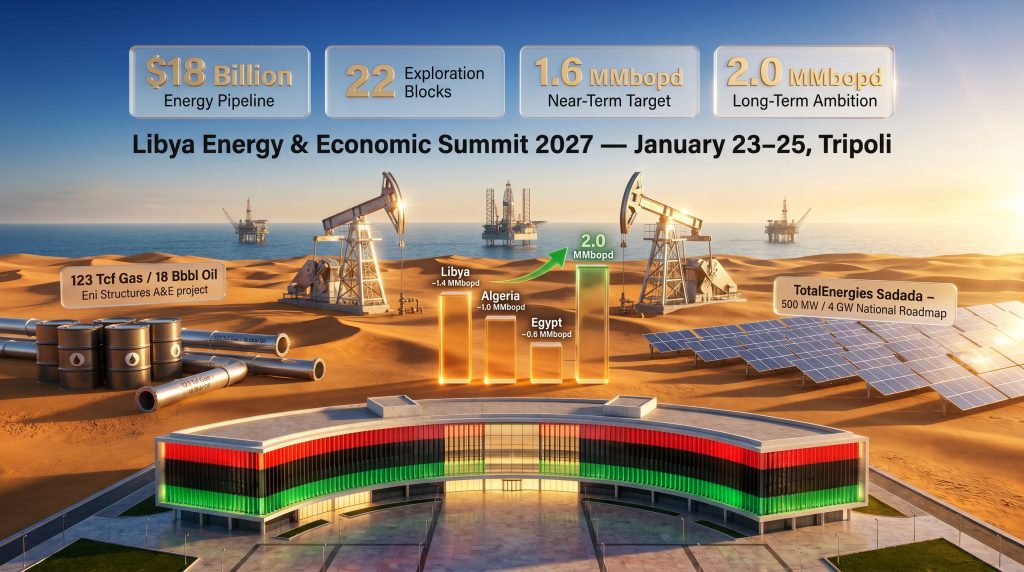
The Libya Energy and Economic Summit 2027 is not simply another regional energy conference. It represents the fifth iteration of a process that has progressively shifted from diplomatic positioning to transactional delivery. The 2026 edition of the summit established an estimated $18 billion pipeline of energy and infrastructure projects, effectively converting Libya's recovery narrative into a concrete investment thesis. What happens in January 2027 at the Tripoli International Convention Center will determine whether that thesis holds.
For investors, policymakers, and energy executives assessing North African hydrocarbons, understanding what LEES 2027 is, what it contains, and what it demands is no longer optional background reading. It is foundational analysis.
When big ASX news breaks, our subscribers know first
What Is the Libya Energy and Economic Summit 2027?
Event Architecture and Institutional Foundations
The Libya Energy and Economic Summit 2027 is the fifth annual gathering of its kind, scheduled to take place from January 23 to 25, 2027, at the Tripoli International Convention Center in Libya's capital. The summit carries direct institutional endorsement from the National Oil Corporation (NOC) of Libya and the Ministry of Oil and Gas, with the Renewable Energy Authority of Libya (REAOL) serving as an institutional partner for the renewables-focused agenda.
The event's thematic architecture spans five core pillars:
- Upstream hydrocarbon development and licensing progression
- Gas monetisation and large-scale offshore infrastructure
- Power generation capacity and grid integration
- Energy transition pathways including solar and independent power structures
- Human capital formation and workforce localisation
How LEES 2027 Differs From Its Predecessors
Each preceding edition of the summit has served a distinct strategic function. Earlier iterations focused heavily on restoring investor confidence and re-establishing diplomatic engagement with international oil companies (IOCs) following years of political disruption. The 2026 summit marked a turning point, shifting the conversation from strategic intent to project-level delivery.
LEES 2027 inherits that momentum but operates under a fundamentally different mandate: execution accountability. The question is no longer whether Libya is open for investment. It is whether the institutional machinery to deliver on that openness is functioning at the required scale and speed.
"LEES 2027 will serve as the sector's execution benchmark, converting licensing frameworks, infrastructure commitments, and production targets into operational outcomes across hydrocarbons, power generation, and next-generation energy systems." (World Oil, June 2026)
What Is the $18 Billion Energy Pipeline at the Centre of LEES 2027?
Breaking Down Libya's Project Pipeline by Sector and Scale
The $18 billion figure associated with LEES 2026 outcomes represents one of the most significant aggregations of energy investment commitments in North Africa in recent memory. For LEES 2027, the agenda is focused on advancing these projects from the commitment stage to execution milestones. Furthermore, understanding the crude oil trends shaping global markets provides essential context for evaluating Libya's positioning within this pipeline.
| Sector | Key Project or Initiative | Estimated Value or Scale |
|---|---|---|
| Upstream Oil and Gas | NOC 2026 licensing round, 22 exploration blocks | Multi-billion USD |
| Offshore Gas Infrastructure | Eni Structures A&E offshore development | $8 billion |
| Unconventional Resources | Chevron-linked basin studies across Sirte, Murzuq, Ghadames | 123 Tcf gas / 18 Bbbl oil (exploration estimate) |
| Renewable Energy | TotalEnergies Sadada solar project | 500 MW (part of 4 GW national roadmap) |
| Annual Drilling Investment Target | Unified drilling regulation framework | $3 to $4 billion per year |
What This Pipeline Signals for Foreign Direct Investment
The diversity of the pipeline is strategically important. Libya is not presenting itself solely as an oil-dependent frontier market. The simultaneous advancement of offshore gas, unconventional resource studies, and renewable energy projects reflects an attempt to position the country as a multi-vector energy economy capable of accommodating different investor risk profiles and sectoral expertise.
For IOCs with offshore deepwater capabilities, the Eni precedent offers a live reference point for what large-scale capital commitment looks like in the Libyan context. For independent operators with exploration-focused mandates, the 22-block licensing round represents an entry point that has not been available since 2009. For infrastructure and power investors, the solar roadmap and independent power purchase agreement (IPPA) structures offer a separate but complementary opportunity set.
Infrastructure Bottlenecks That Could Constrain Capital Deployment
No honest assessment of the $18 billion pipeline can avoid the structural constraints that have historically limited Libya's ability to convert project announcements into production reality. Key constraints include:
- Pipeline integrity issues across the eastern network serving Libya's largest producing fields
- Export terminal capacity limitations at Es Sider and Ras Lanuf, which require sustained rehabilitation investment
- Midstream underdevelopment that creates a gap between upstream production potential and actual export volumes
- Grid infrastructure limitations that complicate the integration of utility-scale solar projects into national power systems
These are not insurmountable obstacles, but they are sequencing challenges. Capital deployed upstream cannot be fully monetised without corresponding midstream and export infrastructure investment, a dynamic that LEES 2027 will need to address directly in its discussions of infrastructure bottlenecks and field optimisation.
How Is Libya's Upstream Oil Sector Being Restructured Ahead of LEES 2027?
The NOC's 2026 Licensing Round: A Historic Reopening
The single most consequential regulatory development in Libya's recent upstream history is the 2026 licensing round, which introduced 22 onshore and offshore exploration blocks. This represents the country's first competitive licensing process in 17 years, spanning the period of significant political disruption that followed 2011.
The significance of this milestone extends beyond the number of blocks on offer. It signals that the institutional infrastructure required to manage a competitive licensing process, including the NOC's technical evaluation capacity, legal framework alignment, and ministerial coordination, has been sufficiently reconstituted to function at international standards.
Drilling Mandates and What 70 to 100 New Wells Per Year Means Operationally
Alongside the licensing round, Libya has established a mandate to drill between 70 and 100 new wells annually. Contextualising this figure is important for investors assessing the operational scale required to achieve it.
Sustaining 70 to 100 wells per year requires:
- A reliable fleet of drilling rigs, both onshore and offshore, with sufficient contracted availability
- Consistent supply chain logistics for drilling consumables, casing, and completion equipment
- Qualified personnel to operate across multiple simultaneous well programmes
- Regulatory processing capacity within the NOC to approve and oversee well programmes in near-real time
The unified drilling regulations announced in 2026 were specifically designed to address the fiscal predictability and contract execution efficiency required to attract and retain the drilling contractors and service companies needed to sustain this activity level.
Seismic Data and the Transition From Rights to Development
A major focus for LEES 2027 will be evaluating the initial seismic results from exploration blocks awarded during the 2026 licensing round. In upstream exploration, the transition from exploration rights to active development phases typically follows a defined technical sequence: acquisition of 2D or 3D seismic data, processing and interpretation, identification of drillable prospects, well permitting, and spud. LEES 2027 provides the first formal forum to assess how far along this sequence the newly licensed blocks have progressed, offering investors a data-informed view of which opportunities are closest to drill-ready status.
What Are Libya's Oil Production Targets and Can They Be Achieved?
Current Output and the Production Growth Pathway
Libya's production baseline and target trajectory can be summarised as follows:
| Milestone | Production Level | Timeframe |
|---|---|---|
| Stabilised 2026 output | Approximately 1.4 MMbopd | Current |
| Near-term target | 1.6 MMbopd | Short to medium term |
| Long-term strategic ambition | 2.0 MMbopd | Long term |
Reaching 1.6 MMbopd from a 1.4 MMbopd baseline requires a 14.3% production increase. Achieving the 2.0 MMbopd ambition would represent a 42.9% uplift from current levels, a substantial operational challenge even under optimal political and infrastructure conditions. Consequently, monitoring oil price movements remains critical for understanding how global market dynamics could influence Libya's production economics.
Libya's Position Within the North African Producer Landscape
Understanding Libya's production ambitions requires contextualising them against regional peers:
| Country | Current Production (approx.) | Key Constraint | Upside Scenario |
|---|---|---|---|
| Libya | ~1.4 MMbopd | Infrastructure gaps and political risk | 2.0 MMbopd long term |
| Algeria | ~1.0 MMbopd | Mature field decline rates | Moderate gas upside |
| Egypt | ~0.6 MMbopd | Reservoir depletion in key fields | Offshore exploration potential |
Libya's technical upside is materially larger than either Algeria or Egypt, reflecting both its greater proven reserve base and the relative underdevelopment of its fields during periods of conflict. However, translating technical potential into produced and exported barrels requires the midstream investment and political continuity that has been inconsistently available throughout the past decade.
Gas Monetisation: Why Libya's Offshore and Shale Resources Could Reshape Mediterranean Energy Supply
Eni's $8 Billion Structures A&E Project
The most advanced large-scale gas project currently progressing in Libya is Eni's offshore Structures A&E development, a project valued at approximately $8 billion that remains on track for completion by late 2027. This project is significant not only for its scale but for what it demonstrates about the conditions under which major IOCs are willing to commit capital to Libyan developments.
Eni's continued engagement reflects a calculated risk-adjusted assessment that Libya's gas resources, combined with the country's geographic proximity to European markets, justify the operational and political risk premium embedded in Libyan upstream investment. The project will also provide practical insights into contract execution efficiency under the country's updated regulatory framework, making its completion milestones closely watched by other IOCs assessing entry.
Libya's Unconventional Resource Base: Scale and Context
"Preliminary basin studies linked to Chevron's research activities suggest that Libya's key sedimentary formations, including the Sirte, Murzuq, and Ghadames basins, may hold combined estimated resources of approximately 123 trillion cubic feet of natural gas and 18 billion barrels of oil. These figures represent exploration-stage estimates and remain subject to technical validation." (World Oil, June 2026)
To contextualise the magnitude of these figures: 123 trillion cubic feet of natural gas would rank among the largest individual country gas resource discoveries reported in the past decade if confirmed through drilling. The Ghadames Basin alone has geological analogues to producing Palaeozoic formations found across North Africa, while the Sirte Basin's carbonate and sandstone reservoirs have historical precedent as significant hydrocarbon producers.
It is critical to emphasise that these are exploration-stage resource estimates, not proved reserves. Converting estimated resources to proved reserves requires systematic drilling, flow testing, and reservoir characterisation, a multi-year technical process. Investors should treat these figures as indicative of geological prospectivity rather than bankable production forecasts.
Libya's Strategic Position in European Energy Security
Libya's geographic location places it within pipeline and LNG shipping distance of Southern European markets that have been actively seeking to diversify away from Russian hydrocarbon dependency since 2022. This structural demand dynamic creates a medium-term market pull for Libyan gas development that did not exist at the same intensity during earlier phases of the country's oil sector recovery.
In addition, tracking natural gas price trends across global markets helps clarify the commercial viability of bringing Libyan offshore gas to European buyers. The potential for LNG export infrastructure development, while not yet the primary focus of LEES 2027 discussions, represents a longer-horizon opportunity that would materially expand Libya's gas monetisation options beyond the existing pipeline connection to Italy via the Greenstream pipeline.
The next major ASX story will hit our subscribers first
What Role Does Renewable Energy Play in Libya's Long-Term Energy Strategy?
Libya's 4-GW Solar Roadmap: Ambition and Implementation Reality
Libya's renewable energy strategy is anchored by a national target of 4 gigawatts of installed solar capacity, with the TotalEnergies Sadada project serving as the primary execution vehicle at 500 MW. The Renewable Energy Authority of Libya provides institutional oversight for the renewables programme, reflecting the government's recognition that energy transition goals require dedicated regulatory infrastructure separate from the NOC's hydrocarbon mandate.
Key implementation parameters for the solar programme include:
- National solar capacity target: 4 GW
- Anchor project: TotalEnergies Sadada, 500 MW
- Institutional oversight body: Renewable Energy Authority of Libya (REAOL)
- Investment structure: Independent power purchase agreements (IPPAs)
- 2027 focus areas: Financial close milestones and construction timeline confirmation
Balancing Hydrocarbon Export Revenue With Domestic Energy Transition Priorities
Libya's energy transition context differs fundamentally from that of European or North American economies. The primary motivation for domestic renewable deployment is not carbon reduction in isolation but rather freeing up hydrocarbon volumes for export by substituting domestically consumed oil and gas with solar power. Libya's power sector currently relies heavily on oil products for electricity generation, creating an inefficient domestic consumption loop that reduces the volume available for higher-value export.
Furthermore, renewable energy solutions adopted in adjacent resource sectors offer instructive parallels for how Libya might accelerate its solar deployment at scale. A successful 4 GW solar deployment programme could theoretically liberate several hundred thousand barrels per day of oil equivalent from domestic power generation, redirecting it toward export revenue. This makes the renewable energy programme strategically complementary to Libya's hydrocarbon production ambitions rather than in tension with them.
How Is Libya Building the Human Capital Required for Long-Term Energy Sector Growth?
The Energy JEEL Initiative: Workforce Development at National Scale
One of the less prominently discussed but operationally critical elements of Libya's energy sector strategy is the Energy JEEL initiative, a nationally coordinated workforce development programme that has delivered structured training to more than 900 participants aged 15 to 35 across disciplines including petroleum engineering, digital systems, and energy operations.
The programme's design reflects a deliberate attempt to address a structural vulnerability in Libya's long-term energy ambitions: the dependency on expatriate technical expertise that creates operational fragility and increases project costs. By building a domestically trained talent pipeline, the Energy JEEL initiative aims to progressively increase the proportion of Libyan nationals in technically demanding upstream and power sector roles.
Why Workforce Localisation Matters for Foreign Investors
For international investors conducting due diligence on Libyan energy projects, workforce localisation programmes are not simply a corporate social responsibility consideration. They are a risk mitigation factor with direct bearing on:
- Long-term project sustainability when expatriate mobility is constrained by security conditions
- Compliance with localisation requirements embedded in NOC production sharing agreements
- The availability of technically qualified counterpart staff within state institutions for contract administration
- Community relations management in areas where large-scale energy projects operate
A maturing domestic talent base reduces several of the soft risk factors that have historically caused international investors to apply elevated discount rates to Libyan project valuations.
What Should International Energy Investors Expect from LEES 2027?
Due Diligence Priorities and Entry Point Analysis
Investors approaching the Libya Energy and Economic Summit 2027 should structure their analytical framework around three distinct risk-return profiles:
- Upstream exploration: High geological upside, elevated political and execution risk, long capital cycle, but potentially transformative returns if resource estimates are validated through drilling
- Brownfield production enhancement: Medium risk profile, shorter payback periods, dependent on infrastructure rehabilitation and stable NOC operating partnerships
- Renewable energy and power generation: Longer-term contracted revenue under IPPA structures, lower geological risk but exposed to grid integration and regulatory completion risk
Regulatory Clarity as the Central Investor Concern
The consistent theme across all three entry point categories is the centrality of regulatory clarity. Libya's new unified drilling regulations, the reactivated licensing framework, and the IPPA structures for renewable energy all represent attempts to provide the institutional certainty that international capital requires before committing to multi-year investment programmes. LEES 2027 will be observed closely for evidence of whether these frameworks are being implemented consistently or whether execution gaps are already emerging.
Moreover, the broader geopolitical risk landscape affecting resource investment across the region provides important context for how Libya's institutional progress will be assessed by global capital allocators.
Strategic Scenario Modelling: Three Investment Outcomes from LEES 2027
Libya's investment trajectory is not binary. The range of plausible outcomes from LEES 2027 and its aftermath can be captured in three distinct scenarios, each with different implications for capital allocation decisions:
| Scenario | Probability Driver | Production Outcome | Investment Implication |
|---|---|---|---|
| Execution Acceleration | Regulatory unity combined with sustained IOC commitment | Approaches 1.6 MMbopd by 2028 | High FDI inflow, strong licensing uptake across sectors |
| Partial Delivery | Midstream bottlenecks and infrastructure delays persist | Stabilises near 1.4 to 1.5 MMbopd | Selective sector entry with risk-adjusted return expectations |
| Geopolitical Disruption | Political fragmentation re-emerges, institutional continuity breaks | Output declines below 1.3 MMbopd | Capital withdrawal and project deferral across all sectors |
Scenario 1: Execution Acceleration
This scenario requires simultaneous progress across multiple dimensions: the 22-block licensing round converting to active drilling programmes, the unified regulations demonstrating fiscal predictability in practice, Eni's Structures A&E project completing on schedule, and the TotalEnergies Sadada project reaching financial close. Each of these milestones is individually achievable; the challenge is delivering them concurrently.
Scenario 2: Partial Delivery
The most analytically probable near-term outcome, partial delivery, reflects the reality that infrastructure rehabilitation and midstream development typically lag upstream licensing progress by 18 to 36 months. In this scenario, Libya demonstrates credible institutional progress at LEES 2027 but falls short of its production targets due to bottlenecks that require additional capital cycles to resolve.
Scenario 3: Geopolitical Disruption
This scenario cannot be dismissed given Libya's history, but it should be assessed against the current structural incentives for political stability: the substantial revenue that oil production generates for all major Libyan institutional actors, the international pressure from both European energy security interests and IOC capital deployment commitments, and the growing domestic workforce with a direct economic stake in sector continuity.
Frequently Asked Questions: Libya Energy and Economic Summit 2027
When and Where Is the Libya Energy and Economic Summit 2027 Being Held?
The fifth edition of LEES takes place from January 23 to 25, 2027, at the Tripoli International Convention Center in Tripoli, Libya. Those wishing to participate can find full attendance details on the official summit website.
Who Endorses and Organises LEES 2027?
The summit carries direct institutional endorsement from Libya's National Oil Corporation (NOC) and the Ministry of Oil and Gas, with the Renewable Energy Authority of Libya serving as an institutional partner for the renewables-focused agenda components.
What Is the Total Value of Energy Projects Under Discussion at LEES 2027?
The summit's project pipeline is estimated at approximately $18 billion, spanning upstream hydrocarbons, offshore gas infrastructure, solar energy development, and associated midstream investment requirements.
How Many Exploration Blocks Were Introduced in Libya's 2026 Licensing Round?
The NOC's 2026 licensing round introduced 22 onshore and offshore exploration blocks, representing Libya's first competitive licensing process in 17 years.
What Are Libya's Oil Production Targets?
Libya's near-term production target is 1.6 million barrels per day, with a long-term strategic ambition of reaching 2.0 million barrels per day from a 2026 baseline of approximately 1.4 million barrels per day.
What Is the Energy JEEL Initiative?
Energy JEEL is a nationally coordinated workforce development programme that has trained more than 900 young Libyans aged 15 to 35 in engineering, digital systems, and energy operations, establishing a talent pipeline aligned with Libya's long-term industrial and energy sector expansion agenda.
What Is the Annual Drilling Investment Target for Libya's Upstream Sector?
Following the introduction of unified drilling regulations in 2026, Libya is targeting $3 to $4 billion in annual drilling investment, supported by a mandate to drill between 70 and 100 new wells per year.
LEES 2027 as Libya's Operational Credibility Test
Why 2027 Is the Year That Commitments Must Become Outcomes
The Libya Energy and Economic Summit 2027 arrives at a moment when the gap between stated ambition and demonstrated execution is becoming the central question for international capital. The pipeline is established. The licensing framework is active. The regulatory architecture is in place. What 2027 demands is evidence.
Investors who have been tracking Libya's trajectory since the 2026 summit will arrive at Tripoli in January asking whether seismic results have validated exploration blocks, whether drilling contractor commitments have been secured under the unified regulations, whether Eni's Structures A&E project is progressing toward its completion timeline, and whether the TotalEnergies solar project has reached financial close milestones.
Each of these questions has a verifiable answer, and that accountability is precisely what distinguishes LEES 2027 from its predecessors. For those wishing to review the full scope of the summit's agenda, the official summit overview provides comprehensive programme and speaker information.
The Broader Significance Within Africa's Energy Investment Landscape
Libya's trajectory at LEES 2027 carries implications that extend well beyond its own borders. North Africa as a region is competing for upstream capital against deepwater West Africa, the Permian Basin, and emerging East African gas plays. Libya's ability to demonstrate credible, scalable execution will influence how global energy investors calibrate their risk tolerance for the broader region.
A successful LEES 2027, defined by measurable progress across upstream licensing, gas monetisation, renewable energy, and human capital development, would signal to global capital markets that Libya has crossed the threshold from a high-risk frontier market to a structurally investable upstream destination. That reclassification, if earned, would be one of the most consequential developments in North African energy in the past two decades.
This article is intended for informational purposes only and does not constitute financial or investment advice. All production figures, resource estimates, and project valuations are sourced from publicly available industry reporting and represent the most current available data at the time of writing. Exploration-stage resource estimates for unconventional formations should not be interpreted as proved reserves. Investors should conduct independent due diligence and seek qualified professional advice before making investment decisions related to any projects or markets discussed herein.
For further analysis of Libya's upstream energy developments and the broader investment landscape for North African hydrocarbons, World Oil provides ongoing coverage of upstream industry trends, licensing developments, and regional energy economics across Africa and the Middle East. Visit worldoil.com for additional industry reporting.
Want to Identify the Next Major Resource Discovery Before the Broader Market Does?
While Libya's $18 billion energy pipeline signals the scale of opportunity emerging across the global resources sector, Discovery Alert's proprietary Discovery IQ model delivers real-time alerts on significant ASX mineral discoveries, instantly translating complex resource data into actionable investment insights. Explore historic discoveries and their remarkable returns to understand what early positioning in a major find can mean for a portfolio, then begin your 14-day free trial to ensure you never miss a market-moving announcement.