June 22, 2026
Libya's Oil Power Dynamics: How Competing Authorities Sustain Production Through Strategic Balance
Libya's hydrocarbon industry operates within a unique framework where political fragmentation paradoxically creates operational stability. This counterintuitive dynamic emerges from carefully calibrated economic dependencies that transcend traditional governance structures, offering valuable insights for understanding resource management in politically divided states.
The North African nation's energy sector demonstrates how competing power centres can maintain production continuity through sophisticated informal coordination mechanisms. Rather than requiring political reconciliation, Libya's oil power dynamics thrive on a system of mutual deterrence where disruption threatens all stakeholders equally.
When big ASX news breaks, our subscribers know first
Understanding Libya's Institutional Power Balance Framework
Libya's energy landscape operates through three primary institutional pillars that maintain operational continuity despite political division. The western-based government controls financial mechanisms through the Central Bank and foreign exchange systems, while eastern military leadership maintains security over key production facilities. The National Oil Corporation serves as the technical bridge between these competing authorities.
This institutional architecture creates what energy analysts describe as a sophisticated equilibrium system. Western Libya's control over financial institutions generates dependency relationships with eastern regions that control major production assets and export terminals. The arrangement functions through practical necessity rather than formal agreement.
Key Institutional Control Points:
• Central Bank operations managing currency flows and international banking relationships
• Foreign exchange window mechanisms controlling hard currency access
• National Oil Corporation technical operations maintaining production scheduling independence
• Export terminal security coordination through eastern command structures
The system operates through what industry observers term "crude-in-kind arrangements" and parallel commercial channels that allow both authorities to access oil value outside standard fiscal frameworks. This creates natural stabilisation mechanisms where excessive pressure from either side triggers proportional counter-responses.
Production Recovery Metrics and Strategic Capacity Expansion
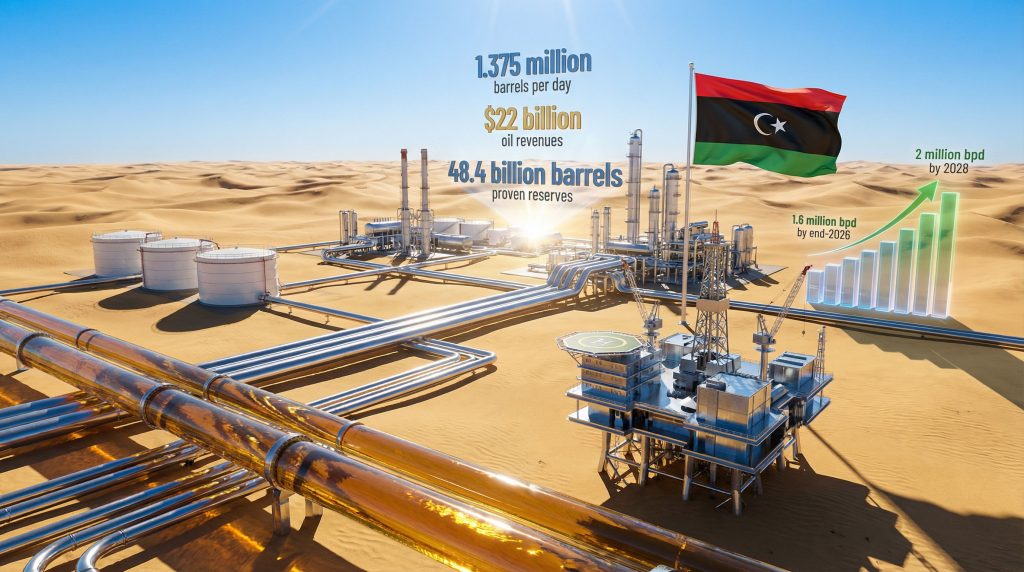
Libya achieved significant production milestones in 2025, reaching 1.375 million barrels per day – representing the highest sustained output levels since 2013. This recovery demonstrates the resilience of informal coordination mechanisms that enable technical operations to continue despite ongoing political divisions.
Current Production Performance Indicators:
| Metric | 2025 Achievement | Future Target |
|---|---|---|
| Daily Production | 1.375 million bpd | 1.6 million bpd (end-2026) |
| Annual Revenue | $22 billion | Projected growth |
| Monthly Revenue | $371 million (Jan 2026) | Sustained levels |
| Proven Reserves | 48.4 billion barrels | Africa's largest |
| Development Wells | 70-100 planned (2026) | Capacity expansion |
The production recovery stems from several technical factors including field rehabilitation programmes, new well development initiatives, and international partnership agreements. Libya's reserve base of 48.4 billion barrels represents Africa's largest proven hydrocarbon deposits, providing substantial foundation for long-term capacity expansion.
Industry projections indicate potential production growth to approximately 2 million barrels per day by 2028, contingent on continued operational stability and international investment flows. This expansion would position Libya among the top global oil producers, with significant implications for Mediterranean crude markets and European energy security.
International Oil Company Strategic Engagement Models
Major international energy companies have developed sophisticated risk management frameworks enabling operations within Libya's complex political environment. These approaches prioritise technical partnerships with the National Oil Corporation while maintaining neutrality regarding competing political authorities.
TotalEnergies-ConocoPhillips Waha Partnership represents the most significant recent commitment:
• Investment commitment: $20 billion over 25 years
• Production baseline: 340,000-400,000 bpd current capacity
• Target production: 850,000 bpd (representing 2.125x to 2.5x increase)
• Strategic significance: Long-term confidence demonstration in operational stability
This partnership encompasses comprehensive field rehabilitation, new well drilling programmes, and production infrastructure modernisation. The 25-year timeframe indicates international oil company assessment that operational continuity mechanisms are sufficiently robust to justify substantial capital expenditure.
Additional International Company Engagements
Eni Gas Infrastructure Development:
- Bahr Essalam project targeting additional 100 million cubic feet per day by early 2026
- Focus on compression and processing facility upgrades
- Dual strategy encompassing crude oil and natural gas development
Recent Company Re-Engagements:
- Chevron signed Memorandum of Understanding (first engagement in over decade)
- Repsol targeting 350,000 bpd from El Sharara field by end-2026
- Shell, ExxonMobil, and OMV active in licensing round preparation
The return of major international oil companies after extended absence indicates material improvement in perceived operational stability. Libya's first upstream licensing round in over 17 years, featuring multiple onshore and offshore blocks, demonstrates confidence in the ability to administer new exploration contracts despite political division.
Furthermore, recent developments in global markets, particularly the oil price rally analysis following new trade policies, have reinforced international investor confidence in Libya's energy sector.
Revenue Distribution Mechanisms Creating Operational Stability
Libya's oil power dynamics operate through sophisticated revenue distribution mechanisms that create mutual deterrence against production disruption. The system functions through economic coercion applied symmetrically: western authorities control financial flows while eastern command structures control production facilities.
This arrangement generates what analysts describe as natural stabilisation mechanisms where disruption threatens all parties' economic interests proportionally. The scale of Libya's oil revenues – approximately $22 billion annually – ensures that either authority's inability to access hydrocarbon income would create severe fiscal crises.
Equilibrium Maintenance Through Balanced Pressure
When western authorities tighten foreign exchange access, audit spending, or slow budget releases, eastern networks respond through oil production or export threats. Conversely, when eastern networks expand off-books crude flows beyond acceptable levels, western authorities respond through legal action, payment freezes, or international exposure.
This pressure-response cycle demonstrates sophisticated informal coordination that maintains balance without formal negotiation. Both sides recognise that excessive leverage application triggers proportional counter-responses, creating self-regulating equilibrium.
"The system operates through practical necessity rather than political agreement, with economic interdependence generating stability mechanisms that transcend official government structures."
However, Libya's oil power dynamics exist within a broader context of global energy developments, including the recent OPEC meeting impact on production quotas, which affects Libya's strategic positioning in international markets.
International Diplomatic Facilitation and Institutional Strengthening
External diplomatic engagement plays essential roles in maintaining Libya's energy sector stability through facilitated coordination between competing authorities. Recent meetings in Paris, organised by French and U.S. officials, demonstrate how international mediation creates space for practical cooperation on energy issues whilst avoiding broader political settlement requirements.
These diplomatic interventions focus specifically on institutional strengthening rather than political reconciliation. The approach recognises that energy sector stability can exist within divided governance structures through enhanced institutional frameworks.
Key Diplomatic Coordination Objectives:
• Central Bank operational continuity and transparency mechanisms
• National Oil Corporation technical independence preservation
• Budget oversight transparency and accountability systems
• Production facility security coordination protocols
The meetings serve what industry observers describe as informal rebalancing functions where both authorities can adjust arrangements to maintain equilibrium. This diplomatic framework enables competing power centres to coordinate on essential energy sector issues without formal political reconciliation.
International oversight provides essential confidence for oil companies considering long-term investments. The involvement of major diplomatic powers creates additional stability assurance for international energy companies evaluating Libya's investment climate.
In addition, Libya's success contrasts sharply with developments elsewhere in the region, particularly regarding Saudi exploration licenses that have intensified competition for investment resources.
The next major ASX story will hit our subscribers first
Global Market Integration and Strategic Supply Significance
Libya's position as Africa's largest oil producer creates significant implications for global energy markets and regional supply security. The country's production stability directly influences Mediterranean crude pricing, European energy security considerations, and broader African hydrocarbon market dynamics.
Regional Supply Chain Integration
Libya's strategic Mediterranean location provides established export infrastructure connecting directly to European refinery networks. The country's high-quality crude oil characteristics make it particularly valuable for European processing facilities, creating strong commercial relationships that transcend political uncertainties.
Market Positioning Advantages:
• Strategic geographic location for European markets
• High-quality crude oil specifications meeting refinery requirements
• Established export infrastructure and commercial relationships
• Competitive production costs relative to alternative supply sources
The potential for production expansion to 2 million barrels per day by 2028 would significantly impact global supply dynamics. This capacity increase represents substantial additional availability for international markets, potentially influencing global pricing mechanisms and supply security considerations.
Libya's energy sector recovery demonstrates how resource-rich nations can maintain production continuity through sophisticated informal coordination mechanisms, even within challenging political environments. This contrasts with concerns about oil price stagnation in other markets due to various geopolitical factors.
Risk Assessment and Future Production Scenarios
Whilst Libya's oil power dynamics have demonstrated remarkable stability, several critical factors could impact future production expansion and operational continuity. Understanding these potential disruption scenarios provides essential context for assessing the sustainability of Libya's energy sector recovery trajectory.
Infrastructure Vulnerability Factors:
• Pipeline security across contested territorial boundaries
• Export terminal operational continuity under competing authorities
• Maintenance capacity for ageing production facilities
• Power supply reliability for critical operational systems
Political Stability Considerations
The current equilibrium system depends on continued mutual recognition of economic interdependence between competing authorities. Significant changes in leadership, international recognition patterns, or regional security developments could potentially disrupt the informal coordination mechanisms that sustain production.
Furthermore, global factors such as the US oil production decline could create additional opportunities for Libya to capture market share, potentially altering internal dynamics.
Economic Sustainability Challenges:
Revenue distribution equity remains a critical factor in maintaining the balance between competing authorities. Significant shifts in global oil prices, currency stability, or public service delivery capacity could alter the economic calculations that currently favour production continuity over political control.
According to recent analysis by Libya's energy revival, the country's strategic position in Mediterranean energy markets continues to strengthen despite ongoing political challenges.
Strategic Development Pathways and Long-Term Projections
Libya's energy future depends on maintaining delicate balance between competing political authorities whilst expanding international investment partnerships. Success requires continued informal coordination mechanisms that transcend official government structures.
Optimistic Development Scenario:
- Sustained political accommodation through economic interdependence
- Accelerated international investment in production infrastructure
- Infrastructure modernisation and capacity expansion completion
- Enhanced regional market integration and export diversification
Conservative Growth Scenario:
- Gradual capacity expansion within existing equilibrium framework
- Selective international partnerships focused on established operators
- Limited infrastructure upgrades maintaining current operational levels
- Continued political division management through economic balance
Potential Disruption Scenario:
- Renewed conflict escalation disrupting informal coordination
- International investment withdrawal due to security concerns
- Production facility disruption through territorial disputes
- Market share erosion to competing regional suppliers
Recent insights from Chatham House research suggest that economic incentives remain the primary driver for maintaining stability in Libya's energy sector.
Libya's oil power dynamics offer valuable insights into how economic interdependence can create stability mechanisms that function independently of formal political structures. The country's experience demonstrates that resource extraction can continue through sophisticated informal coordination, providing lessons for other resource-rich nations facing governance challenges.
Disclaimer: This analysis is based on publicly available information and industry assessments. Oil production figures, revenue projections, and investment commitments require verification through official sources. Future production scenarios involve inherent uncertainties related to political, economic, and technical factors that may impact actual outcomes.
Want to Capitalise on Energy Market Opportunities?
Discovery Alert's proprietary Discovery IQ model delivers real-time alerts on significant ASX mineral and energy discoveries, transforming complex market data into actionable investment insights for both short-term traders and long-term investors. Explore how major mineral discoveries have generated substantial returns by visiting Discovery Alert's discoveries page, then begin your 14-day free trial to secure your market-leading advantage.