June 5, 2026
Modern technological forces are reshaping how critical minerals are extracted from the earth, with automated systems and remote-controlled operations transforming traditional mining approaches. The integration of sophisticated geological modeling, selective extraction methods, and sustainable energy systems represents a fundamental shift toward precision-based resource development that maximizes efficiency while minimising environmental impact. Liontown underground lithium mining operations exemplify this transformation, demonstrating how advanced extraction technologies can enhance both operational excellence and environmental sustainability.
What Makes Underground Lithium Mining Different from Traditional Surface Operations?
Underground spodumene extraction represents a paradigm shift from conventional open-pit methodologies, offering distinct operational and geological advantages that enhance both economic viability and environmental sustainability. This transformation addresses fundamental challenges in lithium production by accessing higher-grade deposits while reducing surface disturbance.
Geological Advantages of Subsurface Spodumene Extraction
The geological benefits of underground operations stem from accessing pristine pegmatite formations that remain unaffected by surface weathering processes. These subsurface deposits typically contain lithium oxide concentrations ranging from 1.0% to 1.5%, significantly higher than weathered surface zones where oxidation and chemical alteration reduce ore quality. Underground extraction eliminates dilution from overburden materials, ensuring consistent feed grades to processing facilities.
Ore grade consistency represents a critical advantage, as underground selective mining methods can target specific pegmatite zones while avoiding waste rock contamination. This precision approach contrasts sharply with surface operations, where mechanical stripping often mixes high-grade and low-grade materials, creating variable mill feed compositions.
Pegmatite formations accessed through underground methods demonstrate superior structural integrity compared to surface-exposed deposits. These intrusive igneous bodies, formed through crystallisation of granitic melts, maintain their original mineralogical composition when protected from surface weathering. The reduced oxidation in subsurface environments preserves spodumene crystal structure, leading to improved flotation recovery rates.
Environmental Impact Reduction Through Underground Methods
Underground lithium operations achieve 70-80% reduction in surface footprint compared to equivalent open-pit projects extracting similar resource volumes. This dramatic decrease in land disturbance preserves topsoil integrity, maintains vegetation coverage, and protects sensitive ecosystems from large-scale mechanical disruption.
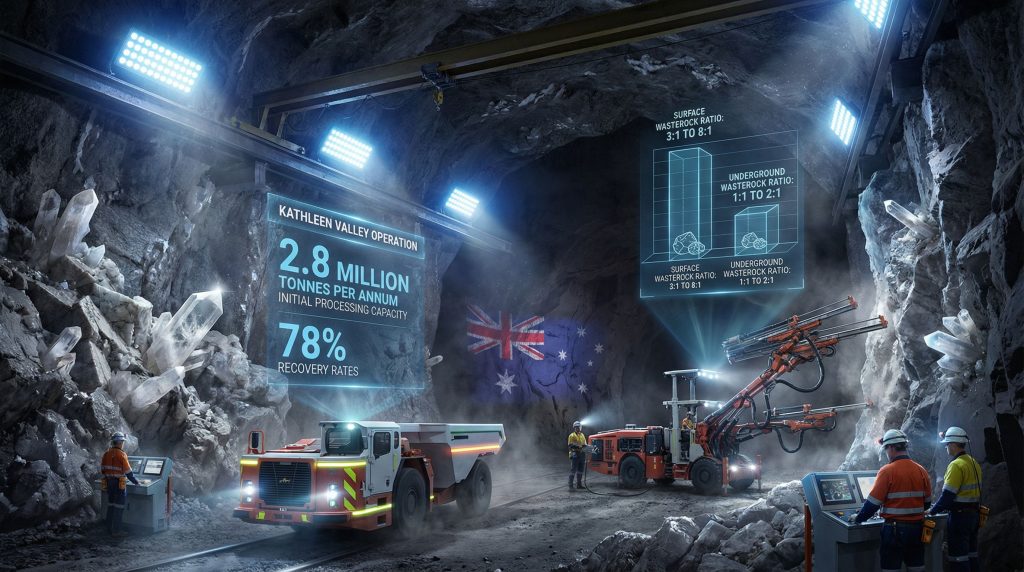
Waste rock generation follows a fundamentally different pattern in underground operations, with typical ratios of 1:1 to 2:1 waste-to-ore, compared to open-pit operations that generate 3:1 to 8:1 ratios. This reduction translates directly to decreased environmental management requirements and lower rehabilitation costs over the project lifecycle.
Water consumption patterns also favour underground methods, particularly regarding dust suppression requirements. Surface operations require continuous watering of haul roads, stockpiles, and active mining areas to control airborne particulates. Underground extraction eliminates these water-intensive dust control measures while requiring only localised ventilation and equipment cooling systems.
Visual impact mitigation becomes increasingly important as mining operations expand near populated areas or sensitive landscapes. Underground infrastructure maintains existing surface topography while providing equivalent production capacity, addressing community concerns about landscape alteration.
| Operational Factor | Open Pit Mining | Underground Mining |
|---|---|---|
| Surface Disturbance | Extensive (100+ hectares) | Minimal (10-20 hectares) |
| Waste Rock Ratio | 3:1 to 8:1 | 1:1 to 2:1 |
| Grade Consistency | Variable due to dilution | High precision targeting |
| Weather Impact | Significant downtime | Continuous operations |
| Dust Generation | High levels requiring suppression | Contained within mine |
When big ASX news breaks, our subscribers know first
How Does Kathleen Valley's Underground Transition Impact Australia's Lithium Supply Chain?
The transformation of Kathleen Valley into Australia's first large-scale underground lithium operation establishes new benchmarks for domestic critical minerals production while strengthening national supply chain resilience. This strategic shift occurred following completion of three years of open-pit extraction, with operations transitioning to fully underground methods by December 2025.
Production Capacity and Processing Infrastructure
Kathleen Valley's processing infrastructure centres on a 2.8 million tonnes per annum capacity facility utilising whole-of-ore flotation technology to achieve 78% lithium recovery rates. The plant design accommodates potential expansion to 4 million tonnes annually through underground scalability advantages, representing significant contribution to Australia's lithium production base.
Strategic stockpile management emerged as a critical success factor during the open-pit to underground transition. The final six months of surface operations exceeded recovery targets while creating substantial clean ore reserves, providing mill feed security through the 2026-27 financial year as underground operations scale to full capacity.
The processing methodology employs advanced flotation chemistry optimised for pegmatite ore characteristics:
- Primary crushing reduces run-of-mine material to -10mm specification
- Secondary crushing achieves -1.5mm particle size for optimal flotation
- pH adjustment using lime compounds enhances spodumene liberation
- Selective flotation separates spodumene from feldspar and mica gangue minerals
- Quality control systems monitor concentrate grades and impurity levels
Concentrate specifications target 5-7% lithium oxide content suitable for direct shipment to downstream lithium hydroxide and lithium carbonate conversion facilities. Quality parameters include iron content below 0.5%, controlled silica and alumina levels, and specific moisture content requirements for transportation and storage.
Critical Minerals Security Through Domestic Production
Australia's underground lithium capacity enhancement addresses strategic supply chain vulnerabilities while reducing dependence on South American brine operations. Spodumene hard-rock processing achieves production ramp-up significantly faster than evaporation pond operations, with ore-to-concentrate processing typically completed within 2-4 weeks compared to 12-18 month brine evaporation cycles.
Liontown underground lithium mining operations provide domestic feedstock with shorter logistics distances to battery-grade lithium refinery facilities, reducing transportation costs and delivery timeframes compared to South American sources. This geographic advantage becomes increasingly important as electric vehicle production scales across the Asia-Pacific region.
The integration with battery manufacturing supply chains offers multiple benefits:
- Reduced supply chain complexity through direct producer relationships
- Quality consistency from controlled extraction and processing methods
- Flexible production scaling responsive to market demand fluctuations
- Lower carbon footprint through reduced international shipping requirements
Underground lithium extraction provides operational flexibility that enables production adjustments based on market conditions while maintaining high-margin ore delivery to processing facilities, supporting Australia's position as a reliable critical minerals supplier.
What Are the Technical Challenges of Underground Spodumene Mining?
Underground spodumene extraction presents complex technical challenges requiring specialised engineering solutions and operational expertise. These challenges encompass geological complexity, ground support requirements, ventilation systems, and water management in subsurface environments.
Geological Complexity and Mining Method Selection
Pegmatite ore bodies present unique structural characteristics that influence mining method selection and operational planning. These intrusive formations typically occur at depths ranging from 100 to 500+ meters below surface, with variable dip angles and fracture frequencies that affect ground stability and extraction approaches.
Structural geology assessment becomes critical for underground development, as pegmatite intrusions often display complex relationships with host granite formations. Fracture networks within pegmatite bodies typically range from 1-10 fractures per meter, depending on proximity to geological contacts and structural stress patterns.
Mining method optimisation considers multiple factors:
- Room-and-pillar extraction for less competent pegmatite zones, utilising permanent pillars for ground support while extracting ore from room areas
- Sublevel stoping methods for competent ore bodies, enabling bulk extraction through horizontal slices with controlled blasting sequences
- Selective mining approaches that target high-grade pegmatite zones while avoiding waste rock dilution
- Ground support engineering incorporating rock bolting, shotcrete application, and cable reinforcement systems
Pegmatite competency evaluation requires detailed rock mass characterisation to determine appropriate support requirements. Typical underground lithium operations employ 2-4 rock bolts per 10 square meters of exposed surface, with 50-150mm shotcrete thickness depending on structural conditions.
Ventilation Systems for Deep Underground Operations
Ventilation design becomes increasingly complex as underground operations extend to greater depths, requiring sophisticated air movement systems to maintain safe working conditions. Thermal gradient increases of approximately 2-3°C per 100 meters depth create challenging temperature management requirements for personnel and equipment operation.
Mechanical ventilation systems must address multiple requirements:
- Exhaust removal from diesel-powered mobile equipment operating in confined spaces
- Fresh air circulation maintaining oxygen levels and removing harmful gases
- Temperature control through air conditioning and cooling systems
- Humidity management preventing equipment corrosion and maintaining air quality
Typical underground lithium operations require 50,000 to 150,000 cubic feet per minute ventilation capacity, depending on mine depth, equipment fleet size, and operational areas. Fan systems employ both primary and secondary ventilation circuits to ensure adequate air movement throughout the underground workings.
How Do Economics Compare Between Underground and Surface Lithium Operations?
Economic analysis of underground versus surface lithium operations reveals complex trade-offs between initial capital requirements, operational costs, and long-term revenue optimisation. While underground development requires higher upfront investment, operational advantages often justify these increased capital expenditures.
Capital Expenditure Analysis
Initial development costs for underground infrastructure significantly exceed surface operation requirements, encompassing mine access development, underground mobile equipment, and specialised ventilation systems. Underground lithium operations typically require $50-100 million additional capital compared to equivalent open-pit developments, depending on depth and geological conditions.
Equipment specifications for underground operations include:
- Underground drilling rigs designed for confined space operation
- Load-haul-dump vehicles with appropriate ventilation and safety systems
- Specialised ground support equipment for rock bolting and shotcrete application
- Underground crushing and ore handling systems to minimise material transport distances
Processing plant design considerations favour underground operations through consistent ore feed characteristics. Reduced variability in ore grade and mineralogy enables optimisation of flotation circuits, potentially reducing processing equipment requirements and operational complexity.
Revenue Optimisation Through Grade Control
Higher lithium concentrations in underground ore provide direct economic benefits through improved processing efficiency and reduced unit costs per tonne of lithium produced. Underground selective mining enables targeting of 1.0-1.5% lithium oxide grades compared to surface operations averaging 0.8-1.2% due to dilution effects.
Processing cost reduction occurs through multiple mechanisms:
- Reduced mill throughput requirements for equivalent lithium production due to higher head grades
- Improved flotation recovery from consistent ore mineralogy and reduced oxidation
- Lower reagent consumption through optimised flotation chemistry for uniform ore feeds
- Decreased waste handling costs from reduced strip ratios and overburden removal
Extended mine life becomes achievable through selective extraction methods that preserve lower-grade zones for future development when market conditions improve. This operational flexibility provides revenue optimisation opportunities unavailable to surface operations with predetermined pit limits.
| Economic Component | Surface Operations | Underground Operations |
|---|---|---|
| Initial Capital | Lower development costs | Higher infrastructure investment |
| Operating Costs | Higher strip ratios | Specialised equipment requirements |
| Grade Control | Limited selectivity | Precise targeting capability |
| Mine Life | Constrained by pit limits | Flexible expansion potential |
| Processing Efficiency | Variable ore feeds | Consistent mill performance |
What Role Does Technology Play in Modern Underground Lithium Extraction?
Advanced technology integration transforms underground lithium operations through automation, remote monitoring, and sustainable energy systems. These technological innovations enhance safety, efficiency, and environmental performance while reducing operational costs and technical risks.
Automation and Remote Operations
Autonomous underground vehicles revolutionise material transport and operational efficiency in confined mining environments. These systems include automated load-haul-dump units that navigate predetermined routes, reducing personnel exposure to hazardous areas while maintaining continuous production schedules.
Remote-controlled drilling and blasting systems enable precise ore extraction from control stations located in safe areas. Furthermore, ai in drilling & blasting technologies allow operators to maintain optimal standoff distances while executing complex drilling patterns and blasting sequences with enhanced accuracy and safety.
Real-time ore grade monitoring utilises portable X-ray fluorescence analysers and automated sampling systems to provide immediate feedback on lithium content and ore quality. This information enables dynamic production planning and grade control decisions that optimise mill feed composition.
Integrated mine planning software combines geological modelling, production scheduling, and equipment management into comprehensive operational platforms. These systems enable optimisation of:
- Development sequencing to maintain consistent ore access
- Equipment allocation across multiple underground work areas
- Ventilation planning for optimal air circulation patterns
- Material flow scheduling from extraction through processing
Sustainable Energy Integration
Renewable power systems address environmental objectives while reducing operational costs in underground lithium operations. Solar and wind energy installations can power surface facilities, ventilation systems, and material handling equipment, reducing reliance on fossil fuel energy sources.
Battery storage integration creates synergies between lithium production and energy storage applications. Underground operations can utilise battery systems for peak load management, emergency power backup, and integration with renewable energy sources to create more sustainable operational profiles.
Energy-efficient technologies include LED lighting systems, variable-speed drive motors, and optimised ventilation controls that reduce overall energy consumption. These systems can achieve 20-30% energy reduction compared to conventional underground mining technologies.
Electrification of mobile equipment represents an emerging trend in underground operations, with battery-powered vehicles eliminating diesel emissions and reducing ventilation requirements. Electric vehicles also provide operational advantages through reduced noise levels and maintenance requirements.
How Does Underground Mining Support Indigenous Community Partnerships?
Underground lithium extraction methods create enhanced opportunities for meaningful Indigenous community engagement through reduced surface disturbance and long-term economic partnerships. These relationships extend beyond traditional compensation models to encompass cultural preservation, skills development, and community empowerment initiatives.
Cultural Heritage Preservation
Minimal surface disturbance from underground operations provides superior protection for culturally significant sites compared to large-scale open-pit developments. At Kathleen Valley, operations proceeded through close consultation with the Tjiwarl people, ensuring protection of sacred areas and archaeological sites through careful surface infrastructure planning.
Collaborative archaeological assessment processes engage Traditional Owners as partners in cultural site identification and protection planning. These assessments inform mine planning decisions and establish protocols for cultural heritage management throughout operational phases.
Traditional owner employment programs create pathways for Indigenous community members to develop technical skills and advance into leadership positions within mining operations. These initiatives include:
- Apprenticeship programs in specialised underground mining trades
- Equipment operation training for underground mobile machinery
- Technical education in geology, mining engineering, and environmental management
- Leadership development preparing community members for supervisory and management roles
Revenue sharing arrangements establish long-term economic benefits that extend beyond immediate employment opportunities. These agreements often include royalty payments, equity participation, and community development funding that supports education, healthcare, and cultural preservation initiatives.
Long-term Community Benefits
Sustainable employment opportunities from underground operations provide career stability due to extended mine life and reduced sensitivity to commodity price fluctuations. Underground methods enable selective extraction that preserves resources during market downturns, maintaining employment levels through economic cycles.
Skills development programs transfer specialised technical knowledge to Indigenous communities, creating capabilities that extend beyond mining applications. Underground mining expertise includes:
- Geotechnical assessment and ground support engineering
- Ventilation system operation and air quality management
- Remote equipment operation and maintenance technologies
- Environmental monitoring and rehabilitation techniques
Local procurement initiatives prioritise Indigenous-owned businesses for service contracts, equipment supply, and logistics support. These partnerships create economic multiplier effects within communities while building local business capacity and expertise.
Environmental stewardship collaborations combine traditional ecological knowledge with modern mining practices to enhance environmental protection and rehabilitation outcomes. These partnerships recognise Indigenous communities as environmental custodians while supporting sustainable resource development.
The next major ASX story will hit our subscribers first
What Are the Global Implications of Australia's Underground Lithium Leadership?
Australia's advancement in underground lithium extraction establishes new international standards for critical minerals development while positioning the nation as a technology leader in sustainable mining practices. This leadership creates opportunities for technology export, strategic partnerships, and influence over global lithium market dynamics.
International Market Positioning
Technology export opportunities emerge as Australian companies develop specialised expertise in underground spodumene extraction. This knowledge includes geological assessment techniques, processing optimisation methods, and environmental management practices that can be applied to lithium deposits worldwide.
Strategic partnerships with battery manufacturers leverage Australia's technological capabilities and resource base to create integrated supply chain relationships. These collaborations provide security of supply for critical battery materials while ensuring Australian producers access to growing electric vehicle markets.
However, Liontown underground lithium mining operations demonstrate how australian lithium innovations can influence global pricing through consistent production capacity and advanced extraction methods. Underground operations' ability to maintain production during market downturns provides price stability and supply security that benefits downstream industries and consumers.
Competitive advantages in critical minerals trade stem from:
- Consistent product quality through controlled extraction and processing methods
- Reliable supply capacity unaffected by weather and seasonal variations
- Lower environmental impact meeting increasingly stringent sustainability requirements
- Technological innovation that reduces costs and improves efficiency
Future Industry Development
Additional underground lithium projects across Australia can benefit from technological developments and operational experience gained at Kathleen Valley. This knowledge transfer accelerates development timelines and reduces technical risks for subsequent projects.
Research and development initiatives in extraction technologies focus on improving recovery rates, reducing environmental impacts, and enhancing automation capabilities. Australian universities and research institutions collaborate with industry to advance underground mining methodologies.
Integration with battery recycling creates circular economy opportunities where underground lithium operations provide feedstock for primary battery production while recycling facilities recover lithium from end-of-life batteries. This integration reduces dependence on virgin resource extraction while maximising resource utilisation.
Climate change mitigation through sustainable mining practices demonstrates how critical minerals extraction can support clean energy transition while minimising environmental impact. In addition, green metals leadership positions Australia as a global benchmark for responsible resource development.
Underground lithium mining represents a fundamental shift toward precision-based critical minerals extraction that balances economic viability with environmental responsibility, establishing new benchmarks for sustainable resource development globally.
Technical Specifications and Operational Excellence in Underground Spodumene Processing
The technical complexity of underground spodumene processing requires sophisticated understanding of mineral liberation, flotation chemistry, and quality control systems. These specialised processes enable transformation of pegmatite ore into battery-grade lithium concentrates suitable for downstream conversion facilities.
Advanced Flotation Technology for Pegmatite Ores
Mineral liberation characteristics of spodumene require precise crushing and grinding to achieve optimal particle size distribution for flotation. Primary crushing reduces ROM material to -10mm, followed by secondary crushing to -1.5mm specification that maximises spodumene crystal exposure while minimising over-grinding that creates difficult-to-float fines.
Flotation chemistry optimisation addresses the challenge of separating spodumene from similar gangue minerals including feldspar and mica. The process employs:
- pH control using lime to maintain optimal chemical conditions (typically pH 10-11)
- Selective collectors that preferentially attach to spodumene crystal surfaces
- Frother compounds that stabilise air bubbles for mineral attachment
- Depressants that prevent unwanted mineral flotation while maintaining spodumene recovery
Quality control measures monitor concentrate composition continuously, ensuring consistent product specifications. Modern systems track lithium oxide content, iron levels below 0.5%, silica content, and moisture levels throughout the process stream.
Recovery rate optimisation through whole-of-ore flotation achieves the targeted 78% lithium recovery at Kathleen Valley. This performance demonstrates effective mineral processing design and operational control that maximises resource utilisation while maintaining product quality standards.
Underground Mining Safety and Risk Management
Ground support engineering in pegmatite formations requires comprehensive understanding of rock mass properties and structural behaviour. Support systems include systematic rock bolting at 2-4 bolts per 10 square meters, shotcrete application of 50-150mm thickness, and cable reinforcement for critical spans exceeding 5 meters.
Ventilation safety protocols ensure continuous air quality monitoring and emergency response capabilities. Systems monitor oxygen levels, carbon monoxide concentrations, and airborne particulates while maintaining positive pressure gradients that prevent accumulation of harmful gases.
Emergency evacuation procedures include multiple escape routes, communication systems, and refuge stations positioned throughout underground workings. Personnel tracking systems monitor worker locations and provide immediate notification capabilities during emergency situations.
Water management systems control groundwater inflow through active pumping and drainage infrastructure. Pegmatite formations typically demonstrate lower permeability than overlying weathered zones, but local aquifer intersections require specialised dewatering systems and water treatment facilities.
Economic Analysis: Underground Lithium Mining Investment Considerations
Investment analysis for underground lithium operations requires comprehensive evaluation of capital requirements, operational costs, and revenue potential across extended project lifecycles. These economic assessments inform financing decisions and strategic planning for critical minerals development.
Capital Investment and Infrastructure Requirements
Development capital for underground lithium projects typically ranges from $200-400 million, including mine access development, underground mobile equipment, processing facilities, and surface infrastructure. This investment level reflects the sophisticated technology and safety systems required for successful underground operations.
Operational cost structures differ significantly from surface mining due to specialised equipment requirements and underground operating conditions. Key cost components include:
- Equipment operation including underground drilling, loading, and haulage systems
- Ground support materials for rock bolting, shotcrete, and structural reinforcement
- Ventilation energy costs for air circulation and cooling systems
- Safety and emergency systems including communication networks and evacuation infrastructure
Revenue optimisation strategies focus on maximising lithium recovery while maintaining product quality specifications. Higher ore grades achievable through underground selective mining directly translate to improved project economics through reduced processing costs per unit of lithium produced.
Market positioning advantages include operational flexibility to adjust production rates based on lithium price cycles, extended mine life through selective extraction, and premium pricing for consistent, high-quality concentrate products. This operational resilience supports the broader mining industry evolution toward more sustainable and technologically advanced practices.
Disclaimer: This analysis contains forward-looking statements regarding lithium market conditions, production estimates, and economic projections. Actual results may vary significantly due to commodity price volatility, operational challenges, regulatory changes, and market conditions. Investment decisions should be based on comprehensive due diligence and professional financial advice.
Looking to capitalise on Australia's underground lithium revolution?
Discovery Alert's proprietary Discovery IQ model delivers instant notifications on significant ASX mineral discoveries, empowering investors to identify actionable opportunities ahead of the broader market. Explore how major mineral discoveries can generate substantial returns by visiting Discovery Alert's dedicated discoveries page and begin your 30-day free trial today to position yourself at the forefront of critical minerals investing.