June 12, 2026
The global supply chain challenges facing electric vehicle manufacturers have fundamentally transformed how critical materials are procured and secured. Traditional spot-market purchasing models prove inadequate when production schedules require predictable access to premium-grade materials over extended timeframes. This transformation has elevated lithium supply agreements from simple commodity transactions into sophisticated financial instruments that underpin both mining project development and automotive manufacturing strategies.
Understanding Modern Lithium Procurement Strategies
Lithium supply agreements represent far more than traditional commodity contracts. These arrangements function as strategic partnerships between producers and buyers, incorporating volume commitments, pricing mechanisms, quality specifications, and financial structuring elements designed to address supply chain volatility whilst enabling project financing for mining operations.
Key Components of Lithium Supply Agreements
| Contract Element | Typical Range | Purpose |
|---|---|---|
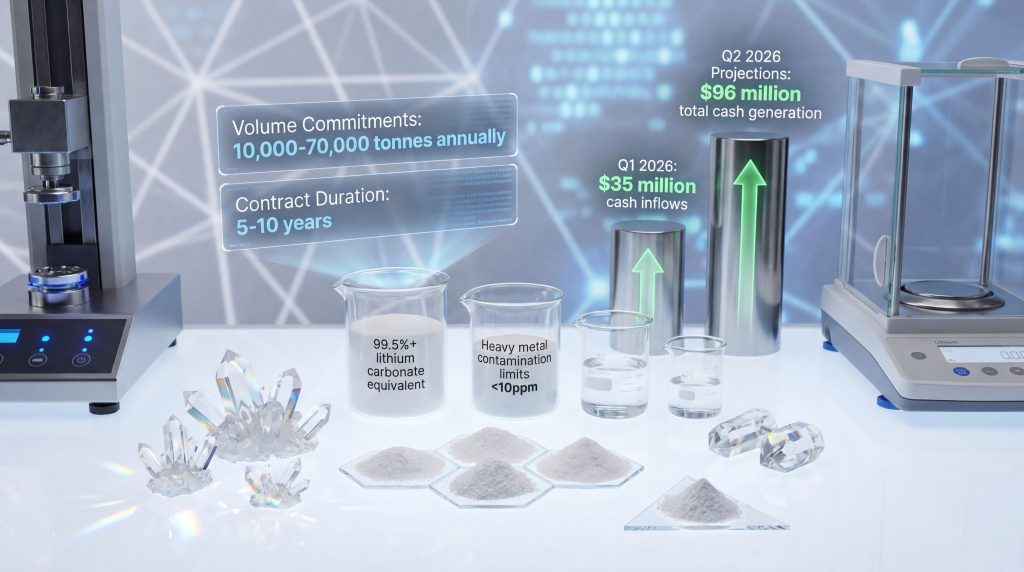
| Volume Commitments | 10,000-70,000 tonnes annually | Guarantee supply security |
| Contract Duration | 5-10 years | Long-term price stability |
| Take-or-Pay Clauses | 60-80% of contracted volume | Financial security for producers |
| Pricing Mechanisms | Fixed, indexed, or hybrid | Risk management |
Contemporary lithium supply agreements have evolved beyond traditional procurement models to address specific challenges facing both mining companies and battery material consumers. Recent market data demonstrates this evolution through increasingly sophisticated contract structures that accommodate production variability whilst providing revenue certainty for project development.
The Brazilian lithium sector exemplifies this market maturation. Sigma Lithium's recent financial performance illustrates how supply agreements function as revenue stabilisation mechanisms. The company generated $35 million in Q1 2026 cash inflows primarily through premium lithium oxide concentrate sales, with operational cash flows of $31 million after accounting for $10 million in operational costs.
Quality specifications have become increasingly granular, with premium lithium oxide concentrate requiring purity levels exceeding 99.5%, specific particle size distribution parameters, and stringent contamination limits. These technical requirements reflect the automotive industry's transition toward high-performance battery chemistries demanding superior material consistency.
Furthermore, modern agreements incorporate Australia lithium innovations that demonstrate how regulatory frameworks support supply chain development through enhanced tax incentives and technological advancement programs.
The Strategic Role of Offtake Agreements in Battery Supply Chains
Battery supply chain security depends heavily on predictable access to lithium compounds meeting precise specifications. Automotive manufacturers require lithium hydroxide for nickel-rich cathode chemistries, whilst energy storage applications often utilise lithium carbonate for iron phosphate formulations. This technical differentiation necessitates supplier relationships extending beyond simple volume commitments.
Supply agreement structures now incorporate multiple delivery mechanisms to address varying production capabilities and buyer requirements. Sigma Lithium's dual-agreement approach demonstrates this sophistication: a single-year commitment for 70,500 tonnes with $96 million prepayment, and a three-year agreement for 40,000 tonnes annually with $50 million advance payment.
Geographic diversification has become essential for automotive manufacturers seeking to minimise supply chain risks. Ford's procurement strategy exemplifies this approach through its 11-year agreement with Nemaska Lithium for 13,000 tonnes of lithium hydroxide annually, representing approximately 37% of Ford's projected lithium requirements for EV production targets.
In addition, Argentina lithium brine insights reveal how South American producers develop cost-effective extraction methodologies that enhance global supply diversification strategies.
When big ASX news breaks, our subscribers know first
How Lithium Supply Agreements Enable Project Financing
Mining project development requires substantial capital investment before revenue generation begins. Lithium projects typically demand $500 million to $2 billion in development capital, making debt facility approval contingent on demonstrated revenue security through binding supply agreements.
Lenders evaluate lithium projects based on contracted revenue percentages, with industry standards requiring 60-70% of planned production to be committed through binding offtake agreements before debt facility approval. This threshold has increased from 50-60% in 2020 as supply chain security concerns intensify.
"Lenders typically require at least 60-70% of planned production to be contracted through binding offtake agreements before providing debt facilities for lithium projects."
Financial Security Mechanisms in Supply Agreements:
- Minimum purchase guarantees regardless of market conditions
- Revenue certainty for project development phases
- Risk mitigation for capital-intensive mining operations
- Enhanced creditworthiness for financing applications
Prepayment structures within lithium supply agreements function as quasi-equity capital for mining operations. Sigma Lithium's combined prepayment receipts totalling $146 million demonstrate how these mechanisms provide immediate capital for operational scaling whilst guaranteeing buyers priority access to premium materials.
The company's cash position improved from $6.2 million at Q4 2025-end to $12 million at Q1 2026-end, despite utilising significant cash portions for debt amortisation. This progression illustrates how prepayment-structured agreements enable simultaneous debt service and operational expansion funding without proportional debt facility increases.
Debt Facility Requirements and Lender Expectations
Mining lenders employ three-step approval processes for lithium project financing: binding offtake agreements covering minimum production percentages, feasibility study verification of cost assumptions, and reserve-based lending facility approval based on geological resource confidence levels.
Financial Covenant Interrelationships
| Provision Type | Typical Parameters | Business Rationale |
|---|---|---|
| Volume Tolerance | ±10-20% annual variation | Production ramp flexibility |
| Quality Adjustments | 6-12 month stabilisation | Technical commissioning |
| Delivery Schedules | Quarterly/monthly shipments | Supply chain optimisation |
Credit facility pricing reflects supply agreement execution, with successful offtake agreement completion typically reducing interest rates by 50-150 basis points based on commitment percentages and buyer credit quality. These pricing adjustments acknowledge reduced project risk through contractual revenue certainty.
However, spodumene extraction sources illustrate how geological complexity influences financing requirements and agreement structuring for hard-rock lithium operations.
Risk-adjusted financing becomes increasingly important as lithium project development costs escalate. Projects without binding supply agreements face higher financing costs, smaller debt facility commitments, and extended development timelines as lenders require additional security measures.
Defining Successful Lithium Agreement Terms
Contract sophistication has increased substantially as market participants develop more nuanced approaches to risk allocation and operational flexibility. Modern lithium supply agreements incorporate multiple adjustment mechanisms addressing production variability, quality specifications, and market condition changes.
Volume flexibility provisions acknowledge that newly commissioned lithium operations require stabilisation periods before achieving consistent production rates. Industry practice contemplates ±10-20% annual volume variation within binding commitments, enabling producers to manage geological challenges whilst maintaining contractual obligations.
Pricing mechanism evolution reflects market maturation from simple fixed-price structures toward indexed mechanisms incorporating commodity benchmarks. Contemporary agreements increasingly utilise lithium carbonate equivalent pricing with quarterly adjustment periods based on published pricing indices from specialised market data providers.
Contract Flexibility Mechanisms
| Provision Type | Typical Parameters | Business Rationale |
|---|---|---|
| Volume Tolerance | ±10-20% annual variation | Production ramp flexibility |
| Quality Adjustments | 6-12 month stabilisation | Technical commissioning |
| Delivery Schedules | Quarterly/monthly shipments | Supply chain optimisation |
Quality assurance protocols have become increasingly sophisticated as battery manufacturers require consistent material specifications. Premium lithium oxide concentrate specifications typically include lithium oxide purity exceeding 99.5% (measured via X-ray fluorescence spectroscopy), particle size distribution with 80-90% of material passing 200-mesh screens, and moisture content limitations below 0.5%.
Volume Flexibility and Delivery Specifications
Production scheduling flexibility enables mining operations to accommodate geological variability whilst meeting contractual commitments. Three-year agreements typically incorporate quarterly review mechanisms allowing delivery schedule adjustments within specified tolerance bands based on production conditions.
Force majeure provisions address circumstances beyond operator control, including natural disasters, government actions, transportation disruptions, and geological conditions. Post-pandemic contract language increasingly incorporates health emergency provisions, whilst climate-related force majeure clauses are emerging as extreme weather events impact mining operations.
Termination mechanisms provide contractual certainty whilst enabling parties to address material breaches. Standard cure periods range from 30-60 days for non-compliance issues, with termination fees commonly structured at 5-15% of remaining contract value for buyer-initiated termination and substantially higher percentages for seller-initiated termination.
Consequently, delivery logistics specifications address transportation cost allocation, inspection protocols at delivery points, and risk transfer mechanisms. Sigma Lithium's agreements, based on cash flow timing patterns and prepayment structures, appear to contemplate quarterly or semi-annual delivery batches rather than continuous monthly shipments.
Major Automaker Supply Security Strategies
Automotive manufacturers face unprecedented challenges securing lithium supplies sufficient for ambitious EV production targets. Ford's EV platform strategy requires approximately 35,000+ tonnes of lithium hydroxide annually by 2026-2027, necessitating multiple supply agreement executions across different geographic regions and suppliers.
Ford's 11-year agreement with Nemaska Lithium represents total commitment value of approximately $1.7-2.0 billion based on prevailing lithium hydroxide pricing. This agreement demonstrates automotive industry willingness to accept long-term price exposure in exchange for supply security and strategic relationship development.
Ford's Multi-Jurisdictional Procurement Approach
Ford's Lithium Security Strategy Components:
- Geographic diversification across multiple jurisdictions
- Technology-specific material requirements (hydroxide vs. carbonate)
- Vertical integration considerations
- Strategic partnership development with miners
Multi-jurisdictional procurement strategies address geopolitical risks whilst enabling competitive pricing through supplier diversification. North American automakers increasingly prioritise domestic and allied-nation suppliers to qualify for federal tax incentives under Inflation Reduction Act provisions.
Supply chain risk management extends beyond simple volume commitments to encompass technical specifications, delivery reliability, and long-term relationship development. Automotive manufacturers require suppliers capable of scaling production volumes proportional to EV platform expansion whilst maintaining consistent quality standards.
For instance, battery-grade lithium refinery developments in emerging markets provide additional supply diversification options for global automotive manufacturers seeking to reduce concentration risk.
OEM supply chain integration increasingly involves technical collaboration with lithium producers on material specifications, processing optimisation, and quality assurance protocols. These relationships enable continuous improvement in battery performance whilst reducing downstream processing costs.
OEM Supply Chain Risk Management
Vertical integration considerations influence automotive manufacturers' approach to lithium procurement. Whilst most automakers avoid direct mining operations, strategic investments in lithium producers provide supply security benefits and pricing transparency advantages.
Strategic partnership development enables knowledge transfer between automotive manufacturers and lithium producers regarding technical requirements, quality specifications, and production scheduling coordination. These relationships prove essential for managing complex supply chains involving multiple processing stages.
Battery chemistry evolution impacts lithium procurement strategies as automakers transition between different cathode formulations. Nickel-rich chemistries require lithium hydroxide, whilst iron phosphate alternatives utilise lithium carbonate, necessitating flexible supply arrangements accommodating technology shifts.
Regional Market Dynamics and Financial Innovation
Brazilian lithium market development demonstrates how regional players structure innovative supply agreements addressing local capital market conditions whilst meeting international buyer requirements. Sigma Lithium's financial performance illustrates successful integration of export-oriented production with domestic financial markets.
Q1 2026 financial results demonstrate the effectiveness of diversified revenue streams combining long-term supply agreements with spot-market sales of premium materials. The company's $35 million cash inflows derived primarily from premium lithium oxide concentrate sales, with operational cash generation of $31 million after operational costs.
Sigma Lithium Financial Performance Timeline:
- Q4 2025: $6.2 million cash position
- Q1 2026: $12 million cash position with $35 million inflows
- Q2 2026 Projection: $96 million total cash generation
- Supply Agreement Impact: $83 million from contracted deliveries
Prepayment structures enable Brazilian producers to access international capital whilst maintaining operational flexibility. Sigma's $96 million single-year prepayment for 70,500 tonnes delivery and $50 million three-year prepayment for 40,000 tonnes annually demonstrate sophisticated financial structuring addressing both parties' requirements.
Brazilian Market Dynamics and Cash Flow Models
Currency hedging becomes essential for Brazilian producers operating with USD-denominated supply agreements whilst managing BRL-denominated operational costs. Exchange rate volatility creates additional complexity requiring sophisticated financial risk management strategies.
Regional competitive advantages include proximity to Atlantic shipping routes, established mining infrastructure, and favourable geological conditions enabling lower-cost production. Brazilian lithium projects typically achieve lower capital intensity per tonne of production compared to Australian or North American alternatives.
Working capital management requires careful coordination between prepayment receipts, operational cash requirements, and debt service obligations. Sigma's ability to maintain debt amortisation whilst generating positive operational cash flows demonstrates successful working capital optimisation.
Moreover, geothermal lithium extraction Italy showcases how European markets develop innovative extraction technologies that complement traditional hard-rock and brine operations globally.
The dual-agreement structure implemented by Sigma reflects sophisticated approach to buyer relationship management and cash flow optimisation. Single-year high-volume commitments capture opportunistic demand whilst multi-year lower-volume agreements provide long-term revenue visibility.
Prepayment Structures as Development Capital
Prepayment mechanisms within lithium supply agreements constitute alternative financing for mining operations, enabling capital access without traditional equity dilution or proportional debt facility increases. These structures provide immediate capital for operational scaling whilst guaranteeing buyers priority access to premium materials.
Prepayment Structure Benefits:
- Immediate capital access for operational expansion
- Reduced dependency on traditional debt financing
- Improved debt-to-equity ratios without equity dilution
- Enhanced cash flow predictability for buyers and sellers
Capital allocation optimisation becomes possible through strategic prepayment timing coordination with operational requirements. Sigma's projected $96 million Q2 inflow substantially exceeds typical quarterly operational cash generation, indicating prepayment scheduling aligned with capital expenditure requirements.
Risk distribution between buyers and sellers requires careful contract structuring addressing production variability, quality specifications, and market condition changes. Prepayment structures typically incorporate delivery guarantees, quality assurance provisions, and penalty mechanisms for non-performance.
Capital Allocation and Working Capital Management
Working capital optimisation requires coordination between prepayment receipts, operational cash requirements, debt service obligations, and capital expenditure programmes. Successful integration enables mining operations to scale production whilst maintaining financial flexibility.
Alternative financing scenarios without supply agreements include equity crowding, smaller debt facilities with higher financing costs, and extended project development timelines awaiting favourable market conditions. Prepayment-supported development typically achieves faster project commissioning and reduced financing costs.
Project development acceleration through prepayment financing enables earlier revenue generation compared to traditional financing mechanisms. This timing advantage proves particularly valuable in rapidly expanding markets where early production capabilities command premium pricing.
Furthermore, investment return optimisation benefits both parties through reduced financing costs for producers and secured supply access for buyers. Long-term relationships developed through prepayment structures often evolve into broader strategic partnerships encompassing technical collaboration and market development initiatives.
The next major ASX story will hit our subscribers first
Quality Specifications and Premium Material Markets
Premium lithium oxide concentrate commanding significant price premiums reflects battery manufacturers' increasing focus on material quality and processing efficiency. Technical specifications have evolved from general purity requirements toward comprehensive quality parameters addressing downstream processing optimisation.
Premium Grade Technical Requirements:
- Lithium oxide purity exceeding 99.5% (X-ray fluorescence measurement)
- Particle size distribution: 80-90% passing 200-mesh screens
- Moisture content limitations below 0.5%
- Heavy metal contamination controls for iron, nickel, cobalt, manganese
Quality assurance protocols involve continuous monitoring throughout production processes, with third-party verification required for export sales. Testing methodologies include atomic absorption spectroscopy for purity verification and comprehensive contamination analysis using inductively coupled plasma mass spectrometry.
Premium pricing differentials typically range from 15-25% above standard concentrate pricing, reflecting enhanced processing requirements and reduced downstream costs for battery material manufacturers. These premiums justify additional quality control investments and specialised production capabilities.
Premium vs. Standard Grade Pricing Differentials
Market segmentation between premium and standard materials creates differentiated revenue opportunities for producers capable of achieving superior quality specifications. Sigma's specific focus on premium lithium oxide concentrate demonstrates strategic positioning within higher-value market segments.
Processing optimisation enables producers to achieve premium specifications through enhanced beneficiation, improved flotation chemistry, and advanced filtering systems. These technical improvements require capital investment but generate substantial pricing premiums over project lifecycles.
Quality consistency proves essential for automotive applications where material variability can impact battery performance and manufacturing efficiency. Long-term supply agreements increasingly incorporate quality stability provisions ensuring consistent material properties across delivery periods.
Consequently, downstream processing cost reductions achieved through premium material utilisation often exceed premium pricing, creating value for battery manufacturers through reduced chemical processing requirements and improved production yields.
Market Forces Reshaping Agreement Terms
Lithium supply deficit projections drive increasingly aggressive procurement strategies among battery manufacturers and automotive companies. Industry analysis suggests potential shortfalls ranging from 300,000-768,000 tonnes lithium carbonate equivalent by 2030, intensifying competition for high-grade deposits and proven production capacity.
Geographic concentration risks in traditional lithium suppliers (Australia, Chile) motivate procurement diversification toward emerging producers in Brazil, Canada, and other jurisdictions. This geographic rebalancing creates opportunities for new suppliers whilst increasing complexity in supply chain management.
Market Intelligence Summary:
- Projected LCE shortfall: 300,000-768,000 tonnes by 2030
- Increased competition for high-grade deposits
- Geographic concentration risks in traditional suppliers
- Technology transition impacts on demand patterns
Technology transition impacts demand patterns as battery chemistry evolution affects lithium compound requirements. Nickel-rich cathodes requiring lithium hydroxide gain market share, whilst iron phosphate applications utilising lithium carbonate maintain significant presence in energy storage markets.
Supply Deficit Projections and Strategic Response
Market response to supply deficit projections includes acceleration of development projects, increased exploration investment, and more aggressive supply agreement terms favouring producers. Buyers increasingly accept longer-term commitments and advance payment structures to secure supply access.
Geopolitical considerations influence supply agreement structuring as governments implement critical mineral security policies. Domestic content requirements, allied-nation supplier preferences, and strategic stockpiling initiatives create additional complexity in international supply arrangements.
Price volatility management becomes increasingly sophisticated as market participants develop hedging strategies addressing both supply security and financial risk management. Contemporary agreements incorporate various pricing mechanisms balancing cost predictability with market participation.
Strategic stockpiling by governments and major corporations creates additional demand beyond immediate consumption requirements. These inventory accumulations affect supply-demand balance calculations and influence long-term supply agreement structuring.
Emerging Applications Beyond Battery Markets
Fusion energy development creates specialised lithium demand requiring enriched lithium-6 isotopes for tritium breeding blanket applications. Initial commercial fusion reactor deployments (projected 2030s) will require kilogram-scale lithium supplies, but subsequent scaling could generate substantial additional demand.
Fusion Energy Lithium Requirements:
- Enriched lithium-6 for tritium production
- Kilogram-scale initial deliveries (2027 timeline)
- Strategic agreements with technology developers
- Premium pricing for specialised applications
Advanced battery technologies including solid-state electrolytes may require specialised lithium compounds with enhanced purity specifications. Research and development programmes increasingly focus on lithium metal anodes requiring ultra-high purity lithium materials.
Pharmaceutical applications utilise lithium compounds for mood stabilisation medications, creating steady demand independent of battery market fluctuations. Whilst volumes remain modest compared to battery applications, pharmaceutical requirements provide market diversification opportunities.
Technology Diversification Beyond Battery Markets
Ceramic and glass manufacturing applications utilise lithium compounds for thermal expansion control and chemical strengthening. These industrial applications provide stable demand with different technical requirements compared to battery applications.
Nuclear reactor applications beyond fusion energy include lithium-7 hydroxide for pressurised water reactor coolant systems. These specialised applications require extreme purity levels and specific isotopic compositions justifying significant pricing premiums.
Emerging technologies including quantum computing, advanced ceramics, and specialised alloys may create additional lithium demand streams. Whilst currently limited in scope, these applications demonstrate lithium's broader technological utility beyond energy storage.
Research and development investments in lithium applications continue expanding potential demand sources. Technology diversification reduces dependence on single-market dynamics whilst creating opportunities for specialised suppliers meeting niche technical requirements.
Strategic Implications for Industry Development
Lithium supply agreements have fundamentally evolved from commodity transactions into strategic partnership frameworks addressing complex supply chain requirements, financial structuring needs, and technological collaboration opportunities. This transformation reflects market maturation and increasing sophistication among both producers and consumers.
Key Strategic Developments:
- Evolution from commodity trading to strategic partnerships
- Financial innovation reducing project development risks
- Geographic diversification driving contract complexity
- Technology advancement requiring specialised materials
Long-term market stability depends on successful contract framework development balancing producer revenue security with buyer supply access. Contemporary agreements demonstrate increasing sophistication in risk allocation, quality specifications, and operational flexibility provisions.
Investment implications include recognition that lithium supply agreements constitute strategic assets enabling both project development and supply chain security. Successful agreement execution often determines project viability and long-term competitive positioning.
Market maturation continues driving contract innovation as participants develop more sophisticated approaches to risk management, quality assurance, and strategic relationship development. These trends suggest continued evolution toward integrated supply chain partnerships encompassing technical collaboration and market development initiatives.
This information is provided for general informational purposes only and should not be construed as investment advice. Market conditions, supply-demand dynamics, and individual project circumstances can significantly impact actual outcomes. Prospective investors should conduct independent due diligence and consult qualified financial advisors before making investment decisions related to lithium market participants or supply agreement structures.
Looking to Capitalise on ASX Lithium Market Opportunities?
Discovery Alert's proprietary Discovery IQ model delivers real-time alerts on significant lithium and critical mineral discoveries across the Australian Stock Exchange, instantly empowering subscribers to identify actionable opportunities ahead of the broader market. Understand why major mineral discoveries can lead to substantial returns by exploring Discovery Alert's discoveries page, showcasing historic examples of exceptional outcomes, and begin your 14-day free trial today to position yourself ahead of the market.