Livium Ltd
- ASX Code: LIT
- Market Cap: $16,512,857
Livium Targets the Battery Waste Stream Powering Australia's AI Boom
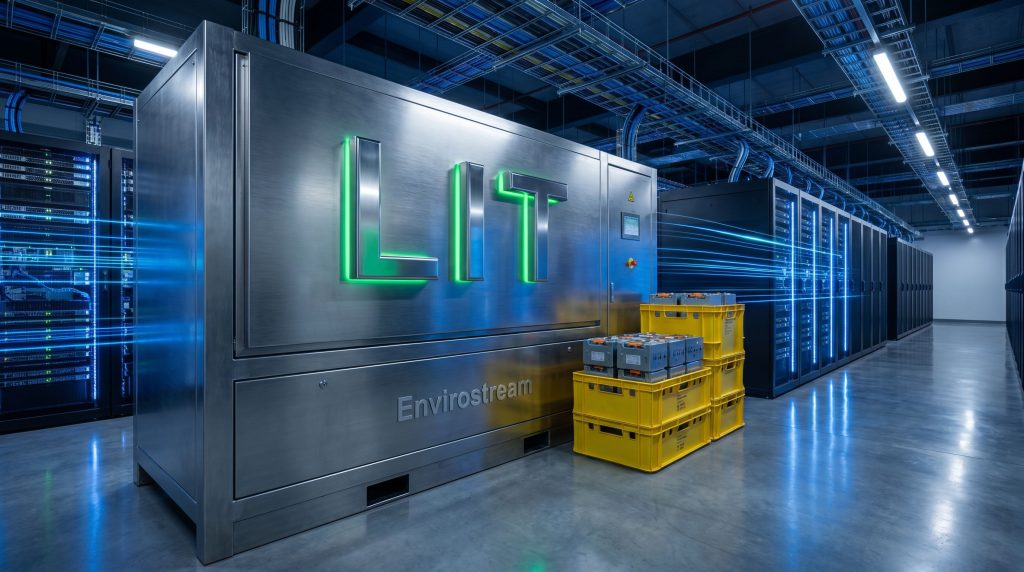
Livium Ltd (ASX: LIT) has outlined a targeted expansion of its growth strategy into data centre battery recycling, using the existing platform of its wholly owned subsidiary Envirostream. Livium data centre backup battery recycling in Australia is now a formal part of the company's strategic agenda, following early engagement with data centre operators, developers and IT Asset Disposition (ITAD) partners to assess how Envirostream can service future end-of-life backup battery systems, as per the ASX announcement dated 25 June 2026.
This positioning connects Livium Ltd to two fast-moving themes:
- The rapid build-out of AI and cloud data centres in Australia
- Increasing regulatory and customer focus on compliant, auditable e-waste and battery recycling
The company has highlighted that this is an engagement phase. There is no guarantee that discussions will convert into commercial volumes or customer agreements.
When big ASX news breaks, our subscribers know first
Australia's Data Centre Boom Is Creating a Future Battery Waste Stream
According to the announcement, Australia is emerging as a global hub for AI and data centres. This build-out is placing new demands on the electricity grid and creating a future stream of large-format backup batteries that will ultimately require retirement and recycling.
Key figures cited in the ASX release include:
- Data centres consumed an estimated 3.9 TWh of electricity in FY25
- This represented approximately 2% of total grid-supplied consumption
- The Australian Energy Market Operator forecasts 25% annual growth, reaching 12 TWh by 2030 and 34.5 TWh by 2050
The growth is being driven by artificial intelligence workloads and broader digitisation. BDO has reported that Australia ranked second globally in 2024 for attractiveness as a data centre investment destination, after the United States. The NSW development pipeline includes:
- 44 data centres
- 11.4 GW of planned capacity
Large technology companies are committing substantial capital to this infrastructure. The announcement references Amazon's US$13 billion planned investment in Australian data centre capacity through to 2029, in addition to build programmes by Microsoft, Google and other hyperscalers.
Every facility relies on backup power systems to keep operations running during grid failures or fluctuations. This dependence on uninterruptible power supply (UPS) batteries creates a direct link between the expansion of data centres and the longer-term requirement for recycling.
What Is a UPS System and Why Does It Matter?
An Uninterruptible Power Supply (UPS) is a system that provides short-term backup electricity when the main power source is lost or unstable. In data centres, these systems:
- Protect servers and networking hardware from power cuts and voltage spikes
- Bridge the gap between a grid outage and the start-up of generators
- Prevent data loss and service disruption that can occur in milliseconds
From an investor perspective, UPS batteries are:
- Non-discretionary: Data centres must have them to operate reliably
- Recurring: Batteries are replaced on cycles, creating a predictable waste stream
- Material-rich: Particularly lithium-ion systems, which contain valuable metals
Historically, data centres have used lead-acid UPS systems with typical replacement cycles of 3 to 5 years. However, operators are increasingly adopting lithium-ion batteries for their higher energy density and lower total cost of ownership. Lithium-ion UPS batteries are generally expected to have 5 to 12 year replacement cycles.
From a recycling and materials recovery standpoint, lithium-ion batteries contain higher-value critical minerals per unit volume and are attractive feedstock for processors able to produce materials such as black mass — the concentrate of metals like lithium, cobalt and nickel recovered after shredding.
Understanding UPS systems helps explain why Livium Ltd sees the data centre sector as a long-term recycling opportunity rather than a one-off disposal event.
Data Centre Battery Recycling: A US$2.5 Billion Global Market
According to MarketIntelo data cited in the ASX release, the global market for onsite battery recycling services in data centres — including collection, dismantling, recycling and refurbishment of UPS and backup battery systems — was approximately US$1.2 billion in 2025. This is forecast to grow to around US$2.5 billion by 2034, implying a compound annual growth rate (CAGR) of about 9.8%.
The announcement identifies several factors expected to support this growth:
- Rapid hyperscale data centre expansion driven by AI and cloud computing
- Battery replacement cycles in the range of 5–12 years for lithium-ion systems
- Tightening regulations that mandate material recovery and responsible disposal
- Commercial value of recovered materials, including lithium, cobalt and nickel
A summary of the key metrics presented is:
| Metric | Figure |
|---|---|
| Global data centre battery recycling market (2025) | US$1.2B |
| Forecast global market (2034) | US$2.5B |
| Forecast CAGR | ~9.8% |
| Australian data centre energy use FY25 | 3.9 TWh (~2% of grid) |
| Forecast 2030 data centre use | 12 TWh |
| Forecast 2050 data centre use | 34.5 TWh |
| NSW data centre pipeline | 44 sites / 11.4 GW |
For investors, these figures indicate that Livium Ltd is targeting an addressable market that is already material in size and is expected, based on third-party research, to grow meaningfully over the next decade.
Envirostream: Existing Platform Aimed at a New Waste Stream
Livium Ltd is not proposing to build a new capability from the ground up for this opportunity. Instead, it is aiming to apply the existing infrastructure and commercial model of Envirostream into a new customer segment.
According to the announcement, Envirostream currently operates:
- EPA-licensed battery processing facilities in Australia
- A national collection network capable of servicing geographically dispersed customers
- Established chain-of-custody processes that document each step of material handling
- A commercial model that combines customer fees with downstream materials recovery
The chain of custody is particularly important for data centre operators and ITAD partners. It refers to a full, auditable record of where the batteries have been, who has handled them, and how they were processed. Furthermore, this documentation can support compliance, reduce liability and satisfy customer and regulatory requirements.
Envirostream's current revenue model is described as having two components generated from a single waste stream:
- Customer fees for certified disposal and liability transfer
- Downstream recovery of materials from lithium-ion batteries
Livium Ltd notes that this structure, already used with existing large-format battery customers, can be extended to data centre operators. Where battery retirement is managed through e-waste specialists or ITAD firms, Livium Ltd intends to work with these intermediaries to provide an onshore recycling pathway.
CEO Commentary
"AI data centres are becoming a major new pillar of digital and energy infrastructure, and every facility depends on large-format backup batteries. Livium has commenced early engagement across the Australian data centre ecosystem to understand how Envirostream can support operators and ITAD partners as battery replacement cycles mature. As those batteries reach end of life, operators will need responsible, auditable and onshore recycling pathways. Envirostream is already built for this requirement, with EPA-licensed processing facilities, national collection infrastructure and established chain-of-custody processes. This is a natural extension of Livium's strategy to apply its recycling and critical minerals recovery capability to high growth clean energy and technology waste streams."
— Simon Linge, Managing Director and CEO, Livium Ltd
Regulatory and Policy Context for Data Centre Operators
The ASX announcement refers to the Australian Government's Expectations of Data Centres and AI Infrastructure Developers, released in March 2026. This document sets out expectations around contribution to the energy transition, water security and alignment with the national interest.
The policy direction signals rising scrutiny on the full life cycle of data centre infrastructure, including how batteries and hardware are retired and recycled. Consequently, the Livium Ltd announcement indicates that:
- Data centre operators are increasingly looking at whole-of-lifecycle management for infrastructure
- Battery retirement, transport, disposal and recycling are part of that focus
- Operators and ITAD partners are expected to seek auditable, compliant recycling pathways
Envirostream is described as having EPA-licensed facilities, chain-of-custody processes, and a national expansion plan supported by government grants. These attributes position the business as an audit-ready partner for operators aiming to limit regulatory and reputational exposure linked to improper disposal of end-of-life batteries.
For investors, policy and regulatory frameworks matter because they can influence demand for onshore recycling services and may affect how quickly operators adopt formalised, documented recycling solutions.
Medium-Term Alignment With Rare Earth and Hardware Recycling
In addition to batteries, Livium Ltd holds rare earth element (REE) extraction technology that is being developed for adjacent waste streams. Rare earth elements are a group of metals used in high-performance magnets, electronics and various clean energy technologies.
According to the announcement, this technology provides medium-term alignment with future decommissioning of AI servers and electronic equipment in data centres. As data centre hardware reaches end of life, operators are likely to need solutions for both battery and hardware recycling.
Livium Ltd suggests that its REE extraction capability may allow it to participate in that future hardware waste stream, potentially extending relationships with data centre customers beyond batteries alone.
Investment Thesis: Structural Demand and Existing Infrastructure
For investors assessing the Livium Ltd announcement, the core elements of the stated thesis can be summarised as follows:
| Investment pillar | Detail from ASX announcement |
|---|---|
| Market growth | Data centre battery recycling market forecast from US$1.2B (2025) to US$2.5B (2034) at around 9.8% CAGR |
| Infrastructure position | Envirostream described as Australia's leading onshore EPA-licensed battery processor, with national collection and chain-of-custody already in place |
| Revenue model | Disposal and liability transfer fees plus downstream material recovery from lithium-ion batteries |
| Regulatory environment | Tightening e-waste and lifecycle expectations for data centres, and government expectations published in March 2026 |
| Technology transition | Shift from lead-acid to lithium-ion UPS systems, with higher per-unit mineral recovery potential |
| Future optionality | Rare earth element extraction capability aligned with future hardware decommissioning requirements |
The company is clear that this is a growth strategy expansion and engagement initiative, not a reporting of new contracts. The ASX release explicitly states there is no guarantee that current engagement will translate into commercial volumes or binding agreements.
Outcomes will depend on the pace of data centre development, the timing of battery replacement cycles and customer decisions regarding recycling partners. From an investor perspective, however, the appeal of the strategy rests on a growing and regulated waste stream, an existing licensed processing platform through Envirostream, and a dual revenue model with exposure to critical minerals recovery.
Key Educational Concepts for Investors
To support assessment of Livium Ltd and the Envirostream platform, several technical terms used in the announcement are worth defining in accessible language.
IT Asset Disposition (ITAD): ITAD firms manage the retirement of IT hardware, including decommissioning, data security, resale and recycling. Data centre operators often use ITAD providers to handle end-of-life servers, storage, networking equipment and sometimes batteries.
EPA-licensed battery processing: This refers to facilities that hold approval from the Environmental Protection Authority to handle, store and process batteries. Licensing generally requires meeting environmental, safety and reporting standards.
Black mass: Black mass is the dark, powder-like material produced when lithium-ion batteries are mechanically processed. It contains a mixture of metals such as lithium, cobalt, nickel and manganese, which can be further refined.
Rare earth elements (REEs): REEs are a group of 17 metallic elements used in technologies including magnets for motors, wind turbines and various electronics. They are not rare in the Earth's crust but are difficult to extract and separate.
Understanding these concepts can help investors interpret how Livium Ltd's existing capabilities may apply across different waste streams and where potential value creation might arise over time.
The next major ASX story will hit our subscribers first
What Investors May Monitor Next
For shareholders and prospective investors in Livium Ltd, the following developments may be relevant to track, based on the themes in the ASX announcement:
- Progress of commercial engagement: Whether early discussions with data centre operators, developers and ITAD partners progress into pilot programmes, memoranda of understanding or contracts.
- Evidence of data centre battery volumes entering the system: Over time, the rate at which large-format batteries are processed by Envirostream from data centre sources, if disclosed.
- Further regulatory developments: Any additional government policies or standards related to data centre lifecycle management, e-waste and battery recycling.
- Pace of lithium-ion UPS adoption: Industry data on how fast operators are shifting from lead-acid to lithium-ion UPS systems, which may influence the material value of the recycling stream.
- Advancement of rare earth element extraction: Technical or commercial milestones on Livium Ltd's REE extraction initiatives that could overlap with data centre hardware decommissioning.
Livium data centre backup battery recycling in Australia represents a strategically coherent move, applying Envirostream's EPA-licensed, onshore platform to the emerging waste stream from the country's expanding data centre sector. While current activity is focused on engagement rather than contracted volumes, the combination of forecast market growth, regulatory attention and existing infrastructure makes this an update of clear interest for investors tracking battery recycling and critical minerals recovery themes on the ASX.
Want to Know More About Livium's Data Centre Battery Recycling Strategy?
Livium Ltd (ASX: LIT) is positioning Envirostream — its EPA-licensed, onshore battery processing platform — to capture a growing slice of Australia's emerging data centre battery waste stream. With forecast market growth, a dual revenue model, and existing national collection infrastructure already in place, this is a strategic expansion worth watching closely. To learn more about Livium's investment proposition and stay across the latest developments, visit the company's investor hub at investorhub.liviumcorp.com.