June 8, 2026
Understanding LNG Infrastructure Complexity and Strategic Importance
The global energy landscape rests upon invisible foundations of extreme engineering precision. Qatar gas infrastructure damage represents one of the most significant vulnerabilities in contemporary energy systems, where liquefied natural gas facilities require operational temperatures below -162 degrees Celsius to maintain methane in its super-chilled liquid state. At these cryogenic extremes, conventional materials undergo fundamental molecular changes – standard carbon steel becomes brittle and structurally compromised, necessitating specialised metallurgical alloys that can withstand repeated thermal cycling between ambient and cryogenic temperatures.
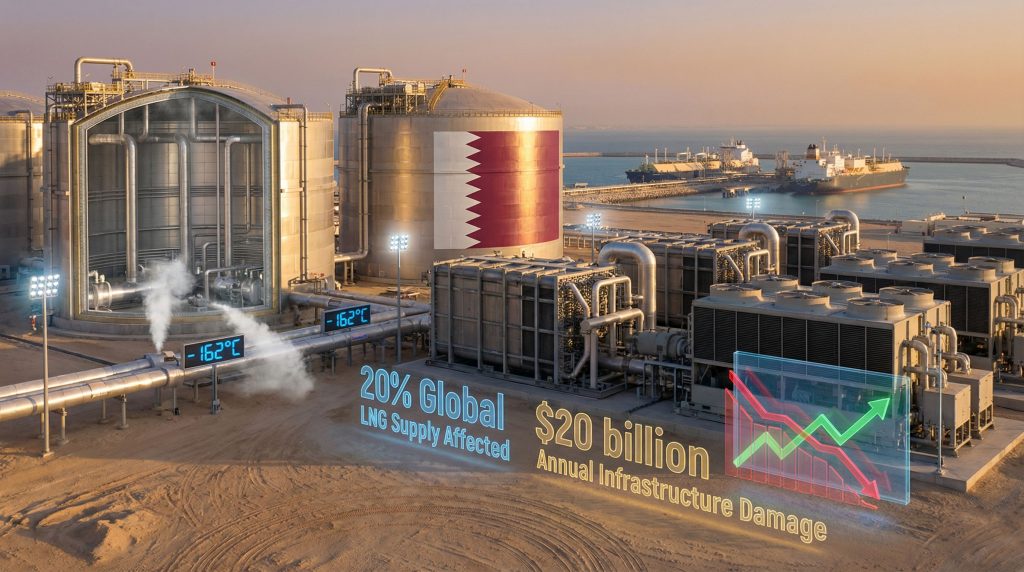
These technical constraints create concentrated vulnerability points throughout the LNG supply chain. Unlike crude oil systems that benefit from redundant pipeline networks and conventional storage options, LNG infrastructure demands highly specialised facilities at every stage. The 295 square kilometre Ras Laffan complex demonstrates this concentration risk – a facility comparable in size to a major metropolitan area that supplies approximately 20 percent of global LNG demand through its advanced liquefaction trains.
Investment requirements for LNG facilities extend across multi-decade construction timelines, with individual projects often exceeding tens of billions of dollars. The scale reflects not only the specialised materials and engineering requirements but also the massive scale of individual components. Main heat exchangers can exceed 50 metres in length, while individual compressor and turbine units can weigh more than 5,000 metric tonnes – making replacement logistics extraordinarily complex.
Geopolitical Risk Assessment Framework for Energy Infrastructure
Geographic concentration amplifies systemic risk within global LNG supply chains. The Persian Gulf region's dominance creates a scenario where regional instability directly threatens disproportionate shares of global energy supply. Qatar's North Field and Iran's South Pars field represent parts of the same massive geological structure, separated only by maritime boundaries – a geological reality that concentrates the world's largest natural gas reserves within a politically volatile region.
Maritime security considerations further compound these risks. LNG transportation requires specialised carrier vessels operating on fixed routes, creating additional chokepoints beyond production facilities. The Strait of Hormuz, through which significant portions of Gulf LNG exports transit, represents a strategic bottleneck where regional conflicts can disrupt global energy flows.
Regional conflict spillover effects demonstrate how localised tensions can trigger global energy security concerns. Furthermore, the March 2026 Qatar gas infrastructure damage illustrates how targeted strikes against energy facilities can create cascading effects throughout international supply chains, forcing major importing nations to activate emergency protocols and alternative sourcing strategies.
When big ASX news breaks, our subscribers know first
Production Capacity Impact Analysis
The immediate consequences of major LNG facility disruptions extend far beyond localised production interruptions. When 17 percent of Qatar's LNG infrastructure capacity faces damage, the global implications become apparent through mathematical precision. Given Qatar's position supplying one-fifth of global LNG demand, this infrastructure damage effectively removes approximately 3.4 percent of total global production capacity from immediate availability.
Global LNG Supply Disruption Metrics
| Impact Category | Scale | Duration |
|---|---|---|
| Global LNG supply affected | 20% reduction | 3-5 years |
| Infrastructure damage scope | $20 billion annually | Extended timeline |
| LNG trains offline | 2 of 14 operational units | Indefinite |
| Force majeure activation | Multiple contracts | Up to 5 years |
However, the energy intensity differential between LNG and pipeline gas creates additional economic complications during supply disruptions. Liquefaction and transportation processes consume approximately 15 percent of the initial natural gas volume extracted, making LNG inherently less energy-efficient than direct pipeline delivery. This efficiency gap becomes economically significant when spot market prices escalate during supply shortfalls, particularly affecting those dealing with the oil and gas market downturn that has already strained industry margins.
Production facility repairs face unique constraints that distinguish LNG infrastructure from conventional energy assets. The requirement for gradual temperature cycling – slowly warming facilities before maintenance and gradually cooling afterward – extends repair timelines significantly. Rapid temperature changes can cause structural damage to specialised alloy piping systems, forcing operators to follow precise thermal management protocols that add months to repair schedules.
Contract Fulfillment and Force Majeure Declarations
Force majeure declarations represent the legal mechanism through which LNG suppliers can suspend contractual obligations during extraordinary circumstances. The threshold for invoking these clauses requires demonstrating that performance has become impossible despite good faith efforts, with circumstances being both unforeseeable and beyond reasonable control.
Long-term LNG supply contracts typically specify fixed volumes and delivery schedules, often spanning 15-20 year terms. When force majeure activates, importing nations face immediate challenges in securing alternative supplies, particularly given the limited global spare capacity available during peak demand periods. The contracts affected by Qatar gas infrastructure damage include major supply agreements with Italy, Belgium, South Korea, and China – collectively representing substantial portions of global LNG import demand.
Legal frameworks surrounding force majeure in energy contracts have evolved to address increasingly complex geopolitical scenarios. Contract suspension can trigger cascading effects through derivative markets, industrial production schedules, and power generation planning across multiple continents. The potential five-year duration mentioned for Qatar's supply disruptions illustrates how infrastructure damage can create long-term contractual complications extending far beyond immediate repair timelines.
What makes LNG price volatility so severe during supply disruptions?
LNG spot market pricing responds immediately to supply disruption signals, with benchmark indices reflecting real-time supply-demand imbalances. The Dutch Title Transfer Facility (TTF), serving as Europe's primary gas price benchmark, had experienced price doubling since mid-January 2026, even before the March infrastructure damage occurred. This pre-existing price escalation demonstrates how geopolitical tensions can drive market volatility independent of actual supply disruptions.
Market reallocation mechanisms operate through transparent bidding processes where available LNG supplies flow to markets offering highest prices. This economic reality means that supply shortfalls disproportionately impact price-sensitive developing economies, which cannot compete with higher bidding from developed market importers. The principle that "gas will end up with the highest bidder" creates a hierarchy where energy access correlates directly with economic capacity to pay premium prices.
Coal-to-gas switching economics shift dramatically during LNG supply constraints. The "spark spread" – representing profit margins from gas-fired electricity generation – narrows relative to the "dark spread" from coal-fired power when gas prices escalate. This economic relationship creates incentives for utilities to temporarily revert to coal generation, particularly in price-sensitive markets where environmental considerations may be subordinated to immediate cost pressures.
Asian Market Exposure Assessment
Asian markets face disproportionate vulnerability to Persian Gulf LNG supply disruptions, with approximately three-quarters of Qatar's production historically flowing to the region. This geographic concentration creates specific exposure patterns across major importing nations, each with distinct vulnerability profiles based on import dependency ratios and alternative sourcing capabilities.
Primary Impact Regions:
-
China: As Qatar's largest LNG customer, China faces immediate industrial sector impacts across petrochemical feedstock supplies and power generation fuel mix optimisation
-
India and Pakistan: Price-sensitive economies where LNG import costs directly influence electricity pricing and industrial competitiveness, with potential for demand destruction during extended price escalations
-
South Korea: Heavily industrialised economy with limited domestic energy resources, requiring emergency activation of strategic LNG reserves and accelerated alternative sourcing negotiations
-
Taiwan: Island economy with constrained alternative supply routes, potentially requiring emergency rationing protocols for industrial users during extended supply disruptions
Import dependency ratios vary significantly across Asian markets, creating differentiated vulnerability levels. Nations with higher domestic natural gas production or established alternative supplier relationships demonstrate greater resilience during supply shocks. Conversely, economies with concentrated supplier relationships face more severe adjustment challenges when primary sources become unavailable.
In addition, strategic reserve adequacy becomes critical during extended supply disruptions. Many Asian importers maintain underground storage facilities and floating storage regasification units (FSRUs) as emergency buffers, but these typically provide coverage for weeks or months rather than the multi-year disruptions possible with major infrastructure damage.
European Market Resilience Evaluation
European market exposure to Qatar gas infrastructure damage varies significantly by nation, reflecting diverse import portfolios and alternative supply infrastructure. The United Kingdom demonstrates relatively lower vulnerability, importing only approximately 1 percent of total supply from Qatar, with majority volumes sourced from North Sea production and established supply relationships with Norway and the United States.
Italy and Belgium face more direct exposure through long-term contract commitments with QatarEnergy, requiring immediate activation of alternative sourcing strategies and potential industrial demand management protocols. These nations must navigate spot market competition while maintaining stable supply for residential heating and power generation requirements.
Pipeline infrastructure provides Europe with diversification advantages unavailable to many Asian markets. Established connections to Norwegian production, North African suppliers, and potential future supplies from alternative sources create supply optionality that can partially offset LNG shortfalls. However, pipeline capacity constraints limit the volume of alternative supplies that can be rapidly scaled during emergency scenarios.
European Union coordination mechanisms for energy security include emergency sharing protocols and joint purchasing initiatives designed to prevent competition between member states during supply crises. These frameworks provide institutional advantages for managing supply disruptions, though their effectiveness during extended shortfalls remains untested at scale.
Secondary Market Effects and Substitution Dynamics
Industrial demand curtailment represents a primary adjustment mechanism during extended LNG supply shortages. Energy-intensive industries including steel production, aluminium smelting, and petrochemical manufacturing face direct production constraints when natural gas supplies become unavailable or prohibitively expensive. These sectors typically maintain fuel switching capabilities to alternative energy sources, though with associated efficiency penalties and emissions increases.
Coal resurgence probability increases substantially during extended gas supply disruptions, particularly in developing markets where environmental considerations may be subordinated to immediate energy security needs. Power generation utilities maintain dual-fuel capabilities specifically for such scenarios, allowing rapid fuel switching when gas supplies become unavailable or economically uncompetitive.
Renewable energy acceleration may paradoxically benefit from LNG supply disruptions, as higher fossil fuel prices improve the economic competitiveness of wind and solar installations. Nations experiencing energy security challenges often respond with accelerated renewable deployment programmes, viewing energy independence as a strategic priority that justifies expedited investment timelines. This trend interconnects with energy transition challenges that many developed economies already face.
Technical Engineering Challenges in LNG Operations
Cryogenic temperature management represents the fundamental technical challenge distinguishing LNG facilities from conventional energy infrastructure. Maintaining temperatures below -162 degrees Celsius requires continuous energy input and sophisticated thermal management systems that must operate reliably across decades. Any interruption to cooling systems can result in catastrophic pressure buildup as LNG returns to gaseous form, expanding by a factor of approximately 600 times its liquid volume.
Material science requirements for LNG facilities necessitate specialised alloy selection throughout the system. Austenitic stainless steels, 9% nickel steels, and aluminium-based alloys maintain structural integrity at cryogenic temperatures while withstanding thermal cycling stresses. These materials command significant cost premiums over conventional construction materials, contributing to the elevated capital requirements for LNG projects.
Heat exchanger specifications represent critical single-point-of-failure components within LNG facilities. These units, which can exceed 50 metres in length, facilitate efficient heat transfer while maintaining structural integrity under extreme temperature differentials. The size and specialisation of heat exchangers create manufacturing constraints, with global production capacity limited to a small number of specialised fabrication facilities.
Compressor and turbine systems operate under extreme conditions, with individual units weighing more than 5,000 metric tonnes. These massive components require specialised transportation infrastructure and installation equipment, creating logistical bottlenecks during both initial construction and maintenance operations. The scale of these components means that manufacturing replacement units typically requires 18-36 month lead times.
Repair Timeline Constraints and Logistical Complexities
Temperature cycling protocols extend repair timelines significantly beyond those required for conventional industrial facilities. LNG plants must be gradually warmed before maintenance access becomes possible, with thermal management requirements preventing rapid temperature changes that could damage specialised piping systems. This warming process can require several weeks, followed by equally gradual cooling protocols after repairs are completed.
Custom component manufacturing represents a critical bottleneck in LNG facility repairs. Unlike conventional power plants or refineries that utilise standardised components with multiple suppliers, LNG facilities rely on highly specialised equipment manufactured by a limited number of global suppliers. This supply chain concentration means that component replacement often requires custom manufacturing with extended delivery timelines.
Sequential repair phases further extend overall recovery periods, as interdependent systems must be addressed in specific sequences to maintain structural integrity. Damage to one system can create cascading effects requiring repairs to multiple interconnected components, transforming what might appear to be localised damage into facility-wide reconstruction projects.
Transportation logistics for replacement components pose additional challenges, given the massive scale and specialised handling requirements for LNG equipment. Delivery of major components requires specialised transportation vessels and port facilities capable of handling extreme weights and dimensions, creating additional scheduling constraints during emergency repair scenarios.
Energy Intensity and Economic Efficiency Factors
Liquefaction energy consumption represents a fundamental economic disadvantage for LNG relative to pipeline-delivered natural gas. The process of cooling and compressing natural gas into liquid form consumes approximately 15 percent of the initial gas volume, creating an inherent efficiency penalty that affects delivered energy costs. This energy intensity becomes particularly significant during supply shortages when alternative sources must be secured at premium prices.
Transportation cost structures for LNG include specialised vessel requirements, cryogenic storage during transit, and regasification infrastructure at destination ports. These costs create economic thresholds that determine the competitiveness of LNG relative to alternative fuels across different market conditions. During supply disruptions, transportation costs can escalate significantly as available carrier capacity becomes constrained.
Furthermore, infrastructure investment recovery periods for LNG projects typically span 20-30 years, reflecting the substantial capital requirements and specialised nature of the facilities. This extended payback timeline creates financial vulnerability during supply disruptions, as revenue interruptions can affect debt service capabilities and project economics across multiple decades.
Financing models for LNG infrastructure often incorporate long-term contract commitments that provide revenue security during normal operations but create additional complexity during force majeure scenarios. When production facilities cannot fulfil contractual obligations, the financial structures supporting these projects face stress that can affect industry investment patterns for years following the initial disruption.
Energy Security Rebalancing Scenarios
Strategic scenario modelling reveals multiple potential pathways for global energy markets responding to extended LNG supply disruptions. Scenario 1 involves accelerated diversification away from Gulf LNG sources, with importing nations prioritising supply relationships with politically stable producers including Australia, the United States, and Norway. This rebalancing would require substantial investment in new terminal infrastructure and transportation logistics to accommodate redirected supply flows.
Scenario 2 contemplates the development of strategic LNG reserve systems modelled after Strategic Petroleum Reserve frameworks. National governments might invest in underground storage capabilities or floating storage regasification units to provide months of emergency supply during future disruptions. Such systems would require substantial public investment but could provide energy security benefits similar to oil reserve programmes.
Scenario 3 envisions regional energy alliance formation for collective supply security, with groups of importing nations coordinating procurement strategies and emergency sharing protocols. These alliances could leverage collective purchasing power while providing mutual support during supply crises, reducing individual nation vulnerability to single-source disruptions.
Scenario Analysis Framework:
-
Timeline: 3-7 year implementation periods for major infrastructure adjustments
-
Investment Requirements: $50-100 billion annually for alternative supply infrastructure development
-
Geopolitical Implications: Reduced influence for traditional suppliers, increased importance of alternative producers
-
Market Structure Changes: Shift toward more diversified, flexible supply arrangements with reduced long-term contract dominance
Industrial Sector Adaptation Strategies
Manufacturing relocation considerations emerge during extended energy supply disruptions, particularly for energy-intensive industries where fuel costs represent significant portions of total production expenses. Industries including aluminium smelting, steel production, and petrochemical manufacturing may evaluate facility relocations to regions with more stable energy supplies, creating long-term shifts in global industrial geography.
Fuel switching investment decisions accelerate during supply crises, with power generation utilities implementing dual-fuel capabilities that provide operational flexibility during future disruptions. These investments typically involve retrofitting existing facilities with alternative fuel handling systems, creating resilience against single-fuel dependency vulnerabilities.
Long-term contract renegotiation trends shift toward greater flexibility and force majeure clarity following major supply disruptions. Both buyers and sellers recognise the need for more sophisticated risk allocation mechanisms that address extended supply interruptions while maintaining economic viability for long-term infrastructure investments.
Industrial demand management protocols develop as permanent features rather than temporary emergency measures, with major consumers implementing operational flexibility that allows rapid fuel switching or production curtailment during supply emergencies. These capabilities provide system-wide resilience while reducing peak demand pressure during crisis periods.
Geopolitical Realignment Implications
Alternative supplier relationship development accelerates as importing nations prioritise energy security over traditional cost optimisation. The United States, Australia, and other politically stable LNG producers benefit from this strategic rebalancing, potentially securing long-term market share gains that extend well beyond the immediate supply crisis period.
Energy infrastructure protection cooperation frameworks emerge between allied nations, recognising that critical infrastructure vulnerabilities create shared security risks. International cooperation on facility hardening, intelligence sharing, and emergency response planning becomes integrated into broader security alliance structures.
Regional conflict containment strategies evolve to explicitly incorporate energy infrastructure protection as a strategic priority. Military planning and diplomatic initiatives increasingly recognise that energy facility security represents a global public good requiring coordinated protection efforts beyond individual nation capabilities.
Maritime security enhancement for LNG transportation routes becomes a multilateral priority, with naval cooperation expanding to protect shipping lanes critical for global energy security. This cooperation extends beyond traditional military alliances to include all nations dependent on seaborne energy imports.
Renewable Energy Investment Acceleration
Solar and wind capacity expansion receives strategic independence justification beyond traditional environmental motivations. Nations experiencing energy security vulnerabilities often accelerate renewable deployment as a means of reducing dependency on volatile international fuel supplies. Investment timelines that might otherwise span decades are compressed into years when energy security becomes a national priority.
Battery storage deployment becomes strategically essential for grid stability during energy transition periods, particularly when renewable sources must rapidly compensate for reduced fossil fuel availability. Large-scale storage systems provide the flexibility necessary to manage intermittent renewable generation while maintaining grid reliability during supply transition periods.
Green hydrogen development emerges as a potential long-term alternative to LNG imports, with hydrogen production facilities potentially utilising excess renewable generation capacity. While current technology costs remain prohibitive for most applications, supply security concerns may justify accelerated development timelines and public investment support.
Energy independence metrics gain political prominence, with renewable energy deployment measured against strategic autonomy objectives rather than purely economic considerations. This shift in evaluation criteria can justify renewable investments that might not meet traditional cost-benefit thresholds but provide valuable supply security benefits.
Energy Efficiency and Demand Management Evolution
Industrial process optimisation receives increased investment as manufacturers seek to reduce gas dependency through efficiency improvements. Advanced process control systems, waste heat recovery, and cogeneration capabilities become strategically important investments rather than optional efficiency measures.
Smart grid implementation accelerates to enable sophisticated demand response capabilities during supply disruptions. Advanced metering infrastructure and real-time pricing systems allow utilities to manage demand dynamically, reducing peak consumption during supply constraint periods while maintaining essential service delivery.
Building sector electrification trends accelerate in regions seeking to reduce natural gas dependency for heating applications. Heat pump deployment, electric heating systems, and building efficiency improvements receive policy support and financial incentives as strategic alternatives to gas-dependent heating infrastructure.
Transportation sector fuel diversification gains renewed attention as natural gas vehicle programmes compete with electric vehicle deployment. Nations must balance immediate fuel security needs against long-term decarbonisation objectives, potentially accelerating multiple alternative fuel pathways simultaneously.
The next major ASX story will hit our subscribers first
Supply Chain Diversification Strategies
Multi-source procurement portfolio optimisation becomes standard practice for energy importers, with sophisticated risk management frameworks replacing single-source dependency strategies. Professional procurement teams develop mathematical models that balance cost optimisation against supply security, creating diversified sourcing strategies that can withstand individual supplier disruptions.
Geographic risk distribution requires sophisticated analysis of political stability, infrastructure vulnerability, and transportation route security across potential supplier regions. Risk assessment methodologies incorporate geopolitical intelligence, climate change projections, and infrastructure resilience evaluations to guide long-term sourcing decisions.
Contract term flexibility becomes a premium feature in LNG supply agreements, with buyers willing to pay higher prices for contracts that include robust force majeure provisions and supply interruption protections. Legal frameworks evolve to address increasingly complex risk allocation scenarios between buyers and sellers.
Contract Enhancement Features:
-
Volume flexibility: ±20% annual adjustment capabilities for demand variability
-
Source flexibility: Multiple production facility options for supply security
-
Pricing mechanisms: Dynamic pricing linked to alternative fuel costs during disruptions
-
Force majeure clarity: Specific definitions and remediation timelines for supply interruptions
Strategic Reserve and Storage Considerations
Underground gas storage capacity expansion receives government support and investment incentives, recognising strategic storage as critical infrastructure for energy security. Salt cavern storage, depleted gas field utilisation, and aquifer storage projects advance with accelerated permitting and public-private partnership models.
Floating storage regasification unit (FSRU) deployment provides tactical flexibility for emergency supply scenarios, allowing rapid deployment of additional import capacity during supply disruptions. These mobile facilities can be repositioned to optimise supply flows and provide redundant import capabilities for critical markets.
Emergency supply sharing agreements develop between allied nations, creating mutual assistance frameworks that provide supply security benefits for all participants. These agreements require sophisticated allocation mechanisms and reciprocal obligation structures that function effectively during crisis periods.
Strategic reserve adequacy calculations become more sophisticated, incorporating extended disruption scenarios that reflect the multi-year repair timelines possible for major LNG infrastructure damage. Reserve sizing must balance storage costs against security benefits, requiring careful analysis of risk scenarios and economic trade-offs.
Price Risk Hedging and Financial Instruments
Long-term price volatility management through derivatives markets becomes increasingly sophisticated, with financial instruments designed specifically for extended supply disruption scenarios. Insurance products, futures contracts, and option strategies provide tools for managing price risk during supply uncertainty periods.
Supply interruption insurance product development addresses gaps in traditional force majeure insurance, providing coverage specifically designed for LNG supply chain disruptions. These specialised products require sophisticated risk assessment and pricing models that reflect the unique characteristics of LNG infrastructure vulnerabilities.
Currency hedging for international LNG transactions gains importance as supply disruptions often coincide with currency volatility, creating compounded financial risks for importing nations. Multi-currency hedging strategies and local currency contract provisions become standard features in international energy procurement.
Financial market development for alternative fuel switching provides economic instruments that support rapid fuel substitution during supply emergencies. These markets enable industrial consumers to manage transition costs while providing price discovery for alternative fuel premiums during crisis periods.
Frequently Asked Questions About LNG Infrastructure Damage
How long do major LNG facility repairs typically take?
Complex LNG infrastructure repairs require 3-5 year timelines under optimal conditions, with actual durations often extending longer due to cascading complications. Temperature cycling requirements alone can add months to repair schedules, as facilities must be gradually warmed before maintenance access becomes possible and slowly cooled afterward to prevent structural damage.
Custom component manufacturing creates additional bottlenecks, with specialised heat exchangers, compressors, and liquefaction trains requiring 18-36 month manufacturing timelines even after orders are placed. The limited global supply base for these specialised components means that multiple facility repairs worldwide could create supply chain constraints that extend individual repair timelines.
Sequential repair phases prevent parallel work on interconnected systems, as damage to one component often affects multiple related systems. What might initially appear as localised damage frequently requires comprehensive facility reconstruction, transforming repair projects into complete rebuilds that can span decades.
Can other LNG facilities compensate for lost production capacity?
Global spare LNG capacity remains limited, particularly during peak demand periods when existing facilities operate at or near maximum capacity. The specialised nature of LNG infrastructure means that production increases require significant lead times and cannot be rapidly scaled to compensate for major facility losses.
Transportation bottlenecks compound supply reallocation challenges, as LNG carrier vessels operate on fixed routes with contracted capacity commitments. Redirecting supply flows requires complex logistics coordination and may encounter physical constraints at terminal facilities not designed for increased throughput volumes.
Long-term contract obligations restrict the flexibility of existing producers to reallocate supply during emergencies. Most LNG production is committed through multi-decade contracts, leaving limited volumes available for spot market sales that could compensate for supply disruptions elsewhere.
What are the environmental implications of switching back to coal?
Carbon emission increases from coal substitution during LNG supply disruptions could temporarily reverse years of decarbonisation progress, particularly in developing markets where coal represents the most accessible alternative fuel. Power generation facilities with dual-fuel capabilities often maintain coal handling infrastructure specifically for such scenarios.
Air quality degradation in industrial centres accompanies increased coal utilisation, creating public health impacts that extend beyond greenhouse gas considerations. Urban areas dependent on gas-fired power generation may experience significant air quality deterioration during extended periods of coal substitution.
Climate commitment challenges emerge for nations attempting to meet emissions reduction targets while managing energy security crises. The tension between immediate energy needs and long-term environmental objectives creates policy dilemmas that may require international coordination and flexibility in climate agreement implementation.
Coal supply chain reactivation during extended gas shortages involves infrastructure investments that may create long-term fossil fuel dependencies even after gas supplies recover. Mining operations, transportation systems, and power plant modifications required for coal substitution represent substantial investments with multi-decade payback periods.
Infrastructure Protection and Resilience Investment
Hardening strategies for critical energy facilities receive increased investment and policy attention following major infrastructure damage events. Physical security enhancements, redundant system design, and rapid repair capabilities become standard features in new LNG facility development and existing facility upgrades.
Redundancy planning for essential supply chains extends beyond individual facilities to encompass entire supply networks, with multiple backup options for critical components and transportation routes. This systematic approach to resilience requires coordination between multiple stakeholders and substantial additional investment in duplicate capabilities.
International cooperation frameworks for infrastructure security develop as multilateral initiatives recognising that energy infrastructure vulnerabilities create shared global risks. Technology sharing, intelligence coordination, and mutual assistance programmes provide tools for enhancing collective energy security beyond individual national capabilities.
Cybersecurity integration becomes essential for physical infrastructure protection, as LNG facilities increasingly rely on digital control systems that create additional vulnerability vectors. Comprehensive security frameworks must address both physical and cyber threats through integrated protection strategies.
Market Structure Evolution and Pricing Mechanisms
Spot market development receives investment and regulatory support to increase supply flexibility and reduce dependency on long-term contract structures that can become liability during extended supply disruptions. Liquid spot markets provide price discovery and supply allocation mechanisms that function effectively during crisis periods.
Risk premium integration in long-term contract pricing reflects the increased recognition of supply interruption possibilities and their associated costs. Buyers and sellers negotiate more sophisticated risk allocation mechanisms that provide appropriate compensation for supply security guarantees.
Alternative fuel pathway investment acceleration includes not only renewable energy deployment but also infrastructure for hydrogen production, advanced biofuels, and synthetic fuel production. These alternative pathways provide strategic optionality that reduces long-term dependency on any single fuel source or supply region.
Market transparency improvements include better information sharing about facility operations, maintenance schedules, and potential supply disruptions. Early warning systems and transparent capacity reporting help market participants make informed decisions and reduce the volatility associated with supply uncertainty.
The Qatar gas infrastructure damage incident demonstrates how concentrated vulnerabilities in global energy systems can create cascading effects across continents and industries, particularly as companies develop their critical materials strategy to address supply chain vulnerabilities. These developments occur alongside broader challenges such as the US natural gas prices forecast showing increased volatility, and growing US-China trade war impacts on global energy markets. Understanding these interconnections provides essential context for evaluating energy security investments and policy decisions that will shape global energy markets for decades to come.
According to why the damage to Qatar's gas infrastructure could push costs higher for years to come, the ripple effects of such damage extend far beyond immediate production losses. Furthermore, analysts suggest that Iran's attack damage wipes out 17% of Qatar's LNG capacity for potentially three to five years, highlighting the critical importance of infrastructure resilience in global energy security planning.
Disclaimer: This analysis contains forward-looking projections and speculative scenarios based on current market conditions and technical assessments. Actual outcomes may vary significantly from projected scenarios due to technological developments, policy changes, and unforeseen circumstances. Readers should conduct independent analysis and consult qualified professionals before making investment or policy decisions based on this information.
Ready to Position Yourself Ahead of Energy Market Disruptions?
Discovery Alert's proprietary Discovery IQ model delivers real-time alerts on significant ASX mineral discoveries, instantly empowering subscribers to identify actionable opportunities ahead of the broader market during volatile energy transitions. Begin your 14-day free trial today and secure your market-leading advantage.