
August 12, 2026
The Hidden Legal Architecture That Can Shut Down Any Mine in Mexico
Most investors evaluating gold mining operations in Latin America focus on ore grades, processing costs, and commodity price forecasts. Far fewer give adequate weight to a legal structure that can render an entire mining operation non-functional overnight, regardless of how valid the federal concession is or how advanced the infrastructure may be. In Mexico, the ejido land tenure system creates a parallel layer of sovereignty over surface access that federal mining rights simply cannot override. Understanding this architecture is not an academic exercise. It is the central variable determining whether Equinox will restart Los Filos after community agreements in Mexico are successfully concluded.
When big ASX news breaks, our subscribers know first
What Makes Los Filos a High-Stakes Asset in the Global Gold Landscape
Situated in Guerrero State, one of Mexico's most mineralised corridors and simultaneously one of its most complex socio-political environments, the Los Filos mine operates using a combination of open-pit and underground extraction methods targeting gold-silver ore bodies. The operation has historically ranked among Mexico's largest gold producers by output volume, with heap leach processing infrastructure forming the backbone of its gold recovery methodology.
Heap leach processing, which involves stacking crushed ore onto lined pads and applying a cyanide solution to dissolve and recover gold, is particularly capital-intensive to restart after a prolonged shutdown. The lined pad infrastructure, solution management systems, and processing circuits require recommissioning procedures that add both time and cost to any restart scenario. This technical dimension is frequently underappreciated by investors focused purely on the social licence question.
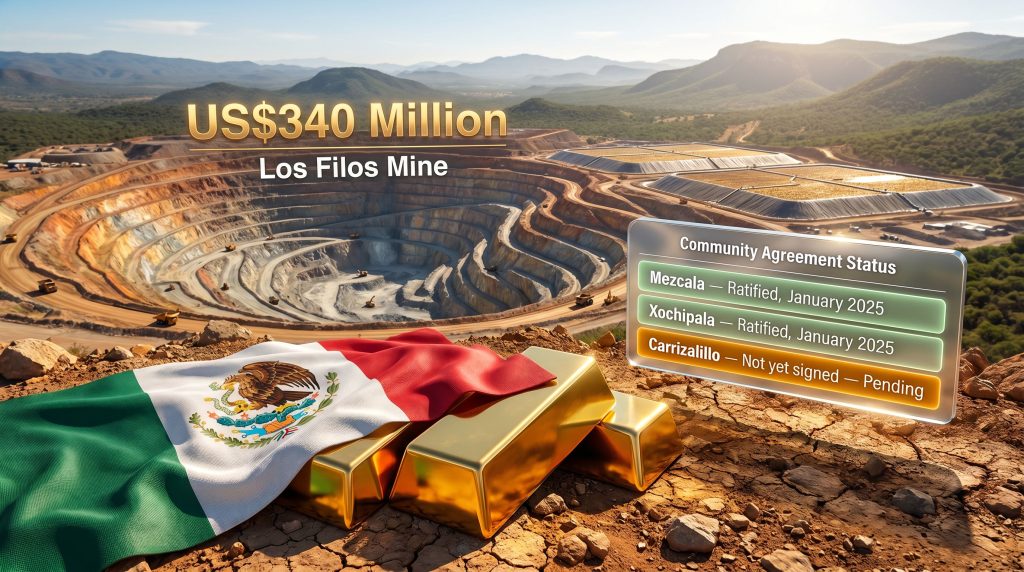
The financial stakes attached to Los Filos are substantial. The November 2025 state-level agreement brokered by the Guerrero government is linked to an estimated US$340 million capital investment commitment, covering underground development, mine expansion phases, and associated infrastructure upgrades. Furthermore, with the gold price outlook maintaining elevated levels through 2025 and into 2026, the economics of restarting a suspended operation of this scale have materially improved, creating intense board-level pressure to resolve the remaining access barriers.
Equinox Gold's broader portfolio context amplifies this urgency. Los Filos is not a peripheral asset. It represents one of the company's highest-leverage production recovery opportunities, meaning that a successful restart would contribute disproportionately to group production metrics and potentially re-rate the stock in a high gold price environment.
Why the March 2025 Suspension Was Both a Symptom and a Consequence
Equinox Gold formally suspended all operations at Los Filos on March 31, 2025, following the expiry of its surface land access agreement with the Carrizalillo community. The absence of a replacement agreement removed the company's legal right to access the land underpinning its core production infrastructure.
The immediate operational consequences were severe:
- The processing plant was shut down and removed from active production scheduling
- The workforce was displaced, affecting both direct employees and a broader network of indirect contractors
- Los Filos was excluded from Equinox's 2025 production guidance, creating a material gap in projected output
- Carrying costs on a suspended asset continued to accumulate without offsetting revenue
However, the March 2025 event did not emerge in isolation. The suspension was the culmination of a deteriorating relationship that stretched back to a 2019 social collaboration agreement between Equinox Gold and the Carrizalillo community. A critical finding that has shaped the entire subsequent negotiation is that approximately 70% of the clauses within that 2019 agreement were reportedly not fulfilled by the company. Unmet commitments spanning local infrastructure development, employment allocations, and community benefit obligations eroded trust progressively over a multi-year period.
This pattern of partial compliance is particularly dangerous in the context of ejido agreements because it creates a documented grievance record that strengthens the community's negotiating position in any subsequent renegotiation. When communities can point to a specific list of unfulfilled obligations, they enter new negotiations with both moral authority and legal leverage. Miningwatch Canada's analysis of the Los Filos timeline offers important historical context on how these obligations were tracked and disputed over time.
Partial compliance with social agreements tends to compound risk over time rather than contain it. Each unfulfilled clause becomes a precedent for distrust, and communities learn from prior experience that accepting new commitments without enforcement mechanisms yields the same outcome.
The Ejido System: A Legal Framework That Mining Companies Cannot Navigate Around
The ejido is a form of communal land holding established under Mexican agrarian law, originating from post-revolutionary land reform and codified in the Agrarian Law of 1992. Ejido communities hold surface rights entirely independently of federal mining concessions. A company can hold a perfectly valid federal concession and still be legally prohibited from conducting any surface disturbance without the explicit consent of the ejido assembly.
This creates a structural dynamic that is fundamentally different from mining jurisdictions where surface and mineral rights travel together. In Mexico, the negotiation architecture operates across three distinct tiers:
- Federal level: Mining concessions issued by the Secretariat of Economy (SE), which grant the right to explore and extract minerals but not to access surface land
- State level: Subnational governments that increasingly function as mediators between operators and communities, as seen with the Guerrero government's November 2025 framework
- Community assembly level: The ejido general assembly, whose vote is the only mechanism that can legally bind the collective to a surface access agreement
The assembly voting requirement is a critical detail that operators frequently misunderstand. Individual ejido leaders, regardless of their title or apparent authority, cannot unilaterally commit the community to a surface access agreement. The agreement must be ratified by a formal assembly vote, typically requiring a quorum of registered ejidatarios and a majority or supermajority depending on the nature of the commitment. This procedural reality means that even when negotiations appear close to resolution, the final ratification step can introduce unexpected delays. Consequently, the broader mining geopolitical landscape across Latin America is increasingly shaped by precisely these kinds of subnational legal frameworks.
Community Agreement Status at Los Filos
| Community | Agreement Status | Ratification Date | Operational Implication |
|---|---|---|---|
| Mezcala | Ratified | January 2025 | Surface access secured |
| Xochipala | Ratified | January 2025 | Surface access secured |
| Carrizalillo | Not yet signed | Pending as of mid-2026 | Full restart blocked |
| Eduardo Neri Municipality | Framework agreement | November 2025 | Investment roadmap support |
The table above illustrates a situation where significant diplomatic progress has been made, but the single most consequential agreement remains unsigned. Carrizalillo's land holdings are geographically positioned in relation to the mine's core production infrastructure in a way that makes this community's consent non-negotiable. No operational configuration of Los Filos can proceed at meaningful scale without it.
What the November 2025 Guerrero Agreement Actually Established and What It Did Not
The Guerrero state government's intervention as an active mediator in late 2025 produced a framework agreement that formalised investment commitments, outlined environmental obligations, and established a structure for ongoing community collaboration. This is meaningful progress. However, it is essential that investors and analysts draw a clear distinction between a state-level framework agreement and a binding community surface access contract.
The November 2025 deal advanced the overall process by:
- Creating a documented investment roadmap that signals operator commitment
- Establishing environmental compliance checkpoints that give communities measurable accountability mechanisms
- Providing a state-sanctioned framework within which the Carrizalillo negotiation can be completed
- Generating confidence signals for contractors, workforce, and capital markets
What it did not do is resolve the Carrizalillo impasse. The state government also committed to publishing a phased investment and milestone roadmap before year-end 2025, detailing capital deployment timelines, employment targets, and environmental checkpoints. The publication of this roadmap is being watched by investors as a confidence signal, since delays in its release tend to erode goodwill among the communities whose cooperation is still being sought.
The Remaining Barriers: What Must Happen Before Full Production Can Resume
The Carrizalillo Negotiation
The outstanding demands from the Carrizalillo community reflect lessons learned from the 2019 agreement's failure. Unlike the earlier framework, which lacked robust enforcement mechanisms, the community is now seeking more structured accountability provisions, including:
- Independent monitoring of compliance with employment and community development commitments
- Escrow or bonding arrangements that create financial consequences for non-fulfilment
- Specific local employment quotas with verification procedures
- Environmental monitoring protocols with community participation rights
Precedents from other Mexican mining operations, including operations in Sonora and Oaxaca states, demonstrate that post-suspension renegotiations can succeed when operators adopt a fundamentally different approach to agreement architecture. The key shift involves moving from aspiration-based language toward measurable, time-bound obligations with clear remedy provisions.
Under an optimistic scenario in which negotiations conclude in the second half of 2026, production could potentially resume in late 2026. However, if the Carrizalillo assembly fails to ratify a new agreement within that window, the timeline extends to 2027 or beyond, with each additional month of suspension representing a quantifiable revenue gap relative to what an operating mine at current gold prices would generate.
Regulatory and Environmental Dimensions
Beyond the community access question, a formal environmental evaluation process must be completed before production can resume. Guerrero State's environmental regulatory environment adds procedural requirements that run parallel to the community negotiations rather than sequentially. This means that even a resolved Carrizalillo agreement would not immediately translate into production, as environmental compliance milestones would need to be achieved concurrently.
Mexico's broader mining regulatory landscape, including ongoing legislative discussions around potential reforms to the concession framework, adds a layer of policy uncertainty that prudent investors should monitor. Changes to concession duration, renewal conditions, or environmental liability provisions at the federal level could affect the long-term economics of Los Filos independently of the current community access situation.
Workforce Reactivation Challenges
The employment impact of the March 2025 suspension in the Guerrero region has been significant, affecting both direct mine workers and the broader network of service contractors and local suppliers. Reactivating a skilled underground and open-pit mining workforce after an extended operational pause involves:
- Retraining and safety recertification requirements
- Competition from other regional employers who may have absorbed displaced workers
- Community expectations around local hiring preferences that may not align with rapid ramp-up timelines
- Contractor relationship management after a period of contract suspension
The next major ASX story will hit our subscribers first
Los Filos as a Reference Case for Latin American Mining's Structural Challenge
Research into Latin American mining project delays consistently identifies social licence failures as a leading cause of operational interruption, in many cases exceeding technical or financial factors as the primary driver. The Los Filos situation is increasingly referenced in mining industry consolidation analysis as a textbook illustration of how a multi-year pattern of partial compliance can convert a manageable community relations challenge into a full operational suspension.
Comparative cases across Mexico, Peru, and Ecuador reveal a consistent dynamic: operators who treat community agreements as compliance exercises rather than genuine partnership frameworks tend to face escalating conflict, while those who invest in enforcement mechanisms and independent monitoring see significantly better long-term stability.
The role of subnational governments as active mediators, rather than passive regulatory bodies, is also evolving rapidly. The Guerrero government's engagement in the Los Filos situation reflects a broader trend across Latin America where state-level administrations recognise that unresolved mining conflicts impose economic and reputational costs that fall partly on the state itself. Whether formalised state mediation frameworks ultimately reduce social conflict or simply defer it depends heavily on whether the agreements produced are genuinely enforceable, a question that remains open at Los Filos.
When gold prices are elevated, the opportunity cost of a suspended mine escalates with each passing quarter. However, financial pressure on operators should not be confused with the community trust-building process, which operates on a fundamentally different timeline and cannot be accelerated by market conditions alone.
Frequently Asked Questions: Los Filos Mine Restart and Community Agreements
Why did Equinox Gold suspend Los Filos operations in March 2025?
Operations were suspended effective March 31, 2025, when the surface land access agreement with the Carrizalillo community expired without a replacement in place, removing the company's legal right to access land critical to its core mining activities.
Has Equinox Gold reached agreements with all communities at Los Filos?
No. While the Mezcala and Xochipala communities ratified agreements in January 2025, the Carrizalillo community, whose land is integral to core operations, had not signed a new long-term access agreement as of mid-2026. Equinox Gold's official announcement provides further detail on the agreements secured and the planning work now underway.
What does the US$340 million investment commitment cover?
The figure represents estimated capital investment associated with the November 2025 Guerrero state-level framework, encompassing underground development, mine expansion phases, and related infrastructure upgrades.
What is an ejido and why does it matter for mining access?
An ejido is a communal land holding under Mexican agrarian law. Ejido communities hold surface rights independently of federal mining concessions, meaning a valid federal concession does not grant the right to access or disturb surface land without a separately negotiated community agreement ratified by the ejido assembly.
When could Los Filos realistically resume full production?
A full restart depends on securing a ratified long-term agreement with the Carrizalillo community. An optimistic scenario points to late 2026; an extended negotiation outcome could push the timeline to 2027 or later. In the meantime, the performance of gold mining equities with suspended assets such as Los Filos will remain closely tied to how swiftly these community negotiations progress.
Why did the 2019 social agreement break down?
Approximately 70% of the clauses within the 2019 social collaboration agreement with Carrizalillo were reportedly not fulfilled by the operator over the subsequent years, generating sustained grievances that culminated in blockades and the eventual expiry of access without a replacement arrangement.
Key Takeaways for Investors and Operators Monitoring Los Filos
- Community surface rights in Mexico are legally sovereign and operationally determinative — no federal concession can override them
- Partial compliance with social agreements creates compounding risk that becomes substantially harder to resolve with each unfulfilled obligation
- The November 2025 Guerrero framework represents genuine progress but is not a restart trigger in isolation
- Carrizalillo's unsigned status remains the single most important variable in the Los Filos production recovery timeline
- The US$340 million investment commitment reflects long-term operator confidence, but capital deployment cannot commence until surface access is legally secured and environmentally cleared
- Heap leach recommissioning requirements add technical timeline complexity that is separate from, and runs in parallel with, the social licence resolution process
- The Los Filos case is increasingly cited as a defining reference point for how mid-tier gold producers should structure, monitor, and honour community engagement frameworks across Latin American operations. Furthermore, those tracking gold M&A activity will recognise that suspended assets of this scale frequently attract acquisition interest when restart timelines become clearer
This article contains forward-looking scenarios and analytical perspectives that involve uncertainty and should not be construed as financial advice. Timelines and outcomes discussed are speculative and subject to change based on negotiation developments, regulatory processes, and market conditions.
Want to Stay Ahead of Significant ASX Mineral Discoveries Before the Broader Market Reacts?
While complex land access disputes play out across Latin American operations, Discovery Alert's proprietary Discovery IQ model scans ASX announcements in real time, instantly identifying high-potential mineral discoveries across more than 30 commodities — explore historic discovery returns on Discovery Alert's dedicated discoveries page to understand the scale of opportunity these moments can generate, then begin your 14-day free trial to ensure you're positioned at the earliest possible stage.