July 22, 2026
The Hidden Climate Risk Reshaping Chile's Copper Corridor
Every copper mine in the world carries geological risk. But for the cluster of high-altitude operations scattered across northern Chile's Atacama Region, a second category of risk is increasingly asserting itself: climate volatility at elevation. The July 2026 atmospheric river event that struck the region did not simply disrupt one mine. It simultaneously stressed multiple nodes of a supply chain that underpins everything from electric vehicle batteries to power grid infrastructure. Understanding how mining companies respond to these events, and how they price the risk into their annual planning, has become essential knowledge for anyone following the global copper market.
When big ASX news breaks, our subscribers know first
What Atmospheric River Events Mean for High-Altitude Mining
Atmospheric rivers are elongated corridors of concentrated water vapour that travel through the atmosphere, capable of transporting moisture equivalent to many times the daily flow of the Amazon River. When these systems make landfall over the Andes during the Southern Hemisphere winter, the consequences for high-elevation mining operations can be severe.
The July 2026 event that swept across northern and central Chile's mining corridor is classified within this meteorological category. At elevations approaching and exceeding 4,000 metres, the temperature differential between the moisture-laden air mass and the surrounding terrain translates that moisture into heavy snowfall rather than rain. This distinction matters enormously for mining operations: snowfall accumulation blocks access roads, adds structural load to surface infrastructure, and can disrupt overhead power transmission in ways that rainfall at lower elevations typically does not.
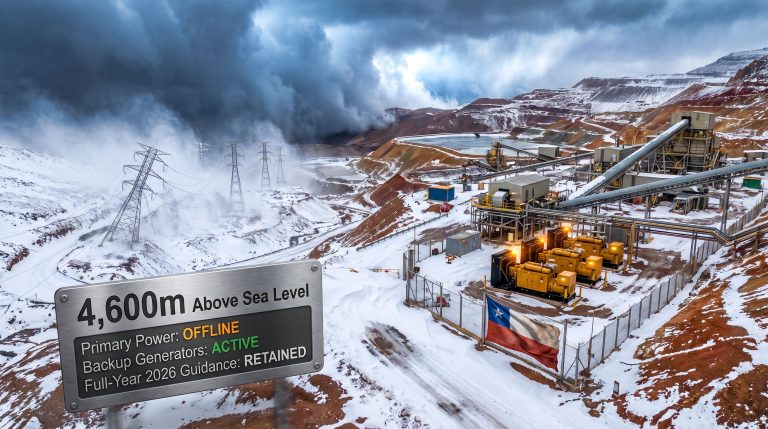
The Caserones copper mine, situated at approximately 4,600 metres above sea level in Chile's Atacama Region, sits squarely within this vulnerability zone. At that altitude, even moderate snowfall events can isolate a site within hours. Furthermore, the Chile copper price forecast for the region factors in precisely these kinds of disruption risks when modelling annual output expectations.
Why Elevation Changes Everything
The operational risk profile of a mine changes dramatically as elevation increases. Consider the cascading effects that a single heavy snowfall event can trigger at altitude:
- Road access closures, which prevent personnel rotation, equipment servicing, and reagent delivery to processing plants
- Overhead power line failures caused by ice accumulation and wind load on transmission infrastructure
- Structural stress on tailings storage facilities and process buildings from snow loading
- Disruption to water management systems, which are critical for ore processing circuits
- Increased risk to worker safety during evacuation or emergency response scenarios
These are not hypothetical concerns. They represent documented operational failure modes at Andean mining sites, and they explain why the industry has developed increasingly sophisticated emergency protocols specifically for altitude environments.
Lundin Mining Operations in Chile Suspended by Atacama Winter Storm
When the July 2026 system intensified, Lundin Mining moved proactively rather than reactively. The company had been monitoring the developing weather system and implemented precautionary measures at both its Chilean copper assets before conditions deteriorated to critical levels.
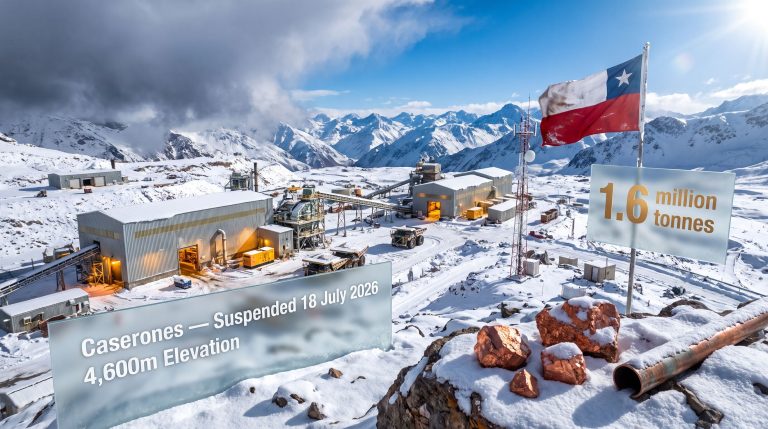
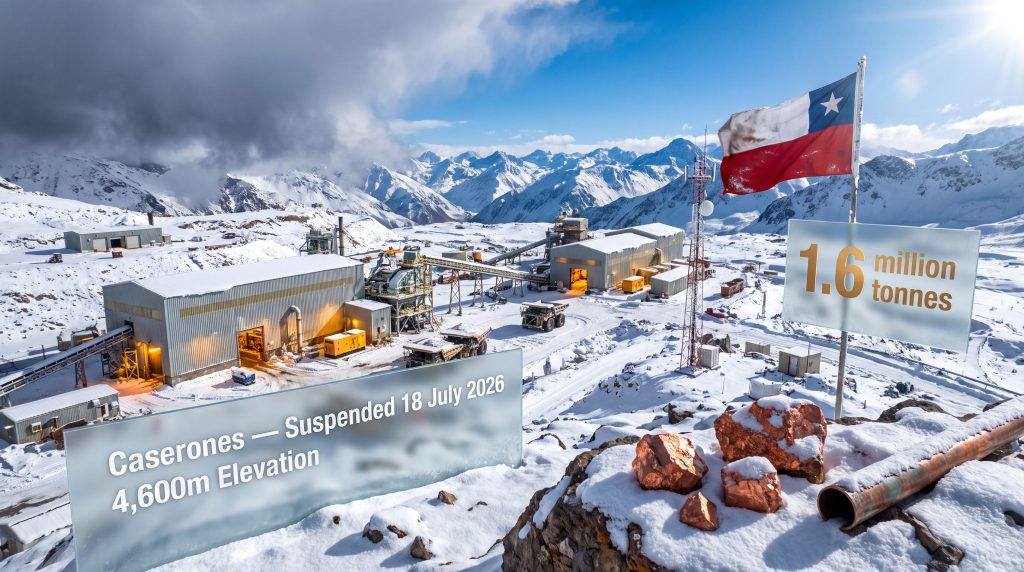
At Caserones, the situation escalated quickly. Operations were formally suspended on 18 July 2026 following heavy snowfall accumulation that disrupted the primary power supply and blocked access routes to the site. Backup generators were activated to maintain power to critical infrastructure, keeping essential systems online while full grid power was unavailable. Emergency response coordination was established with local authorities and first responders to support not only the mine site but surrounding communities in the region.
At the lower-elevation Candelaria complex, the dynamic was different. Candelaria experienced heavy rainfall rather than snowfall, reflecting the altitude differential between the two operations. Critically, the processing mill at Candelaria remained operational throughout the event by drawing on pre-positioned ore stockpiles, demonstrating the strategic value of maintaining buffer inventory ahead of seasonal risk windows.
Side-by-Side: How the Two Operations Compared
| Factor | Caserones | Candelaria |
|---|---|---|
| Weather Type | Heavy snowfall | Heavy rainfall |
| Elevation Exposure | ~4,600 metres | Lower elevation |
| Operational Status | Fully suspended (18 July 2026) | Mill operational via stockpiles |
| Power Status | Backup generators active | Unaffected |
| Formal Suspension | Yes | No |
| Recovery Timeline | Subject to power and road restoration | Ongoing with precautions |
The contrast between these two sites within the same company's portfolio is instructive. It illustrates how elevation, not just geographic proximity, determines the nature and severity of weather-related operational disruption.
Production Guidance: Why Lundin Held Its Targets
One of the most significant signals to emerge from this event was Lundin Mining's confirmation that it retains its full-year 2026 production guidance despite the Caserones suspension. This is not a trivial decision. Guidance revisions carry substantial reputational and market consequences, and companies typically only maintain targets when they have genuine operational confidence in their ability to recover lost output within the planning period.
The decision to hold full-year targets following a complete site suspension reflects a degree of climate-adjusted operational modelling sophistication that distinguishes mature high-altitude operators from those still treating weather disruption as an exceptional rather than expected variable.
Lundin's full-year 2026 production targets for its Chilean and broader portfolio are substantial:
- Full-year copper production target: 500,000 tonnes
- Full-year gold production target: 550,000 ounces
- Q1 2026 copper output benchmark: approximately 80,000 tonnes, establishing the run-rate against which subsequent quarters are measured
The company's annual production model for Caserones incorporates pre-modelled allowances for typical Andean winter weather disruptions. By treating seasonal weather risk as an embedded variable rather than an external shock, Lundin's planning framework is able to absorb events like the July 2026 suspension without triggering a guidance revision, at least when the disruption falls within historically observed parameters.
For investors, this approach to climate-adjusted production modelling is increasingly becoming a differentiating factor when assessing the operational quality of mining companies with high-elevation assets. In addition, the copper price growth drivers underpinning long-term valuations make operational resilience a premium quality in producer assessments.
The Broader Market Signal: 1.6 Million Tonnes in Jeopardy
The Caserones suspension did not occur in isolation. The same atmospheric system affected multiple major copper operations across the Atacama corridor simultaneously. The combined annualised production capacity temporarily curtailed across the region is estimated at approximately 1.6 million tonnes, a figure that carries real weight in global copper market terms.
Chile is the world's largest copper-producing nation, accounting for roughly one quarter of global mine supply. Any event that simultaneously constrains multiple operations within its highest-producing regions creates a supply signal that copper markets cannot ignore, even when the disruption is expected to be short-lived. Moreover, Chile's copper supply gap is already a concern for analysts tracking the global balance between demand growth and production capacity.
Major Operations Reported Affected by the July 2026 System
| Mine | Operator | Reported Impact |
|---|---|---|
| Caserones | Lundin Mining | Full suspension from 18 July 2026 |
| Candelaria | Lundin Mining | Mining disrupted; mill operational |
| Escondida | BHP / Rio Tinto | Brief suspension or operational restrictions |
| El Teniente | Codelco | Operational restrictions reported |
| Los Bronces | Anglo American | Operational restrictions reported |
Note: Impact severity and duration vary by site elevation and individual storm track. Reported impacts reflect conditions at the peak of the weather event.
The meteorological system began losing intensity following the peak event, with precipitation forecast to ease within 24 to 48 hours. Additional weather systems were forecast for the region during the same week, though modelling indicated significantly lower severity compared to the primary event. However, infrastructure restoration, particularly road access recovery and power grid reconnection at high-elevation sites, was expected to extend operational delays for several days beyond the storm's meteorological conclusion.
Structural Vulnerability and the Case for Climate Scenario Planning
The June to August window represents the core seasonal risk period for Andean mining operations. During this window, polar air masses interact with moisture-laden Pacific systems to produce the most intense winter weather across the high Andes. For operators at altitude, this window demands proactive management rather than reactive response.
The strategies that distinguish well-prepared operators from their peers include:
- Maintaining strategic ore stockpiles at processing facilities to decouple mine production from plant throughput during access disruptions
- Installing and regularly testing backup power generation capable of sustaining critical infrastructure indefinitely
- Establishing pre-negotiated emergency response protocols with regional civil authorities before the winter season begins
- Building weather-variance buffers directly into annual production guidance models rather than treating disruptions as exceptional events
- Deploying real-time meteorological monitoring systems that enable proactive site shutdowns before conditions become dangerous
An often-overlooked dimension of altitude mining risk is the compound effect of multiple simultaneous failure modes. A snowfall event at 4,600 metres does not simply block a road. It can simultaneously disrupt power supply, prevent personnel rotation, halt reagent deliveries to processing circuits, and trigger structural safety inspections of surface infrastructure, all of which must be resolved before operations can safely resume. This compounding effect explains why recovery timelines at altitude consistently extend beyond what the meteorological duration of a storm would suggest.
Climate Change as a Long-Term Variable
The frequency and intensity of atmospheric river events affecting the high Andes is an active area of climate research. Some scientific literature suggests that changing Pacific sea surface temperatures and shifting atmospheric circulation patterns may be altering the seasonal precipitation regime across northern Chile, with implications for the mining sector that extend well beyond any single storm event.
For mining companies, insurers, and project financiers, this evolving climate picture is beginning to reshape how high-altitude operational risk is quantified. Scenario planning that incorporates multiple precipitation futures, rather than relying solely on historical averages, is gradually becoming a standard expectation in environmental and operational risk assessments for Andean operations. Consequently, the future of copper mining will increasingly depend on how well operators integrate climate modelling into their long-term planning frameworks.
The next major ASX story will hit our subscribers first
FAQ: Caserones Suspension and Atacama Winter Storm
When Were Lundin Mining Operations in Chile Suspended by the Atacama Winter Storm?
Operations at the Caserones copper mine were formally suspended on 18 July 2026, following heavy snowfall that disrupted primary power supply and blocked access routes to the high-altitude site.
Did the Suspension Affect Lundin Mining's Annual Production Targets?
Lundin Mining confirmed it retains its full-year 2026 production guidance, indicating the disruption falls within the pre-modelled weather variance ranges built into the company's annual planning framework for Caserones.
How Does Candelaria Differ from Caserones in Terms of Storm Exposure?
Candelaria operates at a lower elevation and experienced heavy rainfall rather than snowfall. Its processing mill continued operating throughout the event using pre-positioned ore stockpiles, and no formal operational suspension was declared.
What Is the Broader Market Significance of This Event?
The storm temporarily curtailed an estimated 1.6 million tonnes of annualised copper production capacity across the Atacama region, affecting multiple major operations simultaneously in the world's largest copper-producing nation. Understanding the copper market supply crunch that events like this can accelerate is essential for investors tracking the commodity closely.
How Long Will Disruptions Persist Beyond the Storm Itself?
Access restrictions and logistical delays were expected to continue for several days beyond the storm's peak, as road infrastructure and power grid connections at high-elevation sites required time to restore fully.
Key Takeaways for Investors and Industry Observers
- High-altitude copper mining in the Andes carries a structural seasonal risk profile that is distinct from lower-elevation operations, and elevation is the primary determinant of exposure severity
- Lundin Mining's proactive suspension of Caserones and deployment of backup power systems reflects the value of pre-established emergency protocols tailored to altitude environments
- The retention of full-year 2026 production guidance signals that climate-adjusted operational modelling is embedded in Lundin's planning framework, which is a meaningful indicator of operational maturity
- Simultaneous disruption across multiple major Chilean copper operations during a single weather event underscores the concentration risk embedded in the global copper supply chain
- As climate patterns evolve, the capacity to absorb Andean winter disruptions without guidance revisions will increasingly distinguish premium-quality operators from those carrying unmanaged seasonal risk
This article contains forward-looking information including production guidance figures and meteorological forecasts. Actual outcomes may differ materially from those described. Readers should conduct independent research before making any investment decisions.
For further coverage of South American mining operations across multiple commodity sectors, readers can explore reporting from Brasil Mineral.
Want to Stay Ahead of the Next Major Copper Discovery on the ASX?
Discovery Alert's proprietary Discovery IQ model delivers real-time alerts the moment significant mineral discoveries — including copper — are announced on the ASX, transforming complex data across 30+ commodities into clear, actionable insights for traders and investors at every experience level. Explore historic discovery returns on Discovery Alert's dedicated discoveries page and begin a 14-day free trial to position yourself ahead of the broader market.