July 21, 2026
The Engineering Reality Behind High-Altitude Copper Mining Disruptions
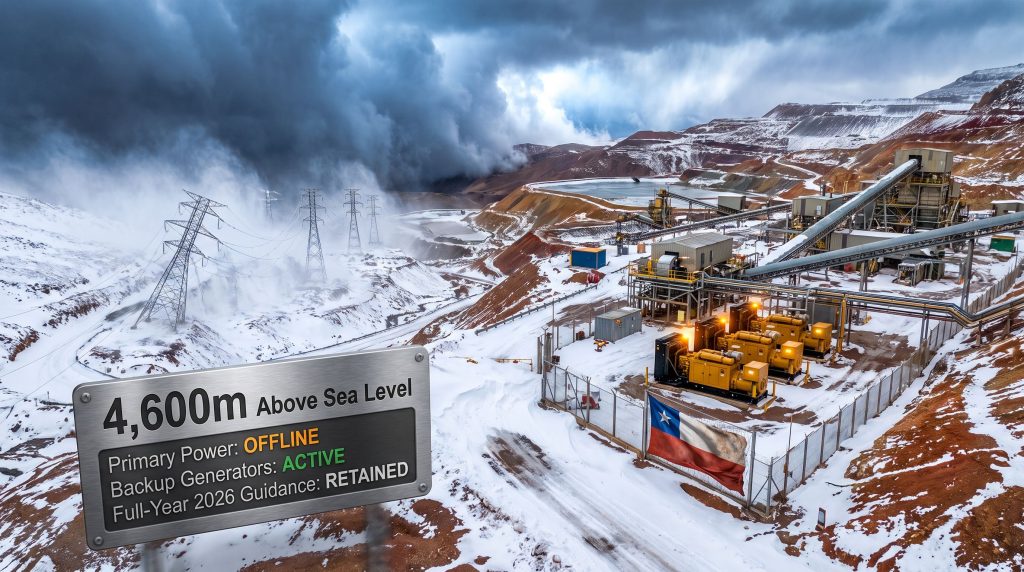
Few industrial environments on Earth test the limits of engineering and logistics quite like an open-pit copper mine operating at nearly 4,600 metres above sea level in Chile's Atacama Region. At that elevation, atmospheric oxygen sits roughly 40% below sea level norms, temperatures swing violently between day and night, and the infrastructure corridors connecting a mine to the outside world stretch across some of the most exposed terrain imaginable. The Lundin Caserones copper mine power cut in Chile offers a stark reminder of how quickly these conditions can force a complete operational suspension. When a severe Andean winter storm arrives, it can simultaneously disable power transmission, seal road access, and halt production within hours.
This is precisely the scenario that unfolded at the Caserones copper mine in mid-July 2026, offering a revealing case study in the operational fragility and resilience planning that defines high-altitude Andean mining. Understanding what happened, why it happened, and what it signals for the broader copper supply chain requires looking well beyond the immediate weather event.
When big ASX news breaks, our subscribers know first
Caserones in Context: Geology, Ownership, and Extreme-Altitude Operations
The Caserones deposit sits within the copper-molybdenum porphyry belt that runs along the Andean cordillera, a geological zone responsible for a substantial share of the world's copper endowment. Porphyry copper systems at these elevations are characterised by large, disseminated ore bodies with relatively consistent grades across extensive volumes of mineralised rock. At Caserones, copper mineralisation is associated with molybdenum credits, which contribute meaningful byproduct value to the operation's economics.
Operated by Lundin Mining, a globally significant base metals producer headquartered in Canada, Caserones was acquired as part of Lundin's strategic expansion into South American copper assets. The mine processes ore through a conventional concentrator circuit, producing copper concentrate for export. The combination of porphyry-style mineralisation, high-altitude location, and long-distance concentrate logistics makes Caserones both a high-value and high-complexity asset within Lundin's portfolio.
What is less commonly understood is how profoundly altitude shapes every aspect of mine engineering at a site like Caserones. Furthermore, these challenges compound one another during severe weather events:
- Processing equipment must be engineered or modified to account for reduced air density, which affects combustion efficiency, conveyor performance, and flotation dynamics in the concentrator
- Workforce health protocols are substantially more demanding than at lower-elevation operations, with acclimatisation periods, medical screening, and altitude illness monitoring forming part of standard operating procedure
- Diesel consumption rates for heavy mining equipment increase at altitude, raising operating costs relative to sea-level equivalents
- Emergency response times are extended by the combination of remoteness, elevation, and limited access corridor options
What Triggered the July 2026 Suspension at the Lundin Caserones Copper Mine
The Storm Event and Its Compounding Failures
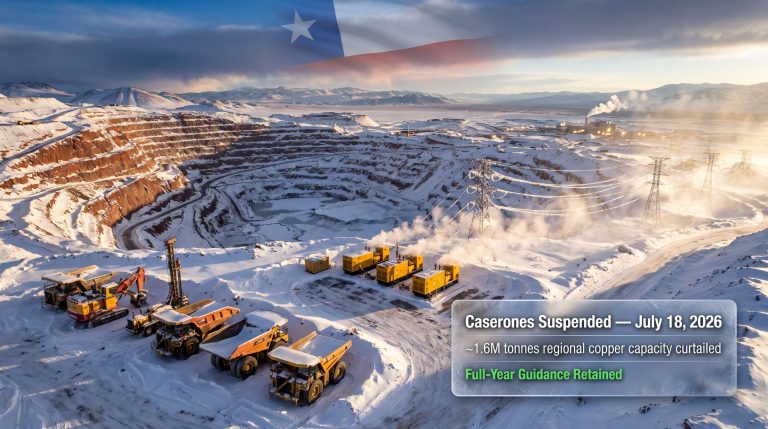
On approximately July 18, 2026, a severe winter storm descended on the Atacama Region's high-altitude zones, delivering heavy snowfall across the area where Caserones operates. What made this particular storm operationally decisive was not any single failure but the simultaneous disruption of two independent critical systems.
First, the mine's primary grid-connected electricity supply was compromised. High-voltage transmission lines serving remote Andean mining operations span enormous distances across exposed ridgelines and valley corridors. Snow loading on transmission infrastructure, combined with storm-force wind conditions, is a recognised failure mechanism for these long-haul power systems. When primary supply failed, the site transitioned to backup diesel generator capacity.
Second, and critically, the road access corridors serving Caserones were blocked by snow accumulation. At nearly 4,600 metres above sea level, even moderate snowfall events can render unpaved and semi-paved mountain access routes impassable. This is not merely an inconvenience. Blocked roads prevent equipment resupply, restrict personnel movement, and limit the ability to deploy repair crews to damaged transmission infrastructure.
The table below illustrates how these compounding failures translated into operational consequences:
| Failure Mode | Operational Consequence |
|---|---|
| Primary power supply disrupted | Processing plant and major equipment offline |
| Road access blocked by snow | Personnel mobility and resupply restricted |
| Elevation of approximately 4,600m | Limited options for rapid infrastructure repair |
| Backup generators activated | Critical safety and communications systems maintained |
Why Backup Generators Cannot Substitute for Full Grid Supply
A point that frequently escapes general understanding is the enormous power demand gap between critical safety loads and full production operations. A copper concentrator processing plant draws power at industrial scale across crushers, ball mills, flotation cells, thickeners, and ancillary systems. Backup diesel generation at a remote mine is typically sized to protect life-safety systems, maintain communications, power lighting, and sustain essential equipment — not to run a full processing circuit.
This architectural limitation means that once primary grid power fails at a site like Caserones, production suspension is not a precautionary choice. It is an engineering inevitability. The processing plant simply cannot operate at scale on backup generation capacity alone. Notably, Chile's copper supply role in the global market makes every such suspension consequential far beyond a single operation.
Recovery Timeline and Operational Restoration
By July 21, 2026, storm conditions had begun to ease, and Lundin's site teams were initiating assessment and recovery planning. However, easing weather does not equate to immediate operational resumption. The restoration sequence at a high-altitude mine following a multi-system disruption typically follows a staged progression:
- Weather confirmation — Verification that storm conditions have subsided sufficiently to allow safe movement of personnel and equipment
- Road clearing operations — Deployment of specialised snow-clearing equipment across access corridors, which at 4,600 metres can require days of sustained effort
- Infrastructure inspection — Physical assessment of transmission line integrity, substations, and power distribution equipment before reconnection is attempted
- Phased power restoration — Sequential reconnection of the grid supply, with load testing prior to committing production circuits
- Processing plant restart — Staged recommissioning of concentrator circuits, typically beginning with lower-intensity systems before bringing major mills and flotation banks online
Each of these steps carries its own timeline uncertainty, and the cumulative delay before full production resumes can extend well beyond the storm's own duration. For context, wild weather has previously disrupted copper mines and ports across central Chile in similar fashion.
Production Guidance and What Retained Guidance Actually Signals
Lundin's Decision to Maintain Full-Year 2026 Guidance
One of the most analytically important aspects of the July 2026 event is Lundin Mining's confirmation that its full-year 2026 copper production guidance for Caserones remains unchanged. To an uninformed observer, retaining guidance despite a multi-day operational suspension might appear optimistic or even dismissive of the disruption's scale. In practice, it signals something quite different.
Major mining companies operating assets in extreme climate environments build what are known as weather contingency buffers into their annual production plans. These are quantified allowances for expected production loss from predictable but timing-uncertain events: seasonal storms, access disruptions, power interruptions caused by weather. The buffer is calibrated using historical event data, climate models, and statistical analysis of prior disruption frequencies and durations.
When Lundin retains its guidance after a storm suspension, it is communicating that the duration and production impact of this specific event falls within the range that was already anticipated and absorbed in the plan. This is a materially different situation from an unplanned structural failure, equipment breakdown, or labour dispute — all of which would sit outside the weather contingency framework.
For investors evaluating mining companies with high-altitude Andean assets, guidance retention following a weather disruption is a credible signal of planning sophistication. It indicates the operator understands the probabilistic risk profile of the operating environment and has modelled it conservatively enough to absorb real-world disruptions without guidance revision.
When Guidance Retention Becomes a Watch Point
Retained guidance is reassuring only within limits. If road clearing or power restoration extends substantially beyond the initial recovery estimate, or if secondary damage is discovered during infrastructure inspection, the weather contingency buffer could be exhausted. Investors monitoring the Lundin Caserones copper mine situation should watch for:
- Any update indicating the restoration timeline has extended beyond the initial days-long estimate
- Communication about infrastructure damage beyond what weather loading alone would typically cause
- Commentary on water balance impacts at the processing plant, which can be affected by snow accumulation and subsequent melt volumes
How This Event Differs From Previous Disruptions at Caserones
The Caserones operation has a documented history of disruptions from causes including transmission infrastructure failures and, separately, labour relations issues. Indeed, a strike at Lundin's Caserones copper mine previously demonstrated how non-weather factors can equally destabilise production. However, the July 2026 event is structurally distinct from both prior categories.
Earlier transmission-related outages at Andean mines have sometimes been linked to grid-wide reliability issues across Chile's Sistema Eléctrico Nacional, where interconnected failures propagate across the network. The July 2026 event at Caserones was not a network-wide grid failure. It was a localised, weather-driven disruption to the specific transmission corridor serving the mine.
This distinction matters for two reasons. First, the recovery pathway is different. A weather-damaged transmission line serving one site requires localised repair, not system-wide grid stabilisation. Second, the insurance and operational accounting treatment differs between a network outage event and a site-specific weather casualty, which carries implications for how production losses are recorded and potentially recovered.
The next major ASX story will hit our subscribers first
The Structural Intersection of Climate Risk and Copper Supply Security
Why Extreme Weather at Andean Copper Mines Is a Growing Concern
Chile's Atacama Region hosts a disproportionate share of global copper production capacity. The country consistently produces approximately 25–28% of the world's mined copper supply, with high-altitude Andean operations contributing significantly to that total. Consequently, weather-related disruptions at individual mines carry supply chain relevance that extends well beyond any single company's production schedule. The Chile copper market outlook reflects just how integral these operations are to global supply dynamics.
What is increasingly understood within the industry, though less widely appreciated by broader markets, is that the frequency and intensity of extreme winter storm events at high Andean elevations is not static. Climate models applied to the central Andes suggest that while long-term precipitation averages may decline in some lower-elevation areas of the Atacama, high-altitude precipitation events are becoming more episodic and intense. For mine operators, this means that fewer but more severe storm events may define the risk profile of coming decades, rather than predictable seasonal snowfall patterns.
| Risk Factor | Current Exposure | Mitigation Pathway |
|---|---|---|
| Transmission line vulnerability | High (long exposed corridors) | On-site generation, microgrids |
| Road access disruption | High (single-route sites common) | Alternative access planning, strategic stockpiling |
| Seasonal storm intensity trends | Increasing at altitude | Advanced meteorological modelling integration |
| Production guidance volatility | Moderate (buffered by planning) | Expanded contingency allowances |
The Energy Transition Paradox Facing Andean Copper Producers
There is a structural irony embedded in the broader context of events like the Caserones suspension. The copper mined at high-altitude Andean operations is an essential feedstock for the global energy transition. EV battery systems, offshore wind transmission cables, grid-scale storage connections, and solar panel wiring all depend on copper supply. Furthermore, energy transition mining demands are accelerating precisely as physical climate risks intensify at the mines producing that copper.
Yet the same shifts in climate patterns driving demand for the energy transition's copper inputs are also intensifying the physical weather risks that periodically interrupt the production of that copper. This self-referential tension is not unique to Caserones or to Chile, but the Atacama's extreme operating environment makes it one of the most visible arenas where that tension plays out in real operational terms.
For mining engineers and capital allocators alike, the implication is clear. Investment in climate-resilient power infrastructure at high-altitude mines is transitioning from an aspirational sustainability initiative to a hard operational necessity. The broader copper supply crunch being felt across global markets only intensifies the urgency of this transition. Options being evaluated across the industry include:
- Modular on-site generation combining diesel, solar, and battery storage to reduce transmission dependency
- Redundant access road corridors engineered specifically for winter storm resilience
- Underground cable routing to protect critical power transmission segments from surface weather loading
- Real-time snowpack monitoring systems integrated with operational pre-positioning protocols
In addition, understanding the copper price growth drivers at play in 2025 and beyond helps contextualise why capital is increasingly flowing towards resilience infrastructure at sites like Caserones.
Frequently Asked Questions: Caserones Mine Power Cut and Suspension
When did operations at Caserones suspend in 2026?
The operational suspension at the Lundin Caserones copper mine power cut in Chile commenced on approximately July 18, 2026, following the onset of severe winter storm conditions across the high-altitude Atacama Region.
What specifically caused the power cut?
Heavy snowfall from the winter storm disrupted the mine's primary grid-connected electricity transmission infrastructure. Backup diesel generators were activated to maintain critical site functions, but full processing operations could not continue on backup power alone.
Did Lundin Mining revise its copper production guidance?
No. Lundin Mining confirmed its full-year 2026 copper production guidance for Caserones was retained, with the disruption's production impact falling within the weather contingency buffers already embedded in the annual plan.
How high is the Caserones mine and why does elevation matter?
Caserones operates at approximately 4,600 metres above sea level. At this altitude, reduced atmospheric oxygen affects equipment performance, road access corridors are acutely vulnerable to snowfall, and the distance of transmission infrastructure from grid connection points creates extended weather exposure.
How long before full operations resumed?
Storm conditions began easing on July 21, 2026, but full operational restoration was expected to require additional days beyond that point as access roads were cleared and power transmission infrastructure was inspected and reconnected.
Is this disruption related to Chile's broader electricity grid?
No. The July 2026 Caserones suspension was a site-specific, weather-induced event affecting the localised transmission corridor serving the mine. It was not connected to broader Sistema Eléctrico Nacional grid reliability issues or to any prior labour-related stoppages at the operation.
This article contains forward-looking references to production guidance and operational recovery timelines based on information available as of the date of publication. Mining operations are subject to numerous uncertainties including weather conditions, infrastructure performance, and regulatory requirements. Readers should not rely on this content as financial advice. Production outcomes may differ materially from guidance or expectation.
Want to Stay Ahead of the Next Major Copper Discovery on the ASX?
Discovery Alert's proprietary Discovery IQ model scans ASX announcements in real time, transforming complex mineral data into clear, actionable insights — so investors can identify significant copper and base metals discoveries the moment they are announced. Explore how historic discoveries have generated substantial returns on Discovery Alert's dedicated discoveries page, and begin a 14-day free trial today to position ahead of the market.