July 21, 2026
Europe's copper squeeze is becoming an execution story, not just a policy story
Copper shortages are often discussed as a distant energy transition problem, but in mining, supply stress is decided project by project, circuit by circuit, and permit by permit. That is why Eldorado Skouries processing plant commissioning matters. A commissioning milestone at a major copper-gold development inside the European Union does not solve the continent's raw material dependence on its own, but it does shift the conversation from theory to physical progress. Furthermore, the broader copper supply crunch reshaping global markets makes every operational advance like this one more consequential than it might otherwise appear.
The broader backdrop is clear. Copper sits at the heart of electrification because it is embedded in power grids, renewable generation, electric motors, transformers, charging systems, cabling and industrial equipment. Gold, while driven by a different demand profile, improves project economics in polymetallic systems by acting as a revenue support metal. In that context, Skouries is more than a local development in northern Greece. It is one of the more advanced large-scale copper-gold projects inside EU borders at a time when new mine supply globally has struggled to keep pace with long-range demand expectations.
The EU's Critical Raw Materials Act has intensified focus on domestic and regional sourcing. Concerns around European critical raw materials supply have pushed policymakers to accelerate strategies for supply chain resilience. However, investors should be careful with wording. The existence of a supportive policy framework does not mean project-specific backing, faster approvals, or official support for any one asset unless explicitly stated by the company.
The key significance of this milestone is simple: a large Western-jurisdiction copper-gold project has moved deeper into the operational phase, where value creation becomes more tangible and risks become more specific.
When big ASX news breaks, our subscribers know first
What Eldorado Skouries processing plant commissioning actually means
Commissioning is one of the most misunderstood phases in mine development. It is not the same as commercial production, and it is not a ceremonial moment. It is a structured process where each part of a processing plant is tested first in isolation and then as an integrated system.
A typical commissioning sequence looks like this:
- Mechanical completion
- Dry commissioning, where motors, conveyors, instruments and controls are tested without process fluids
- Wet commissioning, where water or slurry is introduced to validate flow, pumps, tanks, thickeners and piping
- First ore introduction, where actual mined rock enters the plant
- Ramp-up, where throughput, recoveries and reliability are progressively increased toward design levels
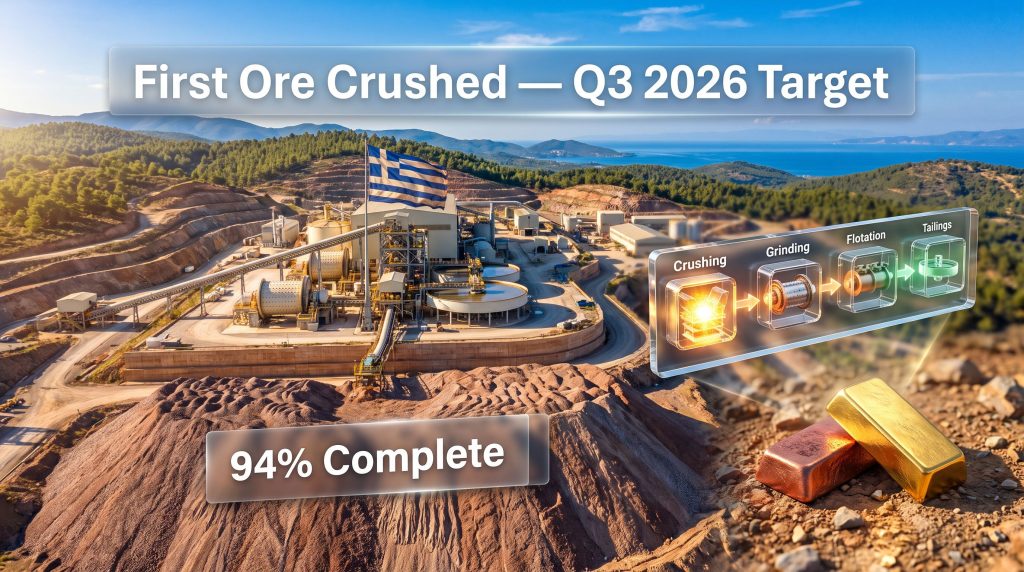
For Skouries, the most visible recent step is that first ore has been crushed through the processing plant's crushing circuit. According to the latest operational reporting, this confirms that the front end of the plant is behaving as expected. That may sound narrow, but it is a meaningful checkpoint because failures in crushing can choke the entire downstream process.
Why first ore crushed matters to investors
The phrase first ore crushed is often treated like a headline marker, but operationally it signals several things at once:
- Ore handling systems are functioning under real load
- The crusher, conveyors, transfer points and controls have moved beyond simulation and no-load tests
- The plant is transitioning from construction logic to operating logic
- Downstream bottlenecks become easier to identify because feed is now entering the process chain
Plants can still face setbacks after this point. Grinding, flotation, concentrate handling, water balance, tailings filtration and electrical integration may each create delays. However, first ore is still a major threshold because many projects stall before they ever process mined material.
Where Skouries stands now
As of March 31, 2026, the Skouries project was reported at 94% overall completion. By July 2026, the site had entered commissioning, and ore was being processed through the crushing circuit. Eldorado has also indicated that first copper-gold concentrate is targeted before the end of Q3 2026, with commercial production expected in Q4 2026, subject to final site energisation and ramp-up.
The status of major plant areas can be summarised as follows:
| Processing area | Current status | Why it matters |
|---|---|---|
| Crushing circuit | First ore processed; handover to operations underway | Confirms front-end readiness |
| Grinding circuit | Instrumentation pre-commissioning under way | Critical for throughput and liberation |
| Flotation circuit | Air and instrumentation pre-commissioning started | Core separation stage for concentrate quality |
| Process water systems | Wet commissioning active | Essential for stable slurry movement |
| Tailings thickeners | Two of three mechanically complete | Important for dewatering and plant balance |
| Filtered tailings plant | Still a key final stage | Identified as a critical path item |
| Electrical rooms and controls | Handover to commissioning progressing | Needed for integrated automation |
| Compressors and blowers | Construction complete and handed over | Supports utilities and process stability |
This is the phase where investors should stop thinking in binary terms such as built or not built. A mine plant nearing completion can be substantially constructed yet still operationally exposed to a few narrow but highly consequential tasks.
Why the schedule changed
The revised timeline is important because it reminds investors that late-stage mining projects rarely move in perfectly straight lines.
The original and revised targets are as follows:
| Milestone | Original target | Revised 2026 target |
|---|---|---|
| First copper-gold concentrate | Q1 2026 | Q3 2026 |
| Commercial production | Mid-2026 | Q4 2026 |
| First cash flow generation | H1 2026 | H2 2026 |
Two main factors were cited behind the delay:
- Moisture-related damage to variable speed drive capacitors in the main mill discharge cyclone feed pump system, requiring replacement and re-testing
- Slower-than-expected approvals linked to the permanent power line connection, which delayed full site energisation
The cost impact attached to the delay and remediation was estimated at about $50 million in additional construction capital. Consequently, understanding the copper price growth drivers that support project economics becomes especially important when assessing whether additional capital expenditure remains justified.
This matters because mining investors often underestimate how small component issues can disturb an entire schedule. A failed drive element inside a critical pump system can delay wet testing, balanced commissioning, ore movement, and ultimately concentrate production. In other words, tiny hardware faults can have enterprise-level timing consequences.
The importance of the 3.9-million-tonne ore stockpile
One of the more constructive details in the Skouries update is the ore inventory already built on surface. The site has accumulated about 3.9 million tonnes of ore, of which roughly 3.4 million tonnes came from open pit mining.
That stockpile matters for several reasons:
- It reduces start-up vulnerability because the plant does not depend on mine crews delivering every tonne in real time during the most delicate ramp-up months
- It supports operating flexibility if plant tuning takes longer than expected
- It indicates mining performance has been robust, with open pit activity running ahead of schedule
- It gives management more options in blending feed and sequencing material during early production
In practice, a sizeable stockpile acts like an operational shock absorber. During commissioning, plants rarely run smoothly from day one. Throughput fluctuates. Wear rates get refined. Instrument calibration changes. Water balance can behave differently from the model. Having ore already stacked nearby reduces one layer of risk.
A pre-built ore buffer is one of the clearest signs that commissioning risk is becoming more concentrated in the plant, not the mine.
The biggest remaining risks before commercial production
Even with strong progress, Skouries is not risk-free. The remaining issues are narrower than they were a year ago, but they are still material.
1. Final energisation remains a gating item
The final transmission tower has been installed, which signals the physical line build is complete. However, full site energisation still depends on a final inspection and sign-off by the relevant Greek authority. Until that occurs, permanent grid-connected power remains pending.
Eldorado has said it added additional generators to provide interim processing-plant power as required. That is a practical mitigation, but it is not a perfect substitute for full permanent energisation across a large integrated operation.
2. Tailings systems are still on the critical path
The filtered tailings plant remains especially important. Tailings filtration is often less glamorous than crushing or milling, but in modern plant design it can become a schedule-defining element. If filtration cannot keep pace, the rest of the circuit may not sustain target operating rates.
3. Grinding and flotation must prove stable at scale
Pre-commissioning work in the SAG mill, ball mill and flotation systems still has to translate into reliable integrated performance. Grinding is where ore is reduced for mineral liberation, while flotation is where valuable sulphide particles are separated into concentrate. Problems in either step can affect recovery, concentrate grade and throughput.
A concise risk map looks like this:
| Risk category | Specific issue | Current mitigation |
|---|---|---|
| Regulatory | Final sign-off for grid connection | Interim generators in use |
| Technical | Filtered tailings plant delay | Prioritised as critical path |
| Technical | Reliability after drive-system repairs | Replacement and re-testing completed |
| Operational | Feed continuity during ramp-up | 3.9 Mt ore stockpile |
| Financial | Additional capital burden | Incorporated into revised project spending |
The next major ASX story will hit our subscribers first
How Skouries fits into Europe's mining pipeline
Europe has relatively few copper projects that are truly in construction or commissioning, rather than still navigating studies, funding or permitting. That gives Skouries unusual weight in regional supply discussions. In addition, completing a rigorous definitive feasibility study in earlier project phases gave Eldorado a stronger technical foundation as it approached this critical stage.
Several characteristics make it stand out:
- EU location, which matters for supply chain diversification
- Copper-gold polymetallic economics, which can be more resilient than single-commodity projects
- Advanced construction status, now moving into full commissioning
- Timing, as new global copper supply remains constrained relative to long-term demand scenarios
Industry forecasts from major market participants and international institutions have repeatedly pointed to stronger copper demand into the mid-2030s, driven by electrification and grid investment. Estimates vary by source, but a commonly cited range implies demand could run 20% to 30% above current consumption levels over that period. Forecasts are inherently uncertain, but the direction of travel is widely understood.
That does not guarantee high prices or perfect margins. Copper markets are cyclical, treatment charges move, and project ramp-ups can disappoint. Still, projects entering production in 2026 are arriving during a period when the market has become increasingly sensitive to real, buildable tonnes rather than conceptual supply. Furthermore, careful attention to cut-off grade economics will remain essential as the team optimises ore selection during ramp-up.
Investor takeaway: what this commissioning milestone does and does not prove
For investors, Eldorado Skouries processing plant commissioning should be viewed through a probability lens.
What this milestone does support:
- Construction risk has materially fallen
- The crushing front end is functioning with ore
- Mining readiness is strong, helped by the large stockpile
- The project is much closer to cash generation than early-stage developers
What it does not prove yet:
- That the full plant will ramp smoothly to nameplate capability
- That all remaining circuits will clear commissioning without slippage
- That final power-related dependencies will resolve on the company's preferred timetable
- That market conditions at ramp-up will perfectly reward the asset
A sensible investing framework here is to distinguish between existential risk and execution risk. Skouries appears to have moved much further away from existential questions like whether it will be built at all. The remaining debate is now mostly about execution quality, timing, and how efficiently the asset crosses from commissioning into stable commercial production.
This article is for informational purposes only and is not financial advice. Production targets, commissioning timelines, capital impacts and demand outlooks involve uncertainty and may change as further operational data becomes available.
In short, the latest progress at Skouries is not the start of the story. It is the narrowing of the risk corridor. With 94% completion, first ore through crushing, a 3.9-million-tonne ore stockpile, and a path toward first concentrate in Q3 2026 and commercial production in Q4 2026, the project now sits in the final stretch where engineering detail matters more than broad narrative. For Europe's copper supply picture, that is a meaningful development.
Want To Track the Next Major Copper Discovery Before the Market Does?
Discovery Alert's proprietary Discovery IQ model delivers real-time alerts on significant ASX mineral discoveries, instantly translating complex mineral data into actionable opportunities for both short-term traders and long-term investors — explore historic discovery returns on Discovery Alert's discoveries page to see what's possible, and begin your 14-day free trial today to position yourself ahead of the market.