July 21, 2026
The Hidden Economics of Multi-Front Underground Mining and Why It Changes Everything
Underground copper mining is not simply a matter of digging deeper. The architecture of how a mine is spatially organised across multiple working fronts determines everything from unit cost structure to operational resilience. When a single mining front becomes exhausted or encounters geotechnical challenges, the entire production system feels the impact. This is precisely why the decision to introduce a third underground mining front at Kanmantoo represents a more consequential operational shift than headline capital figures might suggest.
The Hillgrove Emily Star development at Kanmantoo copper mine, board-approved in July 2026, is not an isolated expansion event. It is the latest expression of a deliberate systems-level production strategy that has been quietly reshaping how this South Australian operation manages throughput, cost, and mine life simultaneously.
When big ASX news breaks, our subscribers know first
What Emily Star Actually Is and Where It Sits in the Kanmantoo System
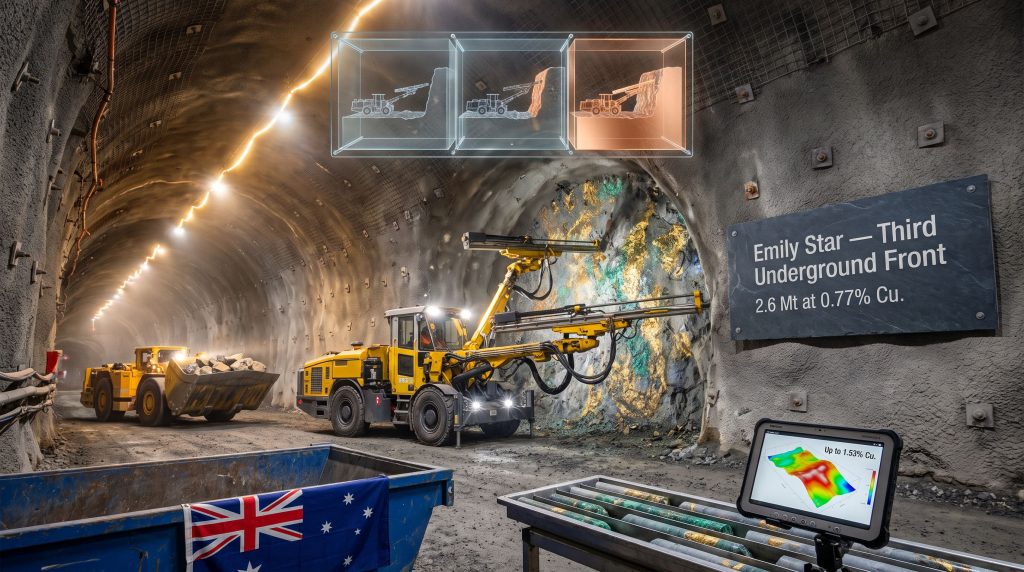
The Kanmantoo copper mine has evolved from an open-pit operation into a progressively more complex underground system. Emily Star represents the third underground mining front to be formally commissioned within this system, following the Kavanagh production zone and the Nugent development front.
Understanding why a third front matters requires appreciating the production logic of underground mines. Each mining front provides:
- Independent ore sources that can be scheduled and blended to maintain plant feed grade
- Redundancy against geotechnical delays or equipment downtime at any single front
- The ability to sustain or grow throughput while development work continues elsewhere
- Staggered depletion timelines that extend the useful operating life of surface infrastructure
Emily Star is designed to partially displace lower-level Kavanagh production as those ore zones approach depletion. Rather than waiting for Kavanagh to wind down before identifying a replacement, Hillgrove has overlapped the development cycle to maintain continuity of feed. This sequencing discipline is a hallmark of well-managed underground operations and is far less common among smaller ASX-listed miners than institutional investors might assume.
The Mineral Resource: Grade Profile, High-Grade Intercepts, and What the Numbers Mean
The foundation of the Emily Star investment decision rests on the 2024 Emily Star Mineral Resource Estimate. The deposit carries an inferred classification across its full extent, which is a standard starting point for underground development decisions of this type. Inferred resources carry higher geological uncertainty than indicated or measured categories, but drilling at the upper levels of Emily Star has confirmed that grade distribution aligns with the block model, reducing geological risk in the near-term mining zones.
| Parameter | Estimate |
|---|---|
| Resource Classification | Inferred |
| Total Resource Tonnage | 2.6 million tonnes (Mt) |
| Copper Grade | 0.77% Cu |
| Gold Grade | 0.08 g/t Au |
| High-Grade Intercept (Cu) | Up to 1.53% Cu |
| High-Grade Intercept (Au) | Up to 0.21 g/t Au |
| Average Stope Size | ~35,000 tonnes |
The headline grade of 0.77% Cu is worth contextualising. Australian underground copper operations have historically targeted grades above 1% Cu to justify the capital intensity of decline and stope development. Emily Star sits below this informal threshold, which makes the fixed-cost absorption argument central to the economic case. At a 2 million tonne per annum (Mtpa) system-wide run rate, the Kanmantoo processing plant operates near capacity, and the marginal cost of processing additional tonnes from Emily Star becomes substantially lower than the average fully-loaded cost.
Furthermore, when interpreting drill results from this deposit, the presence of high-grade intercepts reaching 1.53% Cu within an inferred resource is significant. As infill drilling converts inferred material to indicated classification, there is genuine potential for the grade profile to improve in zones where the block model currently blends high and low-grade domains. This upside optionality is not priced into the development decision but represents meaningful value if drilling outcomes are favourable.
The gold credits at 0.08 g/t Au, while modest, contribute to overall revenue per tonne and partially offset copper price volatility. The high-grade gold intercepts of up to 0.21 g/t Au suggest selective higher-value material exists within the broader resource envelope.
Geotechnical Realities: Variable Ground Conditions and Conservative Mine Planning
One of the less discussed but critically important aspects of the Emily Star development is the geotechnical characterisation work completed ahead of the board approval. Geotechnical logging and structural interpretation identified variable ground conditions typical of the broader Kanmantoo geological system.
This finding carries specific meaning for underground mining professionals. Variable ground conditions in South Australian basement geology typically refer to:
- Alternating competent and fractured rock mass domains
- Fault and shear zone intersections that require modified support strategies
- Stress regime variability that influences decline orientation and stope sequencing decisions
- Potential for localised squeezing or ravelling in weaker geological domains
In addition, the use of accurate geological logging codes during this characterisation phase ensures that geotechnical findings are recorded consistently and can be compared reliably across different zones of the deposit.
Critically, the geotechnical assessment found no conditions that would prevent development or future stoping. This is the key binary outcome that underpins the investment decision. Mine planning has incorporated conservative ground-support parameters and decline-advance assumptions, which effectively builds a buffer into both the cost estimate and the development schedule.
What this means practically is that the $20 to $22 million AUD capital estimate already accounts for more robust ground support than would be required in ideal conditions. If ground conditions at depth prove better than the conservative assumptions, there is scope for schedule improvement and modest capital savings. If conditions prove as challenging as the worst-case geotechnical scenario, the estimate remains valid.
Capital Structure: The Significance of Cash-Flow Funding
The funding mechanism for the Hillgrove Emily Star development at Kanmantoo copper mine deserves more analytical attention than it typically receives in coverage of junior and mid-tier ASX miners.
| Cost Component | AUD Estimate | USD Equivalent |
|---|---|---|
| Total Development Capital | $20-$22 million | ~USD $14-$15.4 million |
| Prior Drilling and Early Works | $2.9 million | ~USD $2.03 million |
| Total All-In Capital Commitment | ~$22.9-$24.9 million | ~USD $16-$17.4 million |
| 2026 H2 Planned Spend | $6.5-$7.5 million | Approx. USD $4.6-$5.3 million |
The entire programme will be funded from Hillgrove's operating cash flow. No equity raising. No debt facility. This is a materially different risk profile compared to exploration-stage or development-stage copper companies that must access capital markets at potentially unfavourable dilution rates to fund equivalent programmes.
For context, a capital requirement of approximately $23 to $25 million AUD funded entirely from operations implies that Kanmantoo is generating meaningful free cash flow at current copper prices. This operational cash generation capacity simultaneously funds Emily Star development and the concurrent Mutooroo Prefeasibility Study Phase 1, which triggered a revised 2026 Major Capital Guidance of $15 to $17 million AUD (up from the previous $8 to $10 million guidance range).
The upward revision of capital guidance is an important signal. Management is deploying more capital precisely because the business can support it, not because it is being forced into investment by competitive or operational necessity.
The Ventilation Raise Bore: A Technical Detail That Explains the Cost Premium
The primary reason Emily Star carries a modestly higher capital cost than the preceding Nugent development is the requirement for an additional ventilation raise bore. This technical distinction is worth understanding because it reveals something important about underground mine spatial planning.
Raise bore ventilation infrastructure is not simply a cost item. It is a fundamental safety and operational prerequisite for underground mining beyond certain depths and distances from existing air circuits. Australian underground mines operating under the relevant state Work Health and Safety legislation must maintain minimum airflow velocities and volume requirements across all working areas.
Emily Star's position within the Kanmantoo mine layout requires a dedicated ventilation raise bore because:
- It occupies a spatial zone not adequately served by the existing ventilation network
- The stoping areas, once operational, will require sustained fresh air volumes for personnel, equipment exhaust dilution, and blast fume clearance
- Raise bore drilling is a specialised operation requiring contracted equipment and is typically on the critical path for decline development timelines
This single infrastructure item accounts for the capital cost differential versus Nugent, confirming that the underlying deposit and development complexity are broadly comparable.
The next major ASX story will hit our subscribers first
Development Timeline and the PEPR Approval Critical Path
The staged development sequence for Emily Star follows a logical progression, with each phase unlocking the next:
- Drilling and early works (completed): $2.9 million invested to validate the geological model and establish site readiness
- Decline development (commenced July 2026): Primary access decline driven toward stoping horizons
- Ventilation raise bore installation: Critical infrastructure enabling safe operations at depth
- Level access development: Horizontal drives established at stoping levels to define stope boundaries
- First stoping commencement (targeted H2 2027): Production extraction from initial stope panels
- Full system integration: Emily Star production combined with Kavanagh and Nugent output to achieve 2 Mtpa system run rate
A Stage 2 Final Investment Decision was anticipated for the September quarter of 2026, informed by ongoing infill drilling results. This FID represents the formal commitment gate for deeper development phases and will be an important milestone for investors monitoring the project's progression. Understanding the full range of feasibility study stages helps contextualise how this FID fits within a broader development framework.
The PEPR (Programme for Environment Protection and Rehabilitation) framework is a South Australian regulatory instrument specific to the state's mining legislation. Unlike environmental impact assessments in some other jurisdictions, the PEPR is a living document that must be updated whenever a mining operation materially changes its activities. The critical timing point is that the updated PEPR must be approved before stoping commences, even though early decline development can proceed under the existing PEPR framework.
This regulatory architecture has a practical implication: Hillgrove can maintain physical development momentum through the decline and level access phases while the PEPR update works through the approval process. The two streams run in parallel rather than sequentially, which is the optimal approach to managing regulatory timeline risk against H2 2027 targets.
Fixed-Cost Leverage and the Unit Economics of 2 Mtpa Production
The economic rationale underpinning the Hillgrove Emily Star development at Kanmantoo copper mine extends well beyond the resource tonnes that Emily Star itself contributes. The deeper value proposition lies in what happens to the processing plant's unit cost structure as throughput increases toward the 2 Mtpa run rate.
Underground mines carry two fundamentally different cost categories:
- Variable costs: Explosives consumption, grinding media, reagents, contractor haulage rates, and similar items that scale roughly proportionally with tonnes mined and processed
- Fixed costs: Plant maintenance, site administration, environmental monitoring, infrastructure upkeep, and similar items that remain largely constant regardless of throughput volume
When a processing plant operates below its design capacity, fixed costs are divided across fewer tonnes, inflating the cost per tonne metric. When throughput increases toward design capacity, those same fixed costs are absorbed across a larger production base. The incremental tonnes from Emily Star carry a fixed-cost component significantly lower than the average, improving overall mine economics without requiring a copper price increase.
This dynamic is one reason why multi-front underground operations are structurally more cost-competitive than single-front operations of equivalent total resource size. The Kanmantoo system's evolution toward three active mining fronts represents a deliberate strategy to optimise this cost leverage.
Portfolio Context: Reading Emily Star Alongside the Mutooroo PFS
The simultaneous approval of Emily Star development and advancement of the Mutooroo Prefeasibility Study Phase 1 provides an important lens for interpreting Hillgrove's strategic positioning. These are not coincidental parallel activities. Together, they outline a transition pathway from a single-asset underground operator toward a broader South Australian copper producer.
Mutooroo, as a geographically separate project, introduces:
- Geological diversification beyond the Kanmantoo basement geology system
- A future production option that does not depend on Kanmantoo's mine life trajectory
- Potential scale growth beyond what can be achieved through Kanmantoo system optimisation alone
The revised 2026 Major Capital Guidance of $15 to $17 million AUD encompasses both Emily Star and Mutooroo PFS Phase 1 expenditure, confirming that the company is allocating capital across both near-term production optimisation and medium-term growth optionality simultaneously.
Investor Considerations and Risk Factors
The following section contains forward-looking analysis and should not be construed as financial advice. Investors should conduct independent due diligence and consider their personal risk tolerance before making investment decisions.
Several risk factors are material to the Emily Star development outcome:
- PEPR approval timing: Any delay in South Australian regulatory processing could push the H2 2027 stoping target into 2028
- Copper price variability: The unit cost improvement thesis assumes sustained plant throughput; a significant copper price decline could alter the capital allocation calculus
- Geotechnical performance: While conservative parameters have been incorporated, actual ground conditions at depth may require schedule or cost adjustments
- Infill drilling outcomes: The inferred resource classification means geological confidence at depth is lower than at the validated upper levels; drill results ahead of the Stage 2 FID will be significant data points
Offsetting these risks, the cash-flow funding structure eliminates dilution risk and the conservative mine planning assumptions build schedule buffer into the development timeline.
However, global copper demand growth trajectories driven by electrification infrastructure, battery storage deployment, and grid expansion provide a supportive macro backdrop for Australian copper producers with funded development pipelines. The copper supply crunch anticipated through the late 2020s positions well-timed production additions favourably relative to future demand curves. Consequently, investors exploring copper investment strategies will find that funded, operationally de-risked development pipelines like Emily Star represent a distinctly different proposition from earlier-stage exploration plays.
Further technical context on underground mine development practices and Australian copper operations is available through the Engineering and Mining Journal at e-mj.com, which provides ongoing industry coverage across Australian and global mining sectors.
Want to Stay Ahead of Significant ASX Copper Discoveries?
Discovery Alert's proprietary Discovery IQ model delivers real-time alerts on significant ASX mineral discoveries, instantly translating complex geological data into actionable investment insights for both short-term traders and long-term investors — begin your 14-day free trial today and explore historic examples of exceptional discovery returns to understand what well-timed positioning in major mineral finds can mean for a portfolio.