July 21, 2026
When the Sky Falls on the World's Copper Belt
Few geological realities are as paradoxical as Chile's Atacama Region. Widely regarded as the driest non-polar desert on Earth, it simultaneously hosts some of the planet's most significant copper and molybdenum deposits while remaining vulnerable to periodic, intense weather events that can bring high-altitude operations to a standstill within hours. For investors and mining analysts tracking Lundin Mining Chile adverse weather operations, understanding this paradox is not merely academic. It is a prerequisite for interpreting operational disruptions accurately and avoiding reactive, sentiment-driven investment decisions.
When big ASX news breaks, our subscribers know first
The Atacama's Hidden Climate Complexity
Altitude, Aridity, and the Altiplanic Winter
The Atacama Region's reputation for extreme dryness applies primarily to its lower-elevation coastal and mid-altitude zones. Above 3,500 metres, the climate calculus changes dramatically. High-altitude operations in northern Chile are exposed to what meteorologists call the Altiplanic Winter, also known as the Bolivian Winter, a seasonal weather phenomenon occurring roughly between June and August each year.
During this period, moisture-laden air masses originating over the Amazon Basin are pushed westward and upward by atmospheric circulation patterns, colliding with the Andean plateau. The result is a concentrated burst of precipitation, including heavy snowfall at elevation and intense rainfall at lower altitudes, that can materialise rapidly and with significant operational consequences for mines situated in exposed terrain.
What makes this phenomenon particularly relevant for high-altitude copper mining is its predictability in terms of when it occurs, combined with its unpredictability in terms of severity. Experienced operators in the region model for it annually, but the intensity of any given event can exceed planning assumptions, triggering partial or full operational suspensions. Furthermore, extreme weather is becoming a major threat for mining companies operating across climatically volatile jurisdictions worldwide.
Why Lundin Mining Carries Concentrated Regional Weather Risk
Lundin Mining operates two significant Chilean assets within the same northern corridor:
- Candelaria, a large copper mining complex situated at comparatively lower elevation, producing copper concentrate as its primary output.
- Caserones, a high-altitude copper and molybdenum operation positioned at approximately 4,600 metres above sea level, placing it among the most elevated large-scale mining operations in South America.
This dual-asset exposure within a single geographic weather corridor means that when a significant Altiplanic Winter event strikes, both operations face simultaneous pressure. Consequently, this amplifies the aggregate risk to production in a way that a geographically diversified portfolio would not. The Chile copper market outlook makes this structural concentration risk even more significant for global supply forecasts.
The July 2026 Event: What Actually Happened
Caserones: When Three Problems Compound Simultaneously
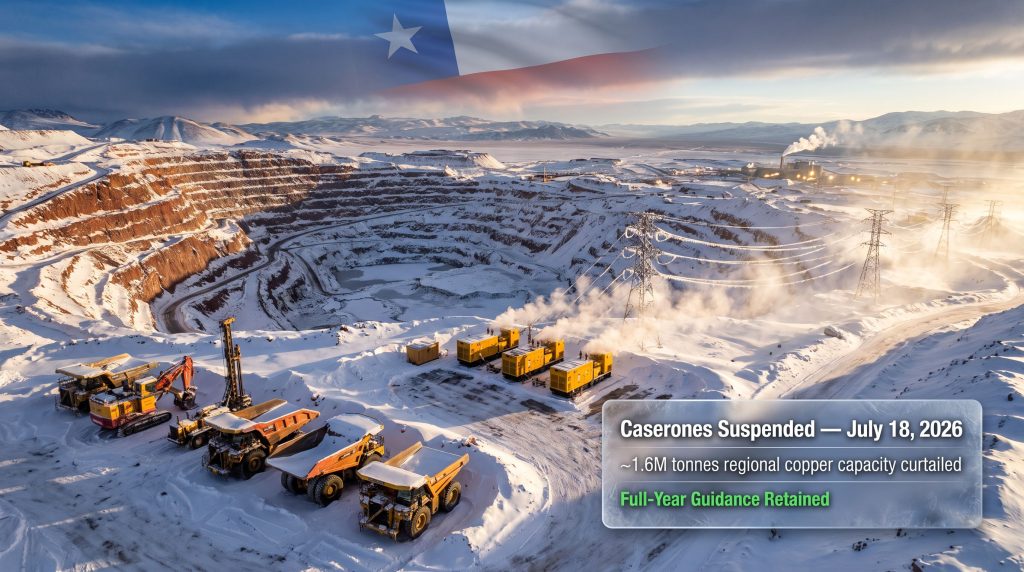
From July 18, 2026, Caserones experienced a complete operational suspension driven by three converging disruption factors:
- Heavy snowfall that physically blocked access to most operational areas of the site.
- Disruption to the primary electricity supply infrastructure serving the mine.
- Restricted mobility for personnel and heavy mining equipment across the site.
The combination of these three factors, rather than any single one in isolation, was what necessitated full suspension. Backup power generators were activated to sustain critical site functions during the downtime, including safety systems, communications infrastructure, and essential environmental monitoring equipment.
Resumption at Caserones remained conditional on two specific thresholds being met: restoration of grid power supply and re-establishment of safe physical access across the site. As of the July 21, 2026 reporting date, the primary storm system had begun weakening, with rainfall forecast to ease over a 24 to 48 hour window, though additional less severe weather systems were anticipated to move through the region in the days following.
Candelaria: Operational Resilience in Practice
At Candelaria, the impact profile was meaningfully different. Heavy rainfall affected open-pit mining activities, but crucially, the processing mill continued to operate throughout the event by drawing on pre-positioned ore stockpiles that had been accumulated ahead of the forecast weather. This is a critical operational distinction. Mining and processing are two separate phases of production, and the ability to decouple them through strategic stockpile management allows operators to maintain revenue-generating throughput even when upstream mining activities are curtailed.
| Operation | Primary Commodity | Weather Impact | Operational Status | Key Resilience Tool |
|---|---|---|---|---|
| Caserones | Copper / Molybdenum | Snowfall + Power Outage + Access Blockage | Fully Suspended from July 18 | Backup generators for critical systems |
| Candelaria | Copper | Heavy Rainfall | Partially Impacted | Mill operating on ore stockpiles |
Guidance Retention: Reading the Signal Correctly
Why Maintaining Full-Year Guidance Matters More Than It Seems
Lundin Mining confirmed it retains its full-year production guidance for Caserones following the suspension event. For investors assessing Lundin Mining Chile adverse weather operations, this is the single most important signal to extract from the announcement. It communicates that the suspension falls within the weather disruption parameters already embedded in the company's annual production model.
When a mining operator explicitly confirms that weather disruptions are pre-modelled within annual guidance, it indicates the event falls within expected operational parameters, materially reducing the probability of a production downgrade announcement.
This practice, often described informally as weather-buffered guidance, reflects a planning methodology common among experienced operators in climatically volatile high-altitude jurisdictions. The key investor implication is the distinction between guidance that absorbs expected weather risk versus guidance that excludes force majeure events. When a company retains guidance through a weather event, it signals robust scheduling management and adequate stockpile buffers. When guidance is revised downward, however, it signals the event exceeded the pre-modelled allowance.
The Investor Framework for Duration Sensitivity
Weather-driven suspensions carry asymmetric risk profiles based on duration:
- Suspensions of one to five days typically fall within pre-modelled guidance buffers and carry limited long-term production impact.
- Suspensions extending one to two weeks begin to erode buffer capacity and increase the probability of guidance revision.
- Suspensions exceeding two to three weeks commonly trigger formal guidance downgrades and may affect quarterly reporting.
The July 2026 Caserones event, with its primary storm system expected to ease within 24 to 48 hours of the July 21 reporting date, appears positioned well within the first category. This is consistent with Lundin Mining's guidance retention announcement and reinforces understanding of the copper price growth drivers that underpin longer-term investor confidence in Chilean assets.
The Broader Market Dimension: Chile's Structural Copper Dominance
A Single Country, a Systemic Supply Variable
Chile accounts for approximately 25 to 27% of global mined copper production, making it uniquely positioned to influence global copper supply dynamics when disruptions are widespread across its northern mining corridor. The Atacama Region specifically hosts a disproportionate concentration of Chile's highest-grade copper and copper-molybdenum assets, including operations run by multiple major international producers.
The July 2026 storm system was not isolated to Lundin Mining's assets. It represented a corridor-wide disruption event affecting multiple operators simultaneously. Across the affected zone, an estimated 1.6 million tonnes of annualised copper production capacity faced temporary curtailment across the various impacted operators. In addition, the copper supply crunch already pressuring global markets means that even short-duration corridor-wide disruptions carry heightened near-term price significance.
The Molybdenum Dimension: An Underappreciated Risk Layer
Caserones is a dual-commodity operation, producing both copper and molybdenum. This is a detail that receives less attention than it warrants in broader market coverage of Atacama weather events.
Molybdenum is an industrial metal primarily used in the production of high-strength steel alloys, superalloys for aerospace applications, and specialty chemical catalysts. Its market is structurally far less liquid than copper, with a smaller and more concentrated producer base globally. This means that weather-related production suspensions at key molybdenum operations can carry a price-sensitivity impact that is disproportionate relative to the volume of metal involved.
Investors in diversified base metals producers with dual-commodity exposure at high-altitude Chilean assets should, therefore, incorporate this molybdenum dimension into their risk assessments, particularly during peak Altiplanic Winter periods.
Operational Risk Management at High-Altitude Mine Sites
Pre-Event Precautionary Protocols
Experienced operators do not wait for weather to arrive before activating protective measures. Ahead of the July 2026 event, precautionary steps were taken to protect both personnel and physical infrastructure at both the Candelaria and Caserones complexes. Standard pre-event protocols across the industry typically include:
- Personnel safety assessments and shelter-in-place or evacuation decisions based on forecast severity.
- Protection of exposed electrical and mechanical infrastructure to minimise weather-related damage.
- Strategic pre-positioning of ore stockpiles to sustain downstream processing during potential mining stoppages.
- Fuel inventory checks and generator readiness verification for backup power systems.
Processing Decoupling as a Revenue Protection Mechanism
The ore stockpile strategy employed at Candelaria during the July 2026 event represents one of the most practically important risk management tools available to mining operators in weather-exposed environments. By accumulating processed ore ahead of forecast weather windows, operators can sustain mill throughput, and therefore revenue generation, even when upstream mining activities are fully suspended.
The use of pre-positioned ore stockpiles as a processing buffer decouples short-term mining disruptions from mill output, protecting revenue continuity during weather events that would otherwise create direct production gaps.
This strategy is particularly effective at operations like Candelaria, where the processing infrastructure is located at lower elevation than the mining face, and where ore transport logistics allow for meaningful pre-event accumulation. The Chile copper price forecast for coming years further underscores why protecting operational continuity at these assets carries significant commercial value for investors.
The next major ASX story will hit our subscribers first
Frequently Asked Questions: Lundin Mining Chile Adverse Weather Operations
Why Was Caserones Fully Suspended While Candelaria Continued Processing?
The two operations face fundamentally different weather exposure profiles. Caserones sits at approximately 4,600 metres elevation, where heavy snowfall simultaneously blocked physical site access and disrupted primary power supply, creating conditions where continued operations were both unsafe and logistically impossible. Candelaria, at lower elevation, experienced heavy rainfall but retained access and power continuity, allowing its mill to keep running on pre-positioned stockpiles.
Does the Caserones Suspension Affect Lundin Mining's Annual Production Targets?
Lundin Mining confirmed it retains its full-year production guidance, indicating the suspension falls within the weather disruption allowances already incorporated into its annual planning model.
How Long Was the Suspension Expected to Last?
The primary storm system was forecast to weaken within 24 to 48 hours of the July 21, 2026 reporting date. Resumption at Caserones remained contingent on power restoration and safe access re-establishment, which may require additional days beyond the weather clearing.
Is the Altiplanic Winter a Recurring Operational Risk for Chilean Copper Producers?
Yes. Periodic extreme winter weather events driven by the Altiplanic Winter phenomenon are a recognised, recurring seasonal risk for high-altitude mining operations across northern Chile. Experienced operators in the region model for these disruption windows as a standard variable within annual production and guidance frameworks. Understanding Chile's copper supply gap helps contextualise why even temporary suspensions attract close market scrutiny.
Why Does Caserones Producing Molybdenum Matter to Broader Markets?
Molybdenum markets are structurally tighter and less liquid than copper markets. Supply disruptions at major molybdenum-producing operations can carry price sensitivity that is disproportionate to the physical volume of metal involved, making dual-commodity disruptions at operations like Caserones a more nuanced market event than copper-only suspensions. Lundin Mining has previously confirmed disruptions at nearby Chilean assets, further illustrating the operational complexity of managing multiple sites across the Atacama corridor.
Key Takeaways
- Caserones operations were fully suspended from July 18, 2026, due to compounding snowfall-driven access restrictions, power infrastructure disruption, and personnel mobility constraints.
- Candelaria's processing mill remained operational throughout the event, sustained by pre-positioned ore stockpiles despite rainfall-related impacts on open-pit mining.
- Lundin Mining retained its full-year production guidance, confirming the disruption falls within pre-modelled weather allowances and reducing the probability of a production downgrade.
- The July 2026 storm system affected the broader Atacama mining corridor, with an estimated 1.6 million tonnes of annualised regional copper capacity temporarily curtailed across multiple operators.
- Backup power generation and strategic ore stockpile management represent the two primary operational resilience mechanisms deployed during the event.
- The primary weather system was forecast to ease within 24 to 48 hours of July 21, with less severe follow-on systems possible in the near term.
- The molybdenum dimension of the Caserones suspension adds a market sensitivity layer that copper-only disruption analyses typically underweight.
Disclaimer: This article contains forward-looking statements and production guidance references based on company announcements current as of July 21, 2026. Production outcomes may differ materially from guidance due to factors including but not limited to weather duration, infrastructure restoration timelines, and subsequent operational developments. This content is for informational purposes only and does not constitute financial or investment advice. Readers seeking further context on Chilean copper operations can explore ongoing coverage at Mining Weekly.
Want to Stay Ahead of the Next Major ASX Mineral Discovery?
Discovery Alert's proprietary Discovery IQ model delivers real-time alerts on significant ASX mineral discoveries — instantly translating complex mineral data into actionable insights for both short-term traders and long-term investors. Explore Discovery Alert's discoveries page to understand how historic discoveries have generated substantial returns, and begin your 14-day free trial today to position yourself ahead of the broader market.