August 7, 2026
The Hidden Economics of Mine Expansion: Why EPCM Contract Structure Shapes Project Outcomes
When a mining company decides to scale throughput from 8 million tonnes per annum to 21 million tonnes per annum, the engineering decision-making that precedes that leap is every bit as consequential as the capital committed to it. The choice of contracting model, the selection of the delivery partner, and the continuity of technical knowledge across project phases can collectively determine whether a mine expansion is delivered on schedule or spirals into costly overruns. These structural choices rarely attract the same attention as headline gold prices or reserve estimates, yet they quietly define the financial outcome of billion-dollar projects.
The Lycopodium contract for the Blackwater EP2 project, announced in August 2026 and valued at A$93 million (approximately USD $65.5 million), offers a compelling case study in how sophisticated mine owners are structuring large-scale expansions to manage execution risk from the ground up.
When big ASX news breaks, our subscribers know first
What the Blackwater Mine Represents in the Context of Canadian Gold Development
The Blackwater Mine sits in the Nechako Plateau region of central British Columbia, positioned roughly 160 kilometres south-west of Prince George and 446 kilometres north-east of Vancouver. It is an open-pit, truck-and-shovel operation extracting both gold and silver from a large, bulk-tonnage orebody that lends itself to high-volume, lower-grade processing strategies rather than the selective, high-grade mining approaches associated with underground operations.
British Columbia has long held a reputation as one of the world's more stable and predictable jurisdictions for mining investment. The province operates under established permitting frameworks, and the British Columbia mining framework has developed significant infrastructure corridors supporting resource extraction, maintaining a contractor ecosystem deep enough to support major EPCM engagements. For internationally active engineering firms, BC represents a market where project execution variables are substantially more controllable than in many emerging market jurisdictions.
British Columbia consistently ranks among the top mining jurisdictions globally in investor surveys, owing to its combination of geological prospectivity, regulatory transparency, and developed infrastructure networks. These factors collectively lower the risk premium that engineering and construction firms must price into project delivery commitments.
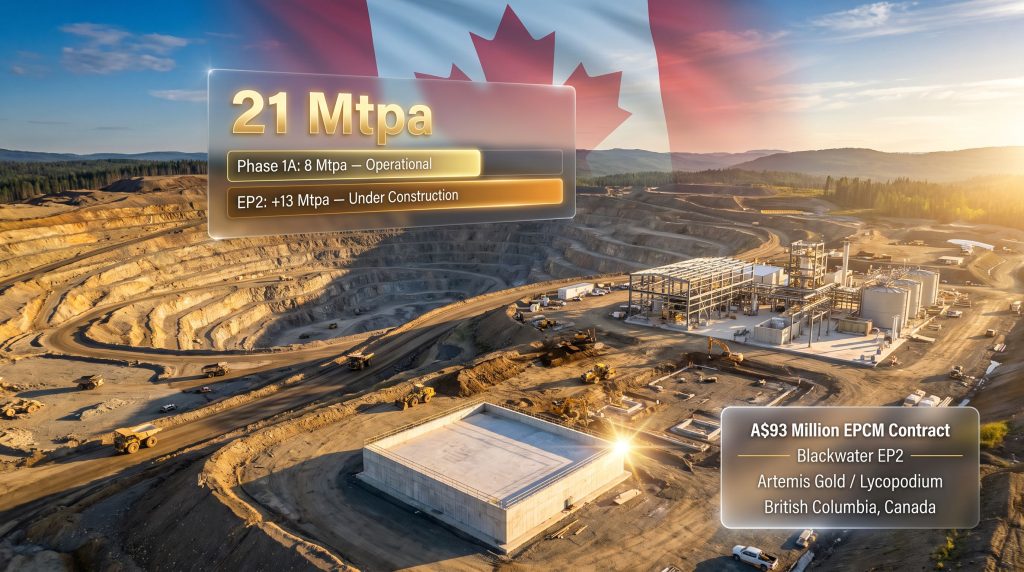
Commercial production at Blackwater commenced in May 2025 under Phase 1A, which established an initial processing capacity of 8 Mtpa. That milestone alone marked a significant transition for the asset, converting it from a development-stage project into an operating mine generating revenue. The EP2 expansion now underway is designed to more than double that output. Understanding the gold mine production forecast context helps frame why such ambitious throughput targets have become a defining feature of modern mid-tier gold development.
Breaking Down the Blackwater Expansion: From 8 Mtpa to 21 Mtpa
The scale of ambition embedded in Artemis Gold's multiphase expansion programme is worth pausing on. The progression from Phase 1A to the combined post-EP2 capacity represents a 162.5% increase in processing throughput over the initial operating configuration.
| Phase | Throughput Capacity | Current Status |
|---|---|---|
| Phase 1A | 8 Mtpa | Operational since May 2025 |
| EP2 Addition | +13 Mtpa | Under construction (August 2026) |
| Total Post-EP2 | 21 Mtpa | Target upon EP2 completion |
For context, 21 Mtpa places Blackwater in a throughput category typically associated with major mid-tier gold producers. Achieving that scale in a phased manner, rather than through a single large capital commitment, is a risk management strategy increasingly favoured by gold developers seeking to demonstrate operational competence before committing full expansion capital.
Why Open-Pit Operations Scale Differently
Open-pit, truck-and-shovel mines like Blackwater have a fundamentally different scaling dynamic compared to underground operations. Underground mines face exponentially rising costs as depth increases, driven by ventilation requirements, ground support complexity, and materials handling constraints. Open-pit operations, by contrast, can often expand throughput capacity by adding processing plant infrastructure while the pit itself is progressively mined to plan.
This means that for bulk-tonnage open-pit deposits, adding a second processing train or expanding an existing plant is a relatively linear capital exercise, provided the orebody geometry supports the additional feed rate. The EP2 addition of 13 Mtpa of incremental capacity is consistent with this logic, representing a new processing plant installation rather than a fundamental reconfiguration of the mining method.
Furthermore, from an investor perspective, this distinction matters considerably. Open-pit expansion projects carry a different risk profile to underground growth projects. Schedule risk is concentrated in plant construction and commissioning rather than in underground development metres or unexpected geotechnical conditions at depth. Decisions around cut-off grade economics also play a meaningful role in determining how aggressively throughput targets are set during the expansion planning process.
Understanding the EPCM Contracting Model and Why It Was Chosen
The term EPCM, standing for Engineering, Procurement and Construction Management, describes a contracting structure that differs materially from a lump-sum EPC (Engineering, Procurement and Construction) model. The distinction has significant implications for how project risk is allocated between the mine owner and the delivery contractor.
Under an EPCM arrangement, the contractor designs the facility, manages equipment and materials procurement on behalf of the client, and oversees the construction workforce without directly employing labourers. Critically, financial responsibility for procurement costs remains with the mine owner. The EPCM firm provides the intellectual and managerial infrastructure to execute the project, but the client carries the balance sheet exposure to procurement market movements.
This structure is widely preferred by sophisticated mine owners who have sufficient in-house capability to manage procurement risk but want external expertise to lead technical design and construction management. It typically delivers better value than lump-sum EPC contracting in commodity-price-sensitive environments, where commodity price impacts can fluctuate significantly between contract award and equipment delivery.
Lycopodium's End-to-End Involvement: A Continuity Advantage
What makes the Lycopodium contract for the Blackwater EP2 project particularly notable from an execution risk perspective is the depth of prior engagement Lycopodium already had with the asset before the main EPCM award. The company's involvement at Blackwater spans the entire project lifecycle:
- Feasibility Study Preparation — establishing the foundational technical and economic parameters for EP2 development
- Front-End Engineering and Design (FEED) — translating feasibility-level concepts into detailed engineering inputs for the new plant configuration
- Phase 1A EPCM Services — full construction management of the initial 8 Mtpa processing facility, now operational
- EP2 EPCM Contract (A$93 million) — the current engagement covering end-to-end project delivery of the expansion plant
This continuity of involvement carries a practical benefit that is frequently underappreciated in project analysis. A contractor that completed the definitive feasibility study and FEED work for a project arrives at the EPCM phase without the knowledge transfer losses that occur when multiple firms hand off sequential project phases. Site-specific conditions, design intent decisions, and procurement lead times are all already embedded in the delivery team's institutional knowledge.
Industry experience suggests that continuity contractors tend to produce fewer variation orders, encounter less rework during construction, and maintain tighter schedule adherence than contractors entering a project mid-lifecycle. For a project of the Blackwater EP2's scale and timeline, these factors can translate into tens of millions of dollars in avoided cost and schedule recovery.
Early Works Progress: What On-the-Ground Activity Signals
As of August 2026, early construction activity at the EP2 plant site is already generating tangible data points about project trajectory. Earthworks at the new plant location are progressing, and Artemis Gold recently confirmed that the first concrete pour for ball mill foundations was completed ahead of the original schedule.
This milestone deserves more than passing attention. Ball mill foundations are among the earliest and most technically demanding concrete works on a mineral processing plant. They require precise geotechnical preparation, complex formwork, and structural concrete placements that must meet strict vibration tolerance specifications for the rotating equipment they will support. Completing this milestone ahead of schedule suggests that site preparation was thorough, ground conditions performed to prediction, and the project team's early mobilisation was well-coordinated.
Ahead-of-schedule performance on early concrete milestones is statistically correlated with stronger overall project schedule adherence. Projects that gain time in the earthworks and foundation phases typically maintain that buffer through structural steel erection and into equipment installation, provided procurement deliveries remain on track.
Lycopodium's Portfolio Context and the Strategic Significance of the Blackwater Award
Lycopodium is an Australian-listed engineering company with a genuinely global operational footprint, maintaining active offices across 12 countries on four continents.
| Region | Countries with Active Offices |
|---|---|
| Americas | Argentina, Brazil, Canada, Peru, United States |
| Africa | Botswana, Ghana, Namibia, South Africa, Tanzania |
| Asia-Pacific | Australia, Philippines |
For a firm of this geographic reach, individual project wins are assessed not only by their dollar value but by their strategic positioning within specific business units. Lycopodium's leadership has indicated that the Lycopodium contract for the Blackwater EP2 project is particularly meaningful to the company's Canadian operations, representing a materially significant domestic project for that business unit.
This framing matters for understanding the competitive dynamics of the Canadian EPCM market. Large-scale mineral processing EPCM contracts in British Columbia are not awarded frequently. Consequently, firms operating in the region compete not only on technical capability and price but on demonstrated local knowledge and established relationships with provincial regulators, equipment suppliers, and specialised construction subcontractors.
Comparing Recent Lycopodium Contract Activity
The Blackwater award follows a pattern of consistent contract wins across Lycopodium's global gold sector practice. The comparison below contextualises the EP2 contract within the firm's recent engagement history.
| Project | Client | Approximate Value | Award Date | Location |
|---|---|---|---|---|
| Blackwater EP2 | Artemis Gold | A$93 million | August 2026 | British Columbia, Canada |
| Nyanzaga Gold Project | Perseus Mining | ~A$48 million | July 2025 | Tanzania |
The near-doubling in contract value between the Nyanzaga award and the Blackwater EP2 engagement reflects both the larger scale of the Blackwater plant addition and the premium associated with tier-one jurisdiction construction costs. Labour rates, equipment access costs, and regulatory compliance requirements differ substantially from sub-Saharan African project environments.
The next major ASX story will hit our subscribers first
What the Blackwater EP2 Contract Signals for Gold Sector EPCM Trends
Several broader industry dynamics are visible through the lens of this single contract award. Mine owners across the gold sector are increasingly structuring expansions around continuity-of-contractor models, seeking to preserve project knowledge across lifecycle phases rather than re-tendering at each development stage.
This reflects a hard-learned industry lesson from the capital cost blowouts that affected numerous large mining projects during the 2010s, many of which were attributed in part to contractor discontinuity and inadequate knowledge transfer between project phases. The preference for EPCM over lump-sum EPC contracting in the current environment also reflects rational responses to input cost volatility.
Furthermore, with steel, concrete, and mechanical equipment pricing subject to supply chain disruptions, mine owners are reluctant to pay the substantial risk premium that EPC contractors must embed in fixed-price offers to cover procurement cost uncertainty. For investors tracking Lycopodium's performance, the Blackwater EP2 contract provides meaningful revenue visibility for the Canadian business unit through the construction and commissioning phases. The A$93 million contract value, spread across the project delivery timeline, represents a material contribution to forward revenue backlog.
Frequently Asked Questions: Lycopodium Contract for Blackwater EP2 Project
What is the value of the Lycopodium contract for the Blackwater EP2 project?
Lycopodium was awarded an EPCM contract valued at A$93 million, equivalent to approximately USD $65.5 million, to deliver the Blackwater Mine Expanded Phase 2 project on behalf of Artemis Gold.
What processing capacity will the EP2 project add at Blackwater?
EP2 is designed to contribute an additional 13 Mtpa of processing throughput. Combined with the existing Phase 1A capacity of 8 Mtpa, Blackwater's total throughput will reach 21 Mtpa upon EP2 completion.
Has Lycopodium worked at Blackwater prior to the EP2 contract?
Yes. Lycopodium delivered EPCM services for Phase 1A and also completed both the feasibility study preparation and the front-end engineering and design work for EP2 before the main construction management contract was awarded.
When did commercial production begin at the Blackwater Mine?
Commercial production at Blackwater commenced in May 2025 under the Phase 1A configuration.
Where is the Blackwater Mine located?
The Blackwater Mine is situated in central British Columbia, approximately 160 kilometres south-west of Prince George and 446 kilometres north-east of Vancouver.
What type of mine is Blackwater?
Blackwater is an open-pit, truck-and-shovel gold and silver mining operation.
What early construction milestones have been achieved on EP2?
As of August 2026, earthworks at the new plant site are underway. The first concrete pour for ball mill foundations has been completed ahead of the original schedule, indicating strong early project momentum.
Key Takeaways
- The A$93 million EPCM contract reflects the capital intensity of scaling a mid-tier gold operation toward 21 Mtpa throughput capacity
- Lycopodium's lifecycle involvement, from feasibility through to active construction management, represents a structurally lower-risk delivery model than multi-contractor handoff approaches
- Ahead-of-schedule performance on ball mill foundation concrete work is an early positive indicator for the EP2 programme
- British Columbia's established mining jurisdiction characteristics continue to attract large-scale engineering commitments from globally diversified contractors
- The contract reinforces Lycopodium's positioning as a recurring EPCM partner across multiple gold sector geographies, with consecutive awards spanning both African and North American operations
- Investors should note that forward-looking statements regarding project timelines and production capacities involve execution risk and should be evaluated alongside independent technical assessments
Disclaimer: This article contains forward-looking information regarding project timelines, production targets, and capacity additions. Such statements involve inherent uncertainty and are subject to operational, technical, regulatory, and market risks. Readers should conduct independent due diligence and not rely solely on this analysis for investment decisions.
Want to Know When the Next Major ASX Mineral Discovery Hits the Market?
Discovery Alert's proprietary Discovery IQ model scans ASX announcements in real time, instantly identifying significant mineral discoveries and translating complex data into actionable investment insights — the same kind of structural advantage that separates informed investors from the rest. Explore historic discoveries and their remarkable returns, then begin your 14-day free trial at Discovery Alert to position yourself ahead of the broader market.