
August 9, 2026
The Engineering Architecture Behind Large-Scale Mine Expansion
When a major gold mine transitions from initial production into a multi-phase expansion program, the engineering and project delivery framework chosen at that moment shapes everything that follows. Throughput targets, capital efficiency, construction timelines, and ultimately mine economics all flow downstream from decisions made at the delivery model selection stage. Understanding the mechanics of how large processing plants get built, who bears what risk, and why contractor continuity matters so profoundly is essential context for evaluating any significant EPCM contract award, including the Lycopodium Blackwater Mine expansion contract recently secured by Lycopodium (ASX: LYL).
When big ASX news breaks, our subscribers know first
What Is EPCM and Why Do Mine Owners Favour It?
The Engineering, Procurement and Construction Management framework is fundamentally a services-based delivery model. Under EPCM, the contractor acts as the owner's representative, managing the full spectrum of design, procurement, and construction activities without taking on direct liability for construction costs or schedule overruns. That risk remains with the mine owner, who retains more direct control over the project.
This contrasts sharply with a traditional EPC or lump-sum turnkey arrangement, where the contractor accepts a fixed price and absorbs cost overrun risk in exchange for a higher margin opportunity. The trade-off for owners is clear:
-
EPCM offers flexibility, owner control, and lower contractor margin, but requires strong owner-side project management capability.
-
EPC (Lump Sum) transfers risk to the contractor, but typically commands a significant pricing premium and limits the owner's ability to modify scope mid-project.
-
Alliance/Integrated Project Delivery distributes risk across parties, linking contractor returns to project performance outcomes.
| Contract Type | Risk Profile | Revenue Certainty | Typical Margin Range |
|---|---|---|---|
| EPCM (Cost-Reimbursable) | Low contractor risk | High (milestone-linked) | Moderate, stable |
| EPC (Lump Sum Turnkey) | High contractor risk | Fixed | Variable (cost overrun exposure) |
| Alliance/Integrated Delivery | Shared risk | Moderate | Performance-linked |
For large, complex, multi-phase mining projects, EPCM has become the preferred model because it preserves owner flexibility to adjust scope as resource knowledge improves and market conditions evolve. A processing plant originally designed for one throughput rate can be engineered for future expansion from the outset, provided the EPCM contractor has the institutional knowledge to carry that intent through successive design phases.
Key Insight: In EPCM contracting, the contractor's accumulated project knowledge functions as a form of intellectual capital that directly reduces schedule risk and rework costs. This is why continuity across feasibility, FEED, and construction phases is strategically valuable, not merely convenient.
Blackwater Mine: Scale, Location, and the Road to 21 Mtpa
The Blackwater Mine occupies a strategically important position in central British Columbia, situated approximately 160 kilometres southwest of Prince George and 446 kilometres northeast of Vancouver. The project operates as an open-pit, truck-and-shovel gold and silver mine, a methodology well suited to the deposit geometry and the terrain of the region.
British Columbia has long been regarded as one of the world's more attractive mining jurisdictions, offering a combination of established regulatory frameworks, access to skilled labour, and existing regional infrastructure networks. These networks include road and transmission connections that reduce greenfield development costs significantly compared to more remote jurisdictions.
From Feasibility Study to Major Producer: How Did Blackwater Reach This Stage?
Blackwater's journey from exploration asset to emerging major producer follows a staged development logic that has become increasingly common among resource developers managing capital discipline alongside production growth ambitions.
| Milestone | Detail |
|---|---|
| Feasibility Study | Completed by Lycopodium |
| Front-End Engineering and Design (FEED) | Completed by Lycopodium for Expanded Phase 2 |
| Phase 1A EPCM Engagement | Ongoing at time of Expanded Phase 2 contract award |
| Commercial Production Commencement | May 2025 |
| Expanded Phase 2 EPCM Contract Award | A$93 million contract to Lycopodium |
| Ball Mill Foundation Concrete Pour | Completed ahead of schedule |
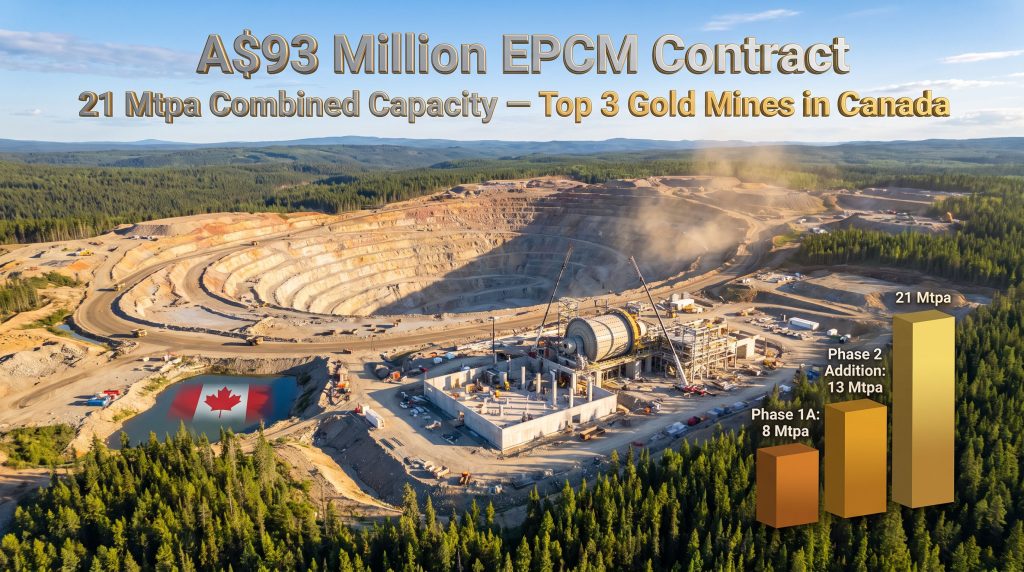
Phase 1A established the mine's initial processing throughput at 8 million tonnes per annum (Mtpa). The Expanded Phase 2 program is designed to add a further 13 Mtpa of processing capacity, bringing total combined throughput to 21 Mtpa. Upon completion of the broader multi-phase expansion program, Blackwater is projected to rank among the largest gold mines in Canada by throughput capacity — a remarkable achievement for any single project.
Scale Benchmark: At 21 Mtpa combined throughput, Blackwater would represent a step-change in Canadian gold production capacity. Very few domestic operations process ore at comparable volumes, positioning Blackwater in a tier occupied by only the most significant mines in the country.
The A$93 Million EPCM Contract: Scope, Structure, and Early Execution Signals
The A$93 million EPCM contract awarded to Lycopodium covers the full scope of engineering, procurement, and construction management services for Artemis Gold's Expanded Phase 2 development at Blackwater. According to reporting by Mining Technology, early works were already mobilised before the contract was formally executed, with earthworks for the new plant site underway and the first concrete pour for ball mill foundations completed ahead of schedule.
This sequencing is more significant than it might appear. In large processing plant construction, the ball mill is among the heaviest and most technically demanding items of equipment. Its foundation design must account for dynamic loading from rotating mass, vibration transmission to surrounding structures, and long-term settlement behaviour of the underlying ground. Completing the foundation pour ahead of programme at this stage of the project suggests:
-
The design and geotechnical investigation work was completed to a high standard during the FEED phase.
-
Early contractor mobilisation was well-coordinated, reducing idle time on critical path activities.
-
The site conditions encountered matched or bettered pre-construction assumptions.
Each of these factors reduces the probability of costly schedule disruptions later in the construction programme, when delays compound across multiple workstreams simultaneously.
Project Execution Insight: An ahead-of-schedule milestone at the foundation stage is a leading indicator of construction programme health. In large mineral processing plant builds, early slippage on civil foundations frequently cascades into equipment installation delays, making this early progress a meaningful signal for investors and project stakeholders alike.
Why Lycopodium's Phase-to-Phase Continuity Is a Structural Competitive Advantage
The decision to retain Lycopodium across the full Blackwater development arc — from a definitive feasibility study through FEED and Phase 1A EPCM to the Expanded Phase 2 EPCM contract — reflects a project delivery philosophy that prioritises accumulated knowledge over periodic retendering.
In practical terms, this continuity delivers measurable benefits:
-
Reduced rework and redesign costs: Engineering teams already familiar with the site layout, equipment vendor relationships, and client preferences avoid duplicating work completed in prior phases.
-
Lower procurement risk: Vendor relationships established during Phase 1A procurement carry into Expanded Phase 2, reducing the time required to qualify suppliers and negotiate long-lead-item delivery schedules.
-
Institutional knowledge retention: Site-specific geology, ground conditions, and infrastructure constraints are embedded in the project team's working knowledge rather than requiring re-investigation.
-
Regulatory familiarity: British Columbia's mining permits and environmental compliance requirements are already understood by the project team, reducing the risk of regulatory process delays.
-
Client relationship depth: A working relationship built through feasibility and Phase 1A reduces the communication overhead associated with onboarding a new contractor at the expansion phase.
From a speculative standpoint, it is reasonable to consider whether Lycopodium's involvement across subsequent phases of the broader Blackwater multi-phase program represents a further pipeline opportunity. The staged development model — where Phase 1A generates early cash flow that can partially fund Expanded Phase 2 — creates a self-reinforcing logic that typically favours accelerating subsequent phases when commodity prices are supportive. This is a speculative observation rather than a confirmed commercial arrangement, and investors should consult company disclosures for confirmed project pipeline information.
Lycopodium's Global Platform: How Blackwater Fits a Broader Growth Strategy
Lycopodium operates across three primary sectors: resources, rail infrastructure, and industrial processes. Its geographic footprint extends across Australia, Canada, the United States, South America, Africa, and the Philippines, giving the firm a diversified project base that insulates revenue from single-commodity or single-region concentration risk.
As presented at the ASX Small and Mid Cap Conference in September 2025, Lycopodium had more than 40 major projects underway across its global business at that time. The Blackwater Expanded Phase 2 contract adds a high-profile, long-duration engagement to that portfolio, with Lycopodium's CEO Peter De Leo characterising the project as a material contribution to the firm's Canadian operations and describing Blackwater as a world-class facility operating within a first-rate mining jurisdiction.
How Does EPCM Revenue Recognition Work for Investors?
EPCM contracts do not typically generate revenue in a single lump sum. Instead, billing progresses through milestones tied to design deliverables, procurement activities, and construction management phases. For investors analysing Lycopodium's financial profile, this means the A$93 million contract value will be recognised progressively over the execution period, providing a forward revenue contribution that extends visibility well beyond the contract award date.
This milestone-based billing structure also means revenue recognition is relatively predictable compared with lump-sum EPC contracts, where margin realisation depends heavily on cost performance against a fixed price.
The next major ASX story will hit our subscribers first
The EPCM Services Market as a Proxy for Mining Capex Cycles
There is a broader market dynamic worth understanding here. EPCM contract awards function as lagging confirmations of committed mining capital expenditure rather than speculative indicators. By the time an EPCM contract is formally awarded, the mine owner has typically completed feasibility studies, secured financing, obtained major permits, and made a formal construction decision. The EPCM award is therefore a reliable signal that capital is flowing into a specific project.
For investors tracking the engineering services sector, order book growth at firms like Lycopodium provides a window into the health of the broader resource development pipeline. Key demand drivers for EPCM capacity in tier-one gold jurisdictions currently include:
-
Gold price environment: The current gold price outlook improves project economics and reduces the hurdle rate for expansion capital decisions.
-
Permitting timelines: Tier-one jurisdictions with established regulatory frameworks reduce the time between feasibility completion and construction commencement.
-
Labour and equipment availability: EPCM contractor capacity is constrained by access to experienced engineers and project managers, creating incumbent advantages for firms already deployed on active projects in a given region.
-
Phased expansion economics: Producers increasingly prefer phased development to manage capital deployment risk, which structurally increases the frequency of EPCM contract awards on individual projects over their mine life.
Investor Perspective: Engineering services firms with multi-phase engagement models on major producing assets represent a different risk profile to pure exploration or development-stage mining companies. Revenue is milestone-linked rather than commodity price-dependent in the short term, though order book growth correlates over time with the broader capital expenditure cycle in the resources sector.
How Blackwater's Expansion Reflects Staged Development Best Practice
Phased mine development has evolved as a capital management discipline in response to the challenges of financing large greenfield projects in a single investment round. The Blackwater model — where Phase 1A establishes production and cash flow while the Expanded Phase 2 adds processing capacity at a point when operational risk has been substantially reduced — follows the textbook logic of staged development.
This approach offers several structural advantages over single-stage builds:
-
Risk sequencing: Operational and geological risks are tested at smaller scale before committing the full expansion capital.
-
Self-funding potential: Early production cash flows can contribute to expansion financing, reducing external capital requirements and dilution.
-
Design iteration: Engineering teams can incorporate lessons from Phase 1A operations into Expanded Phase 2 design, potentially improving efficiency or reducing capital intensity.
-
Market timing flexibility: The phasing structure allows owners to accelerate or defer expansion based on prevailing commodity price conditions.
Furthermore, drilling programs undertaken during Phase 1A operations can refine resource models, directly informing the engineering assumptions that underpin the Expanded Phase 2 design. At 21 Mtpa combined throughput, Blackwater's ultimate processing capacity would represent a genuinely rare scale of operation in the Canadian gold sector, with the projected top-three ranking by capacity underscoring the strategic significance of the Lycopodium Blackwater Mine expansion contract for the country's overall gold production profile.
Key Facts: Lycopodium Blackwater Mine Expansion at a Glance
| Metric | Detail |
|---|---|
| Contract Value | A$93 million |
| Contract Type | EPCM (Engineering, Procurement and Construction Management) |
| Client | Artemis Gold |
| Project | Blackwater Mine Expanded Phase 2 |
| Location | Central British Columbia, Canada |
| Phase 2 Throughput Addition | 13 Mtpa |
| Combined Mine Capacity (Post-EP2) | 21 Mtpa |
| Projected Canadian Ranking | Top 3 gold mines by throughput capacity |
| Commercial Production Start | May 2025 |
| Early Works Status | Underway; ball mill foundations poured ahead of schedule |
| Lycopodium Active Projects (Sept 2025) | 40+ globally |
Frequently Asked Questions: Lycopodium Blackwater Mine Expansion Contract
What is the Lycopodium Blackwater Mine expansion contract?
It is an A$93 million EPCM contract awarded to Lycopodium (ASX: LYL) to manage engineering, procurement, and construction activities for Artemis Gold's Expanded Phase 2 development at the Blackwater Mine in central British Columbia, Canada. As reported by Yahoo Finance, the award reflects Lycopodium's long-standing involvement across all prior phases of the project.
What will Expanded Phase 2 add to Blackwater's production capacity?
The expansion adds 13 Mtpa of processing throughput, lifting combined mine capacity from the Phase 1A level of 8 Mtpa to 21 Mtpa in total.
When did Blackwater commence commercial production?
Commercial production at the Blackwater Mine began in May 2025, following completion of Phase 1A construction and commissioning.
Has Lycopodium worked on Blackwater previously?
Yes. Lycopodium completed the original feasibility study, the front-end engineering and design work for Expanded Phase 2, and is currently delivering EPCM services for Phase 1A. The Expanded Phase 2 contract represents a continuation of a relationship spanning the full project development lifecycle.
What is EPCM and how does it differ from a standard construction contract?
EPCM is a services-based framework where the contractor manages design, procurement, and construction on behalf of the owner without bearing direct construction cost risk. The owner retains risk but also retains flexibility and control. This differs from EPC lump-sum contracts, where the contractor accepts a fixed price and absorbs cost overrun exposure.
What would Blackwater's ranking be among Canadian gold mines after full expansion?
Upon completion of the broader multi-phase expansion program, Blackwater is projected to rank among the three largest gold mines in Canada by processing throughput capacity, making the Lycopodium Blackwater Mine expansion contract a project of genuine national significance.
Disclaimer: This article is for informational purposes only and does not constitute financial or investment advice. Readers should conduct their own research and consult a licensed financial adviser before making investment decisions. Forward-looking statements and projections referenced in this article are subject to risks and uncertainties that may cause actual outcomes to differ materially from those described.
Want to Identify the Next Major ASX Mining Opportunity Before the Market Does?
Discovery Alert's proprietary Discovery IQ model delivers real-time alerts on significant ASX mineral discoveries, turning complex mining and exploration data into actionable investment insights for both short-term traders and long-term investors. Explore historic discoveries and their exceptional returns, then begin your 14-day free trial at Discovery Alert to position yourself ahead of the market.