
July 22, 2026
The Invisible Pricing Revolution Reshaping the Rare Earth Industry
Most commodity markets follow a predictable rhythm: supply rises, prices fall, producers cut output, and the cycle repeats. Rare earth oxides spent decades operating inside this framework, with pricing largely dictated by Chinese production quotas and global manufacturing demand. That framework is now obsolete. What is replacing it is something far more structurally durable: a geopolitically anchored pricing regime where supply origin matters as much as supply volume. Understanding this shift is essential context for interpreting the Lynas Rare Earths fourth-quarter revenue rise that has captured significant attention across critical minerals investment circles.
When big ASX news breaks, our subscribers know first
The Geopolitical Repricing of Rare Earth Oxides
For most of the past two decades, China supplied between 85% and 90% of the world's refined rare earth products. That concentration was tolerated because pricing remained low and supply remained reliable. Both assumptions have now been fundamentally challenged.
China's rare earth export restrictions on select materials, including specific heavy rare earths and processing chemicals, have introduced a supply risk premium into global pricing that did not previously exist in a meaningful structural form. Western industrial buyers, particularly those operating in electric vehicle drivetrain manufacturing, permanent magnet production, defence electronics, and advanced robotics, are no longer treating rare earth procurement as a cost-optimisation exercise. It has become a supply chain sovereignty exercise.
The G7's agreement in June 2026 that no single country should supply more than 60% of member nations' rare earth imports by 2030 represents a formalised policy acknowledgement of this structural shift. This target effectively creates a policy-mandated demand floor for non-Chinese producers, though it is important to note that this is a broad supply diversification framework rather than direct support for any individual project or company.
The rare earth market has undergone a fundamental transformation. Geopolitical risk has been permanently embedded into pricing structures, meaning that producers operating outside China's jurisdiction now carry a structural premium that volume-based pricing models cannot adequately capture.
This repricing dynamic is the essential backdrop against which Lynas Rare Earths' Q4 FY2026 performance must be evaluated.
Breaking Down the Lynas Rare Earths Fourth-Quarter Revenue Rise
The Numbers in Context
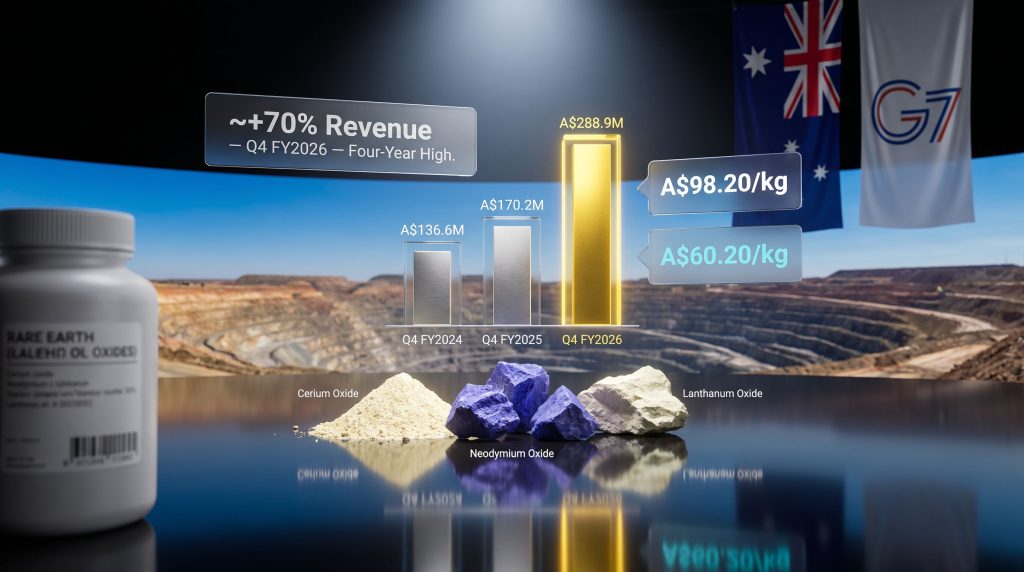
The Lynas Rare Earths fourth-quarter revenue rise of approximately 70% year-on-year is significant not simply because of its magnitude, but because of what drove it. The breakdown reveals a pricing-led expansion with only modest volume contribution.
| Metric | Q4 FY2025 | Q4 FY2026 | Change |
|---|---|---|---|
| Gross Sales Revenue (AUD) | A$170.2 million | A$288.9 million | ~+70% |
| Average Selling Price | A$60.20/kg | A$98.20/kg | ~+63% |
| Total REO Production | 3,212 metric tonnes | 3,481 metric tonnes | ~+8.4% |
| Visible Alpha Consensus Estimate | N/A | A$359.8 million | Missed by ~20% |
The mathematics here are instructive. A production increase of roughly 8.4% generated a revenue increase of nearly 70%. This is the financial signature of a pricing-led expansion cycle, where operating leverage amplifies returns far beyond what volume growth alone could achieve. It also introduces a corresponding sensitivity: if pricing were to normalise, revenue would contract at a rate that production adjustments could not meaningfully offset.
The Average Selling Price Breakthrough
The jump from A$60.20 per kilogram to A$98.20 per kilogram is the single most important data point in the quarterly result. It represents the highest realised price per kilogram in approximately four years and reflects broad-based strength across all rare earth product categories, not a concentrated gain in one specific oxide.
This distinction matters for investors. When price gains are concentrated in a single product, they carry higher reversal risk. Broad-based pricing expansion across neodymium-praseodymium (NdPr) oxides, dysprosium, terbium, and lanthanum products suggests that the underlying demand pressure is systemic rather than isolated.
It is worth understanding what these individual oxides are used for. NdPr is the primary input for neodymium-iron-boron (NdFeB) permanent magnets, which are critical components in EV traction motors and wind turbine generators. Dysprosium and terbium are heavy rare earths used to maintain magnet performance at elevated temperatures, making them irreplaceable in high-performance motor applications. Furthermore, even lanthanum, historically considered a lower-value rare earth, has found renewed demand in fluid catalytic cracking catalysts and emerging battery chemistries.
When every rare earth product category experiences simultaneous price appreciation, it signals that the demand side is structurally broad, not narrowly concentrated in a single application sector.
The Consensus Miss: Should Investors Be Concerned?
Understanding the A$70.9 Million Gap
Despite the headline strength of the quarterly result, Lynas reported revenue of A$288.9 million against a Visible Alpha consensus estimate of A$359.8 million, a shortfall of approximately A$70.9 million or roughly 20%. This gap deserves careful analysis rather than dismissal.
Three explanations merit consideration:
-
Procurement timing displacement: Large industrial buyers restructuring rare earth supply chains away from Chinese sources do not shift contracted volumes overnight. Qualification processes, logistics infrastructure adjustments, and contractual negotiation cycles can delay volume realisation by one to three quarters even when purchasing intent is firm.
-
Contracted versus spot price divergence: Lynas sells a meaningful proportion of its output under medium-term supply agreements. If spot prices rose sharply during the quarter, the company's realised prices would lag spot market movements, creating a gap between analyst spot-price-based revenue models and actual contracted realisation.
-
Processing throughput constraints: While production of 3,481 tonnes represents an 8.4% year-on-year improvement, any rare earth processing challenges at the Mount Weld concentration plant in Western Australia or the Lynas Advanced Materials Plant (LAMP) in Malaysia could have capped the volume available for sale during the period.
It is important to contextualise this miss within the broader trend. The result still represents a four-year revenue high and a continuation of an accelerating quarterly revenue trajectory that has now run for multiple consecutive periods.
Three Years of Accelerating Revenue: The Trajectory Tells the Deeper Story
| Period | Quarterly Revenue (AUD) | YoY Growth |
|---|---|---|
| Q4 FY2024 | ~A$136.6 million | Baseline |
| Q4 FY2025 | A$170.2 million | ~+25% |
| Q4 FY2026 | A$288.9 million | ~+70% |
The sequential pattern across three years reveals something that a single quarterly snapshot cannot: the growth rate itself is accelerating. Moving from approximately 25% annual growth to 70% annual growth in a single year reflects the compounding dynamics of a pricing cycle that is gaining momentum, not plateauing.
For investors accustomed to evaluating commodity producers through traditional discounted cash flow models, this kind of pricing-driven acceleration creates significant valuation complexity. Standard models built on stable long-run price assumptions will systematically undervalue producers when geopolitical risk premiums are structurally embedded, but they will also overstate values if those premiums are assumed to persist indefinitely.
Why Lynas Occupies an Irreplaceable Market Position
The Scarcity of Commercial-Scale Non-Chinese Production
Lynas is not simply the largest rare earth producer outside China. It is one of very few producers anywhere in the world capable of supplying refined rare earth oxides at a scale and purity level that meets the requirements of tier-one automotive and industrial buyers. This distinction is commercially critical.
Building a rare earth mine is difficult. However, building a rare earth separation and refining facility to commercial scale is far harder, more capital-intensive, and more technically demanding. The chemistry involved in separating individual rare earth elements from a mixed concentrate is extraordinarily complex, requiring solvent extraction circuits with hundreds of individual stages and highly specialised metallurgical expertise. This technical barrier to entry means that even well-funded competitors cannot replicate Lynas' operational capability quickly.
Lynas' Mount Weld deposit in Western Australia is consistently described by geologists as one of the highest-grade rare earth deposits in the world. High ore grades reduce the amount of material that must be processed per unit of recoverable rare earth oxide, which directly reduces unit processing costs and improves environmental performance metrics. This geological advantage compounds the company's competitive position.
The Demand Architecture That Underpins Future Revenue
Several structural demand drivers extend well beyond the current pricing cycle:
-
EV drivetrain growth: Each electric vehicle contains approximately 1 to 2 kilograms of NdFeB permanent magnets. Global EV production volumes are projected to continue expanding materially through the early 2030s, creating compounding demand growth for NdPr oxide.
-
Wind energy expansion: Direct-drive offshore wind turbines use significantly larger quantities of rare earth permanent magnets than their onshore counterparts. As offshore wind capacity expands globally, the per-unit magnet requirement creates substantial incremental rare earth demand.
-
Defence and aerospace applications: Precision-guided weapons systems, radar equipment, and advanced communications hardware all rely on rare earth-containing components. Defence procurement cycles are long-term, contracted, and largely price-insensitive, representing a stable demand floor.
-
Emerging magnet manufacturing outside China: Perhaps most significantly for Lynas' long-term positioning, new permanent magnet manufacturing facilities are being established in Japan, Europe, and North America. These facilities require non-Chinese rare earth feedstock to satisfy supply chain auditing requirements from automotive OEM customers, creating direct and durable demand for Lynas' refined output. In addition, rare earth offtake agreements are increasingly being structured to lock in these supply relationships over multi-year periods.
The next major ASX story will hit our subscribers first
The Emerging Role of Rare Earth Recycling
Secondary Supply: Complementary Rather Than Competitive
A parallel development worth monitoring is the accelerating commercialisation of rare earth recycling. Partnerships such as the recently announced collaboration between ERI and Cyclic Materials, which aims to create one of the largest commercial rare earth recycling feedstock portfolios in North America, represent an emerging secondary supply stream that will gradually enter the market.
The critical nuance here is that recycled rare earths, while technically viable, currently represent a very small fraction of total supply. The end-of-life rare earth content in the existing global stock of EV motors and wind turbines is still relatively modest, given that widespread deployment of these technologies is only a decade old. The recycling supply ramp will be gradual, measured in years rather than quarters.
In the medium term, recycling is more likely to reduce supply anxiety than to depress primary producer pricing. It may eventually create a pricing floor effect, but primary producers at the scale and quality level of Lynas are unlikely to face meaningful margin compression from recycling supply for at least the next several years.
Key Takeaways for Investors Evaluating the Lynas Rare Earths Fourth-Quarter Revenue Rise
-
Pricing is structural, not cyclical: The 63% increase in average selling price reflects a geopolitical risk premium that is embedded in market structure, not a temporary commodity spike driven by short-term inventory dynamics.
-
Volume growth is secondary to pricing leverage: An 8.4% production increase generating 70% revenue growth confirms that Lynas' financial performance is driven by its market positioning, not its operational throughput trajectory.
-
The consensus miss introduces near-term uncertainty: A 20% shortfall against analyst estimates raises legitimate questions about demand realisation timelines, contracted versus spot price dynamics, and the pace at which supply chain restructuring translates into incremental contracted volumes for non-Chinese producers. Furthermore, the US rare earth supply chain restructuring adds an additional layer of complexity to how demand materialises for producers like Lynas.
-
Geological quality compounds competitive advantage: Mount Weld's status as one of the world's highest-grade rare earth deposits provides a structural cost advantage that reinforces Lynas' pricing power and margin profile.
-
The three-year trajectory is the most important signal: Moving from ~25% annual revenue growth to ~70% in a single year, while production remains relatively stable, suggests the pricing and demand environment is still intensifying rather than moderating.
Disclaimer: This article is intended for informational and educational purposes only. It does not constitute financial advice or a recommendation to buy or sell any securities. Investors should conduct their own due diligence and consult a qualified financial adviser before making investment decisions. All financial figures referenced are sourced from publicly available reports. Forward-looking statements and projections involve inherent uncertainty and may not materialise as described.
Want to Identify the Next Major Mineral Discovery Before the Broader Market?
Discovery Alert's proprietary Discovery IQ model delivers real-time alerts on significant ASX mineral discoveries, transforming complex mineral data into actionable insights for both short-term traders and long-term investors — explore historic discoveries and their exceptional returns to understand the magnitude of opportunity, then begin your 14-day free trial at Discovery Alert to position yourself ahead of the market.