August 24, 2026
Macro Trends Shaping Deep Geological Repository Development in Canada
Nuclear energy’s role in Canada’s low-carbon future is sparking renewed attention on how countries manage the long-lived radioactive waste generated by nuclear reactors. As global energy systems shift towards sustainability, a robust and permanent solution for used nuclear fuel becomes crucial.
Deep geological repository Canada now stands at the forefront of this challenge, reflecting evolving international best practices and decades of incremental technical progress. Furthermore, this trend highlights broader shifts in environmental and energy policy worldwide.
When big ASX news breaks, our subscribers know first
What Is a Deep Geological Repository and Why Does Canada Need One?
Understanding Deep Underground Nuclear Storage Systems
A deep geological repository is a purpose-built underground system engineered to securely isolate high-level radioactive waste for hundreds of thousands of years. Such facilities rely on a synergy of engineered barriers and stable natural geology. In many cases, similar approaches are seen through mine reclamation innovations.
These repositories in Canada are planned to be constructed roughly 500 metres below the surface within sedimentary rock. This design minimises the risk of radioactive material ever reaching the biosphere. Moreover, the approach mirrors successful strategies used internationally.
The multiple containment strategy includes:
• Crafting ceramic nuclear fuel pellets as the initial containment layer.
• Encasing pellets in durable, copper-coated steel containers engineered for 100,000 years or more.
• Surrounding the containers with bentonite clay that seals out water.
• Embedding the system within geologically stable rock.
• Relying on deep, slow-moving groundwater systems as natural safeguards.
Managing radioactive decay necessitates secure containment across extreme time frames. Consequently, the internationally endorsed defense-in-depth principle ensures that each barrier independently contributes to safety. In addition, advanced waste management solutions are integral to this design.
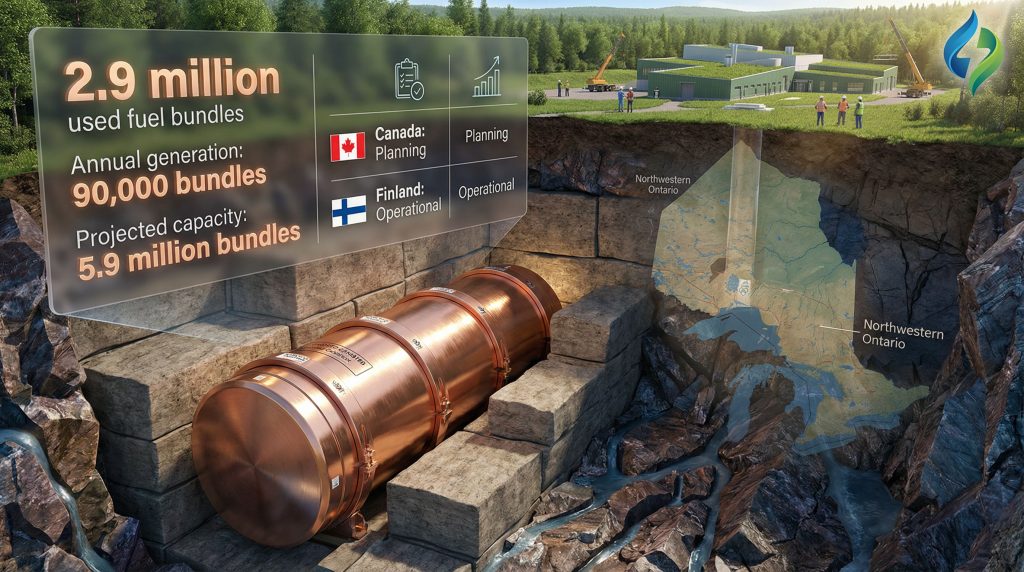
Canada’s nuclear industry has produced a significant volume of used fuel since the early 1970s. Approximately 2.9 million fuel bundles currently exist, with an annual accumulation rate of around 90,000 bundles. Capacity planning for the facility is prepared for up to 5.9 million bundles.
A detailed table outlines current waste distribution:
• Ontario: 3 major facilities storing 2.1 million bundles.
• Quebec: 1 facility with 0.5 million bundles under care/maintenance.
• New Brunswick: 1 facility holding 0.3 million bundles in active operations.
Deep geological repository Canada is instrumental in advancing nuclear waste management.
How Do Deep Geological Repositories Work?
Multi-Barrier Engineering System Design
A modern repository employs multiple safety layers where each barrier offers isolation even if another fails. First, dense ceramic fuel pellets made of uranium dioxide establish a chemically stable containment. Next, copper-coated steel containers are designed to resist corrosion at rates of 1–10 micrometres per 1,000 years.
Furthermore, bentonite clay acts as an effective buffer by absorbing water and filling voids. The sedimentary rock formations ensure long-term stability. Minimal groundwater movement further reduces the chance of radionuclide migration. This concept is aligned with emerging industry evolution trends.
Underground Facility Architecture
Surface facilities include shipping, fuel packaging, laboratory analysis, administrative and security infrastructure. Additionally, access tunnels with spiral declines provide efficient, safe access for transport and construction.
Horizontal galleries, known as placement rooms, house the packaged fuel. Ventilation systems with distinct intakes and exhausts regulate ambient conditions, and advanced monitoring networks offer immediate anomaly detection. Modern logistical planning and continuous evaluation are keys to success. For instance, geological modelling techniques support operational safety and design integrity.
Where Will Canada's Deep Geological Repository Be Located?
Northwestern Ontario Site Selection Results
After a decade-long search, the proposed Canadian site lies southeast of Wabigoon Lake Ojibway Nation, about 43 kilometres from Ignace along a key transport corridor. The planned footprint measures 2 km by 3 km (roughly 600 hectares) in a sedimentary formation known to be geologically quiescent for over half a billion years.
Selection criteria included community support and willing host protocols, as well as rock stability exceeding 100 million years. Very low groundwater flow, nearby road and rail access for used fuel transport, and extensive Indigenous consultation were also key factors.
A comparison table highlights the site’s strengths:
• Rock Stability: Required >100M years; site offers 500M+ years stability.
• Depth Capability: Required 500–850m; site is planned at 500m.
• Groundwater Flow: Minimal; site exhibits very low circulation.
• Seismic Activity: Low risk; region is geologically stable.
What Is the Timeline for Canada's Nuclear Repository Development?
Project Development Phases (2024–2190)
Canada’s DGR project follows multiple development phases. Initially, Phase 0 (up to 2026) focuses on public and Indigenous input through integrated assessments. Next, Phase 1 (2026–2030) involves regulatory reviews and detailed design work alongside impact assessments.
Phase 2 (2030–2040) sees the construction of surface and underground facilities. Operational Phase 3 (2040–2090) includes receipt, fuel emplacement, and continuous monitoring. Finally, Phase 4 (2090–2140) and Phase 5 (2140–2190) cover extended monitoring, closure preparation, and final post-closure verification.
Current Regulatory Assessment Process
Licensing is governed by an integrated review process involving the Impact Assessment Agency of Canada and the Canadian Nuclear Safety Commission. The streamlined “one project, one review” process is designed to accelerate decision-making while maintaining diligence. Transitioning between public consultation, regulatory review, and construction stages is central to the project’s approach.
Important deadlines include:
• Public input from 13 April to 10 May 2026.
• In-person and virtual sessions for affected communities.
• Continued Indigenous engagement at every project phase.
Deep geological repository Canada is under stringent regulatory review. For further context on national strategies, consult the canadian repository plan.
How Does Canada's Approach Compare to International DGR Projects?
Global Deep Geological Repository Status
Several countries are leading in deep repository implementation. Finland’s Onkalo in 2023 was the world’s first operational deep repository. Meanwhile, Sweden’s facility is approved and progressing with construction, France plans to commission Cigéo by 2035, and the UK is in the site selection phase. In contrast, the US utilises the WIPP facility solely for defence-related waste storage.
A concise international comparison shows:
• Canada: Planning stage, 500–850m depth, sedimentary rock, copper-steel containers.
• Finland: Operational, 400–450m depth, granite, copper-iron containers.
• Sweden: Approved, 500m depth, granite, copper containers.
• France: Development phase, 500m depth, clay, steel containers.
The next major ASX story will hit our subscribers first
What Are the Safety and Environmental Considerations?
Radiation Containment Engineering
Safety is enhanced by conservative container designs and stable repository geology. Anticipated container integrity exceeds 100,000 years with proven copper-steel resistance under reducing conditions. Additionally, precise container spacing helps manage thermal loads. Comprehensive gas management is ensured through engineered ventilation and continuous monitoring systems.
Environmental Protection Measures
Long-term ecosystem preservation is a priority. Extensive groundwater baseline studies, regular sampling, surface water isolation, and minimal land disturbance underpin the environmental strategy. Enhanced air filtration systems further secure the site. These measures ensure that the repository meets the highest environmental safety standards.
Deep geological repository Canada remains a model for long-term safety. Moreover, adherence to rigorous safety assessment modelling—extending predictions to one million years—fortifies public trust and regulatory confidence.
Long-term Safety Assessment Modeling
Advanced computer modelling predicts safety over a million-year timeframe. Researchers integrate empirical data from natural analogues, controlled material science experiments, and probabilistic analyses of both worst-case and reference-case scenarios. These models support transparent risk frameworks and complement industry best practices such as geological logging best practices.
Long-term risk analysis for nuclear waste containment illustrates the commitment to safety and innovation in global repository design.
How Will Public Consultation and Indigenous Engagement Proceed?
Current Consultation Framework (2026)
Community and Indigenous participation is formalised through open, accessible consultations. The public comment period runs from 13 April to 10 May 2026. Moreover, information sessions are scheduled in Thunder Bay, Dryden, Ignace, and Melgund Township between 19 and 22 April. French-language virtual sessions are also available on 14 and 16 April via Zoom.
Submissions can be made via the Impact Assessment Registry (Ref #88774) or designated email channels. This inclusive approach reinforces trust and collaborative decision-making.
Indigenous Rights and Consultation Protocols
The Wabigoon Lake Ojibway Nation plays a central role in host arrangements. Traditional territory acknowledgement, cultural knowledge integration, and economic partnership provisions are key elements. Recent community benefit agreements emphasise employment and capacity development in partnership with nuclear industry stakeholders.
What Are the Economic and Operational Implications?
Project Investment and Funding Structure
The DGR project is a multi‐billion dollar initiative funded by reserves managed by the Nuclear Waste Management Organization. Economic benefits flow through direct construction jobs, long-term operational roles spanning over 50 years, and service contracts for local suppliers. Transparent funding and investment structures promote national confidence.
Transportation and Logistics Planning
Efficient logistics are paramount. The project utilises specialised rail containers for secure, shielded transport and conducts extensive route studies for waste haulage. Security operations ensure real-time tracking and constant emergency preparedness. Modern on-site packaging ensures every fuel bundle meets rigorous safety criteria.
Deep geological repository Canada ensures intergenerational protection.
Operational Workforce Requirements
Staffing requirements include skilled mining and engineering teams during construction, highly trained nuclear workers during operations, and dedicated safety, environmental, and security personnel. In addition, specialised decommissioning teams are required for eventual site closure and reclamation.
What Challenges and Opportunities Lie Ahead?
Technical Engineering Challenges
The repository model faces several technical tests. Challenges include proving container durability over geologic timescales, implementing exhaustive three-dimensional mapping, and addressing underground construction issues unique to sedimentary rock. In addition, rigorous quality assurance protocols are being developed using cutting-edge geological modelling techniques alongside ongoing research and development.
Social and Political Considerations
Key challenges include maintaining public trust and ensuring transparency in risk modelling. Political considerations require navigating evolving regulatory standards and incorporating new research findings. Indigenous sovereignty and partnership are also vital in upholding ethical decision-making principles. Consequently, collaborative approaches are essential.
Innovation and Technology Development Opportunities
Research into next-generation corrosion-resistant alloys, advanced sensor systems for continuous monitoring, and remote robotics for underground inspections is underway. Furthermore, international collaboration facilitates the sharing of technical innovations. Such cooperative efforts lead to improvements in both safety protocols and operational efficiency.
For additional background on nuclear waste protocols, consider exploring nuclear waste management.
Deep geological repository Canada is a benchmark for safety and environmental stewardship.
This article incorporates data from publicly available technical reports, regulatory guidance, and industry best practices. Contents related to forecasts, project schedules, and safety outcomes are subject to ongoing technical, political, and regulatory review. Readers should consult the Nuclear Waste Management Organization and governmental sources for the most current project information and updates on consultation opportunities. Always consider the speculative nature of technology timelines and regulatory approvals in investment or policy decisions.
Interested in Discovering the Next Big Geological Find?
Harness the power of Discovery Alert's proprietary Discovery IQ model to receive real-time alerts on significant ASX mineral discoveries, crucial for strategising investments in geological advancements like Canada's deep repository projects. For more insights and examples, explore Discovery Alert's dedicated discoveries page today.