Magnum Mining and Exploration Ltd
- ASX Code: MGU
- Market Cap: $12,852,149
Magnum Mining's Parker Project Moves Closer to First Drill Bit: Integrated Geophysics Builds a Ranked, Drill-Ready Target Pipeline
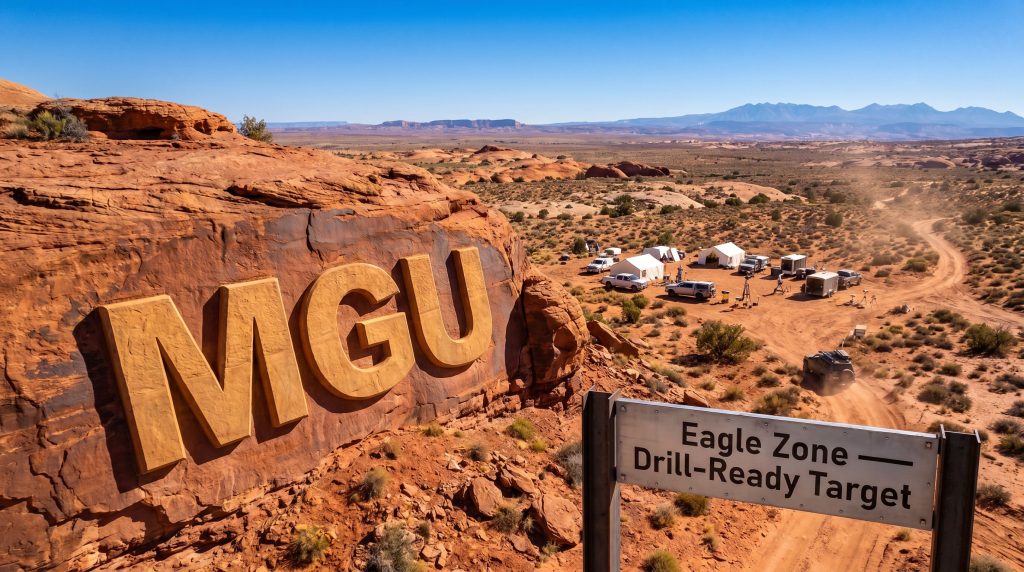
Magnum Mining and Exploration Ltd (ASX: MGU, OTCQB: MGUFF) has completed an integrated geophysical interpretation at its Parker Gold-Copper Project in Arizona, USA, converting previously reported high-grade surface samples into a ranked set of Magnum Mining Parker Gold-Copper Project drill-ready targets in Arizona across approximately 5 km of combined prospective strike.
According to the ASX announcement dated 23 June 2026, the work does not introduce new assay data. Instead, it links geology, geochemistry and geophysics into a single targeting model that is intended to guide first-pass drilling, subject to approvals and funding.
Managing Director commentary
"Parker is now moving from compelling surface evidence to a practical drill-target pipeline. The value of the current work is that it brings geology, geochemistry and geophysics together to show where evidence converges. Eagle Zone is our highest-confidence potential first-pass target, while Red Breccia provides a staged test of shallow breccia and alteration features."
Antonio Vitor Junior, Managing Director, Magnum Mining and Exploration Ltd
Magnum Mining and Exploration Ltd reports that Eagle Zone has been ranked as the highest-confidence first-pass target, with Red Breccia expected to remain a staged target and NSW Detachment in earlier-stage follow-up. First-pass drilling is identified as the next key decision point.
When big ASX news breaks, our subscribers know first
From High-Grade Surface Results to a Drill-Ready Framework
The current update builds on earlier surface sampling at the Parker Project, where selective rock-chip assays indicated strong local gold and copper fertility at two priority areas, Eagle Zone and Red Breccia.
Key previously reported selective rock-chip results at the priority targets are summarised below:
| Target | Sample ID | Au (g/t) | Cu (%) |
|---|---|---|---|
| Eagle Zone | 51013 | 91.6 | 6.39 |
| Eagle Zone | 51090 | 0.215 | 18.35 |
| Red Breccia | 51101 | 178 | 18.30 |
| Red Breccia | 51059 | 142 | 0.16 |
According to Magnum Mining and Exploration Ltd, these rock-chip samples were selectively taken from outcrops, float and mineralised structures and are not representative of width, thickness, volume, grade continuity or economic significance.
The integrated geophysical work reported on 23 June 2026 addresses a typical early-stage issue for investors: isolated high numbers at surface do not automatically provide a drill plan. Furthermore, the new interpretation is aimed at moving from point samples to a three-dimensional structural framework that can be tested by drilling.
What the Geophysics Does: Integrating Multiple Datasets
The Parker interpretation combines several independent datasets and processing techniques, all reprocessed and reviewed within a single project-scale model. According to the announcement, the work included:
-
Airborne magnetics and Tilt Derivative
Used to sharpen contacts, faults and zones where rocks have been structurally disrupted. -
Analytical Signal
Highlights edges of magnetic bodies, supporting interpretation of the structural framework. -
Radiometrics and F-Factor
Radiometrics measure natural radioactivity from the surface and can be used as a proxy for rock type and alteration. F-Factor is a specific radiometric ratio product used to map certain alteration patterns. -
Magnetic lineament density
Identifies areas with many interpreted structural features, which can mark zones where mineralising fluids may have moved. -
VOXI MVI 3D inversion
Produces a three-dimensional model of magnetic susceptibility (how easily rocks become magnetised) below the surface.
These geophysical products were integrated with:
- Geological and structural mapping
- Historical mining and working locations
- 457 soil samples collected during 2026
- 131 selective rock-chip samples with laboratory assays and overlimit re-assays
The value, in the view of Magnum Mining and Exploration Ltd, lies in where independent datasets overlap. Where mapped geology, historical workings, soil and rock-chip geochemistry and geophysical responses coincide, the company considers that it has a stronger basis for ranking targets and planning drill holes.
The ASX release emphasises an important qualification: airborne geophysics and inversion do not directly detect gold or copper mineralisation. They are, however, used to interpret architecture, structures, lithological contrasts and alteration proxies. The interpretations are non-unique and require drilling to be tested.
Educational Section: Understanding VOXI MVI 3D Inversion
For many investors, VOXI MVI can appear highly technical. The Parker update provides a practical example of how this tool is used in mineral exploration.
What Is VOXI MVI?
VOXI MVI (Moving Vector Inversion) is a software-based method that converts airborne magnetic data into a three-dimensional model of the subsurface. The key output is a grid of blocks showing estimated magnetic susceptibility, which is a measure of how easily each rock unit can be magnetised.
In simple terms:
- Rocks with higher magnetic minerals (such as magnetite) have higher susceptibility.
- Rocks that are altered, brecciated (broken into fragments) or contain different mineral assemblages can show lower or contrasting susceptibility.
This does not mean those rocks are mineralised with gold or copper. It simply indicates that their physical properties are different, and these differences can be related to geological features of interest.
Why Does VOXI MVI Matter at Parker?
According to Magnum Mining and Exploration Ltd, at Parker the VOXI MVI modelling is being used to:
- Interpret basement geometry and lithological contrasts.
- Highlight steep structural breaks that could have acted as conduits for hydrothermal fluids.
- Identify shallow low-to-moderate susceptibility domains that may reflect brecciation or alteration.
At Eagle Zone and Red Breccia, these VOXI MVI features are spatially associated with the highest-grade rock-chip samples, historical workings and mapped structures.
Plain-Language Glossary
| Term | Explanation |
|---|---|
| Magnetic susceptibility | A measure of how easily a rock becomes magnetised. Different rocks and alteration types have different values. |
| VOXI MVI inversion | A 3D modelling method that converts airborne magnetic data into a model of subsurface susceptibility. |
| F-Factor | A radiometric ratio used as an indirect indicator of certain types of alteration. |
| Tilt Derivative | A processing method applied to magnetic data to highlight sharp boundaries and structures. |
| Lineament density | A measure of how many mapped structural features (faults, fractures) occur in a given area. |
| IOCG | Iron Oxide Copper Gold deposit style; at Red Breccia this is described as an exploration hypothesis only. |
| Federal lode claims | US federal mining claims that give rights to explore for and potentially develop hard-rock minerals. |
For investors, the key point is that these tools are used to reduce uncertainty in target selection. They provide a framework so that early drill holes are aimed at specific geological questions rather than random locations.
Three Target Areas With Differentiated Confidence Levels
The integrated model at Parker organises three main target areas into a ranked pipeline. Magnum Mining and Exploration Ltd explicitly states that the approximately 5 km of combined prospective strike does not imply mineralised or grade continuity.
| Target area | Approx. prospective strike | Current status | Planned approach |
|---|---|---|---|
| Eagle Zone (Eagle Nest) | ~1.3 km | Highest-confidence first-pass target | Priority for initial drilling |
| Red Breccia | ~2.4 km | Staged prospective target | Staged drilling, shallow first |
| NSW Detachment | ~1.1 km | Earlier-stage follow-up | Ongoing surface work |
| Combined | ~5 km | Ranked potential target pipeline | Staged programme under review |
Eagle Zone Target
At Eagle Zone, several elements coincide:
- Historical workings and remnant infrastructure.
- Selective high-grade gold and copper rock-chip results.
- Mapped intrusive-carbonate relationships.
- Structurally complex corridors interpreted from magnetics and lineament density.
- VOXI MVI sections showing interpreted structural discontinuities and intrusive domains.
The initial drill programme is intended to test whether surface observations, including workings and high-grade samples, relate to a more coherent subsurface structure that could host mineralisation. The company states that no width, continuity, grade significance or economic potential is inferred at this stage.
Red Breccia Target
Red Breccia is described as an area with:
- Mapped hematite-rich polymictic and intrusive-hydrothermal breccia (breccia refers to rock made up of broken fragments in a matrix).
- An interpreted east-west structural and alteration corridor.
- Historical workings and elevated lineament density.
- F-Factor responses and some of the highest-grade Au-Cu rock-chip results.
- VOXI MVI highlighting a large susceptibility contrast and shallow domains interpreted as potential brecciation or alteration.
According to the announcement, Magnum Mining and Exploration Ltd anticipates that Red Breccia will be tested in stages. Early drilling is expected to focus on defining the in-situ source of mineralisation, geometry and the role of matrix, clasts and veins before considering deeper conceptual targets.
NSW Detachment
NSW Detachment is interpreted as a structurally controlled target associated with a low-angle detachment system and local rhyolitic dyke intrusions. It currently remains in surface follow-up and is not prioritised for the initial drilling sequence.
A Systematic Exploration Build at Parker
The Parker work is framed by Magnum Mining and Exploration Ltd as part of a deliberate, staged exploration process. Since acquiring the project, the company reports the following sequence:
- Acquisition of high-resolution heliborne magnetic and gamma-ray spectrometry data on 40 m traverse lines.
- Geological and structural mapping across the main claim blocks.
- Collection of 457 soil samples and 131 targeted rock-chip samples.
- Laboratory analysis and overlimit re-assays, confirming surface results up to 178 g/t Au and 18.35% Cu.
- Advanced 2D and 3D reprocessing of geophysical datasets, including Tilt Derivative, Analytical Signal, F-Factor, lineament density and VOXI MVI inversion.
- Integration of all datasets into a single targeting model and ranking of potential drill targets.
- Planning for first-pass drilling, subject to approvals, access and funding.
This type of stepwise approach is generally intended to focus drilling on the most technically supported targets, which consequently has implications for capital efficiency and risk management from an investor perspective.
What Comes Next: The Path Towards Drilling
The announcement outlines a staged path towards initial drilling at Parker, which remains subject to approvals, access, final collar validation, contractor availability, funding, field conditions and final technical sign-off.
Planned next steps are summarised as follows:
| Step | Activity |
|---|---|
| 1 | Finalise drill sequence, including collar locations, orientations and order of holes, using the integrated model. |
| 2 | Complete ground validation of target positions, access routes, historical workings and geological assumptions. |
| 3 | Continue permitting, land-access and environmental/cultural approvals required for proposed drill pads. |
| 4 | Confirm operational readiness, including contractor selection, mobilisation timing, budget and QA/QC plans. |
| 5 | Undertake staged first-pass drilling, with Eagle Zone expected to receive first priority and Red Breccia tested where validation supports it. |
| 6 | Update the geological and geophysical model using drilling data, including structural measurements, assays and petrophysical data. |
For investors tracking timing, the company has not specified exact drill start dates, highlighting conditions that must be satisfied before drilling proceeds.
Portfolio Context: Parker Within Magnum Mining and Exploration Ltd's Broader Strategy
The Parker Project is one of several assets held by Magnum Mining and Exploration Ltd. The company describes its portfolio approach as identifying potentially fertile systems and increasing expenditure only as technical confidence improves.
Key projects mentioned in the ASX release include:
| Project | Location | Stage | Primary commodities |
|---|---|---|---|
| Parker | La Paz County, Arizona, USA | Pre-drilling, ranked potential drill targets defined | Gold, Copper |
| Wet Mountain | USA | Parallel US workstream, details in earlier releases | Copper-gold (project-level) |
| Azimuth (Piracanjuba North) | Brazil | Ionic Adsorption Clay rare earth discovery, auger drilling underway | Rare Earth Elements (REE) |
At Azimuth in Brazil, the company has reported a confirmed Ionic Adsorption Clay rare earth element discovery at Piracanjuba North, with the first 24 auger holes all intersecting near-surface REE mineralisation, according to earlier ASX releases. The same general exploration philosophy is being applied: systematic data collection, integration and staged expenditure.
For investors, this portfolio structure means that news flow may arise from more than one jurisdiction and commodity, including precious metals and critical minerals.
The next major ASX story will hit our subscribers first
Why Parker Is Attracting Attention From Investors
The ASX announcement outlines several factors that position Parker as a priority gold-copper exploration project within the portfolio of Magnum Mining and Exploration Ltd:
-
Location and access
- Approximately 14 km northeast of Parker, Arizona, within the Buckskin Mountains.
- Situated on the south-eastern extension of the Walker Lane gold-copper trend, a recognised mineralised corridor in the western United States.
- The project area is reported to be close to existing road and rail infrastructure.
-
Land position
- 79 federal unpatented lode claims covering approximately 6.58 km².
- Claim blocks include Eagle Nest, Red Breccia and NSW Detachment.
-
High-grade surface starting point
- Historical workings combined with selective rock-chip assays up to 178 g/t Au and 18.35% Cu at surface.
- These values are selective and not representative of average grades, but they provide a basis for targeting.
-
Ranked target pipeline
- Approximately 1.3 km of prospective strike at Eagle Nest, 2.4 km at Red Breccia and 1.1 km at NSW Detachment, for a combined estimate of ~5 km of prospective target-scale strike.
- Clear differentiation between a highest-confidence initial target (Eagle Zone), a staged target (Red Breccia) and an earlier-stage area (NSW Detachment).
-
Integrated methodology
- Use of modern airborne geophysics, surface geochemistry, mapping and VOXI MVI to build a three-dimensional targeting model.
- Stated commitment to validate geophysical interpretations through drilling and petrophysical data collection.
From an investment perspective, the Magnum Mining Parker Gold-Copper Project drill-ready targets in Arizona represent an early-stage opportunity where the next material catalyst is expected to be the commencement and results of first-pass drilling. The outcome of this drilling will be critical in assessing whether the high-grade surface results and geophysical architecture translate into mineralisation at depth.
Key takeaway for investors
Magnum Mining and Exploration Ltd has reported that integrated airborne magnetic, radiometric and VOXI MVI interpretation at the Parker Gold-Copper Project has produced a ranked set of potential drill targets across approximately 5 km of combined prospective strike. Eagle Zone is identified as the highest-confidence first-pass target, with Red Breccia to be tested in stages and NSW Detachment remaining in surface follow-up. First-pass drilling at Parker, alongside ongoing rare earth drilling at Azimuth in Brazil, forms a key part of the near-term news pipeline for the company.
Ready to Dig Deeper Into Magnum Mining's Parker Gold-Copper Project?
With Eagle Zone ranked as the highest-confidence first-pass target and approximately 5 km of combined prospective strike now supported by an integrated geophysical model, Magnum Mining and Exploration Ltd (ASX: MGU) is moving Parker closer to the drill bit. Investors looking to follow the company's progress at Parker — and across its broader portfolio, including the Azimuth rare earth discovery in Brazil — can access the latest project updates, announcements and corporate information directly at www.mmel.com.au.