June 5, 2026
Why Offshore Gas Development Timelines Hinge on a Single Piece of Equipment
In the world of offshore energy development, the critical path from approved plan to first revenue is rarely blocked by geology, regulation, or even financing. More often, it comes down to one deceptively simple constraint: rig availability. Jack-up drilling rigs are finite, globally mobile assets, and competition for them among upstream operators in Southeast Asia has intensified considerably as regional gas demand climbs and stranded field inventories shrink. When a development-stage company secures a binding rig contract, the transformation is not merely logistical. It signals a fundamental shift from intention to execution, from contingent capital allocation to contracted obligation.
This is the lens through which the Conrad Mako gas field development should be understood. The execution of a binding drilling rig agreement in June 2026 marks the point at which one of the largest fully appraised undeveloped gas fields in the West Natuna Basin crossed from planning into a contracted development pathway. For investors and industry observers, understanding what this means requires working through the technical architecture, commercial structure, and market context of the project itself.
When big ASX news breaks, our subscribers know first
Understanding the West Natuna Basin and Mako's Position Within It
The West Natuna Basin sits in the southern reaches of the South China Sea, a mature but still productive offshore gas province that has supplied pipeline gas to Singapore for decades. The basin's commercial history gives it a characteristic that most frontier offshore regions lack entirely: a proven gas sales framework, established pipeline export infrastructure, and a creditworthy offtake market at the end of the pipe.
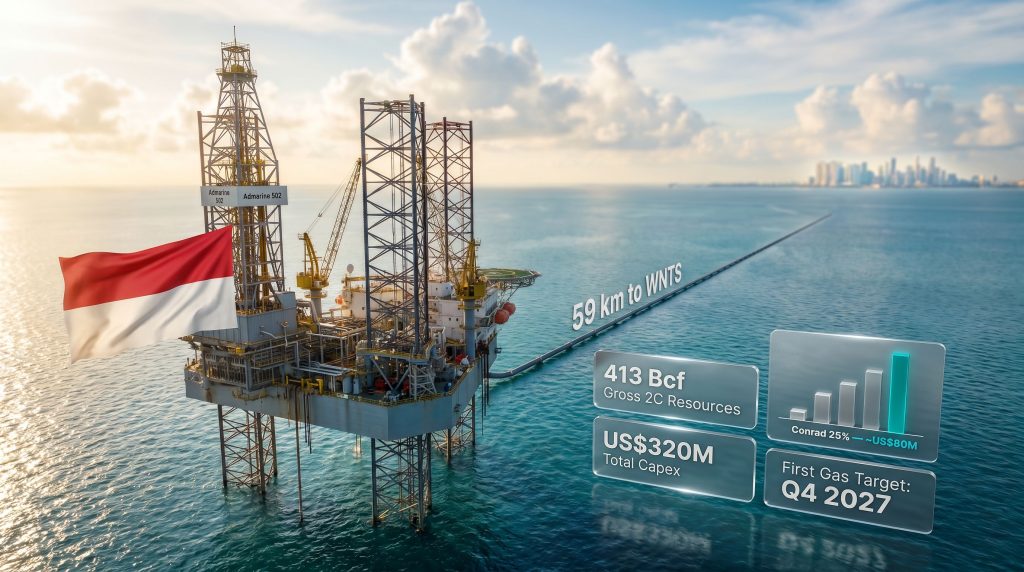
Within this basin, the Mako gas field, which sits within the Duyung Production Sharing Contract area, holds gross 2C contingent resources estimated at 413 billion cubic feet (Bcf). For context, contingent resources at the 2C level represent the central estimate of technically recoverable volumes where commerciality has not yet been fully established or where development is still being planned. Mako's distinction is that it is fully appraised, meaning multiple wells have already confirmed the resource extent and reduced subsurface uncertainty to a level more typically associated with producing assets than development-stage projects.
Conrad Asia Energy (ASX: CRD) holds a 76.5% working interest in the Duyung PSC, with a 25% economic participation in the project under the PSC structure. This distinction between working interest and economic interest is meaningful. In production sharing contracts, the Indonesian state typically retains a portion of production through cost recovery and profit-sharing mechanisms, which is why Conrad's net attributable resource of approximately 215 Bcf reflects its economic entitlement rather than its equity stake in the contract. Understanding PSC economics is essential for investors modelling project cash flows, since gross production figures overstate what an upstream partner will actually receive.
The field sits approximately 20 kilometres from existing gas export and oil infrastructure, a geographic advantage that materially reduces the capital intensity of bringing it to market. Furthermore, proximity to the West Natuna Transportation System (WNTS) pipeline means Mako avoids the standalone export infrastructure costs that burden more remote offshore developments in the region.
The Technical Architecture of the Mako Development Plan
The revised Plan of Development for Mako, approved by Indonesia's upstream regulator SKK Migas in October 2022, adopts a phased development architecture that balances near-term capital efficiency with longer-term production optionality.
Phase 1, which is the focus of current activity, centres on a six-well offshore drilling campaign tied back to a leased Mobile Offshore Production Unit (MOPU). The use of a leased rather than owned MOPU is a deliberate capital efficiency decision. Owning a floating production facility requires substantial upfront capital and ongoing maintenance obligations. Leasing transfers asset ownership risk to the facility provider while preserving Conrad's balance sheet capacity for well drilling and pipeline infrastructure.
How Does the Phase 1 Infrastructure Stack Together?
The full Phase 1 infrastructure stack looks like this:
| Infrastructure Component | Role in Development |
|---|---|
| Mobile Offshore Production Unit (MOPU) | Offshore gas processing and production handling |
| Conductor Support Frame (CSF) | Structural foundation enabling well conductor installation |
| Six Development Wells | Primary production mechanism for Phase 1 gas volumes |
| 59 km Export Pipeline | Connects field output to the WNTS pipeline network |
| West Natuna Transportation System (WNTS) | Existing corridor delivering gas to Singapore |
Phase 1 capital expenditure estimates have ranged from approximately US$251 million to US$303 million across different plan revisions, with total project capex estimated at approximately US$320 million on a 100% basis. Conrad's 25% economic share translates to roughly US$80 million in development capital. The variance in Phase 1 figures across documents reflects iterative plan refinements as engineering work has progressed, a normal characteristic of offshore development projects as scope definition sharpens.
Peak sales gas production rates of up to 111 billion British thermal units per day (bbtu/d) have been cited in project development materials, positioning Mako as a genuinely substantial supply source for the Singapore gas market.
What the Rig Contract Actually Means for Project Execution
Conrad's subsidiary, West Natuna Exploration Limited, executed a binding contract with PT Pertamina Drilling Services Indonesia operating through the PDSI-ADES Consortium for the provision of the Admarine 502, a jack-up drilling rig suited to the water depths and well configurations required at Mako.
The key parameters of the agreement are:
- Firm contract duration: 180 days, calibrated precisely to the six-well drilling program
- Scope of work: Six development wells plus Conductor Support Frame installation
- Targeted drilling commencement: Q2 2027
- First gas target: Q4 2027
- Extension options: Available if subsurface or operational conditions require additional work
The 180-day firm term is not arbitrary. A six-well jack-up program in the Natuna Sea, including rig mobilisation, well construction, completion, and CSF installation, is a well-defined scope. A 180-day window reflects the disciplined project management approach of working within a contracted drilling envelope rather than an open-ended mobilisation. Extension options provide contingency without inflating the base commitment.
The choice of PT Pertamina Drilling Services Indonesia as the drilling contractor also carries operational significance. As a subsidiary of Indonesia's national oil company Pertamina, PDSI brings established regulatory relationships and operating familiarity with Indonesian offshore environments. This matters in PSC jurisdictions, where contractor relationships with national entities can influence operational approvals and logistics coordination.
Conrad's managing director indicated the company had secured the rig on favourable terms, a comment that carries weight in the current jack-up market, where utilisation rates in Southeast Asia have been elevated by competing development campaigns across multiple basins.
The Development Timeline: From Regulatory Approval to First Gas
Understanding how Mako reached this point requires tracing the project's regulatory and commercial history:
| Milestone | Timing |
|---|---|
| SKK Migas Revised POD Approval | October 2022 |
| Final Investment Decision (FID) | Reached ahead of rig contract execution |
| Drilling Rig Contract Executed | June 2026 |
| Drilling Commencement (Target) | Q2 2027 |
| First Gas (Target) | Q4 2027 |
The POD approval by SKK Migas in October 2022 was the foundational regulatory milestone. Without it, no commercial development activities could legally proceed under Indonesian upstream law. The fact that nearly four years elapsed between POD approval and rig contract execution reflects the complexity of offshore development financing and contracting cycles, however the sequence is now firmly forward-looking.
Final Investment Decision, which represents the formal commitment of project capital, was reached prior to the rig contract execution, reversing what might seem like the natural order. In practice, FID and rig contracting are closely linked: most development lenders and project partners require rig availability confirmation before committing capital, while rig contractors require FID confidence before committing their assets. The near-simultaneous resolution of these two gates is a feature of disciplined offshore project management.
Pipeline Access, Market Structure, and the Singapore Premium
One of the less commonly examined commercial advantages of the Conrad Mako gas field development is the nature of its end market. Singapore is structurally dependent on piped gas imports and has historically paid a premium for reliable, pipeline-delivered supply compared to spot LNG. Pipeline gas avoids the liquefaction, shipping, and regasification costs embedded in LNG market pricing, which typically range between US$2.50 and US$4.00 per million British thermal units depending on market conditions. For a field delivering directly into the WNTS pipeline at a tie-in point just 59 kilometres from Mako, this cost structure advantage is locked in by geography.
The WNTS itself is an existing pipeline system that has historically transported gas from the West Natuna Basin to Singapore under long-term agreements. Mako's development does not require building new cross-border pipeline infrastructure, which would involve separate bilateral regulatory processes. Instead, it involves connecting to an already-operational export corridor, substantially reducing both technical risk and timeline uncertainty on the market access side of the project.
Indonesian PSC terms also incorporate domestic market obligation provisions, requiring a defined portion of production to be directed toward Indonesia's internal gas market. This is a standard feature of Indonesian upstream contracts rather than a project-specific condition, and it is factored into Conrad's project economics modelling alongside the Singapore export volumes. Broader natural gas price trends across the region will consequently influence how those economics are assessed over the development horizon.
The next major ASX story will hit our subscribers first
Capital Structure, Funding Requirements, and Investor Considerations
Conrad's approximately US$80 million share of project capex is a relatively modest absolute figure for an offshore gas development of this scale, a function of both its 25% economic participation and the capital efficiency achieved through leased production infrastructure.
However, US$80 million is still a substantial capital requirement for an ASX-listed development-stage company, and how Conrad intends to fund this commitment will be a key area of investor focus as the project moves into its execution phase. The company's ASX listing (ticker: CRD) provides access to Australian equity capital markets, and the share price response of more than 20% on the day of the rig contract announcement reflects the market's interpretation of the milestone as a genuine derisking event.
What Risk Factors Should Investors Consider?
Investors should weigh several risk factors with appropriate care. In addition, commodity price impacts on project economics deserve particular scrutiny given current regional market dynamics:
- Execution risk: Offshore drilling campaigns are exposed to weather interruptions, equipment delays, and subsurface variability that can affect well outcomes and timelines
- Commodity price risk: Mako's economics are denominated in USD and benchmarked against Singapore gas market pricing, which itself responds to regional LNG supply outlook movements
- Financing risk: The pathway to funding Conrad's ~US$80 million capex share through a combination of equity, debt, or project financing has not yet been fully disclosed
- PSC compliance obligations: Domestic market obligation requirements and cost recovery mechanisms under the Duyung PSC affect net revenue calculations in ways that gross production figures do not capture
- Regulatory continuity: While SKK Migas has approved the POD, ongoing compliance with Indonesian upstream regulation remains a standing requirement throughout the development period
Furthermore, investors with exposure to Australian resource and energy exports will recognise many of these structural risk categories from comparable offshore development projects across the region.
This article is informational in nature and does not constitute financial advice. Readers should conduct their own due diligence and consult a licensed financial adviser before making any investment decisions related to ASX-listed securities.
What Separates Mako From Exploration-Stage Assets
A technical point worth examining in detail is the significance of Mako's fully appraised status, a term that carries specific meaning in upstream resource classification. Under the Society of Petroleum Engineers Petroleum Resources Management System (SPE-PRMS), contingent resources at the 2C level represent volumes with a 50% probability of exceeding the stated estimate. Full appraisal means the reservoir geometry, fluid contacts, and production characteristics have been tested and confirmed across multiple wells rather than extrapolated from a single discovery well.
This distinction matters enormously for project financing and partner confidence. Lenders providing project debt against a fully appraised resource face fundamentally different subsurface risk than those financing a single-well discovery. The reduction in geological uncertainty does not eliminate development risk, but it removes one of the largest categories of uncertainty that typically applies to exploration-stage assets.
Mako's 413 Bcf gross 2C resource in this context should be understood not as an exploration estimate subject to wide upside and downside variance, but as a technically grounded central case with meaningful data support from appraisal drilling.
Key Milestones to Monitor Through 2027
As the Conrad Mako gas field development moves from contracted planning into active execution, the following milestones represent the critical monitoring points for investors and industry observers:
Near-Term Milestones (2026 to Early 2027)
- Finalisation and announcement of the MOPU lease agreement and mobilisation schedule
- Confirmation of Conductor Support Frame fabrication commencement
- Progress updates on development financing arrangements
- Any revisions to gas sales agreement terms or volume commitments
Execution Phase Milestones (Q2 2027 Onward)
- Drilling commencement as the primary near-term execution test
- Individual well completion results and any subsurface discoveries that could affect Phase 2 scope
- First gas achievement in Q4 2027 as the primary commercial inflection point
Longer-Term Value Drivers
- Production ramp to plateau rates and sustained delivery against contracted sales volumes
- Phase 2 development scope definition, including potential well additions or production facility upgrades
- Conrad's transition from capital consumption to cash generation, and what that implies for the company's capital allocation strategy and potential return of value to shareholders
The Conrad Mako gas field development now sits at one of the most consequential junctures in any offshore project lifecycle: the moment when paper commitments become contracted obligations, and when the execution skills of the operating team become the dominant variable in whether value creation matches the original investment thesis. The rig is booked. The wells are designed. The pipeline is waiting. What follows is the hard work of turning geology into gas.
Want to Know Which ASX Energy and Resource Companies Are Making Major Discoveries Right Now?
Discovery Alert's proprietary Discovery IQ model scans ASX announcements in real time, instantly identifying significant mineral and energy discoveries and translating complex data into actionable investment insights — the same kind of market-moving events that have historically generated substantial returns, as documented on Discovery Alert's dedicated discoveries page. Start your 14-day free trial at Discovery Alert and position yourself ahead of the broader market the moment the next major announcement hits.