July 21, 2026
When Resilience Becomes the Most Valuable Asset in Energy Markets
For most of the past four decades, the architecture of global energy trade was engineered around a single dominant principle: keep hydrocarbons moving. Speed, volume, and cost efficiency defined competitive advantage. Storage was a buffer, not a strategy. Port infrastructure was optimised for throughput, not redundancy. The Strait of Hormuz was treated as a permanent given rather than a vulnerability requiring mitigation.
That operating assumption has now broken down structurally, not temporarily. Simultaneous disruptions across the world's most critical maritime corridors, from the Persian Gulf to the Red Sea, have forced energy markets to confront a new reality. The freight economics that underpinned decades of Asian energy import strategy have shifted permanently. What was once considered crisis-response infrastructure is rapidly being reclassified as core strategic investment.
It is within this context that the Malaysia Maharani Freeport energy hub has emerged as one of the region's most analytically compelling infrastructure propositions.
When big ASX news breaks, our subscribers know first
Understanding the Maharani Freeport: Architecture and Ambition
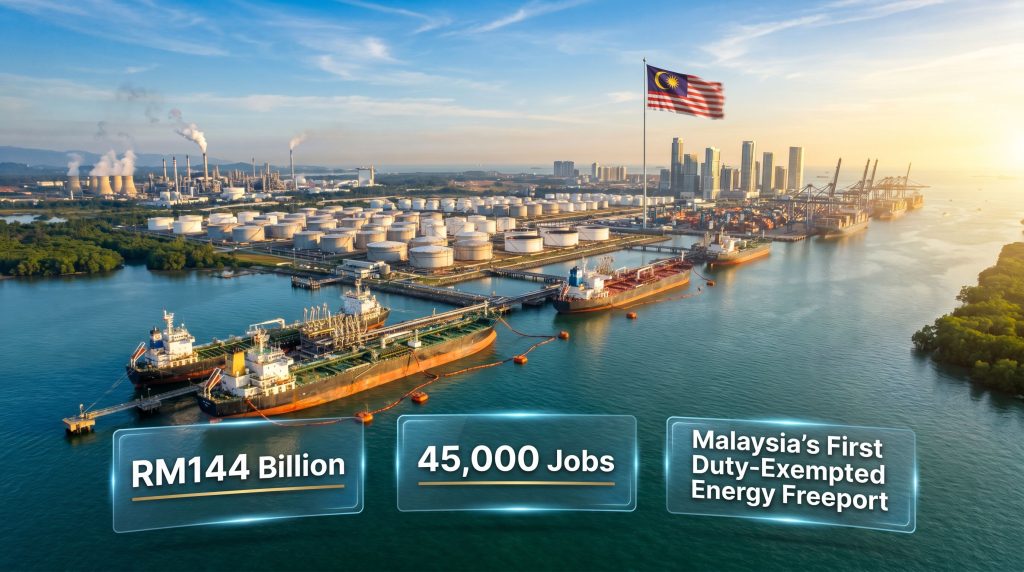
The Malaysia Maharani Freeport energy hub is positioned as Malaysia's first duty-exempted energy freeport, located within the Muar district of Johor on the southwest coast of peninsular Malaysia. Its geographic placement adjacent to the Strait of Malacca, through which an estimated 40% of global seaborne trade transits annually, provides a structural foundation that few competing projects can replicate.
The project's masterplan is constructed around four integrated pillars:
| Pillar | Core Function | Strategic Role |
|---|---|---|
| Energy Hub | Oil and gas storage, refining, blending, bunkering, STS operations, floating storage, renewables | Primary commercial anchor |
| Deep Seaport | VLCC-capable berths, full maritime access infrastructure | Enables large-cargo throughput |
| Industrial Park | Petrochemical processing, downstream value-add manufacturing | Industrial clustering and value capture |
| Financial Hub | Energy trading facilitation, capital markets services | Monetisation and liquidity layer |
The project has reported a total projected investment target of approximately RM144 billion, equivalent to roughly USD $34.56 billion, with ambitions to generate up to 45,000 direct and indirect jobs across the integrated zone. Maharani has officially launched and entered commercial operations, marking the transition from concept to active infrastructure asset.
What separates a genuine strategic energy node from speculative port development is the presence of identifiable demand anchors, geographic irreplaceability, and competitive differentiation. Maharani's case rests on all three, though execution discipline will ultimately determine whether the project achieves systemic relevance.
The Structural Shift Driving Demand for Resilience Infrastructure
From Flow Optimisation to Strategic Redundancy
The global oil and gas trading system was historically constructed on the premise of reliable, uninterrupted access through Gulf shipping corridors. That premise has been progressively dismantled by converging disruptions. Furthermore, oil price movements driven by trade tensions have compounded the instability across these critical supply routes:
- Escalating military confrontations and tanker seizure incidents across the Strait of Hormuz
- Persistent drone and missile attacks targeting commercial shipping near the Bab El-Mandeb strait in the Red Sea
- OPEC+ cohesion fractures creating supply uncertainty independent of logistics factors, with OPEC's influence on oil markets becoming an increasingly contested variable
- Rapidly rising maritime insurance premiums for vessels transiting designated high-risk zones
- Cape of Good Hope rerouting adding approximately 10 to 14 days to voyage times, effectively removing tanker and LNG vessel capacity from the active global fleet
The International Energy Agency has flagged the risk of oil markets entering a critical supply deficit zone driven in part by logistics disruption rather than pure production shortfalls, with some analysts highlighting a potential crunch window emerging in the northern summer months. Goldman Sachs has separately issued warnings on tightening global oil stockpiles as a direct consequence of these compounding pressures.
The Fujairah Precedent: What Bypass Infrastructure Can Become
The most instructive historical analogy for Maharani's potential trajectory is Fujairah in the UAE. Positioned outside the Strait of Hormuz on the Gulf of Oman coastline, Fujairah was long regarded as a secondary logistics outpost of limited strategic significance. As Hormuz instability intensified over successive cycles, however, the value of its bypass positioning underwent a fundamental repricing.
Today, Fujairah is one of the world's most strategically critical bunkering and crude storage hubs precisely because geopolitical instability elevated the commercial value of resilience infrastructure. In addition, the broader geopolitical risk landscape affecting commodities globally has reinforced how decisively external risk environments can reprice strategically positioned assets.
Strategic Insight: The Fujairah case demonstrates that infrastructure timing and geographic positioning can transform secondary assets into primary strategic nodes when the external risk environment shifts. The Maharani Freeport energy hub occupies a structurally analogous position relative to Asia's evolving maritime insecurity landscape.
Asia may now require its own equivalent distributed resilience architecture, and Malaysia's geographic position along the Malacca corridor places it at the centre of that potential development.
Maharani's Competitive Position Within Asia's Hub Landscape
How It Compares to Existing and Emerging Rivals
No single existing Southeast Asian hub outside Singapore currently offers the complete combination of neutral jurisdiction, deep-water VLCC access, integrated energy services, and direct positioning on Malacca corridor traffic flows. Maharani's competitive differentiation opportunity lies in occupying the structural gap between Singapore's constrained expansion capacity and the region's escalating demand for distributed resilience infrastructure.
| Hub | Location | Primary Function | Key Advantage | Key Constraint |
|---|---|---|---|---|
| Singapore | Strait of Malacca (south) | Oil trading, bunkering, LNG | Ecosystem depth, financial markets | Land scarcity, cost, expansion limits |
| Fujairah (UAE) | Gulf of Oman | Bunkering, crude storage | Hormuz bypass positioning | Regional geopolitical exposure |
| Maharani (Malaysia) | Strait of Malacca (west) | Storage, STS, bunkering, industrial | Neutral jurisdiction, VLCC access | Early-stage, unproven at scale |
| Batam and Bintan (Indonesia) | Malacca region | Emerging logistics | Singapore proximity | Regulatory complexity |
| Mundra and Vizag (India) | Indian Ocean coast | Strategic petroleum reserves | Scale, state-backed development | Primarily domestic supply focus |
| Zhoushan (China) | East China Sea | Crude storage, bonded trading | Scale, state backing | Geopolitical sensitivity for non-Chinese users |
Maharani is not designed to replicate Singapore's full ecosystem. Decades of institutional depth, financial market infrastructure, established trading house presence, and legal framework development make Singapore's model impossible to clone on a compressed timeline. The smarter strategic positioning involves occupying the specialist niche of offshore storage, ship-to-ship transfer, and bunkering, absorbing overflow demand as Singapore faces structural expansion limits.
Energy Services Offered Across the Maharani Platform
Hydrocarbon and Conventional Energy Infrastructure
The core commercial layer of the Malaysia Maharani Freeport energy hub encompasses a broad suite of hydrocarbon services:
- Crude oil and refined product storage facilities with competitive capacity for regional redistribution
- Ship-to-ship (STS) transfer operations accommodating VLCC (Very Large Crude Carrier) and Suezmax class vessels, which are among the largest tanker categories in active deployment
- Floating storage units (FSUs) for flexible, market-responsive cargo management
- Petroleum blending and quality adjustment services catering to refinery-specific crude specifications
- Marine bunkering services for fuel supply to vessels transiting one of the world's most heavily trafficked corridors
Transition Energy and Future-Fuels Positioning
Beyond conventional hydrocarbons, the masterplan incorporates infrastructure aligned with the maritime sector's decarbonisation trajectory under IMO 2030 and 2050 frameworks. Consequently, the project's forward-looking design draws on broader trends in renewable energy solutions being adopted across energy-intensive industries:
- Renewable and alternative energy generation components integrated within the industrial zone
- Potential positioning for ammonia, methanol, and biofuel bunkering as regulatory pressure accelerates the adoption of alternative marine fuels
- LNG receiving and storage capacity to serve growing regional gas demand across Southeast and Northeast Asia, consistent with the evolving LNG supply outlook for Asian markets
The integration of future-fuels capability is strategically significant. Port infrastructure that can accommodate only conventional hydrocarbons faces an accelerating obsolescence risk as shipping operators increasingly require multi-fuel flexibility. Maharani's stated intention to incorporate alternative fuel bunkering from inception positions it more favourably against this structural transition than legacy port infrastructure optimised solely for conventional marine fuels.
Scenario Modelling: Three Strategic Trajectories
Scenario 1: Incremental Specialisation (Base Case, 5 to 8 Years)
Maharani establishes itself as a focused offshore storage, STS transfer, and bunkering node. It captures overflow demand from Singapore's capacity constraints without attempting full ecosystem replication. Capital deployment is tied to verifiable demand milestones rather than speculative volume assumptions. The primary investor profile in this scenario includes regional commodity traders, Asian utilities, and mid-tier shipping companies.
Scenario 2: Regional Resilience Hub (Optimistic Case, 8 to 15 Years)
Maharani successfully integrates LNG services, future-fuels infrastructure, and expanded petrochemical clustering. It attracts investment from Middle Eastern national oil companies seeking direct downstream and logistics access in Asian markets. It becomes a recognised complementary node to Singapore within a distributed Southeast Asian energy logistics network.
Scenario 3: Delayed Entry and Competitive Displacement (Risk Case)
Competing regional hubs absorb the strategic momentum currently available to Malaysia. Indonesia's expanding energy corridor ambitions, India's aggressive strategic storage buildout, and China's maritime logistics investments collectively capture the available market opportunity. Maharani remains a secondary domestic facility rather than a globally relevant energy node.
Investor Warning: Infrastructure timing is frequently the decisive variable between systemic relevance and permanent secondary status. The window for capturing first-mover positioning in Southeast Asian energy resilience infrastructure is not indefinitely open. Competing jurisdictions are actively investing, and strategic momentum, once lost, rarely recovers.
The next major ASX story will hit our subscribers first
Probable Capital Sources and Investor Categories
The USD $34.56 billion investment envelope requires a diverse and sustained capital coalition. Phased deployment logic represents industry best practice, tying capital commitments to demand validation milestones rather than front-loaded speculative construction. Modular scalability provides an important financing advantage by enabling incremental infrastructure expansion without requiring full upfront commitment.
The most probable investor categories include:
- Middle Eastern national oil companies such as Saudi Aramco, ADNOC, and QatarEnergy, all of which are actively seeking downstream and logistics positioning in Asian markets to secure long-term demand access
- Asian sovereign wealth funds, including Malaysia's own Khazanah Nasional alongside regional peers, representing natural anchor capital for nationally strategic infrastructure
- Global commodity trading houses including Vitol, Trafigura, Gunvor, and Mercuria, which increasingly require flexible Asian storage and transfer platforms as their trading books become more geographically distributed
- Tanker operators and VLCC fleet managers who benefit directly from accessible, competitively priced STS and bunkering facilities along high-traffic corridors
- Northeast Asian utilities from Japan, South Korea, and Taiwan seeking supply chain diversification and emergency storage optionality in response to their own governments' energy security mandates
Environmental and Regulatory Risk Factors
Investors conducting due diligence on the Malaysia Maharani Freeport energy hub must account for a distinct set of environmental and regulatory risk variables:
- Earlier assessments raised questions about the comprehensiveness of environmental impact assessments (EIA) related to coastal reclamation activities
- Documented concerns from local fishing communities regarding sea access disruption and the effect on traditional livelihoods in the Muar coastal area
- Marine ecosystem considerations linked to reclamation-induced habitat disruption in ecologically sensitive coastal zones
- Multi-agency approval requirements spanning both federal and state environmental authorities in Malaysia
Due Diligence Note: The long-term commercial viability of large-scale port and energy infrastructure increasingly depends on social licence to operate, not just formal regulatory approval. Projects that inadequately address community and environmental concerns face compounding reputational and financing risks in the current ESG-sensitive capital environment. European institutional investors and sovereign wealth funds with environmental mandates will require demonstrated compliance frameworks before committing capital at scale.
Geopolitical Neutrality as a Commercial Asset
A dimension of Maharani's strategic case that receives insufficient analytical attention is the commercial value of Malaysia's historically balanced foreign policy positioning. In an era of expanding sanctions regimes, bloc fragmentation, and maritime militarisation, energy infrastructure located in non-aligned jurisdictions can attract investment and trade flows from multiple competing geopolitical camps simultaneously.
China, Gulf states, and Western-aligned capital pools all face escalating mutual exclusivity risks when selecting infrastructure partners. A neutral jurisdiction reduces that exposure, effectively functioning as a risk-mitigation instrument for commodity traders and energy investors navigating the fractured multipolar order. Japan's crude imports from the Middle East have slumped to record lows amid ongoing corridor disruptions, reinforcing how urgently Northeast Asian buyers require alternative logistics solutions that do not carry embedded geopolitical liabilities.
Malaysia's positioning makes Maharani an unusual asset in this respect, one that could simultaneously serve demand from competing geopolitical blocs without triggering the exclusion dynamics that increasingly afflict infrastructure in more politically committed jurisdictions. The Maharani Energy Gateway project has been the subject of detailed independent assessments that broadly affirm this geopolitical neutrality advantage.
Frequently Asked Questions: Malaysia Maharani Freeport Energy Hub
What is the Maharani Freeport energy hub?
Maharani Freeport is Malaysia's first duty-exempted energy freeport, located in the Muar district of Johor. It is designed as an integrated energy and maritime services zone encompassing oil and gas storage, ship-to-ship transfer operations, bunkering, blending, petrochemical processing, renewable energy infrastructure, deep-sea port facilities, an industrial park, and a financial hub.
Where is Maharani Freeport located?
The project is situated on the southwest coast of peninsular Malaysia, adjacent to the Strait of Malacca, one of the world's most heavily trafficked maritime oil shipping corridors.
How much investment is Maharani Freeport targeting?
The project has reported an investment target of approximately RM144 billion, equivalent to roughly USD $34.56 billion, with projected employment generation of up to 45,000 direct and indirect jobs across the integrated zone.
Is Maharani Freeport operational?
The project has officially launched and entered commercial operations, positioning itself as a nationally strategic energy and maritime hub within Malaysia's broader infrastructure landscape.
How does Maharani Freeport differ from Singapore as an energy hub?
Maharani is not designed to replicate Singapore's full ecosystem. It is positioned as a complementary specialist node offering offshore storage, STS transfer, and bunkering capacity to absorb overflow demand and provide regional resilience redundancy as Singapore faces structural expansion constraints driven by land scarcity, rising costs, and environmental restrictions.
What are the key environmental concerns?
Earlier assessments flagged questions about the comprehensiveness of coastal reclamation EIA processes, potential disruption to local fishing communities, and marine habitat impacts. These represent ongoing regulatory and ESG risk variables for prospective investors.
The Long-Term Investment Thesis: Resilience Over Throughput Volume
The structural forces converging in support of the Malaysia Maharani Freeport energy hub's strategic case are not short-cycle phenomena. Maritime insecurity across Gulf and Red Sea corridors has been repriced by insurance markets as a permanent feature of the operating environment rather than a temporary disruption. Singapore's physical expansion constraints are geological and urban realities, not policy variables. Asia's hydrocarbon import dependence is growing, not contracting.
In this environment, the most commercially valuable energy infrastructure assets of the next decade may not be those commanding the highest throughput volumes during stable periods. They may, however, be the assets capable of maintaining operational continuity, providing storage optionality, and facilitating cargo flexibility precisely when conventional supply chains fracture under geopolitical pressure.
Maharani's investment case rests not on replicating existing hub models but on occupying a structurally underserved niche within Asia's evolving energy resilience architecture. The critical success factors are disciplined phased investment, credible anchor tenant acquisition, robust environmental compliance, and the execution speed required to capture a strategic positioning window that competing jurisdictions are actively pursuing.
Disclaimer: This article is intended for informational and educational purposes only. It does not constitute financial, investment, or legal advice. Forecasts, scenario modelling, and forward-looking assessments involve inherent uncertainty and should not be relied upon as the basis for investment decisions. Readers should conduct independent due diligence and consult qualified advisors before making any investment or commercial decisions related to the projects, assets, or market dynamics discussed.
Want to Stay Ahead of the Next Major Resource Discovery Shaping Asia's Energy Landscape?
As geopolitical disruption continues to reprice strategic infrastructure assets across global energy markets, Discovery Alert's proprietary Discovery IQ model delivers real-time ASX mineral discovery alerts — instantly translating complex data across 30+ commodities into clear, actionable insights for both traders and long-term investors. Explore why significant mineral discoveries have historically generated exceptional returns and begin your 14-day free trial today to position yourself ahead of the broader market.