August 3, 2026
The Hidden Arithmetic Behind Africa's Resource Wealth Problem
Across the African continent, a paradox has persisted for decades: nations sitting atop extraordinary mineral wealth continue to rank among the world's most infrastructure-deprived economies. The issue is rarely a shortage of geological endowment. It is, instead, a failure of institutional architecture — the absence of mechanisms capable of converting underground wealth into overground productivity. Roads remain unpaved, electricity grids remain incomplete, and water systems serve only a fraction of those who need them, even as billions of dollars in mineral revenues flow through national accounts each year.
Mali sits squarely at the centre of this paradox. As Africa's second-largest gold producer, the landlocked West African nation generates substantial export revenues from one of the world's most valuable metals. Yet its infrastructure indicators tell a different story: transport costs inflate the price of nearly every good, electrification rates lag far behind regional peers, and access to clean water remains unreliable across vast stretches of the country.
What has changed, however, is the deliberate policy architecture now being assembled to bridge this gap. The activation of Mali's Energy, Water and Transport Infrastructure Development Fund, and its ambition to leverage up to CFA 500 billion (approximately $900 million) for critical infrastructure, represents one of the most structurally significant deployments of Mali mining revenues for infrastructure in the country's modern history.
When big ASX news breaks, our subscribers know first
What the Infrastructure Fund Actually Is and How It Works
Structure, Mandate, and Financing Mechanics
Established under Mali's revised mining regulatory framework in 2023, the Energy, Water and Transport Infrastructure Development Fund operates on a straightforward but powerful principle: every mining permit holder contributes a mandatory share of their revenues into a ring-fenced pool, which is then directed toward nationally prioritised infrastructure projects.
The contribution structure works as follows:
- 1% of quarterly turnover is levied on all mining permit holders as a base contribution
- An ad valorem tax of 1% applies during a mine's first five years of operation
- This escalates to 2% ad valorem after the initial five-year period, reflecting the higher revenue generation of mature operations
- A parallel Local Mining Development Fund operates separately, directing a portion of contributions toward community-level projects rather than national infrastructure
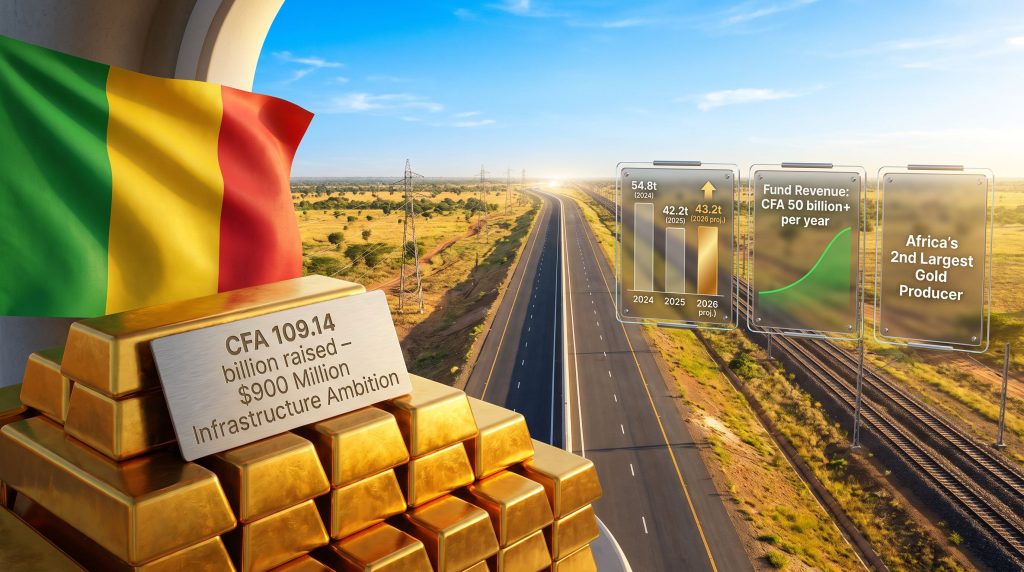
Mali's Finance Minister Alousseni Sanou confirmed at the fund's inaugural meeting that between January 2025 and June 2026, total contributions reached CFA 109.14 billion, equivalent to approximately $193 million USD. The fund is projected to generate at least CFA 50 billion annually, creating the predictable, recurring revenue stream that makes leveraged borrowing viable.
Fund Performance: Key Financial Metrics
| Metric | Value |
|---|---|
| Total capital raised (Jan 2025 to Jun 2026) | CFA 109.14 billion (~$193 million) |
| Estimated annual generation capacity | At least CFA 50 billion per year |
| Projected infrastructure leverage target | Up to CFA 500 billion (~$900 million) |
| Local municipal allocations (separate stream) | CFA 18.4 billion (~$33 million) |
The distinction between the central infrastructure fund and the local development stream is significant from a governance perspective. Separating national-scale project financing from community-level allocations reduces the risk of large capital pools being fragmented into politically motivated micro-disbursements before they can be deployed at scale.
Infrastructure and Transport Minister Dembele Madina Sissoko has indicated that priority projects will span railways, road networks, waterway vessels, energy generation systems, and schemes linked to the state-owned Mali Airlines, reflecting the breadth of the country's connectivity deficit.
How Mali's 2023 Mining Code Rewired the Revenue Architecture
The Regulatory Overhaul That Changed the Fiscal Equation
Before the 2023 mining code reforms, Mali's fiscal relationship with its gold sector was characterised by relatively modest royalty rates, limited mandatory state equity participation, and minimal structural mechanisms for converting mining revenues into public infrastructure. The revised code fundamentally altered each of these dimensions. Furthermore, the broader mining industry consolidation trend globally has put additional pressure on governments to extract greater value from existing operations.
Key structural changes introduced under the 2023 framework included:
- Increased royalty rates tiered across gold production levels
- Expanded mandatory government equity stakes in both new mining ventures and renegotiated existing agreements
- The introduction of mandatory infrastructure contribution levies, which form the direct financing mechanism for the development fund
- Strengthened oversight provisions giving Bamako greater visibility into operator financial reporting
The strategic intent was explicit: capture a substantially larger share of gold sector value for public benefit, rather than allowing the bulk of returns to flow to foreign operators under legacy agreements that no longer reflected Mali's bargaining position.
The Audit Finding That Reinforced Reform Momentum
In December 2025, government officials announced that an audit had identified CFA 761 billion in alleged outstanding payments across mining operators. This figure served as a powerful political and administrative reinforcement of the reform agenda, strengthening Bamako's case for tighter compliance and accelerated fund contributions.
The audit finding also carried significant diplomatic weight, as it directly implicated international operators including Canada's Barrick Mining, whose Loulo-Gounkoto complex became the focal point of a prolonged contractual dispute with the Malian government. The dispute contributed materially to the production disruptions that drove the sector's difficult 2025.
Industry context: Mali's assertive approach to renegotiating legacy mining agreements reflects a pattern visible across the Sahel region. Governments in Burkina Faso, Guinea, and Niger have pursued similar strategies, prioritising resource sovereignty over investor certainty as a medium-term development financing tool. Whether this posture attracts or deters the next generation of exploration capital remains an open and consequential question.
Gold Output Trajectory and the Fund's Revenue Sensitivity
Mali's Position in African Gold Production
Mali holds the position of Africa's second-largest gold producer, trailing only Ghana. Gold constitutes the dominant share of the country's total export earnings and remains the primary source of government fiscal revenue. This concentration creates both an extraordinary opportunity and a significant vulnerability: the fund's revenue capacity is directly and linearly correlated with gold prices and production volumes. Consequently, the broader gold price outlook for 2025 and beyond has direct implications for how much capital the fund can accumulate.
Production Data: Recovery After a Difficult Year
| Year | Industrial Gold Output (metric tonnes) | Year-on-Year Change |
|---|---|---|
| 2024 | 54.8 | Baseline |
| 2025 | 42.2 | -23% |
| 2026 (projected) | 43.2 | +2.4% |
The 23% output decline in 2025 was partly attributable to operational disruptions at the Loulo-Gounkoto complex, Mali's largest gold operation, during the extended dispute between the government and Barrick Mining. The projected recovery to 43.2 metric tonnes in 2026 is modest in absolute terms, representing only a marginal improvement rather than a return to 2024 production levels.
This matters enormously for infrastructure financing capacity. If production recovered fully to 2024 levels of 54.8 tonnes, annual fund contributions could increase by roughly 30% above current projections, meaningfully accelerating the path toward the CFA 500 billion leverage target. Conversely, any further operational disruption or sustained gold price weakness would compress the revenue base and delay the infrastructure pipeline.
Closing the Artisanal Sector Leakage Gap
One of the less-discussed but potentially high-impact dimensions of Mali's revenue strategy is the formalisation of artisanal and small-scale gold mining. The government established the Malian Office of Precious Substances in July 2026 specifically to regulate artisanal gold trading and strengthen oversight of a sector where undeclared exports have historically represented a significant fiscal cost.
The scale of this leakage is difficult to quantify precisely, but across West Africa, artisanal gold production frequently flows through informal cross-border channels before entering international markets, bypassing both royalty obligations and the contribution mechanisms that fund the infrastructure pool. Formalising even a portion of this activity could meaningfully expand the revenue base available for Mali mining revenues for infrastructure, though enforcement capacity and community resistance represent genuine constraints on implementation.
What CFA 500 Billion Could Build: A Scenario Framework
Priority Infrastructure Sectors and Investment Rationale
The infrastructure deficit facing Mali is not one-dimensional. It spans multiple interconnected systems, each of which constrains economic productivity in distinct ways:
- Rail corridors are critical for reducing the cost of moving freight across a landlocked country where road transport is the default and fuel costs inflate logistics expenses at every stage of the supply chain
- Road networks directly connect mining zones to population centres and export routes, reducing both humanitarian and commercial isolation across rural Mali
- Energy infrastructure expansion addresses one of the most binding constraints on economic formalisation, with limited grid access forcing businesses and households into expensive diesel dependency
- Water systems serve both productivity and public health objectives, with inadequate potable water access creating compounding costs across health, agriculture, and domestic labour
- Aviation connectivity through Mali Airlines-linked schemes supports the movement of skilled workers, goods, and investors in a geography where surface transport remains slow and costly
Scenario modelling note: If Mali successfully deploys CFA 500 billion (~$900 million) across a five-year infrastructure programme, regional cost benchmarks suggest the capital could rehabilitate and extend approximately 2,000 to 3,000 kilometres of paved road network, support initial phases of one or two rail corridor development projects, add 200 to 400 MW of grid-connected electricity generation capacity, and extend potable water access to hundreds of thousands of additional households. These are illustrative estimates based on comparable West African infrastructure programmes and require validation against Mali-specific engineering assessments.
Why Transport Infrastructure Delivers the Highest Economic Multiplier
For landlocked economies, transport infrastructure consistently delivers the highest economic return per dollar invested because it reduces what economists term the landlocked penalty: the structural cost premium that every landlocked country bears relative to coastal peers. Studies of Sub-Saharan African economies have consistently found that a 10% reduction in freight costs can translate into productivity improvements across agriculture, manufacturing, and services that compound over time.
Mali's geography makes this multiplier effect particularly pronounced. Freight must travel overland through multiple countries before reaching a seaport, with each border crossing and road quality deterioration adding cost and time. Rail infrastructure, if successfully developed, could fundamentally alter this equation for bulk commodity movements.
Mali Within Africa's Broader Resource Sovereignty Movement
The Continental Pattern Reshaping Mining Finance
Mali's approach to channelling Mali mining revenues for infrastructure is part of a wider continental recalibration. The shifting mining geopolitical landscape across the Sahel has accelerated this trend considerably. Several West African nations have moved in parallel directions, though with distinct structural features:
| Country | Mechanism | Sector Focus | Revenue Scale |
|---|---|---|---|
| Mali | Ring-fenced Energy, Water and Transport Fund | Rail, roads, energy, water | CFA 50 billion+ annually (~$90M+) |
| Ghana | Mineral Income Investment Fund (approved 2025) | Broad development allocation | Varies with gold price |
| Burkina Faso | State mining company expansion and reinvestment | Gold sector reinvestment | Over $6 billion in six months (2026) |
The structural distinction between ring-fenced fund models and general budget allocation approaches is more consequential than it might appear. Ring-fenced funds create institutional separation between mining revenues and general government spending, reducing the risk of fiscal absorption and making revenues visible and trackable. General budget approaches may offer more flexibility but are significantly more exposed to political discretion and short-term spending pressures.
Burkina Faso's reported $6 billion in gold revenues through official channels in a six-month period in 2026 illustrates the scale of fiscal flows now moving through Sahelian gold sectors. Whether those flows translate into durable infrastructure or are consumed by immediate fiscal pressures depends almost entirely on institutional quality, not revenue volume.
The next major ASX story will hit our subscribers first
Risks, Constraints, and the Governance Binding Constraint
Fiscal Risks: Volatility and Production Concentration
The fund's design creates an inherent vulnerability: its revenue base is concentrated in a single commodity whose price and production volumes can shift dramatically in short periods. A sustained decline in the gold price, or a repeat of the 2025 production disruption scenario, could reduce annual contributions well below the CFA 50 billion baseline projection.
Building counter-cyclical reserve buffers into the fund's governance framework would substantially improve its resilience, but there is no confirmed public information indicating that such mechanisms are currently in place. In addition, the relationship between gold and mining equities means that investor sentiment can shift rapidly, further complicating long-term revenue forecasting.
Governance and Accountability Risks
Mali is currently administered by a military-led transitional government, a political context that creates measurable gaps in independent oversight. The absence of elected legislative scrutiny, combined with limited civil society capacity to audit fund deployment decisions, creates conditions under which infrastructure investment could be directed toward politically strategic rather than economically optimal projects.
The Extractive Industries Transparency Initiative (EITI) framework provides a reference standard for extractive revenue reporting, but adherence to reporting norms does not automatically translate into accountable fund deployment. The quality of governance at the project selection and execution level will ultimately determine whether the fund's capital converts into real infrastructure outcomes or dissipates through procurement inefficiencies.
Investor Relations and Long-Term Sector Health
The aggressive revenue extraction posture embedded in the 2023 mining code and the subsequent audit process carries a long-term cost that deserves careful attention. International mining companies make multi-decade capital allocation decisions based on fiscal stability, legal predictability, and the reliability of contractual frameworks. Furthermore, the surge in gold M&A activity globally means that capital has more options than ever, and jurisdictions perceived as unpredictable risk being bypassed in favour of more stable environments.
Speculative perspective: There is a plausible scenario in which Mali maximises short-term revenue extraction from existing operations while inadvertently suppressing the exploration activity needed to discover and develop the replacement reserves that will sustain long-term gold output. This tension between fiscal maximisation and sector sustainability is the defining strategic risk in Mali's current approach, and it is one that few resource-rich nations have managed successfully without careful calibration.
Implementation Complexity in a Landlocked Geography
Even assuming adequate capital and governance quality, building infrastructure in Mali presents formidable logistical challenges. Construction material imports must travel through multiple countries. Domestic engineering and project management capacity is limited. International contractors bring higher costs and knowledge transfer risks. And the same landlocked geography that makes infrastructure so valuable also makes it expensive and slow to build.
These constraints do not make the ambition unachievable, but they do make the CFA 500 billion leverage target a multi-year execution challenge rather than a straightforward financing exercise.
Frequently Asked Questions: Mali Mining Revenues and Infrastructure
How Much Has Mali's Infrastructure Development Fund Raised So Far?
Between January 2025 and June 2026, the Energy, Water and Transport Infrastructure Development Fund collected CFA 109.14 billion, equivalent to approximately $193 million USD.
What Is the Total Infrastructure Financing Target Mali Is Pursuing?
Mali's Finance Ministry has indicated the fund could support borrowing of up to CFA 500 billion, approximately $900 million, by leveraging its predictable annual revenue stream as collateral for infrastructure financing instruments.
How Is the Fund Financed?
Entirely through mandatory contributions from mining permit holders: 1% of quarterly turnover plus an ad valorem levy of 1% for the first five years, rising to 2% thereafter.
What Types of Infrastructure Will the Fund Support?
Priority investments include railways, road networks, energy generation and distribution systems, water supply infrastructure, and transport-related schemes including those connected to Mali Airlines.
Why Did Mali's Gold Production Fall So Sharply in 2025?
Output declined by approximately 23%, from 54.8 to 42.2 metric tonnes, partly due to operational disruptions at the Loulo-Gounkoto complex during a prolonged contractual dispute between the Malian government and Barrick Mining.
Is Mali the Only African Country Pursuing This Model?
No. Ghana approved a comparable mineral income allocation mechanism in 2025, and Burkina Faso recorded over $6 billion in gold revenues through official channels in a six-month period in 2026, with active debates about domestic reinvestment frameworks. For additional context on how policy changes are reshaping the broader Malian mining sector, independent academic analysis offers useful supplementary perspective.
Disclaimer: This article contains forward-looking estimates, scenario modelling, and projections based on publicly available data and regional infrastructure cost benchmarks. These figures are illustrative and should not be treated as financial forecasts. Readers should conduct independent research before drawing investment or policy conclusions.
Further Exploration: Readers interested in broader coverage of African mining sector developments and resource revenue policy can explore related reporting at Business Insider Africa.
Want to Track the Next Major Mineral Discovery Before the Broader Market Does?
Mali's gold sector illustrates just how transformative significant mineral discoveries can be — and Discovery Alert's proprietary Discovery IQ model delivers real-time ASX alerts the moment major discoveries are announced, turning complex mineral data into actionable insights for both traders and long-term investors. Explore historic examples of exceptional discovery returns and begin your 14-day free trial today to position yourself ahead of the market.