August 26, 2026
The Structural Gap Behind America's Manganese Crisis
Few industrial blind spots carry as much strategic weight as the United States' complete absence of domestic manganese production. Unlike lithium or cobalt, where at least some domestic capacity exists, manganese presents a total dependency scenario across every product category that matters: manganese ore, high-purity manganese sulfate monohydrate (HPMSM), and electrolytic manganese metal (EMM). Every tonne consumed in American steel mills, battery plants, and defence facilities arrives from overseas, with China dominating each link in the chain.
This is not a temporary market imbalance. It is a structural condition that has compounded quietly for decades, insulated from public attention by the relative affordability of imported manganese and the absence of a credible domestic alternative. That calculus is now shifting, and the Electric Metals North Star manganese project in the United States is positioned at the centre of what could become the country's first vertically integrated manganese supply chain.
When big ASX news breaks, our subscribers know first
Why Manganese Is Not Just a Battery Material
The popular narrative around manganese focuses almost entirely on its role in electric vehicle batteries. That framing, while accurate, undersells the material's strategic breadth considerably.
Electrolytic manganese metal is an essential input for armour-grade steels, naval vessel construction, artillery systems, and military-specification alloys. Without EMM, manufacturers cannot produce the high-strength steel required for defence applications. The United States currently imports approximately 50,000 tonnes of EMM annually, with virtually all of it originating from China. More strikingly, the Defence Logistics Agency maintains an open, unfilled requisition for electrolytic manganese metal, and no domestic supplier exists to fulfil it. There is currently only one EMM production facility operating outside of China, and only two HPMSM plants located beyond Chinese borders globally.
The U.S. manganese dependency is not a procurement inconvenience. It represents a direct vulnerability in defence industrial readiness, one that sits entirely outside the reach of domestic policy remedies so long as no domestic production capacity exists.
Furthermore, the growing critical minerals demand driven by the energy transition is intensifying this vulnerability with each passing year. On the battery side, manganese's position is strengthening rather than weakening across multiple evolving chemistries:
- NMC batteries (nickel-manganese-cobalt): manganese is a foundational cathode component delivering structural stability at high energy densities
- LMFP batteries (lithium-manganese-iron-phosphate): increasingly the preferred chemistry for entry-level EVs in the U.S. market, with manganese content rising relative to cobalt
- LMR batteries (lithium-manganese-rich): next-generation cells actively reducing cobalt and nickel while increasing manganese intensity per kilowatt-hour
Unlike cobalt, which battery designers are actively engineering out of future chemistries, manganese is being engineered deeper into them. This creates a demand profile that is durable across multiple technology transitions rather than dependent on any single chemistry succeeding.
What the North Star Project Actually Is
An Integrated Model, Not a Conventional Mine
A useful framework for understanding the Electric Metals North Star manganese project in the United States is to think of it the way one would think of a cement company. Cement producers own limestone quarries not because quarrying is the business, but because the quarry feeds the value-generating activity: cement manufacturing. The quarry is infrastructure. The plant is the enterprise.
Electric Metals applies the same logic to manganese. The company is positioning itself as a manganese chemical and metals company, not an ore producer. Its competitive identity will be defined by what comes out of the processing facility, not what comes out of the ground. The two interdependent components of the project are:
- The Emily Manganese Mine located on the Cuyuna Iron Range in Emily, Minnesota
- A high-purity manganese processing facility with the Gulf Coast as the baseline location under the current PEA
This structure matters because downstream chemical and specialty materials businesses attract fundamentally different valuation multiples than mining operations. The majority of long-term shareholder value is expected to come from HPMSM and EMM production, not ore sales.
The Emily Deposit: North America's Highest-Grade Manganese Resource
The Emily deposit sits within the Cuyuna Iron Range, a historically significant mineral district in the U.S. Midwest that produced the majority of America's domestic manganese output during the 1950s and 1960s. The deposit's exploration history extends back to that era, with Pickands Mather and U.S. Steel conducting the initial exploration work. U.S. Steel developed an open-pit mine plan for Emily as far back as 1959, ultimately shelved due to large Minnesota tax incentives directing capital toward the Mesabi Range.
That historical documentation provides an unusually high degree of geological confidence for a junior-stage project. The resource metrics as defined by the current PEA are as follows:
| Metric | Value |
|---|---|
| Inferred Resource (10% Mn cut-off) | 7.6 million tonnes at 19.1% Mn |
| Indicated Resource (10% Mn cut-off) | 3.7 million tonnes at 17.0% Mn |
| PEA Delivered Ore Grade | 17.5% manganese |
| Deposit Type | Manganiferous iron range (oxide mineralogy) |
| Primary Mineral | Manganite (manganese oxide hydroxide) |
| Historical Precedent | Open-pit plan drafted by U.S. Steel in 1959 |
The mineralogy is dominated by manganite, a manganese oxide hydroxide. Crucially, the deposit contains no sulfide minerals, a characteristic with significant implications for both metallurgical processing and regulatory permitting.
The ore composition breaks down to roughly equal thirds of silica, iron, and manganese in the broader material. Silica separated from the ore has potential application as paste backfill in underground mining operations, reducing void management costs. The iron fraction represents an unpriced upside scenario: the PEA assumed zero revenue from iron co-products, meaning any viable iron product pathway would represent incremental economics not captured in current financial models.
Mining Method and Operational Design
The Emily mine is planned as an underground mechanised underhand cut-and-fill operation, accessing ore via two vertical shafts: an 18-foot production shaft and a spiral ramp system. Target ore production is 500,000 tonnes per year. At theoretical full conversion to HPMSM, this ore volume could yield approximately 250,000 tonnes of HPMSM annually, representing roughly 30% of forecast U.S. domestic demand for that product.
The underground configuration is not simply a technical choice. It is also a community relations asset. An underground footprint means minimal surface disruption, reduced truck traffic on local roads, lower noise and dust impacts, and a smaller visible presence in the surrounding area.
Project Economics: What the PEA Numbers Say
Financial Summary
| Economic Indicator | Value |
|---|---|
| Post-Tax NPV (10% discount rate) | US$1.39 billion |
| Internal Rate of Return (IRR) | 43.5% |
| Payback Period | 23 months |
| Mine Capital Cost (Emily) | ~US$150 million |
| Base Case Mine Life | 25 years |
| Total HPMSM Production (base case) | 4.3 million tonnes |
| Initial Processing Capacity | 100,000 tonnes/year HPMSM |
| Expansion Capacity | 200,000 tonnes/year HPMSM |
| HPMSM Production Cost | US$825/tonne |
Important Disclaimer: PEA-level estimates carry a standard accuracy range of ±50%. These figures should not be interpreted as definitive projections of project economics. Investors should treat them as indicative parameters subject to material revision through subsequent feasibility studies.
The Cost Competitiveness Argument
One of the most strategically important numbers in the PEA is the HPMSM production cost of US$825 per tonne. Applying the full ±50% upward variance produces an adjusted cost of approximately US$1,200 per tonne. At that level, the product is estimated to remain competitive with Chinese-origin HPMSM under existing tariff structures, without requiring punitive trade measures or domestic price premiums to achieve commercial viability.
This cost discipline framing reflects a deliberate strategic choice: to build a project that competes on economics rather than regulatory protection. Understanding how a definitive feasibility study can further refine these figures will be critical as the project advances through development stages.
Why the Processing Plant Drives More Value Than the Mine
At full HPMSM output capacity, the processing facility could supply approximately 30% of forecast U.S. domestic demand. Even combined with the one other company currently capable of producing 100% domestic HPMSM, total domestic supply would likely cover only 50 to 60% of projected U.S. demand. This structural undersupply means pricing pressure from domestic overproduction is not a realistic near-term risk.
| Scenario | Estimated U.S. HPMSM Domestic Supply Coverage |
|---|---|
| Current (2025) | 0% domestic production |
| North Star at initial capacity (100,000 t/yr) | ~12–15% of forecast demand |
| North Star at full capacity (200,000 t/yr) | ~25–30% of forecast demand |
| North Star + one other domestic producer at max output | ~50–60% of forecast demand |
The Three-Product Processing Architecture
How the Front-End Chemistry Works
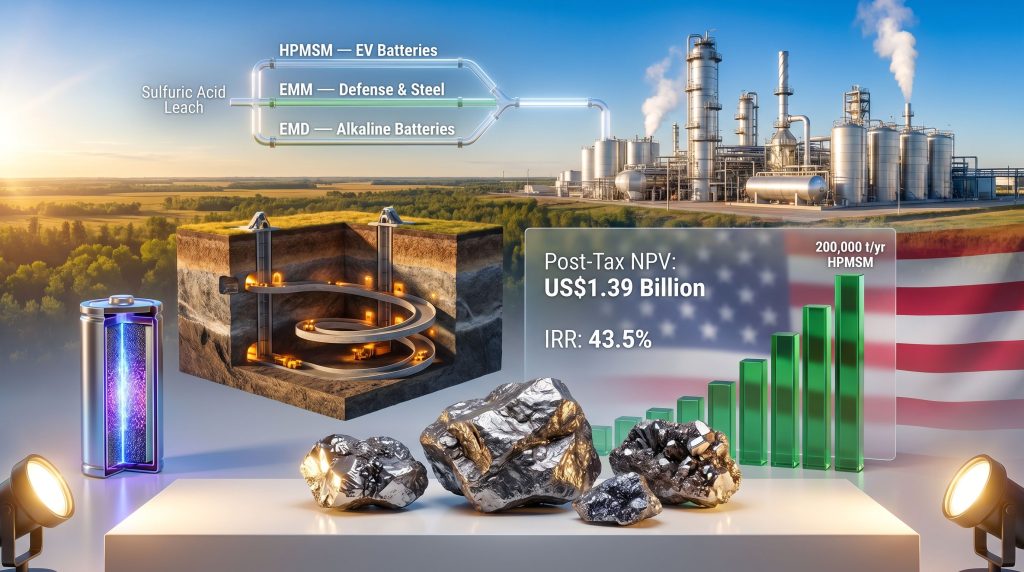
A critical and often overlooked technical advantage of the Emily deposit is that a single processing front-end serves all three target products. The ore is dissolved in sulphuric acid, and from that common leach solution, three separate product streams can be directed:
- Stream A → HPMSM — EV battery cathode precursor
- Stream B → EMM — defence steels and specialty alloys
- Stream C → EMD — alkaline batteries (AA, AAA, C, D cells)
Laboratory-scale production of all three products has been completed at Kemetco Research, a facility with extensive manganese processing expertise. Manganese extraction rates of up to 98% have been achieved in leach test work, indicating the ore dissolves exceptionally well in sulphuric acid. This recovery rate is operationally significant: high leach recovery reduces waste and improves unit economics across all three product streams.
The primary technical challenge at this stage is not whether the products can be made. It is whether the flow sheet can be optimised to consistently meet battery-grade specifications at pilot and then commercial scale, across varying ore feed compositions. The key impurity benchmarks for HPMSM qualification are manganese and calcium thresholds aligned with Chinese industry standards.
Technical Risk Hierarchy
| Risk Category | Current Status | Next Milestone |
|---|---|---|
| HPMSM production quality | Lab-scale validated | Pilot-scale demonstration plant |
| Flow sheet optimisation | In progress | Continuous refinement for impurity removal |
| Iron separation pathway | Under evaluation | Test work on mine-site vs. plant-site separation |
| Feed variability management | Partially addressed | Multi-ore metallurgical testing programme |
| EMM circuit integration | PEA underway | Report expected late Q3 2025 |
Feed variability is the subtlest and potentially most consequential technical risk. Different ore zones within a deposit, and certainly different external ore sources, will carry varying impurity profiles. Each impurity type requires a specific chemical removal step. This is one reason the company's drilling programme serves a dual purpose: resource classification and metallurgical sample collection.
In addition, direct lithium extraction technology developments offer useful parallels here, as similar flow sheet optimisation challenges have been navigated successfully in adjacent battery material sectors.
The EMM Circuit: Defence Supply Gap as Capital Catalyst
The decision to incorporate a 10,000 tonne per year EMM circuit into the processing plant PEA reflects both strategic and financial logic. On the strategic side, it addresses the most acute supply gap in the entire U.S. manganese complex: the complete absence of domestic EMM production. On the financial side, projects that directly address national security supply deficits are better positioned for non-dilutive capital consideration from government funding agencies.
The EMM circuit was not part of the original North Star Manganese PEA scope. Its addition reflects an evolution in the company's strategic positioning since the initial economic assessment was published. Australia's own defence critical materials strategy offers a comparable policy precedent for how governments are responding to these supply vulnerabilities.
Processing Plant Location: Why the Gulf Coast Makes Sense
The Gulf Coast was selected as the baseline processing plant location for the current PEA because it represents the most conservative transportation cost scenario, given that it is the maximum distance ore would travel from the Emily mine. Using the highest-cost scenario as the planning basis provides a more stress-tested economic model than assuming a nearby plant location.
Beyond conservatism, the Gulf Coast offers several structural advantages:
- Proximity to sulphuric acid production infrastructure: sulphuric acid is the primary processing input and is far more economical to source locally than to transport long distances
- Export market optionality: coastal access supports HPMSM sales into Asian or European markets if domestic demand absorption is slower than anticipated
- Import ore flexibility: the location enables the plant to receive manganese ore from international trading houses including Glencore, Traxys, and Wogenite, supplementing or temporarily replacing Emily ore if needed
Ore sourcing diversification is therefore not a fallback plan. It is a deliberate risk management structure built into the project from the outset.
The next major ASX story will hit our subscribers first
Permitting in Minnesota: The Oxide Advantage
Two Tracks, One Clear Choice
Minnesota operates what amounts to a bifurcated mineral permitting system. Projects involving ferrous mineralogy follow a well-established regulatory pathway with substantial institutional experience and community familiarity. Projects involving non-ferrous mineralogy, specifically those containing sulfide minerals, face a substantially more complex and contentious process.
The Emily deposit is an oxide system. It contains no sulfide minerals and is physically incapable of generating sulphuric acid drainage, the primary environmental concern that drives opposition to sulfide mining projects in Minnesota. This positions Emily firmly on the ferrous permitting track, which is the more straightforward of the two pathways.
The absence of sulfide mineralogy removes the central basis on which environmental activists have sustained multi-year opposition to other Minnesota mineral projects. This is not a marketing narrative. It is a chemical fact with direct regulatory consequences.
Understanding the fundamentals of grade, permitting, and project development is useful context for appreciating how significant this oxide advantage genuinely is in the Minnesota regulatory environment.
Congressional and Community Relationships
The Emily deposit sits within a congressional district represented by Pete Stauber, a Republican currently serving as Chairman of the House Subcommittee on Energy and Mineral Resources. The company also maintains contact with the office of Tom Emmer, Minnesota's House Majority Whip and the third-ranking Republican in the House of Representatives.
At the board level, the company includes a director with more than two decades of Minnesota mining industry experience, including a prior CEO role at a company subsequently acquired by Antofagasta. This combination of regulatory positioning, political familiarity, and local institutional knowledge represents a meaningful operational asset for navigating what is always a complex permitting environment.
Capital Requirements and Development Timeline
Where the Money Goes
| Phase | Estimated Cost | Purpose |
|---|---|---|
| Emily Mine Development | ~US$150 million | Underground mine construction |
| Drilling Programme (core deposit) | Up to ~US$10 million | Resource upgrade to Proven/Probable category |
| Process Plant PEA (underway) | TBD | Capital and operating cost definition including EMM circuit |
| Pilot/Demonstration Plant | TBD | Product qualification for offtaker engagement |
The drilling programme is being evaluated using AI-assisted scenario modelling across US$2 million, US$5 million, and US$10 million budget parameters to determine the minimum drilling investment required to achieve Proven reserve classification for the core deposit. Approximately 50% of the total land package remains undrilled, though the core deposit alone is expected to support more than 20 years of mining without any expansion drilling.
Indicative Timeline to Production
- 2025: Process Plant PEA completion (Q3) | Ore sorting results release | Metallurgical test programme expansion across multiple ore types
- 2026: Pre-Feasibility and Feasibility Studies | State and Federal permitting advancement | Drilling programme execution
- 2027+: Construction decision | 12–18 month mine build | ~3 years to HPMSM production (subject to funding)
The processing plant and mine are being advanced in parallel rather than sequentially. This matters because the processing facility has greater certainty on its permitting and construction timeline than the mine, and the plant can, if necessary, operate on imported ore while the mine's permitting process runs its course.
The Chicken-and-Egg Dynamic in Domestic Battery Supply Chains
One of the more nuanced market dynamics affecting the HPMSM sector is a structural coordination problem between two groups of buyers who each need the other to move first. Battery precursor manufacturers want confirmed domestic HPMSM supply before committing capital to U.S.-based production facilities. HPMSM producers, in turn, need confirmed offtake commitments before they can justify the capital investment in processing infrastructure.
This is not unique to manganese. It appears in most emerging critical mineral supply chains where domestic production capacity is being built from scratch. The resolution pathway typically involves demonstration-scale production, government involvement, or an anchor customer with sufficient strategic motivation to move ahead of the market.
Major automotive investments underway in the U.S. suggest demand certainty is building. Toyota's US$13 billion commitment to an EV battery manufacturing facility in North Carolina, alongside ongoing EV production programmes at Ford, GM, Stellantis, Rivian, and Lucid, indicates that the downstream demand side of this equation is becoming more concrete. The shift toward lithium manganese iron phosphate (LMFP) as a compromise chemistry is furthermore gaining traction, accelerating competitive pressure on U.S. manufacturers to reduce battery costs.
Frequently Asked Questions
What Makes the Emily Deposit Different From Other North American Manganese Projects?
Emily is the highest-grade manganese deposit in North America, located within the historically productive Cuyuna Iron Range. Its oxide mineralogy means no sulfide content, which simplifies both metallurgical processing and environmental permitting relative to sulfide-bearing deposits in the same state.
What Products Will the North Star Project Produce?
Three outputs are targeted: HPMSM for EV battery cathode precursor manufacturing, EMM for defence steels and specialty alloys, and EMD for alkaline batteries including standard consumer cell sizes.
How Competitive Is the Projected HPMSM Production Cost?
The PEA estimates US$825 per tonne. Even applying the full ±50% upward variance to reach approximately US$1,200 per tonne, the product is estimated to be competitive with Chinese-origin HPMSM under existing tariff conditions, without requiring additional trade barriers.
What Is the Current Status of U.S. EMM Production?
There is currently zero domestic EMM production in the United States. The country imports approximately 50,000 tonnes annually, almost entirely from China. The Defence Logistics Agency has an open, unfilled requisition for EMM with no domestic supplier capable of fulfilling it.
Why Is the Processing Plant Potentially Located on the Gulf Coast?
The Gulf Coast maximises transportation cost conservatism in the PEA, provides access to sulphuric acid infrastructure, enables export market optionality, and allows the plant to receive supplementary ore from international suppliers as needed.
What Is the Timeline to HPMSM Production?
Subject to funding availability, the company estimates approximately three years to first HPMSM production from the processing facility, with the mine and plant being advanced in parallel to optimise the overall schedule.
The Investment Case in Context
The Electric Metals North Star manganese project in the United States occupies a genuinely unusual position in the critical minerals development landscape. A US$1.39 billion post-tax NPV at a 43.5% IRR against a mine capital requirement of approximately US$150 million represents a risk-adjusted development profile that is difficult to replicate across comparable projects at a similar stage.
The project's structural advantages compound across multiple dimensions simultaneously:
- Highest-grade North American manganese deposit with six decades of geological documentation providing confidence beyond what most junior projects possess
- Vertically integrated model capturing chemical processing margins rather than commodity ore pricing
- EMM circuit addressing the most acute defence supply gap in the U.S. manganese complex, with no other domestic solution currently in development
- Oxide mineralogy providing a structural permitting advantage in a state where sulfide projects face entrenched opposition
- Ore sourcing flexibility allowing the processing plant to operate independently of mine permitting outcomes
The primary execution risks remain real and should not be minimised. Scaling HPMSM production from bench to pilot to commercial level with consistent battery-grade output is technically demanding. Permitting timelines in Minnesota, even on the ferrous track, carry inherent uncertainty. Capital access for a company of this size requires continued market confidence and investor support.
All financial projections referenced in this article are derived from a Preliminary Economic Assessment carrying a standard accuracy range of ±50%. They do not constitute confirmed project economics, financial forecasts, or investment advice. Prospective investors should conduct independent due diligence and consider their own financial circumstances before making investment decisions.
Want to Track the Next Major Critical Minerals Discovery Before the Market Does?
Discovery Alert's proprietary Discovery IQ model delivers real-time alerts on significant ASX mineral discoveries — including critical minerals like manganese — instantly converting complex data into actionable insights for investors at every level. Explore historic examples of major mineral discoveries and their returns, then begin your 14-day free trial at Discovery Alert to position yourself ahead of the market.