
July 14, 2026
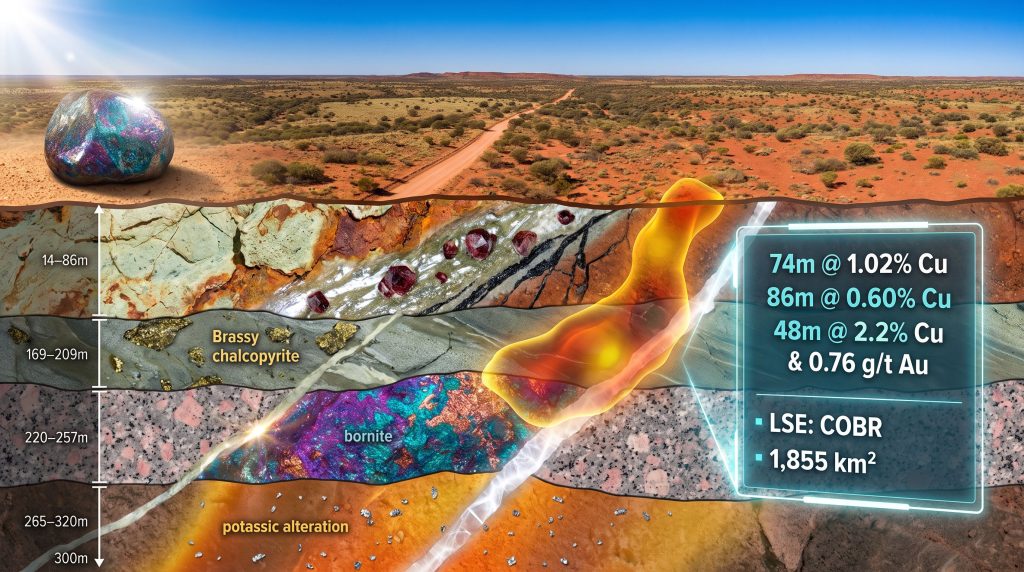
The Geological Architecture Behind One of South Australia's Most Compelling Copper Targets
Copper exploration has always been a game of geological inference. Unlike gold, which can concentrate in remarkably small structural traps, economically meaningful copper deposits typically require an enormous thermal and fluid system to form. The largest of these systems, porphyry copper deposits, are the product of magmatic arcs, deeply emplaced intrusive bodies, and millions of years of hydrothermal fluid circulation. They are not found everywhere, and when early-stage drilling returns a suite of mineralogical indicators that collectively fingerprint a fertile porphyry system, the exploration community pays close attention.
That is precisely the situation unfolding at the Manna Hill Copper Project in South Australia's Nackara Arc, where the Cobra Resources Manna Hill bornite-rich porphyry copper discovery has rapidly reframed what appeared to be a high-grade shallow skarn target into something potentially far more significant.
When big ASX news breaks, our subscribers know first
Understanding the Nackara Arc: An Underexplored Porphyry Corridor
South Australia's Nackara Arc sits within a broader metallogenic framework that has attracted comparatively little systematic modern exploration relative to established copper provinces in Queensland and Western Australia. This is partly a function of historical access, partly a function of cover sequences obscuring surface expression, and partly a function of exploration capital gravitating toward more familiar geological addresses.
Yet the Nackara Arc possesses the structural and magmatic prerequisites for porphyry copper mineralisation. Porphyry systems form where calc-alkaline magmas intrude at moderate crustal depths, typically between two and four kilometres, releasing copper-rich hydrothermal fluids that precipitate sulphide minerals across a broad alteration halo. The surrounding country rock, when favourable, develops skarn mineralisation at reactive contacts, particularly where carbonate units interact with the thermal plume emanating from the intrusive body.
This dual-value architecture, a deeper porphyry core surrounded by shallower skarn mineralisation, is exactly what appears to be developing at Manna Hill. It is also one of the more commercially attractive exploration configurations available in the current market, because it offers both near-surface, potentially higher-grade feed and deeper, bulk-tonnage potential from the same geological system. Understanding IOCG deposit formation helps contextualise why South Australia's broader geological setting continues to attract serious exploration attention.
The Blue Rose Prospect: High-Grade Skarn as a Window into a Deeper System
Historical and Recent Drilling Results
The Blue Rose prospect was already a technically credible target before the July 2026 diamond drilling programme commenced. Reverse-circulation drilling had returned intersections that would attract attention on any exploration programme:
| Intersection | Width (m) | Cu Grade (%) | Au Grade (g/t) | Depth From (m) |
|---|---|---|---|---|
| RC Hole A | 74 | 1.02 | 0.25 | 72 |
| RC Hole B | 86 | 0.60 | 0.14 | 18 |
| Historic Skarn | 48 | 2.20 | 0.76 | Shallow |
These results are notable not just for grade but for width. Eighty-six metres of mineralisation beginning at just 18 metres depth is the kind of intersection that suggests a thick, continuous mineralised envelope rather than a narrow structural vein. The historic skarn result of 48 metres at 2.2% copper and 0.76 grams per tonne gold places Blue Rose among genuinely high-grade shallow copper-gold targets by Australian exploration standards.
What Skarn Lithologies Reveal About the Heat Source Below
The lithological assemblage at Blue Rose provides important genetic context. Calc-silicate assemblages, garnet, and magnetite are the diagnostic minerals of contact metasomatic skarns, systems driven by heat and fluid derived from an underlying intrusive body. Their presence at surface tells geologists that a significant magmatic heat source was once active beneath the prospect and that the thermal gradient increases with depth toward an intrusive contact.
This is why the decision to drill deeper with diamond core, rather than simply extending the known skarn laterally with additional RC holes, was geologically rational. The skarn is not the primary target; it is the thermal aureole of something larger below.
Breaking Down the Four-Hole Diamond Drilling Programme
Programme Design Rationale
The four-hole, 1,465-metre diamond core programme was structured with a dual mandate: test the lateral and depth continuity of the Blue Rose skarn system, and evaluate whether the structural plumbing beneath it connects to a deeper porphyry copper source. Diamond core was selected specifically because oriented, continuous samples are necessary to resolve lithological contacts, alteration assemblage sequences, and structural orientations at depth. RC chips, while faster and cheaper, cannot provide this resolution.
This methodological choice carries an important implication for data quality. Every interval in the diamond programme is represented by a continuous core sample rather than a disaggregated chip pile. The geological model built from this data will carry significantly more spatial precision than one derived from RC alone. Furthermore, interpreting drill results correctly at this stage is essential for shaping the follow-up programme with maximum efficiency.
Hole-by-Hole Technical Findings
Flagship Hole: Bornite Intersection and Porphyry Intrusions
The flagship hole is the centrepiece of the programme. Chalcopyrite was observed from 169 to 209 metres depth within biotite schists and calc-silicate skarn lithologies, broadly consistent with sulphide quantities observed in earlier RC drilling. Below this, from 220 to 257 metres, the hole entered a mineralised biotite schist enveloping porphyry diorite and monzonite intrusions, and it was here that the bornite-rich zone was intersected.
Visual estimates of bornite reach up to 2% across the 37-metre zone. It is critical to note that visual estimates are observational only and cannot substitute for laboratory assay, which remains pending as of the time of this report. Sulphide mineralisation was confirmed to continue to a depth of 300 metres within the high-grade footprint.
Supporting Hole 1: Potassic Alteration Zone
This hole intersected a potassic alteration zone from 265 to 320 metres depth, characterised by significant pyrite and pyrrhotite with minor chalcopyrite. While sulphide grades here are lower than in the flagship hole, the potassic alteration assemblage itself is highly informative. Potassic alteration, dominated by secondary biotite and potassium feldspar, forms within and immediately around the mineralising intrusive centre of a porphyry system. Its presence at this depth indicates the drill hole was in proximity to the porphyry core rather than within it, suggesting the system extends further at depth or along strike.
Supporting Hole 2: Fault-Bound Anhydrite Breccia
A large anhydrite breccia zone was intersected from 190 to 220 metres depth. This is a structurally significant finding that deserves careful interpretation. Anhydrite breccias in porphyry systems form where sulphate-bearing, oxidising hydrothermal fluids move along fault conduits. They are, by their oxidising nature, free of sulphide minerals, which can initially appear disappointing in a drill log. However, their presence is recognised in porphyry system modelling as a positive vector indicator, because these structures represent the actual plumbing through which mineralising fluids travelled from the parent intrusion upward into the overlying skarn.
Anhydrite breccias of this scale are uncommon in Australian exploration programmes. Internationally, their identification at deposit-scale porphyry systems is well-documented in the technical literature as a structural indicator of large, active hydrothermal systems. Their rarity in Australian drill logs makes their appearance at Manna Hill particularly noteworthy.
Supporting Hole 3: Skarn Extension, Oxide Copper, and Molybdenite
The fourth hole intersected shallow copper oxide mineralisation from 14 to 67.5 metres depth, outside the current modelled skarn footprint. This is significant because it extends the known mineralised envelope beyond the existing Blue Rose model boundary. Magnetite and chalcopyrite were observed to increase with depth, while garnet assemblages confirmed an increasing temperature gradient consistent with proximity to an intrusive contact. Critically, molybdenite was recorded at depth within this hole.
Molybdenite is a pathfinder mineral with strong diagnostic value in porphyry copper-molybdenum systems. Its formation requires the reducing, high-temperature conditions found within or immediately adjacent to a porphyry core. Molybdenite in an exploration hole, combined with other porphyry indicators, constitutes a meaningful addition to the multi-vector case for a fertile system at depth.
The Mineralogical Significance of Bornite in Porphyry System Architecture
Why Bornite Outranks Chalcopyrite as an Indicator of Grade Potential
Understanding why the Cobra Resources Manna Hill bornite-rich porphyry copper discovery carries such technical weight requires a brief mineralogical detour. Both bornite (Cu₅FeS₄) and chalcopyrite (CuFeS₂) are copper sulphide minerals, but they differ fundamentally in their copper-to-iron ratios and their formation conditions.
Chalcopyrite contains approximately 34.5% copper by weight, while bornite contains approximately 63.3% copper by weight. This distinction matters for grade calculations, but the more important difference lies in what bornite's presence tells geologists about the temperature and chemical environment of formation. Bornite precipitates at higher temperatures and under more reducing conditions than chalcopyrite. These are precisely the conditions that characterise the potassic core zone of a porphyry system, the innermost and typically highest-grade architectural domain.
Porphyry Deposit Zonation: Where Bornite Fits
Porphyry copper systems are concentrically zoned around the intrusive centre, with distinct alteration and mineralisation assemblages at each radial distance from the heat source:
| Alteration Zone | Typical Minerals | Temperature Range | Copper Grade Potential |
|---|---|---|---|
| Potassic Core | Bornite, chalcopyrite, biotite, K-feldspar | High (>400°C) | Highest |
| Phyllic/Sericitic | Chalcopyrite, pyrite, sericite | Moderate | Moderate to High |
| Propylitic Halo | Pyrite, chlorite, epidote | Lower | Lower |
| Argillic Overprint | Variable sulphides, clays | Variable | Variable |
The bornite zone at Manna Hill, sitting from 220 to 257 metres within potassic alteration minerals including biotite and potassium feldspar, is architecturally positioned within what appears to be the potassic core domain. At world-class porphyry systems globally, such as Escondida in Chile and Cadia in New South Wales, bornite-dominant potassic zones are associated with the highest-grade ore shells and typically represent the primary economic target of development-stage mining operations.
The co-occurrence of bornite, potassic alteration, anhydrite breccias, and molybdenite at Manna Hill constitutes a multi-indicator fingerprint for a fertile porphyry copper system. It is rare for early-stage exploration drilling to return all four of these vectors in a single programme. Each indicator individually would be encouraging; together, they form a technically compelling case for a large, architecturally intact system at depth.
Geophysics as a Targeting Engine: The Inversion-Modelled Magnetic Anomaly
From Airborne Survey to Drill Confirmation
One of the most operationally significant outcomes of the July 2026 programme is the direct correlation established between the bornite mineralisation and an inversion-modelled magnetic anomaly. This correlation transforms a geophysical feature from a speculative target into a confirmed mineralisation proxy, fundamentally changing how follow-up drilling can be designed across the broader 1,855 square kilometre tenure.
Inversion modelling of magnetic data is a computationally intensive technique that solves for the three-dimensional distribution of magnetic susceptibility in the subsurface. When a drill hole confirms mineralisation at the predicted anomaly location, the model gains calibration confidence. Each subsequent hole informed by a calibrated model carries statistically higher intersection probability than a hole designed without this constraint. In addition, 3D geological modelling of this kind is increasingly standard practice at serious exploration programmes seeking to maximise drilling efficiency.
Scalability of the Targeting Framework
The east-west striking magnetic feature that hosts the bornite zone acts as a structural guide for identifying additional high-grade shoots along strike and at depth. Multiple additional magnetic anomalies within the Manna Hill tenure coincide with modelled calc-silicate skarn, providing a systematic and scalable targeting framework for follow-up drilling well beyond the current Blue Rose footprint.
This is a material advantage from an exploration economics standpoint. Direct geophysics-to-mineralisation correlation reduces the number of speculative drill holes required to define a system, decreasing both cost per meaningful intersection and time-to-resource estimate. For a company managing two parallel South Australian projects, this efficiency matters significantly.
The next major ASX story will hit our subscribers first
Cobra Resources' Dual-Project Portfolio Strategy
Advancing Manna Hill Alongside Wudinna
Cobra Resources (LSE: COBR) is advancing Manna Hill concurrently with its Wudinna Project in the Gawler Craton, which hosts the Boland ionic rare earth discovery. Wudinna is described as Australia's only rare earth project suited to in situ recovery (ISR) mining, a method that extracts mineralisation through fluid injection without conventional excavation, significantly reducing surface disturbance and upfront capital intensity compared with open-pit or underground development.
The 2025 divestment of the Wudinna gold assets to Barton Gold for up to A$15 million in cash and shares streamlined the company's portfolio and provided capital optionality without diluting the core strategic positions in copper and rare earths. This structural simplification positions Cobra as a focused critical minerals vehicle across two distinct demand themes simultaneously. Notably, prevailing copper market trends point to a sustained supply deficit, lending additional strategic weight to discoveries of this nature.
Acquisition Mechanics and Regulatory Position
The formal acquisition of Manna Hill was completed in July 2026, when Cobra's subsidiary Manna Hill Mining Pty Ltd exercised its option to acquire Hamelin Gully Pty Ltd, the entity holding the Blue Rose tenure. The option had first been announced in August 2025. Several regulatory and community milestones underpin the project's operational readiness:
- A Native Title Agreement with the Wilyakali People is in place
- A registered 1% overriding royalty agreement with Springton Trust is registered on the tenure
- Cultural heritage surveys have been completed across all proposed drill sites
- No additional permitting obstacles are disclosed as outstanding for the planned follow-up programmes
Upcoming Catalysts and Exploration Milestones
What Investors and Geologists Are Watching
The near-term event schedule for Manna Hill is densely packed with quantitative confirmation points. The current programme has generated compelling visual evidence for a porphyry system, but the translation of visual observations into assay-confirmed grades is the pivotal step that will determine the scale of market and technical response.
| Milestone | Target Date |
|---|---|
| Assay results from diamond drilling programme | August 2026 |
| Petrological thin-section analysis completion | August to September 2026 |
| RC drilling at Blue Rose, Desert Rose, Double Delight | September 2026 |
| Diamond drilling follow-up at Desert Rose | TBC post-assay |
| Greenfields soil sampling programme across tenure | TBC |
The August 2026 assay release will be the most closely watched single data point. If laboratory copper grades within the bornite zone approach or exceed the visual estimate of up to 2% bornite across 37 metres, the geological narrative will shift materially toward resource-scale discussion. If grades are more moderate, the focus will pivot to system size and the potential for bulk-tonnage economics at lower grades, which is the norm for porphyry deposits globally.
The September 2026 RC programme across three prospects — Blue Rose, Desert Rose, and Double Delight — will begin to quantify the district-scale potential of the 1,855 square kilometre tenure. Each prospect represents an independent geological target, and positive results across multiple prospects within the same programme would significantly de-risk the thesis that Manna Hill hosts a major copper system rather than a single isolated occurrence. Encouragingly, recent updates from Manna Hill published by industry analysts highlight the growing confidence among technical observers that this system has genuine district-scale potential.
Disclaimer: This article is intended for informational purposes only and does not constitute financial advice. Visual estimates of mineralisation are not a substitute for laboratory assay results. Exploration outcomes are inherently uncertain, and readers should not make investment decisions based solely on early-stage drilling observations. All forward-looking statements are subject to risks and uncertainties inherent in the mining exploration sector.
Want to Track the Next Major ASX Copper Discovery the Moment It's Announced?
Discovery Alert's proprietary Discovery IQ model scans ASX announcements in real time, instantly alerting subscribers to significant mineral discoveries — including high-potential copper and critical minerals opportunities like those emerging at Manna Hill — so both short-term traders and long-term investors can act ahead of the broader market. Explore historic examples of what major mineral discoveries can return and begin your 14-day free trial at Discovery Alert to position yourself at the forefront of the next major find.