July 11, 2026
The Hidden Cost of Conventional Flotation: Why Mines Are Leaving Value in Their Tailings
Every tonne of ore a mine processes carries a hidden question: how much of the value inside it actually makes it to the final concentrate? For decades, the honest answer has been uncomfortable. Conventional flotation circuits, despite decades of incremental refinement, are structurally blind to two specific segments of the particle size distribution. What exits through the tailings stream at the coarse end and the ultrafine end represents not just a recoverable resource, but in many operations, a significant share of the total metal inventory being processed every day.
This is not a marginal inefficiency. As copper head grades across major producing regions continue compressing, with global averages having declined from roughly 1.5% in the early 2000s to below 0.6% in many operations today, the financial consequence of incomplete recovery amplifies with each passing year. When you are processing lower-grade material, losing 4% of your recoverable copper to a coarse tailings stream stops being a technical footnote and becomes a strategic problem.
Understanding why this happens, and what Eriez HydroFloat and StackCell mineral recovery technology does differently, requires looking carefully at the physics of flotation itself.
When big ASX news breaks, our subscribers know first
The Elephant Curve: Flotation's Structural Blind Spots
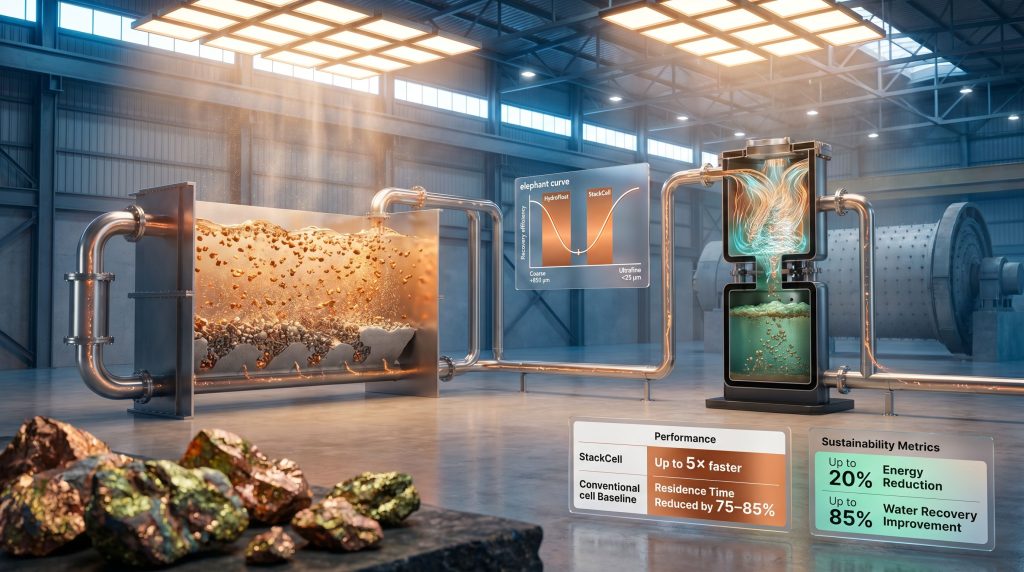
Metallurgists working in flotation circuits are familiar with what is often described as the elephant curve: a recovery efficiency profile plotted against particle size that shows strong performance in the mid-range but drops sharply at both the coarse and fine extremes. The shape of this curve is not coincidental. It reflects fundamental physical constraints baked into the design of conventional mechanical flotation cells.
At the coarse end, particles exceeding approximately 150 micrometres face a mechanical problem. As bubble-particle aggregates form and begin rising through the pulp phase, the gravitational force acting on heavier coarse particles can overcome the surface tension holding them to air bubbles. Before these aggregates can travel the distance required to enter the froth phase, detachment occurs, and the particle settles back into the pulp, eventually reporting to tailings.
At the fine end, the problem is inverted. Particles below roughly 25 micrometres carry so little mass that their probability of achieving a productive collision with a rising air bubble drops dramatically. The high surface-area-to-mass ratio of ultrafine particles also makes them prone to non-selective entrainment, where gangue and valuable mineral report together to the froth, degrading concentrate grade.
Conventional mechanical cells, which operate with bubbles typically ranging from 500 to 1,500 micrometres in diameter, are simply too coarse in their bubble generation to efficiently collect particles at this scale. The result is that the particle size window where conventional flotation performs well sits between roughly 25 and 150 micrometres. Everything outside this range carries a recovery penalty that compounds quietly against the economics of the entire operation. Understanding cut-off grade economics helps contextualise just how significant these losses become at scale.
How the HydroFloat Separator Recovers Coarse Particles Conventional Cells Cannot
The Physics of Fluidized-Bed Separation
The HydroFloat separator operates on a fundamentally different physical principle to a mechanical flotation cell. Rather than suspending particles in an agitated pulp and relying on bubble-particle collision in a turbulent environment, the HydroFloat creates a hindered-settling fluidized bed. Upward-flowing water counteracts the gravitational settling of particles, creating a suspended, relatively quiescent bed through which fine air bubbles are continuously injected from below.
Within this environment, hydrophobic mineral surfaces interact with rising bubbles in a gentler, more sustained contact zone. Rather than forming a bubble-particle aggregate that must survive a turbulent journey to a froth surface, the hydrophobic particle simply becomes buoyant enough to rise through the fluidized bed and overflow into the product launder. Hydrophilic gangue particles, insufficiently altered in their effective density, continue settling and are discharged as underflow.
This architecture eliminates the axial mixing that characterises conventional cells, extending the effective residence time available for bubble-particle contact without requiring a larger equipment footprint. Critically, it extends the recoverable particle size range from the conventional ceiling of around 150 micrometres up to particles exceeding 850 micrometres. For a detailed overview of Eriez flotation products, including HydroFloat specifications, the Eriez product catalogue provides comprehensive technical documentation.
A Key Distinction: Composite Particle Recovery
Perhaps the least widely understood capability of the HydroFloat is its ability to recover composite, or multiphase, particles with as little as 1 to 2% exposed mineral surface area. In conventional flotation, particles with low surface liberation typically require much finer grinding to expose enough mineral surface for bubble attachment. The HydroFloat's gentler physical environment changes this threshold materially, opening a path to recovering partially liberated particles that would otherwise require prohibitively fine grinding to make floatable.
| Recovery Technology | Upper Particle Size Limit | Minimum Surface Liberation Required |
|---|---|---|
| Conventional Flotation Cell | ~150 μm | 20 to 30% |
| HydroFloat Separator | +850 μm | 1 to 2% |
Two Ways to Deploy the Technology
The HydroFloat can be incorporated into a processing circuit in two distinct configurations, each targeting a different economic objective:
-
Tailings Scavenger (TS) configuration: Positioned downstream of conventional rougher flotation, this deployment intercepts coarse, semi-liberated particles that would otherwise exit the circuit as tailings. Documented copper recovery improvements in this role typically range from 2 to 6% across operating installations.
-
Coarse Gangue Rejection (CGR) configuration: Deployed upstream of the ball mill, this approach rejects 30 to 40% of coarse gangue material before energy-intensive grinding begins. By removing barren or near-barren rock early, the ball mill can operate at a coarser target grind size, reducing ball mill energy consumption by 30 to 50% and shifting value-based separation to an earlier point in the processing sequence.
The CGR configuration in particular represents a philosophical shift in how circuits are designed. Rather than grinding everything finer to liberate more mineral, the approach rejects what is demonstrably gangue first, then grinds only what remains. This changes the energy economics of the entire downstream circuit. The HydroFloat has now been commissioned at more than 70 mining installations worldwide, spanning copper, nickel, gold, and platinum group element operations across multiple continents.
StackCell: Solving the Ultrafine Recovery Problem Through Architectural Innovation
Why Fine Particles Defeat Conventional Cell Design
The StackCell addresses the opposite end of the elephant curve. Ultrafine particles below 25 micrometres require a very different flotation environment to those in the mid-range. The fundamental challenge is kinetic: slow-floating fine minerals require extended residence time in conventional cells to achieve adequate recovery, which drives large equipment footprints, high capital costs, and substantial operating area requirements.
Conventional mechanical cells are not optimised to solve this problem. Their single-stage design attempts to perform both bubble-particle collection and froth stabilisation within the same physical environment, creating a compromise that serves neither function particularly well when ultrafine particles are the primary target.
The Two-Stage Architecture
The StackCell resolves this by separating the flotation process into two distinct, independently optimised stages:
-
High-intensity collection canister: Feed slurry and air are combined in a small-volume, high-energy mixing zone. Energy inputs in this stage can reach up to 5 times greater than those in conventional flotation cells, dramatically increasing bubble-particle collision frequency and attachment probability for ultrafine particles. The bubble size generated in this zone averages approximately 100 micrometres in diameter, compared to 500 to 1,500 micrometres typical of conventional cells. Smaller bubbles increase the collision cross-section available to ultrafine particles that larger bubbles routinely bypass.
-
Quiescent froth recovery chamber: Once bubble-particle aggregates form in the high-intensity canister, they enter a low-turbulence separation chamber designed to stabilise these aggregates and allow clean froth recovery without detachment. The separation of collection from recovery is the central design innovation.
| Performance Metric | Conventional Flotation Cell | StackCell |
|---|---|---|
| Flotation Kinetics | Baseline | Up to 5x faster |
| Residence Time Requirement | Baseline | Reduced by 75 to 85% |
| Bubble Size (typical) | 500 to 1,500 μm | ~100 μm |
| Primary Target Particle Size | 25 to 150 μm | Under 25 μm (ultrafine) |
The 75 to 85% reduction in residence time requirements carries a direct implication for circuit footprint. For a new project, a substantially smaller flotation circuit means materially lower capital expenditure. For a brownfield operation constrained by existing plant footprint, it means the ability to add flotation capacity or shift circuit configuration without a full plant rebuild. Furthermore, Australian Mining's coverage of the StackCell provides additional industry context on how this technology is being received across the sector.
Closing the Elephant Curve: How HydroFloat and StackCell Work Together
The relationship between these two technologies is complementary rather than competitive. Mapped against a typical flotation feed particle size distribution, the HydroFloat addresses the coarse tail that conventional cells cannot retain, while the StackCell accelerates recovery of the fine tail where conventional cells are kinetically constrained. Together, they extend recovery performance across the full particle size spectrum rather than leaving value at either extreme.
Combined circuit architectures deploying both technologies have demonstrated:
-
Up to 20% reduction in total circuit energy consumption relative to conventional equivalents
-
Up to 85% improvement in water recovery efficiency, a material benefit in water-stressed operating jurisdictions across Australia, Chile, and the southwestern United States
-
Generation of coarser tailings particles from higher grind targets enabled by CGR deployment, improving amenability to dry-stack tailings storage and reducing the long-term liability profile associated with conventional tailings dams
"The economic argument for advanced flotation is not simply about recovering more metal. It is about restructuring where in the processing sequence value is captured, and at what energy cost per unit of metal recovered."
The Sustainability Dimension: Grinding Less as Climate and Cost Strategy
Comminution, the process of grinding ore to a target particle size, typically accounts for 30 to 50% of all electrical energy consumed on a mine site. It is the single largest energy draw in most processing operations, and by extension, the largest contributor to Scope 2 carbon emissions from mineral processing facilities. The broader mining electrification trends reshaping the sector make reducing this energy intensity increasingly urgent for operators.
The implication of coarser grinding targets enabled by HydroFloat deployment is therefore not only economic. Every percentage point reduction in comminution energy translates into lower operating costs, reduced diesel or grid electricity demand, and a lower carbon intensity per tonne of metal produced. For operations working toward credible net-zero commitments embedded in corporate ESG frameworks, this is not a peripheral benefit. In fact, the mining decarbonisation benefits flowing from reduced comminution energy are increasingly central to investment cases for advanced flotation technology.
| Sustainability Dimension | Conventional Circuit Baseline | Advanced Flotation Circuit |
|---|---|---|
| Energy Consumption | Baseline | Up to 20% reduction |
| Water Recovery Efficiency | Baseline | Up to 85% improvement |
| Tailings Particle Size | Fine, difficult to stack | Coarser, dry-stack compatible |
| Gangue Rejection Point | Post-grinding | Pre-grinding (CGR configuration) |
The dry-stack tailings compatibility enabled by coarser grind targets deserves particular attention. Conventional tailings dams, which store fine, water-saturated tailings, represent one of the most significant environmental and financial liabilities in the mining industry. The 2019 Brumadinho dam failure in Brazil, which released 12 million cubic metres of tailings and caused catastrophic loss of life, intensified regulatory and investor scrutiny of wet tailings storage across the global industry.
Technologies that structurally shift tailings characteristics toward larger, stackable particles reduce this liability, and the coarser tailings generated through HydroFloat-enabled circuits represent a genuine engineering contribution to that goal. Consequently, the broader mining sustainability transformation underway across the industry is increasingly aligned with the performance characteristics these technologies deliver.
The next major ASX story will hit our subscribers first
Redesigning Circuit Philosophy: A Comparison of Old and New Approaches
The combined deployment of Eriez HydroFloat and StackCell mineral recovery systems does not simply add equipment to an existing circuit. It represents a different design philosophy from the ground up.
| Design Dimension | Traditional Approach | Advanced Flotation Approach |
|---|---|---|
| Grinding Target | Fine liberation across full feed | Coarse liberation with selective rejection |
| Flotation Cell Design | Single-function mechanical cell | Dual-function collection and froth recovery |
| Recovery Focus | Mid-range particle sizes | Full particle size spectrum |
| Circuit Footprint | Large, driven by long residence time | Compact, 75 to 85% residence time reduction |
| Energy Philosophy | Grind finer to recover more | Recover more by grinding less |
For new project development, this shift is most immediately visible in capital expenditure modelling. A flotation circuit sized around StackCell kinetics rather than conventional residence time requirements can be significantly smaller, with flow-on effects for civil works, structural steel, and reagent handling infrastructure. For brownfield operations, the combination of tailings scavenging via HydroFloat and fine particle acceleration via StackCell offers a route to improving overall recovery without committing to a full plant expansion. Furthermore, data-driven mining operations are increasingly being used to optimise circuit configuration decisions across both new and existing installations.
Frequently Asked Questions: Eriez HydroFloat and StackCell Mineral Recovery
What particle sizes does the HydroFloat recover that conventional flotation misses?
The HydroFloat is engineered for coarse particles in the +150 to +850 micrometre size range, well beyond what conventional mechanical cells can retain due to bubble-particle detachment forces at larger sizes.
How much faster is the StackCell compared to a conventional flotation cell?
The StackCell delivers flotation kinetics approximately 5 times faster than conventional cells, with residence time requirements reduced by 75 to 85% through its high-intensity collection canister design.
Can these technologies be retrofitted into existing processing plants?
Both are designed for circuit integration flexibility. The StackCell's compact footprint suits brownfield installations with constrained space, while the HydroFloat can be inserted as a tailings scavenger or pre-mill gangue rejection stage within existing layouts.
What is the typical overall recovery improvement from deploying both technologies?
Combined deployment has demonstrated global recovery improvements of 2 to 6%, with the precise gain dependent on ore type, existing circuit configuration, and the volume of value currently reporting to tailings.
How do these technologies support mine site sustainability goals?
By enabling coarser grinding, these systems reduce comminution energy by up to 20%, improve water recovery efficiency by up to 85%, and generate coarser tailings particles more amenable to dry-stack storage, directly supporting carbon reduction and water stewardship commitments.
In how many operations is the HydroFloat currently deployed?
The HydroFloat has been commissioned in more than 70 mining operations globally across a range of commodity types and circuit configurations.
Key Takeaways
-
Conventional flotation circuits are structurally unable to efficiently recover particles at either the coarse end (above 150 micrometres) or the fine end (below 25 micrometres) of the size distribution, creating the elephant curve recovery profile
-
The HydroFloat extends the recoverable size ceiling to over 850 micrometres through fluidized-bed separation, while the StackCell accelerates ultrafine recovery through a dual-stage, high-intensity collection and quiescent froth recovery architecture
-
Combined deployment has demonstrated up to 20% energy reduction, up to 85% water recovery improvement, and circuit-wide metal recovery gains of 2 to 6%, without processing additional ore tonnes
-
For operations facing declining ore grades, the ability to extract more value from material already being processed represents a structural competitive advantage that no amount of additional throughput can replicate
-
Tailings reprocessing represents an emerging frontier for coarse particle recovery technology, with legacy tailings deposits globally representing substantial stranded metal value that advanced flotation systems are now technically positioned to unlock
Readers seeking additional technical commentary on mineral processing innovation, grinding efficiency, and flotation circuit design can explore further perspectives through the Canadian Mining Journal at canadianminingjournal.com.
Want to Know Which ASX Miners Are Applying These Recovery-Boosting Technologies First?
Discovery Alert's proprietary Discovery IQ model instantly scans ASX announcements to identify significant mineral discoveries, delivering real-time alerts so subscribers can act on high-potential opportunities before the broader market catches on — explore historic discoveries and their returns to see what early positioning has meant for investors, then begin your 14-day free trial at Discovery Alert to gain your market-leading edge.