July 11, 2026
The Geological Gamble Beneath South Africa's Energy Future
Few energy challenges are as structurally complex as unlocking gas resources buried beneath a geologically uncertain, water-scarce, and regulatorily fragmented landscape. Before a single hydraulic fracturing operation begins in South Africa's Karoo Basin, the subsurface is already communicating through tremors, fault lines, and wildly divergent resource estimates. Understanding what those signals mean for Karoo shale gas development geological risks is not merely a technical exercise. It is the central question determining whether the country's most ambitious unconventional energy prospect becomes a viable asset or a cautionary tale.
When big ASX news breaks, our subscribers know first
South Africa's Energy Dilemma and the Karoo's Strategic Role
South Africa generates the overwhelming majority of its electricity from coal, a dependency that has created chronic grid instability, rolling blackouts, and a structural vulnerability to fuel price shocks. Aging power infrastructure compounds the problem, with load-shedding becoming a near-permanent feature of the national energy experience in recent years. Against this backdrop, natural gas has been positioned as a pragmatic bridging fuel, capable of providing dispatchable, lower-emission generation capacity while the country scales up its renewable energy pipeline.
The Karoo Basin sits at the epicentre of this ambition. Stretching across a vast semi-arid interior plateau, the basin has attracted sustained interest from energy planners and resource developers who see its deep shale formations as a potential domestic gas source. Furthermore, energy transition mining dynamics are reshaping how policymakers and investors think about bridging fuels, which in turn affects how urgently South Africa is pursuing its unconventional gas potential.
What the Karoo Basin Actually Is: A Geological Overview
The Karoo Basin is a sedimentary basin of Permian to Triassic age, covering much of South Africa's interior. Its shale gas prospectivity is concentrated in two primary formations: the Whitehill Formation and the underlying Prince Albert Formation, both of which contain organic-rich shales deposited under ancient marine conditions.
Commercially relevant shale intervals are estimated to lie at depths ranging from 1,500 to 4,000 metres below the surface, placing them well within the operational envelope of modern hydraulic fracturing technology. However, depth alone does not determine viability. The semi-arid surface environment of the Karoo creates compounding risk factors, because any subsurface contamination event in a region where groundwater is already scarce carries consequences that extend far beyond the wellbore.
How Large Is the Karoo's Shale Gas Resource? Reconciling Wildly Divergent Estimates
The honest answer to how much shale gas the Karoo contains is: nobody knows with precision. The scale of estimation uncertainty here is not a rounding error. It is a 30-fold spread between the most conservative and most optimistic projections, which reflects a genuine absence of the deep drilling and reservoir characterisation data needed to anchor any estimate reliably.
The Resource Estimation Problem: A 30-Fold Spread in Recoverable Gas Projections
| Estimating Body | Estimated Technically Recoverable Gas | Year |
|---|---|---|
| Petroleum Agency South Africa | ~209 trillion cubic feet | Ongoing |
| University of Johannesburg Geologists | ~13 trillion cubic feet (lower bound) | 2017 |
| Upper Bound (Range) | ~390 trillion cubic feet | 2017 |
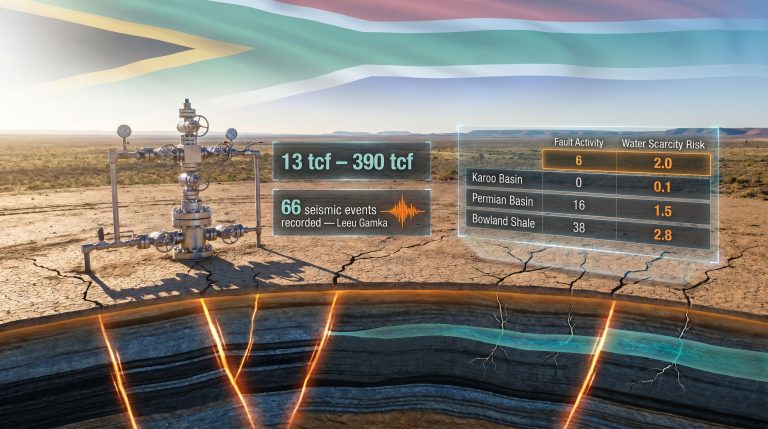
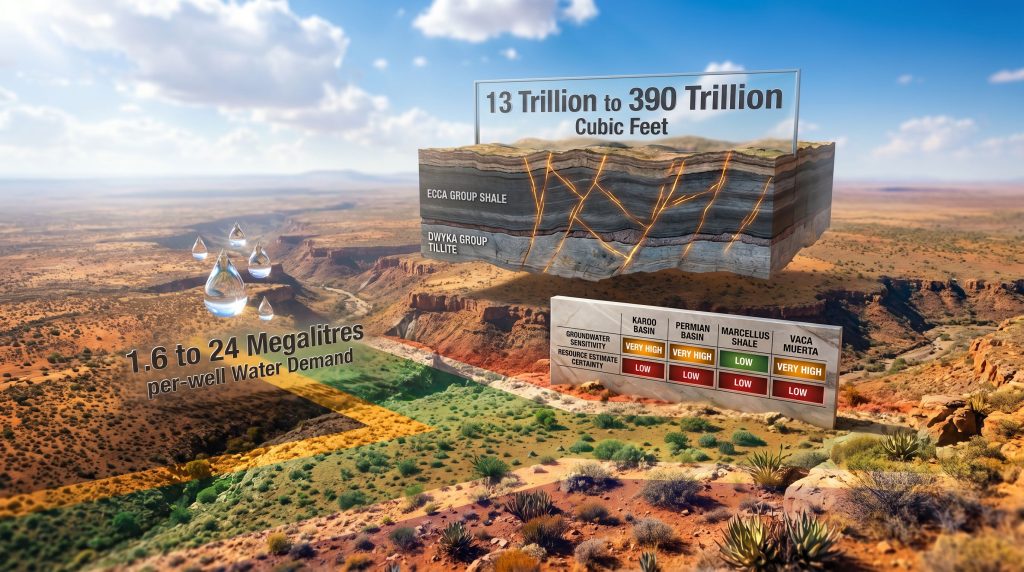
The Petroleum Agency South Africa estimates that the basin holds approximately 209 trillion cubic feet of technically recoverable gas. A 2017 study by University of Johannesburg geologists placed the lower bound at roughly 13 trillion cubic feet, within a broader range extending to 390 trillion cubic feet. These figures are not competing errors. They reflect fundamentally different assumptions about reservoir properties that remain unconfirmed by direct subsurface measurement.
A critical distinction often overlooked in public debate is the difference between gas in place and technically recoverable gas. Even a basin with enormous in-place volumes may yield only a fraction of that gas under real-world fracturing conditions, depending on rock brittleness, natural fracture networks, formation pressure, and fluid chemistry. Petroleum Agency South Africa has explicitly identified geological risk and uncertainty as a primary constraint on prospectivity, underscoring that resource size cannot be confirmed without targeted deep drilling, core sample analysis, and three-dimensional seismic profiling.
Why Unproven Recoverability Is Itself a Geological Risk
Reservoir heterogeneity across the Whitehill and Prince Albert formations means that rock properties vary significantly over relatively short lateral distances. Whether hydraulic fracturing will be commercially viable at any given location depends on:
- Rock brittleness, which controls how effectively fractures propagate through the formation
- Matrix porosity, which determines how much gas the rock can store and release
- Natural fracture density, which can either enhance or complicate stimulation outcomes
- Formation pressure regimes, which affect both production rates and wellbore integrity
The Council for Geoscience's Karoo Deep Drilling Project represents a foundational effort to establish the geological and environmental baseline data needed to answer these questions. Among the critical parameters that baseline studies must map are groundwater aquifer architecture, subsurface fault networks, and ambient seismic activity across the basin. Without this foundation, any commercial program would be operating with structurally inadequate risk intelligence.
What Are the Primary Geological Risks of Karoo Shale Gas Development?
Risk 1: Hidden Fault Systems and Induced Seismicity
Critical Finding: Researchers at the University of Cape Town identified a previously unknown fault structure beneath the Karoo Basin, capable of generating seismic events under conditions of geological stress.
The fault was identified through analysis of more than 66 seismic events recorded near Leeu Gamka in the Western Cape since 2007, a sequence that included a magnitude 4.8 earthquake in a region previously classified as having relatively low seismic activity. Researchers confirmed that these events were of natural tectonic origin, with no hydraulic fracturing having been conducted in the area. The absence of industrial activity as a causal factor is significant: it demonstrates that subsurface faults in the Karoo are not dormant remnants, but active structures already operating under stress.
This matters enormously for induced seismicity risk. The mechanism is well understood from global shale-producing regions. When wastewater injection or hydraulic fracturing changes pore pressure in the subsurface, critically stressed faults can be destabilised and reactivated, sometimes producing seismic events at magnitudes that damage surface infrastructure or disrupt operations. Indeed, a swarm of earthquakes in the Karoo Basin has already raised serious questions about the suitability of certain zones for oil and gas development, further underscoring the need for pre-operational risk assessment. Documented cases from the Permian Basin in the United States illustrate how even subsurface operations conducted within regulatory parameters can trigger seismicity when underlying fault conditions are not adequately mapped.
Critically, the UCT discovery does not constitute a veto on Karoo development. But it does fundamentally elevate the due diligence standard required before operations begin. Pre-operational fault mapping across the entire basin is no longer optional. It is a prerequisite.
Risk 2: Groundwater Contamination Through Fracture Migration Pathways
The tight geological formations overlying Karoo shale layers typically act as containment barriers under undisturbed conditions. The exception is fault lines, which can function as preferential migration pathways for fracturing fluids and mobilised gas, potentially connecting deep shale intervals to shallow groundwater aquifers.
In the Karoo's semi-arid surface environment, this risk carries amplified consequences. Groundwater is not an ancillary resource in this region. It is a primary water source for rural communities and agricultural users across a vast area with minimal surface water alternatives. Each hydraulic fracturing well requires between 1.6 and 24 megalitres of fluid per operation, a range that reflects the variability of well design and reservoir conditions. At the upper end, a multi-well pad program could impose substantial water demand pressure on an already water-stressed system.
The absence of a comprehensive baseline water quality assessment across the basin represents a current and serious data gap. Without pre-operational baseline measurements, distinguishing contamination caused by fracturing operations from pre-existing water quality conditions becomes legally and scientifically contested. Effective monitoring infrastructure capable of detecting contamination events in real time would need to be installed before, not after, drilling begins.
Risk 3: Reservoir Uncertainty and Technical Recoverability Risk
Geological risk in the Karoo is not confined to fault systems and groundwater pathways. The subsurface reservoir itself carries fundamental uncertainty that affects both the technical case for development and the financial case for investment. Extrapolating resource estimates from limited borehole data across a geologically heterogeneous basin of this scale introduces errors that no modelling refinement can fully resolve without additional physical data.
Unconfirmed reservoir properties have direct consequences for investment bankability. Lenders and equity investors financing shale development programs typically require demonstrated resource certainty through pilot drilling and production testing before committing to commercial-scale capital. The Karoo currently lacks this foundation, making staged exploration an operational and financial necessity rather than simply a regulatory preference. Mineral exploration importance in resource-constrained contexts like this one is precisely why robust pre-commercial data acquisition is treated as non-negotiable by serious investors.
Comparing Karoo Geological Risk Against Global Shale Basins
| Risk Dimension | Karoo Basin (South Africa) | Permian Basin (USA) | Marcellus Shale (USA) | Vaca Muerta (Argentina) |
|---|---|---|---|---|
| Known Fault Complexity | High (newly identified) | Moderate-High | Low-Moderate | Moderate |
| Induced Seismicity History | Natural baseline established | Documented cases | Limited cases | Limited cases |
| Groundwater Sensitivity | Very High (semi-arid) | Moderate | Moderate-High | Low-Moderate |
| Resource Estimate Certainty | Low | Very High | High | High |
| Regulatory Framework Maturity | Low | Very High | High | Developing |
The comparison makes clear that the Karoo's challenge is not any single risk factor in isolation. It is the convergence of multiple high-severity uncertainties across geological, hydrological, and regulatory dimensions simultaneously. In established shale provinces like the Permian or Marcellus, decades of drilling have resolved reservoir uncertainty, regulatory frameworks have matured through operational experience, and induced seismicity management protocols are embedded in standard practice. The Karoo begins this journey with less foundational data and higher environmental sensitivity than any of these comparators.
What South Africa's Regulatory History Reveals About Development Readiness
A Decade of Policy Reversals: The Regulatory Timeline
- 2011: The South African government imposed a moratorium on new shale gas exploration permit applications following widespread public concern and environmental objections about hydraulic fracturing risks in the Karoo region.
- 2017: The High Court struck down regulations governing hydraulic fracturing, creating a legislative vacuum that left the sector without an enforceable operational framework.
- Current status: No comprehensive environmental assessment framework exists specifically for shale gas exploitation via hydraulic fracturing in the Karoo.
Regulatory Gap Warning: South Africa's existing legislative architecture does not provide a dedicated environmental impact assessment process for Karoo hydraulic fracturing operations. This structural deficiency must be resolved before any commercial program can proceed responsibly.
What a Fit-for-Purpose Regulatory Framework Must Address
A regulatory framework capable of managing Karoo shale gas development geological risks would need to incorporate, at minimum:
- Pre-operational fault mapping and seismic hazard classification requirements across the entire basin
- Mandatory groundwater baseline surveys completed and independently verified before any permit issuance
- Real-time seismic monitoring obligations active throughout drilling and fracturing operations, with defined shutdown thresholds
- Water sourcing and wastewater disposal standards calibrated to the specific constraints of the semi-arid Karoo environment
- Community consultation and land access protocols that reflect the interests of rural populations dependent on groundwater resources
In addition, the mining claims framework experience in other jurisdictions offers instructive lessons about how to structure permit systems that account for both geological uncertainty and community interests simultaneously.
The next major ASX story will hit our subscribers first
How Geological Risk Should Shape the Karoo Development Strategy
A Risk-Tiered Development Framework
Best-practice approaches to unconventional gas development in geologically uncertain environments consistently favour staged programs that allow risk intelligence to accumulate before capital commitments scale up. For the Karoo, this suggests a three-phase structure:
- Phase 1 – Geological Characterisation: Basin-wide fault mapping using modern 3D seismic techniques, deep drilling for core samples from target formations, and installation of a permanent ambient seismic monitoring network to establish a definitive pre-operational baseline.
- Phase 2 – Monitored Pilot Program: Limited-scale hydraulic fracturing in areas identified through Phase 1 as lower-risk, with continuous groundwater quality surveillance and real-time seismic monitoring. Results from this phase would generate the reservoir performance data needed to constrain resource estimates. Furthermore, drilling programs of this kind are well-established as the most reliable method of resolving subsurface uncertainty at scale.
- Phase 3 – Conditional Commercial Expansion: Scaled operations contingent on Phase 2 risk thresholds being met, regulatory frameworks fully enacted, and community consultation processes completed.
International technical partnerships, including engagement with US unconventional gas expertise, could meaningfully accelerate Phase 1 data acquisition by bringing established seismic interpretation and reservoir characterisation methodologies to a basin that lacks the institutional knowledge base built over decades of North American shale development. In addition, downhole geophysics techniques would play an essential role in characterising subsurface conditions accurately before any commercial program is sanctioned.
No-Go Zones: Where Risk Convergence Makes Development Indefensible
The UCT fault discovery introduces a concept that risk-informed development planning must formalise: designated no-go zones where the convergence of fault stress levels, groundwater proximity, and surface environmental sensitivity creates cumulative risk profiles that no operational safeguard can adequately mitigate. Identifying these zones requires precisely the kind of pre-operational geological characterisation that Phase 1 is designed to deliver. The alternative, discovering them through operational failures, is not a viable risk management strategy.
Frequently Asked Questions: Karoo Shale Gas Geological Risks
What fault was discovered in the Karoo Basin and why does it matter?
University of Cape Town researchers identified a previously unmapped fault structure near Leeu Gamka in the Western Cape, detected through analysis of a sustained sequence of natural seismic events including a magnitude 4.8 earthquake. Its significance lies not in its existence alone, but in what it reveals about the stress state of the broader subsurface: faults that are already critically loaded by natural tectonic forces are substantially more susceptible to reactivation from the pressure changes associated with hydraulic fracturing or wastewater injection.
Can hydraulic fracturing cause earthquakes in the Karoo?
Natural seismicity and induced seismicity operate through the same underlying mechanism, which is fault reactivation under pressure change, but through different triggers. Natural seismicity results from tectonic stress accumulation over geological time. Induced seismicity results from human activities that alter pore pressure in the subsurface, including hydraulic fracturing fluid injection and wastewater disposal into deep formations.
Critically stressed faults are far more vulnerable to induced reactivation than faults in low-stress environments. The Leeu Gamka seismic sequence demonstrates that at least some Karoo faults fall into the critically stressed category, making pre-operational seismic hazard assessment non-negotiable. Operationally significant magnitude thresholds vary by regulatory jurisdiction, but events above magnitude 2.5 to 3.0 typically trigger operational review or suspension requirements under modern induced seismicity management protocols.
How much water does Karoo shale gas development require?
Each hydraulic fracturing operation requires between 1.6 and 24 megalitres of fluid per well, depending on well design, target formation depth, and fracturing program intensity. In a semi-arid environment where surface water is minimal and groundwater is the primary resource for communities and agriculture, this demand cannot be treated as a manageable logistical detail. It is a compounding geological and environmental risk that requires dedicated water sourcing strategies, potentially including treated municipal wastewater, recycled fracturing fluid, or brackish water sourcing from non-potable aquifers. None of these alternatives eliminates water risk. They redistribute it.
How much shale gas does the Karoo Basin actually contain?
Technically recoverable gas estimates range from approximately 13 trillion cubic feet at the low end to 390 trillion cubic feet at the upper bound, with Petroleum Agency South Africa's working estimate of around 209 trillion cubic feet sitting in the middle. This range reflects genuine geological uncertainty about reservoir properties across a large and geologically heterogeneous basin, not methodological disagreement. Narrowing the range requires direct subsurface data from targeted deep drilling, core analysis, and production testing. That data does not yet exist at sufficient density to anchor a commercially reliable estimate.
Is Karoo shale gas development viable given these risks?
The risks documented to date are significant but not inherently prohibitive. The UCT researchers themselves concluded that their findings underscore the need for deeper geological understanding and stronger monitoring rather than development abandonment. What the current evidence does rule out is a fast-tracked commercial program that bypasses adequate geological characterisation. Risk-informed development conducted under a robust regulatory framework, with staged escalation and genuine no-go zone identification, represents a credible pathway. Development conducted without that foundation represents an unnecessary and avoidable gamble.
Key Takeaways: Geological Risk as a Strategic Variable
| Geological Risk Category | Primary Evidence Base | Current Status |
|---|---|---|
| Hidden fault systems and induced seismicity | UCT seismic study, 66+ events near Leeu Gamka | Confirmed natural seismicity; pre-operational fault mapping absent |
| Groundwater contamination pathways | Fault-aquifer connectivity modelling; 1.6-24 ML per well demand | No comprehensive baseline water quality assessment exists |
| Reservoir uncertainty and recoverability | 13-390 TCF estimation range; limited deep drilling data | Unresolved; requires targeted exploration program |
Karoo shale gas development geological risks are not a collection of isolated technical problems. They form an interconnected challenge in which fault complexity, water sensitivity, reservoir uncertainty, and regulatory immaturity amplify each other. South Africa faces a strategic imperative that cannot be resolved by choosing between energy ambition and geological caution. The country needs both, and the sequence matters enormously. Geological characterisation must precede commercial development, not follow it.
The timeline for regulatory reform, baseline study completion, and potential first exploration permits remains uncertain. What is clear is that the outcome of pre-commercial geological studies will determine whether the Karoo becomes a material contributor to South Africa's energy future or remains a prospective resource indefinitely deferred by risks that adequate preparation could have managed.
Want to Stay Ahead of the Next Major Resource Discovery?
Discovery Alert's proprietary Discovery IQ model scans ASX announcements in real time, delivering instant alerts on significant mineral discoveries across more than 30 commodities — turning complex geological data into clear, actionable investment insights. Start your 14-day free trial today and see why historic discoveries have generated extraordinary returns for investors who moved early.