July 10, 2026
The Geological Logic Behind ISR Rare Earth Projects and Why Formation Architecture Matters
Most investors evaluating rare earth exploration companies focus on grade and tonnage as the primary value drivers. This is a reasonable starting point, but it misses a more fundamental question: how the mineralisation was emplaced and whether the physical and chemical properties of the host rock allow for cost-effective extraction. These geological factors, more than headline intercept grades, determine whether a project can be developed at a capital cost structure that actually works for a junior explorer. Understanding this distinction is essential context for interpreting the Cobra Resources Boland and Head rare earth results, which are advancing toward a maiden Mineral Resource Estimate across South Australia's Wudinna district.
Ionic clay-hosted rare earth deposits form through deep weathering of basement rocks over geological timescales. Rare earth ions are released from primary minerals and adsorbed onto clay particles in the weathering profile, creating deposits where the valuable elements are held loosely enough to be desorbed by simple ionic exchange chemistry. This is fundamentally different from hard-rock rare earth deposits, where rare earths are locked within resistant minerals like bastnäsite or monazite and require energy-intensive comminution, flotation, and aggressive chemical processing to liberate. The consequence of this difference is not incremental; it reshapes the entire cost and capital structure of the project.
When big ASX news breaks, our subscribers know first
How Palaeochannel Geology Creates the Wudinna Opportunity
The Wudinna region of South Australia hosts a palaeochannel system spanning approximately 3,200 square kilometres, a sedimentary architecture that predisposes the area to stacked, laterally extensive mineralisation horizons. Palaeochannels are ancient river systems now buried beneath younger sediments, and their fill sequences often include clay-rich intervals that are ideal hosts for ionic rare earth mineralisation. Furthermore, the rare earth strategic importance of such deposits has become increasingly recognised by governments and industry alike.
What makes the Boland and Head prospects particularly notable within this context is the presence of three distinct mineralised formations stacked vertically, each with different permeability, confinement, and metallurgical characteristics:
- Narlaby Sand: The shallowest horizon, currently undergoing confinement testing to determine its suitability as an ISR target.
- Garford Clay: An intermediate layer where permeability characterisation work is ongoing; represents significant tonnage potential but requires further data before resource classification.
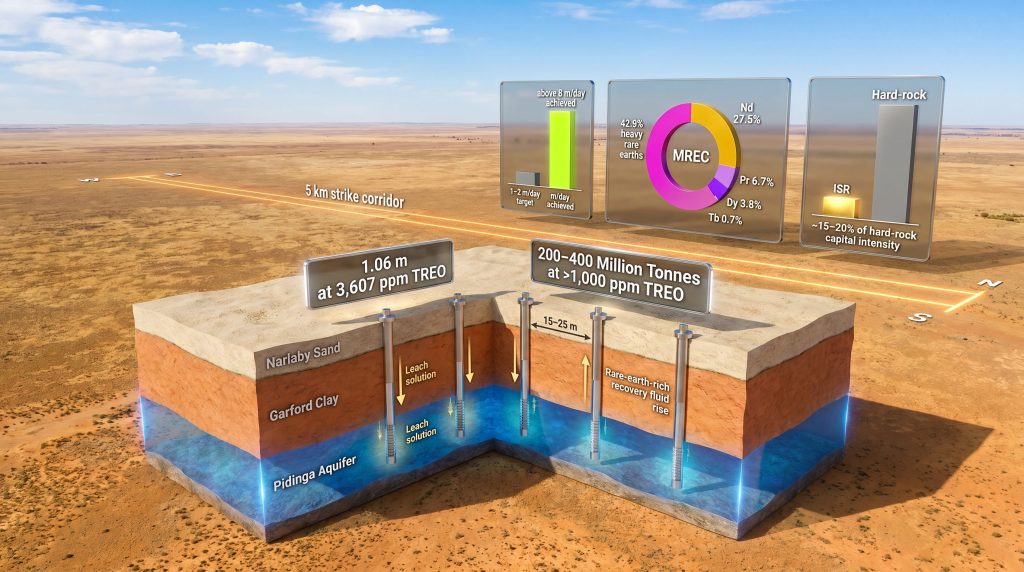
- Pidinga Aquifer: The deepest and most technically mature formation, with completed hydrology, confirmed strong head pressure, and demonstrated metallurgical performance. This horizon is expected to underpin the indicated component of the maiden Mineral Resource Estimate.
This tiered resource architecture reflects a maturity differential across formations rather than uniform geological confidence. Investors should interpret the three-formation stack as a staged value unlock rather than a single monolithic resource.
The Pidinga's naturally pressurised aquifer conditions are particularly significant for ISR design. Head pressure reduces the energy required to circulate leach solution through the ore body, lowering operating costs before a single reagent litre is consumed. These mineral deposit tiers reflect the geological complexity that underpins the project's staged development approach.
Cobra Resources Boland and Head Rare Earth Results: Drilling Metrics and Highlight Intercepts
The drilling programme across both prospects comprised 74 sonic core holes totalling approximately 3,200 metres. Sonic core drilling is the preferred method for ionic clay characterisation because it recovers undisturbed samples that preserve moisture content, critical for accurate permeability measurement and clay mineral identification. Approximately 80% of assay and permeability results have been received, with 12 drillholes at Head still outstanding.
Drill Programme Summary
| Metric | Detail |
|---|---|
| Total Drill Holes | 74 |
| Total Metres Drilled | ~3,200 m (sonic core) |
| Results Received | ~80% of assay and permeability data |
| Outstanding Drillholes | 12 (Head prospect) |
| Continuous High-Grade Flank Defined | ~5 km at Head |
| Mineralisation Status | Open to north and south |
Highlight intercepts from the programme demonstrate both exceptional peak grades and meaningful width, two characteristics that together support large-scale tonnage modelling. For further detail on the 74-hole resource drilling campaign at these prospects, Crux Investor has published a detailed breakdown of the programme:
- 1.06 m at 3,607 ppm TREO from 18.6 m depth (highest grade reported in the programme)
- 3.8 m at 1,322 ppm TREO from 26.1 m depth
- 2.7 m at 1,458 ppm TREO from 33.3 m depth
- 5.9 m at 1,232 ppm TREO demonstrating grade continuity at broader widths
- 6.6 m at 636 ppm TREO confirming lower-grade envelope material
- Boland intercepts including 3.2 m at 688 ppm, 1.05 m at 1,004 ppm, and 5.62 m at 459 ppm TREO
The significance of mineralisation remaining open to the north and south at Head cannot be overstated for resource estimation purposes. Unclosed strike extensions mean the current drilling footprint represents only a portion of the potential resource envelope, giving the company optionality to grow the tonnage base through step-out drilling after the maiden estimate is finalised.
The collective maiden MRE target sits at 200 to 400 million tonnes at greater than 1,000 ppm TREO, with the Pidinga formation expected to carry indicated classification and the Narlaby and Garford layers contributing inferred tonnes as permeability and confinement work is completed.
ISR Extraction Economics: Why the Method Changes the Investment Calculus
In-situ recovery eliminates physical excavation entirely. Leach solution is injected through a network of wells, dissolves the adsorbed rare earth ions through ionic exchange chemistry, and is then pumped to surface through extraction wells for processing. The ore body is never physically moved. The in-situ leaching benefits extend well beyond simple cost reduction, encompassing environmental performance metrics that are increasingly scrutinised by regulators and investors alike.
This distinction from conventional mining has profound capital and environmental implications:
| Cost Factor | ISR Method | Hard-Rock or Open-Cut Mining |
|---|---|---|
| Capital Intensity | ~15-20% of hard-rock equivalent | Baseline (100%) |
| Surface Disturbance | Minimal, no excavation | Significant land clearing and waste management |
| Remediation Liability | ~28x lower per unit of production | High, particularly for open-cut strip operations |
| Leach Cycle Duration | 30-60 days (targeted) | N/A |
| Well-Field Spacing | 15-25 m (targeted) | N/A |
For junior explorers operating without access to large balance sheets, the ISR capital intensity profile is not a minor advantage; it is the primary mechanism through which a small company can credibly build a pathway to production. The difference between 15-20% and 100% of hard-rock capital requirements represents the gap between a fundable project and one that requires major partner support.
Permeability performance is the technical gateway to ISR viability. The project is targeting rates of 1 to 2 metres per day for operational economics, and scaled bench studies have already returned rates above 8 metres per day, well in excess of the minimum threshold. An emulated tracer test returned approximately 80% tracer recovery within two days, providing strong proxy evidence for fluid connectivity within the ore body. This directly validates the concept of injecting lixiviant and recovering it at extraction wells, the fundamental physical premise of ISR.
South Australia's ISR Track Record
South Australia has hosted four ISR pilot studies over the prior two years, providing a growing regional dataset on ISR performance in these specific geological formations. Long-running commercial ISR uranium operations have been active in the same Pidinga formation for decades, offering the most direct geological analogue available for validating ISR fluid behaviour. A recently completed uranium ISR pilot by Alligator Energy, conducted a few hundred kilometres from Wudinna, adds contemporary technical confirmation that the method functions as expected in this geological setting.
The Actinium Finding: A Processing Chemistry Challenge in Context
Radionuclide testing of the Mixed Rare Earth Carbonate product returned acceptable levels for all measured elements except actinium, which exceeded targeted thresholds. This result requires careful contextualisation to understand its actual significance. Indeed, the rare earth processing challenges encountered at this stage are not unusual for projects working with ionic clay-hosted mineralisation.
Actinium is a naturally occurring radioactive material (NORM) present at trace levels throughout Earth's crust and is associated with the uranium and thorium decay chains. Its presence in rare earth mineralisation is not unusual because rare earth deposits frequently co-occur with uranium and thorium-bearing minerals. The critical distinction is between actinium dispersed within the raw ore body versus actinium concentrated into a refined product stream.
MREC Product Composition
| Component | Value |
|---|---|
| Total Rare Earth Oxide (TREO) in MREC | 58.83% |
| Heavy Rare Earth Proportion of TREO | 42.9% (rising to 43% after cerium precipitation) |
| Neodymium (Nd) share of TREO | 27.5% |
| Praseodymium (Pr) share of TREO | 6.7% |
| Dysprosium (Dy) share of TREO | 3.8% |
| Terbium (Tb) share of TREO | 0.7% |
Testing at the Australian Nuclear Science and Technology Organisation (ANSTO) is addressing the actinium issue through three parallel workstreams: ISR pre-conditioning protocols, pH control optimisation during the leach cycle, and specific actinium suppression chemistry. The underlying principle is that actinium mobility in solution is strongly pH-dependent, meaning that by manipulating the chemistry of the injected lixiviant, the ISR process can be designed to suppress actinium mobilisation at the ore body level rather than attempting to remove it from the product stream after the fact.
A capital-light demonstration through ANSTO's pilot facility is under evaluation as an intermediate validation step, estimated to cost only a few million Australian dollars. This is a meaningful option because it would produce commercial-scale MREC volumes for downstream qualification without committing to full field trial capital expenditure.
Natural Acid Generation: The Operating Cost Differentiator
Net Acid Production Potential analysis measures the balance between acid-generating sulphide minerals and acid-consuming carbonate minerals within an ore body. Where sulphide mineral content is elevated relative to carbonates, the net result is natural acid generation during the leach process. This is a particularly relevant consideration given the growing critical minerals demand driven by the global energy transition, which is placing pressure on project economics across the sector.
At Boland and Head, NAPP analysis has confirmed that high-grade zones generate more acid than they consume. The numbers are commercially material:
| Acid Parameter | Value |
|---|---|
| Maximum Potential Acidity (NAPP result) | 60 kg H₂SO₄ per tonne |
| Modelled Acid Consumption Range | 1-16 kg H₂SO₄ per tonne |
| Reagent Acid as % of Standard MREC Operating Cost | ~30% |
| Standard MREC Operating Cost Reference | US$18-20/kg |
Reagent sulphuric acid can represent approximately 30% of operating costs in a standard MREC production scenario, making it the single largest variable operating expense in the process. A project where the ore body itself contributes acid generation that partially offsets reagent requirements occupies a structurally advantaged cost position relative to peers that must source 100% of their acid requirements externally.
The maximum potential acidity of 60 kg of sulphuric acid per tonne against modelled consumption of 1 to 16 kg per tonne suggests the natural acid generation capacity is substantially larger than operational needs, which could allow for significant cost savings without requiring the project to utilise its full natural acid generation potential.
The next major ASX story will hit our subscribers first
Why Heavy Rare Earth Enrichment Elevates the Revenue Profile
Not all rare earths carry equivalent market value. Lanthanum and cerium, the most abundant light rare earths, trade at prices that reflect their relative availability. By contrast, dysprosium and terbium, the heavy rare earths critical to permanent magnet performance at elevated temperatures, command substantial price premiums because of their scarcity and irreplaceability in high-efficiency motor applications.
The MREC product from the Cobra Resources Boland and Head rare earth results contains a 42.9% heavy rare earth proportion of TREO, rising to 43% after cerium is precipitated during impurity removal. This cerium precipitation step is notable because it is a standard processing step for impurity removal that simultaneously upgrades the heavy rare earth fraction of the product without requiring additional processing steps or reagents.
Laboratory-confirmed recovery rates for the key magnet metals are:
- Terbium (Tb): Up to 79% recovery
- Dysprosium (Dy): Up to 67% recovery
These recovery rates, achieved at low acid consumption relative to conventional leaching, reinforce the metallurgical case for the ISR approach at this deposit type. The ISR leach process also acts as a passive beneficiation mechanism, preferentially mobilising the adsorbed rare earth ions while leaving behind less soluble gangue minerals.
Australia's ISR Rare Earth Landscape
The Wudinna project is positioned as Australia's only rare earth project currently targeting commercial ISR extraction, a distinction that places it in a global peer group dominated by operations in southern China and emerging projects in Southeast Asia. Western supply chain diversification for magnet-critical rare earths has become a pressing industrial policy concern, and ISR-amenable Australian projects with high heavy rare earth proportions represent a potential contributor to that diversification. However, the project remains at the pre-resource stage and significant development work lies ahead. Mining Weekly has reported on Cobra's confirmation of low-cost recovery potential across these South Australian formations.
Tenure, Royalties, and the Path to the Maiden MRE
The Boland prospect sits on licence EL7074, held 100% through LAM Wudinna, a wholly owned subsidiary. The Head prospect is on licence EL6784. Alcrest Royalties Australia retains a 1.5% NSR royalty over future production from licences EL7074 through EL7078, a royalty obligation that investors should factor into long-run revenue modelling at the scoping study stage.
A Native Title Agreement with the Barngarla people is in place, and heritage surveys have cleared all drilling areas completed to date, removing a potential permitting constraint that has delayed other Australian resource projects at similar stages.
Key Milestones on the Development Timeline
- Remaining 12 Head drillhole results due within weeks, completing the dataset for MRE calculation.
- Maiden MRE incorporating permeability data and acid-generation modelling as integrated inputs, a methodological distinction from conventional resource estimation that reflects ISR's unique dependency on fluid flow characteristics.
- Scoping study using the MRE as the technical foundation, incorporating ISR well-field design and detailed acid consumption modelling.
- ANSTO pilot facility demonstration as a capital-light intermediate step estimated at only a few million Australian dollars, targeting MREC product qualification and actinium suppression validation.
- Field trial targeting early 2027 to produce larger-scale MREC volumes for downstream commercial qualification.
Disclaimer: This article contains forward-looking statements and projections based on publicly available information from company announcements. These statements involve inherent uncertainty, and actual results may differ materially. Nothing in this article constitutes financial advice. Investors should conduct their own due diligence and consult a qualified financial adviser before making investment decisions.
For further context on in-situ recovery methods and the development progress at this project, additional investor-focused coverage is available at Crux Investor.
Want to Be First When the Next Major Mineral Discovery Hits the ASX?
Discovery Alert's proprietary Discovery IQ model delivers real-time alerts on significant ASX mineral discoveries — including rare earth and critical mineral projects like those reshaping Australia's supply chain position — turning complex geological data into actionable investment insights the moment announcements are made. Explore historic discoveries and their market returns, then start your 14-day free trial to ensure you're positioned ahead of the broader market.