July 8, 2026
The Hidden Engine of Every Mine: How Mineral Processing Turns Rock Into Revenue
Every smartphone, electric vehicle, and wind turbine that exists today required more than a mining permit and a fleet of excavators to come into existence. Before a single tonne of copper cathode reaches a smelter, before gold bullion is poured, and before lithium enters a battery precursor facility, an entire industrial discipline operates quietly between the mine face and the marketplace. That discipline is mineral processing, and understanding its mechanics, economics, and strategic weight is essential for anyone seeking to comprehend how the global resources sector actually functions.
When big ASX news breaks, our subscribers know first
What Mineral Processing Actually Means
Mineral processing, also referred to as ore dressing or mineral beneficiation, is the branch of extractive metallurgy focused on physically and chemically separating commercially valuable minerals from the surrounding waste rock known as gangue. The output of a successful mineral processing operation is a high-grade concentrate ready for downstream metallurgical treatment, alongside a residual waste stream called tailings.
This definition conceals enormous complexity. The ore extracted directly from a mine, known as run-of-mine (ROM) ore, bears almost no resemblance to the concentrate that eventually enters a smelter or refinery. A typical copper porphyry deposit might carry a head grade of 0.3 to 0.8% copper, meaning that between 99.2% and 99.7% of the material hoisted from the ground must be identified, separated, and managed before any saleable product exists.
Selling ROM ore directly is commercially and logistically impossible in almost every scenario, making mineral processing not a value-add activity but an absolute prerequisite for monetisation. Furthermore, cut-off grade economics play a crucial role in determining which material enters the processing circuit in the first place.
Gangue minerals — the economically worthless silicates, carbonates, and oxides that surround ore minerals — are not merely inconvenient. Their presence drives up transport costs, lowers smelter feed quality, and introduces penalty elements that reduce the value of concentrates. Their systematic removal through processing is what creates commercial viability from geological coincidence.
The Four Core Stages That Build Value From the Ground Up
Mineral processing follows a sequential pipeline in which each stage is a prerequisite for the one that follows. Inefficiency at any point compounds losses downstream, making integrated circuit design one of the most technically demanding aspects of mine planning.
Stage 1: Comminution
Comminution, encompassing crushing and grinding, is the process of reducing ROM ore to a particle size fine enough that individual mineral grains become physically separable from surrounding gangue. This critical threshold is known as the liberation size, and it varies by deposit and mineral type.
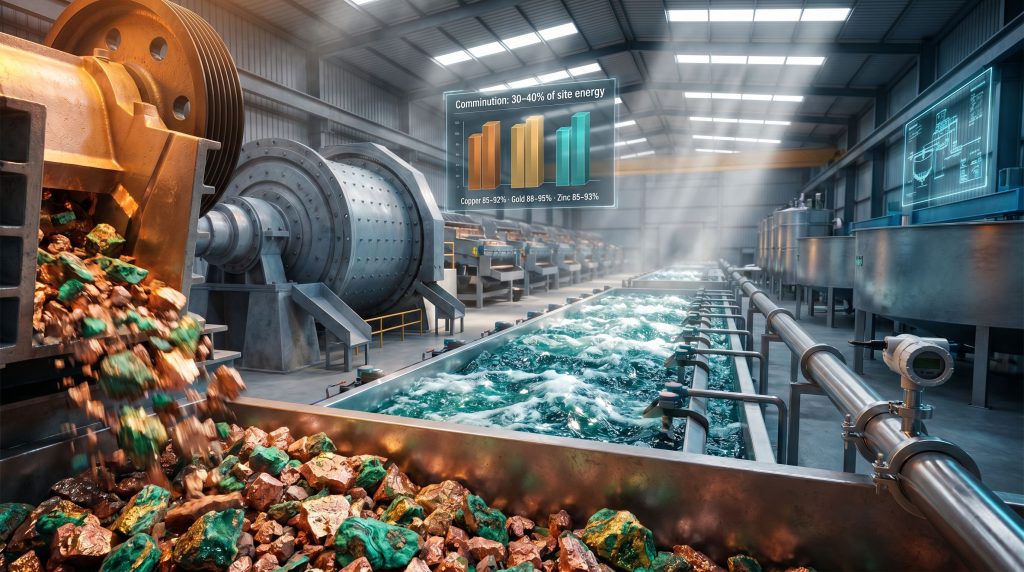
The comminution circuit typically begins with primary crushing using jaw or gyratory crushers, progresses through secondary and tertiary crushing stages, and concludes with fine grinding in semi-autogenous (SAG) mills and ball mills. This is where the economics of mineral processing bite hardest. Comminution accounts for approximately 30 to 40% of total mine site energy consumption, making it the dominant cost and carbon driver across the processing plant.
The trade-off that haunts every metallurgist designing a grinding circuit is the tension between over-grinding and under-grinding. Grind too coarsely and valuable mineral grains remain locked inside gangue particles, reporting to the tailings stream. Grind too finely and the resulting ultrafine slimes become difficult to recover by conventional concentration methods, again driving recovery losses. Optimising this balance requires detailed mineralogical characterisation before a single tonne of ore enters the circuit.
High-pressure grinding rolls (HPGR) have emerged as one of the most significant energy-reduction technologies in comminution, with documented specific energy reductions of 15 to 25% compared to conventional ball milling. Their adoption has accelerated particularly in hard-rock copper and iron ore applications.
Stage 2: Sizing and Classification
Once ore has been ground, particles must be routed by dimension to ensure each fraction enters the appropriate downstream circuit. Screening using vibrating decks handles coarser fractions, while hydrocyclones use centrifugal force to classify fine particles by their settling behaviour in water.
Particle size distribution (PSD) analysis governs how efficiently the subsequent concentration stage will perform. A poorly classified feed creates variability in flotation cells or gravity circuits that no amount of reagent adjustment can fully correct. Most modern grinding circuits operate in closed-circuit configuration, meaning oversized particles are returned to the mill for further size reduction rather than being passed forward to concentration.
Stage 3: Concentration
Concentration is where the commercial value of a mineral processing circuit is either captured or lost. The method selected depends entirely on the physical and chemical properties of the target mineral relative to its gangue.
| Concentration Method | Operating Principle | Best-Suited Minerals |
|---|---|---|
| Froth Flotation | Surface chemistry and hydrophobicity | Copper, lead, zinc, molybdenum |
| Gravity Separation | Density differential | Gold, tin, tungsten, chromite |
| Magnetic Separation | Magnetic susceptibility | Iron ore, magnetite, ilmenite |
| Electrostatic Separation | Electrical conductivity | Rutile, zircon, rare earths |
| Sensor-Based Ore Sorting | Optical, XRF, and XRT detection | Diamonds, coal, industrial minerals |
Froth flotation remains the dominant concentration method globally, underpinning the recovery of the majority of base metal production. The process works by conditioning a finely ground slurry with reagents that selectively render target mineral surfaces hydrophobic. Air bubbles introduced into the flotation cell attach preferentially to hydrophobic mineral particles and carry them to the froth layer at the surface, where they are skimmed off as concentrate. Gangue minerals, which remain hydrophilic, settle and report to the tailings stream.
One detail rarely discussed outside specialist metallurgical circles is the sensitivity of flotation performance to ore mineralogy at the grain scale. Two copper deposits with identical head grades can deliver dramatically different flotation recoveries if the mineralogical association of copper minerals with penalty elements differs. Chalcopyrite in a clean quartz gangue processes quite differently from chalcopyrite intimately associated with arsenic-bearing enargite, regardless of the headline copper percentage.
Stage 4: Dewatering
Concentrate produced by flotation or other wet separation methods typically carries moisture levels that make transport uneconomical and smelter reception problematic. Dewatering involves three progressive mechanisms: thickening, filtration, and thermal drying. Target moisture specifications vary by commodity, with copper concentrates generally required to arrive at smelters below 8 to 10% moisture to avoid handling and spontaneous combustion risks during shipping.
Dewatering infrastructure also plays a central role in water management. Modern thickening circuits at leading operations achieve process water recycling rates of 85 to 92%, substantially reducing fresh water consumption and the hydraulic loading on tailings storage facilities.
What Mineral Processing Extracts and Why Diversity Matters
The scope of mineral processing extends well beyond the base and precious metals that dominate mining headlines.
- Base metals: Copper, nickel, zinc, and lead recovered primarily through froth flotation
- Precious metals: Gold, silver, and platinum-group elements (PGEs) recovered through flotation, gravity concentration, and cyanide leaching circuits
- Ferrous metals: Iron ore and manganese concentrated through magnetic separation and dense media separation
- Industrial minerals: Quartz, fluorite, barite, and wollastonite, each requiring distinct separation flowsheets tailored to their specific physical properties
- Construction materials: Limestone, sand, gravel, and clay, processed through lower-intensity beneficiation circuits
Diamond recovery deserves particular attention as one of the more technically demanding applications of mineral processing. Dense media separation (DMS) exploits the high density of diamonds relative to host kimberlite, while X-ray luminescence sorting uses the unique fluorescence of diamond crystals under X-ray irradiation to identify and recover stones without physical contact. This non-destructive sorting technology is critical because mechanical damage during processing directly destroys value in a way that has no equivalent in base metal operations.
The Boundary Between Processing and Metallurgy
A persistent source of confusion in both industry and investment analysis is the distinction between mineral processing and metallurgy. The boundary is technically precise: mineral processing operates entirely within the physical and surface-chemical domain. No metal is extracted from its mineral form during ore dressing. A copper flotation concentrate contains copper still locked inside chalcopyrite mineral grains. Metallurgy begins where mineral processing ends.
The pyrometallurgical route applies heat, smelting concentrates to liberate molten metal from sulphide minerals, then converting and refining to achieve market-grade purity. The hydrometallurgical route, including the copper leaching process, dissolves target metals using chemical leachants, then applies solvent extraction and electrowinning (SX-EW) to recover pure metal from solution. Heap leaching of oxide copper ores sits at the intersection of these domains, applying dilute sulphuric acid directly to crushed ROM ore stacked on engineered lined pads, bypassing conventional milling entirely in oxide-dominant deposits.
Key Performance Metrics That Determine Commercial Success
Two metrics dominate the commercial evaluation of any mineral processing operation: recovery rate and concentrate grade. Understanding their relationship is fundamental to evaluating the economic performance of a mine.
Recovery rate measures the percentage of the target mineral in the mill feed that is successfully captured in the final concentrate. Industry benchmark ranges vary substantially by commodity and process route:
| Commodity | Typical Recovery Rate Range |
|---|---|
| Copper (flotation) | 85 to 92% |
| Gold (CIL/CIP leach) | 88 to 95% |
| Iron ore (magnetic separation) | 80 to 90% |
| Nickel sulphide (flotation) | 75 to 88% |
| Zinc (flotation) | 85 to 93% |
Concentrate grade measures the purity of the recovered product. The critical insight here is that recovery and grade pull in opposite directions on the grade-recovery curve. Pushing flotation conditions to maximise concentrate grade typically drags more valuable mineral into the tailings stream. Pushing conditions to maximise recovery typically produces a lower-grade concentrate that attracts smelter penalties for impurity content.
Smelter penalty elements represent a dimension of processing economics that receives insufficient attention in project-level financial models. Arsenic, bismuth, antimony, and mercury in copper concentrates trigger escalating penalty charges at most custom smelters, and these penalties can consume a significant portion of the payable metal value if mineralogy is not carefully understood during feasibility study work.
Overall Equipment Effectiveness (OEE) provides a third lens, combining availability, performance rate, and quality rate into a single integrated measure of processing plant productivity. Planned maintenance windows have a direct and often underestimated impact on annual processed tonnage and unit cost profiles.
The next major ASX story will hit our subscribers first
Technology Reshaping the Processing Landscape
The mineral processing industry is undergoing a genuine technological inflection, driven by energy cost pressure, water scarcity, labour constraints, and the demand for higher throughput from lower-grade deposits.
Sensor-Based Ore Sorting
Sensor-based ore sorting has transitioned from a niche diamond-recovery technology to a mainstream pre-concentration strategy across multiple commodities. Platforms using XRT ore sorting and other detection methods such as optical imaging, near-infrared (NIR) spectroscopy, and laser-induced breakdown spectroscopy (LIBS) now operate at the front end of processing circuits, diverting low-grade and barren material before it enters the mill.
Operations that have deployed pre-concentration sorting have reported throughput improvements of 10 to 25% on the basis of the same installed milling capacity, with corresponding reductions in reagent and energy consumption per tonne of valuable mineral recovered.
Electrified and Automated Drilling Feeding Smarter Processing
A less obvious but increasingly significant development is the way electrified and automated drilling systems are generating richer fragmentation and ore characterisation data that feeds directly into comminution circuit optimisation. When blast fragmentation is better understood and more consistent, SAG mill feed variability decreases, allowing advanced process control (APC) systems to operate closer to their optimal set points.
This upstream-to-processing data linkage is an area of growing operational focus, and recent advances in automated drilling technology are expanding the quality of information available to plant metallurgists before ore even reaches the primary crusher.
Clamp-On Ultrasonic Flow Measurement
Accurate slurry flow measurement has historically required intrusive inline instrumentation that demands process shutdowns for installation and maintenance. Portable clamp-on ultrasonic flow meters represent a meaningful operational advance, allowing non-invasive measurement of slurry flow rates across thickener feed lines, concentrate pipelines, and tailings circuits without interrupting plant operation.
The operational benefits extend beyond convenience: improved mass balance accuracy, reduced maintenance downtime, and better data resolution for water management and tailings circuit monitoring. Emerson's recently released Flexim FLUXUS 631 series is a current example of this technology being actively deployed in mineral processing environments.
AI and Automated Mineralogy
Artificial intelligence is reshaping ore characterisation at the mineralogical scale. Automated mineral analysis systems such as QEMSCAN and MLA (Mineral Liberation Analyser) now generate quantitative mineralogical data at speeds and volumes that were commercially impractical using manual petrographic methods a decade ago.
Machine learning models trained on drill core mineralogy data are beginning to predict flotation recovery outcomes before ore reaches the processing plant, enabling proactive circuit adjustments rather than reactive responses to feed variability. Furthermore, advances in critical minerals processing are pushing AI-assisted characterisation techniques into increasingly demanding applications.
Environmental Obligations and the ESG Dimension
Mineral processing generates the vast majority of the solid and liquid waste produced by mining operations, placing it at the centre of the industry's environmental and social performance debate.
Tailings Management
Tailings storage facilities (TSFs) represent the most significant long-term liability associated with mineral processing operations. The catastrophic failures at Brumadinho in Brazil (2019) and Fundao (2015) have driven the development and adoption of the Global Industry Standard on Tailings Management (GISTM), which establishes performance requirements across engineering, governance, emergency preparedness, and public disclosure.
Dry stack tailings, which filter press concentrate tailings to below 20% moisture before mechanical stacking, represent the most stringent risk-reduction approach, eliminating the freeboard water management risks that characterise conventional wet impoundments. The trade-off is substantially higher capital and operating cost for the dewatering infrastructure.
Water and Energy Stewardship
Process water recycling has become a genuine competitive differentiator in water-stressed mining jurisdictions. Operations achieving 85 to 92% water recycling rates not only reduce their freshwater licensing requirements but also lower the hydraulic load on tailings facilities, reducing failure risk.
The shift toward HPGR technology and stirred media mills in fine grinding applications reflects the industry's recognition that comminution energy intensity is both a cost liability and an increasingly scrutinised carbon emissions issue. Electrification of plant auxiliary systems, including conveyors, pumps, and ventilation infrastructure, extends decarbonisation efforts beyond the grinding circuit.
Reagent Stewardship and Chemical Risk
Flotation chemistry is evolving under pressure from both regulatory requirements and community licence-to-operate considerations. The toxicity profile of conventional sulphide collector chemistries and the management of cyanide in gold processing circuits are areas of ongoing regulatory scrutiny.
Compliance with the International Cyanide Management Code (ICMC) has become a baseline expectation for gold operations seeking investment from institutional capital, while the development of lower-toxicity collector alternatives is an active area of process chemistry research. Acid mine drainage (AMD) prevention begins not at the TSF but in the mineralogical characterisation work conducted during feasibility.
Processing Capacity as a Geopolitical and Strategic Asset
The strategic debate around critical minerals has undergone a significant conceptual evolution. For much of the past decade, policy discussions focused on securing mining rights and resource access. The more sophisticated understanding that has emerged recognises that downstream processing capacity, not mining rights alone, determines supply chain sovereignty.
A nation that mines lithium but lacks the ability to process it into battery-grade lithium hydroxide has not secured a supply chain position. It has secured a raw material export position, which is a fundamentally different and more precarious commercial arrangement. Canada's focus on expanding germanium output through smelter upgrades at facilities such as Teck's Trail Operations in British Columbia illustrates the policy logic of investing in processing capacity as a strategic multiplier on upstream mining activity.
The geographic concentration of processing capacity in single jurisdictions — most notably China's dominant position across rare earth, lithium, cobalt, and graphite processing — represents a systemic supply risk that is only partially addressed by diversifying mine supply. New processing capacity in jurisdictions outside this concentration requires not just capital but the accumulated metallurgical expertise, reagent supply chains, and workforce skills that take years to develop.
In addition, deep-sea mining regulations add another layer of strategic complexity to this picture. Polymetallic nodule deposits on the abyssal seafloor and seafloor massive sulphide (SMS) deposits at hydrothermal vent systems contain substantial concentrations of nickel, copper, cobalt, and manganese. However, the mineralogy and physical properties of deep-sea ores differ sufficiently from terrestrial equivalents that conventional land-based processing flowsheets require significant adaptation.
High-purity graphite processing sits at the intersection of mineral processing and advanced material manufacturing, feeding both battery anode production and the emerging graphene supply chain. As graphene compounding networks expand, with facilities being added in locations such as Midland, Ontario, the mineral processing requirements for ultra-high-purity graphite feedstock become increasingly stringent, pushing processing technology toward finer liberation sizes, higher-purity acid leaching, and more precise thermal treatment protocols than are required for conventional graphite products.
Frequently Asked Questions About Mineral Processing
What is the difference between mineral processing and mining?
Mining involves the physical extraction of ore from the ground. Mineral processing begins after extraction, transforming ROM ore into a concentrated, saleable product through physical and chemical separation. The two activities are sequential and interdependent but involve distinct engineering disciplines, equipment classes, and workforce skills.
What happens to tailings after mineral processing?
Tailings are the residual waste slurry remaining after valuable minerals have been extracted. They are typically pumped to engineered tailings storage facilities where water is progressively recovered and solids consolidate. Modern operations also explore reprocessing historical tailings as mineral prices rise and processing technology improves, particularly for gold and copper.
Which mineral processing method is most commonly used globally?
Froth flotation is the most widely applied concentration method globally, underpinning base metal recovery across copper, lead, zinc, nickel, and molybdenum operations. According to mineral processing research published by ScienceDirect, it is estimated that flotation processes more than two billion tonnes of ore annually worldwide.
Is mineral processing the same as beneficiation?
The terms are used interchangeably in most industry contexts. Beneficiation is the broader term sometimes used to encompass all activities that upgrade ore value ahead of smelting or refining, including mineral processing, whereas mineral processing more specifically denotes the physical and surface-chemical separation stages. For a comprehensive technical overview, the CSIRO's mineral processing resource provides further detail on how these distinctions apply in practice.
Mineral Processing at a Glance
| Dimension | Core Insight |
|---|---|
| Definition | Physical and surface-chemical separation of valuable minerals from gangue |
| Primary Stages | Comminution, Classification, Concentration, Dewatering |
| Dominant Energy Consumer | Comminution at 30 to 40% of site energy budget |
| Critical Performance Metrics | Recovery rate and concentrate grade |
| Emerging Technology Drivers | AI, sensor sorting, automation, HPGR, electrification |
| ESG Pressure Points | Tailings management, water recycling, reagent stewardship |
| Strategic Significance | Processing capacity equals supply chain sovereignty |
Readers seeking ongoing coverage of mineral processing developments, equipment innovation, and critical mineral strategy can explore the Canadian Mining Journal at canadianminingjournal.com, which provides regular editorial coverage of processing technology advances, ESG compliance trends, and commodity-specific operational developments across the Canadian and global mining sector.
This article contains forward-looking statements and general industry analysis for informational purposes only. It does not constitute financial or investment advice. Readers should conduct independent research and consult qualified professionals before making investment or operational decisions.
Want to Know Which Mineral Discoveries Could Deliver the Next Major Market Return?
Discovery Alert's proprietary Discovery IQ model scans ASX announcements in real time, instantly transforming complex mineralogical data into actionable investment insights across more than 30 commodities — from copper and gold to critical minerals reshaping global supply chains. Explore historic discoveries and their extraordinary returns, then begin your 14-day free trial to position yourself ahead of the market.