July 7, 2026
Why Safer Blasting in Hot and Reactive Ground Conditions Demands a Systems-Level Approach
Modern mining operations are pushing deeper, faster, and into geological environments that would have been considered marginal or inaccessible a generation ago. As ore bodies become more complex and mining footprints expand, the conditions underground and at the bench face are changing in ways that legacy blasting procedures were never designed to handle. Among the most technically demanding challenges in contemporary drill-and-blast engineering is the convergence of thermal hazards and chemical instability in the same blast environment. Getting this wrong does not simply mean a failed shot. It means premature detonation, personnel casualties, and uncontrolled explosive events that can shut down entire operations.
Safer blasting in hot and reactive ground conditions is not a niche concern limited to a handful of specialist mines. It is a discipline that applies across coal, PGM, base-metal, and other metalliferous operations globally, and it requires a fundamentally different management architecture than standard blasting practice.
When big ASX news breaks, our subscribers know first
The Dual Hazard Problem: Why Hot Holes and Reactive Ground Are Not the Same Risk
One of the most consequential misunderstandings in blast site management is the assumption that hot holes and reactive ground represent a single, unified risk category. They do not. They are mechanistically distinct, they require separate control frameworks, and they can coexist in the same blast block in ways that compound each other's danger.
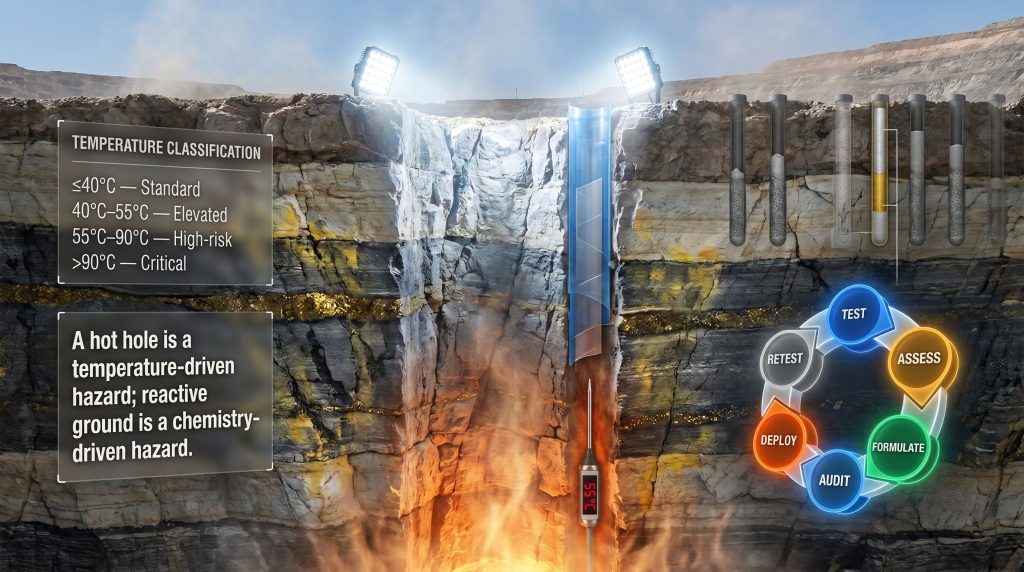
A hot hole is a temperature-driven hazard. Heat enters the blast hole through conduction from surrounding rock, convection through groundwater or gas movement, radiation from nearby combustion sources, or geothermal gradients associated with depth. The result is an elevated-temperature environment that can degrade explosive products, soften initiating components, and accelerate decomposition reactions in ammonium nitrate-based systems.
Reactive ground is a chemistry-driven hazard. It arises when sulphide-bearing minerals, acidic ground conditions, or alkaline mineralogy interact chemically with the ammonium nitrate component of bulk explosive systems. This interaction is exothermic, meaning it generates its own heat, independent of the initial hole temperature. In extreme cases, the reaction can escalate to thermal runaway, where heat production outpaces the rock mass's ability to dissipate energy, ultimately triggering premature detonation.
Treating both hazards under a single control framework creates critical gaps. A site that monitors temperature but neglects geochemical screening may deploy the correct thermal controls while remaining entirely exposed to reactive ground chemistry.
The geological categories of reactive ground and their associated explosive compatibility risks can be summarised as follows:
| Reactive Ground Type | Primary Chemical Driver | Explosive Interaction Risk |
|---|---|---|
| Sulphide-bearing rock | Pyrite/pyrrhotite oxidation | Ammonium nitrate decomposition, thermal runaway |
| Acidic ground | Low-pH mineralogy | Nitrate destabilisation, detonation performance loss |
| Alkaline ground | High-pH mineral content | Emulsion sensitiser degradation |
A critical but underappreciated thermodynamic principle governs reactive ground severity: oxidation rates approximately double with every 10°C rise in temperature. This means that a blast hole already classified as mildly warm can, under the right geochemical conditions, transition from a manageable situation to a runaway thermal event far faster than field observation alone would suggest.
How Do You Identify Reactive Ground Before It Becomes a Blasting Hazard?
The Silent Killer Classification
Reactive ground has earned its industry designation as the silent killer for a precise technical reason: some of the most severe chemical interactions in blast holes occur in environments that show no surface-level thermal signature before charging. There is no visible steam, no elevated collar temperature, no discolouration of drill cuttings that would alert an untrained observer to the developing hazard.
This is what makes reactive ground categorically more insidious than hot holes. A hot hole can, in principle, be detected with a thermometer. Reactive ground, however, requires systematic geological assessment and laboratory chemistry to identify accurately. Much like geological logging codes underpin the integrity of any subsurface dataset, rigorous geochemical screening underpins the integrity of a safe blast plan.
Reactivity Screening Protocols
Effective pre-blast geotechnical screening for reactive ground should incorporate the following elements:
- Sulphide content analysis, with concentrations above approximately 1% sulphide minerals commonly used as an industry screening trigger for elevated reactivity risk
- Visual identification markers including black sulphide-bearing sediments in drill cuttings, acidic drainage at the collar, and discolouration patterns indicative of oxidised sulphides
- Assessment of pH conditions in groundwater and formation fluids, as both acidic and alkaline extremes can compromise emulsion stability through different mechanisms
- Review of geological domain transitions, since reactive ground profiles are not static across a pit or underground development face
A frequently overlooked problem in reactive ground sampling is the effect of oxidation on sample integrity. Once sulphide-bearing drill cuttings are brought to the surface, the oxidation process accelerates in the presence of atmospheric oxygen and moisture. Delays between sample collection and laboratory analysis can therefore alter the chemical character of the sample and understate the true reactivity of in-situ conditions.
This places significant importance on both sampling protocols and the speed with which samples reach the laboratory. Robust check sampling methods should be applied to verify the consistency of reactive ground classifications across adjacent holes and domains.
Testing frequency should also scale with the rate at which mining is advancing into new geological domains. A stable geological environment may tolerate periodic re-testing intervals, whereas operations transitioning through heterogeneous ore bodies should treat each domain boundary as a trigger for full reassessment.
What Temperature Thresholds Define a Hot Hole and What Controls Apply?
The Hot Hole Classification System
Industry practice classifies a blast hole as a hot hole when measured temperatures exceed 40°C, or when monitoring records a temperature increase of 3°C or more during the observation period. This dual criterion is important: a hole may begin within an acceptable temperature range but still represent a dynamic thermal hazard if it is actively heating.
The following tiered framework reflects the operational response requirements that apply across different temperature ranges:
| Temperature Range | Classification | Required Operational Response |
|---|---|---|
| ≤40°C | Standard | Normal loading procedures |
| 40°C – 55°C | Elevated | Enhanced monitoring, additional controls |
| 55°C – 90°C | High-risk | Mandated use of specialised heat-resistant packaged emulsions |
| >90°C | Critical | Backfill required; no charging permitted |
| >600°C (coal seam fire zones) | Extreme | Site abandonment or cooling intervention before reassessment |
The 55°C threshold carries particular engineering significance. At this temperature, explosive degradation rates begin to accelerate in a non-linear fashion. Certain emulsion components may start to soften at approximately 70°C, increasing the risk of premature sensitisation or detonation. Both electronic and non-electric initiation systems can also be adversely affected if thermal conditions are not correctly characterised before deployment.
Heat Sources in Mining Environments
Understanding where heat originates is essential to correctly mapping the thermal risk profile of a blast block. The primary sources include:
- Underground coal seam fires, which represent the most extreme thermal hazard in mining environments. Active combustion can generate hole temperatures exceeding 600°C, with peak intensities during active combustion surpassing 1,000°C
- Sulphide oxidation, which functions as both a reactive ground chemistry driver and a secondary heat-generating mechanism, meaning it simultaneously worsens reactive ground conditions while raising ambient temperature
- Geothermal gradients, which increase predictably with depth and establish a baseline thermal load in deep operations that compounds all other heat sources
- Interaction effects, where multiple heat sources coexist within a single blast block, creating non-uniform temperature profiles that can vary significantly between holes drilled metres apart
Furthermore, according to guidance published by Orica on reactive ground management, a structured approach to identifying and classifying heat sources before drilling programmes commence is fundamental to preventing explosive incidents in these conditions.
What Explosive Products and Engineering Controls Are Required?
Inhibited Emulsion Formulations
When reactive ground conditions are confirmed, inhibited explosive formulations represent the primary product-level control. These formulations incorporate chemical inhibitors, most commonly urea-based compounds, that slow the rate of exothermic reaction between ammonium nitrate and reactive sulphide minerals. This extends the safe operational window between charging and detonation, providing a quantified buffer against premature initiation.
Inhibitors can be introduced at two points in the explosive system:
- During the manufacturing process, where inhibitor concentrations are embedded in the emulsion matrix before delivery to site
- At the point of sensitisation, where inhibitors are introduced into the explosive column during the loading process itself
A critical limitation must be clearly understood: inhibited emulsions reduce reaction rates but do not neutralise the underlying chemistry. They extend the safety window, not eliminate the hazard. Inhibitor concentrations must always be determined through site-specific laboratory testing rather than applied at generic manufacturer-specified levels, because the reactivity profile of sulphide mineralogy varies significantly between ore bodies and even between geological domains within the same mine.
Blast Hole Liners, Stemming, and Charging Sequence
Beyond explosive formulation, several physical and procedural controls contribute to safe outcomes in reactive and hot-hole environments:
- Blast hole liners: Plastic sleeving creates a mechanical barrier between the reactive hole wall and the explosive column, reducing direct mineral-to-explosive contact. Liner deployment is considered mandatory in confirmed reactive ground conditions and advisory in elevated-risk zones
- Stemming material: Drill cuttings must never be used as stemming material where reactive ground or elevated temperatures are present. Cuttings mixed back into the collar zone can contaminate the explosive column and create localised temperature buildup. Inert, non-reactive materials meeting site-specific specifications should be used exclusively
- Charging sequence: Hot blast holes should be loaded last within a blast block to minimise the duration of explosive exposure to elevated temperatures. Primers should be assembled immediately before charging rather than prepared in advance, and the collar zone should be cleared of drill cuttings before any explosive is introduced
How Should Sleep Time Be Managed to Prevent Explosive Degradation?
Sleep Time as a Safety-Critical Variable
Sleep time refers to the period between explosive loading and detonation. Under standard conditions, sleep time is primarily a logistics and operational planning concern. In hot and reactive ground environments, however, it becomes a safety-critical variable with quantified limits.
Elevated temperatures and reactive ground conditions compress the safe sleep time window by accelerating the chemical and thermal degradation processes within the loaded explosive column. A product that performs safely over a standard intended sleep period under normal conditions may become unstable far sooner in a reactive or high-temperature environment.
Laboratory testing can validate safety windows that extend operational sleep times significantly beyond standard intended periods, providing a quantified margin of safety. However, this buffer must be recalculated whenever ground conditions, explosive formulations, or inhibitor concentrations change.
The practical implication is that sleep time limits are not fixed product specifications. They are site-specific, condition-specific parameters that must be re-derived whenever the geological or thermal environment changes. A sleep time validated for one geological domain cannot be assumed to apply in an adjacent domain with different sulphide mineralogy or groundwater chemistry.
The next major ASX story will hit our subscribers first
The Four Management Controls That Form the Foundation of a Safe Blasting System
Control 1: Site-Specific Risk Assessment
Every blast hole, bench, and mining block must be evaluated against current ground conditions before loading commences. This evaluation should integrate geotechnical data, temperature monitoring records, historical reactivity data, and current explosive product selection. The outcomes of the risk assessment must be communicated to all personnel involved in the blast event, not retained as engineering documentation alone.
Control 2: Defined Site-Specific Blasting Procedures
Generic explosive handling procedures are insufficient for reactive and hot-hole environments. Site-specific procedures must define, at a minimum:
- Temperature thresholds and their corresponding operational responses
- Product selection criteria for each classification zone
- Loading sequences and primer assembly protocols
- Maximum allowable sleep times under current ground conditions
- Emergency response triggers and stop-work authority
These procedures must be version-controlled and updated as geological conditions evolve during mine advancement. In addition, mine permitting challenges can directly influence the speed at which updated procedures are formally approved and deployed, making early regulatory engagement a practical priority.
Control 3: Operations Auditing
Regular conformance auditing serves to identify procedural drift before it becomes an incident. Audit scope should cover product selection compliance, temperature monitoring records, stemming material use, and blast timing adherence. Critically, audit findings should feed directly back into procedure updates and targeted training interventions rather than being filed as standalone compliance records.
Control 4: Personnel Training and Competency Verification
Training programmes for personnel operating in reactive ground and hot-hole environments must cover:
- Recognition of reactive ground indicators including fumes, smoke, and abnormal odours emanating from loaded blast holes
- Temperature monitoring techniques and classification decision-making
- Emergency response procedures, including stop-work authority and exclusion zone establishment
- Refresher training requirements tied to geological domain changes and incident history
What Emergency Protocols Must Be in Place Before Charging Begins?
Stop-Work Authority and In-Progress Reactive Events
No charging should proceed in circumstances where uncertainty exists regarding hole temperature, reactive ground potential, product suitability, or sleep time validity. Stop-work authority must be clearly defined in site procedures and must be genuinely empowered, meaning frontline personnel must have the authority to halt operations without requiring supervisory approval when trigger conditions are met.
Where a chemical reaction has already been initiated within a loaded blast hole, the response protocol is unambiguous: personnel must never attempt to extract explosives from the hole. Doing so risks triggering a detonation event. The required immediate actions are:
- Establish a defined exclusion zone around the affected area. Industry reference standards for severe reactive events recommend a minimum clearance of 1,000 metres
- Activate site emergency procedures and notify all relevant personnel
- Conduct post-event investigation before any further charging activities resume in the affected area
Mock drill requirements for reactive ground emergency scenarios should specify both frequency and realistic scenario design, covering the full sequence from hazard identification through exclusion zone establishment and emergency service notification. The WorkSafe WA Code of Practice on elevated temperature and reactive ground provides a detailed regulatory reference for structuring these emergency response protocols.
Building a Continuous Improvement Framework for Blasting Safety in Challenging Ground
Integrating Reactive Ground Management Into the Broader Safety Architecture
Reactive ground and hot-hole management cannot function as standalone procedural overlays. To be genuinely effective, these protocols must be connected to the mine's geological model so that hazard forecasting can inform drill-and-blast planning proactively rather than reactively. Historical reactive event data from one area of a pit or underground development should automatically inform the risk assessment framework for adjacent zones where similar geology is anticipated.
Cross-functional collaboration between geotechnical engineers, blast engineers, and site safety teams is not optional in these environments. The chemistry, thermal physics, and operational execution of a safe blast in reactive or hot ground draw on disciplines that rarely sit within a single team's expertise. Consequently, drilling programs should be designed from the outset to capture the geochemical data needed to populate reactive ground assessments before blasting commences.
The Continuous Validation Cycle
The most important conceptual shift required in approaching safer blasting in hot and reactive ground conditions is moving from a point-in-time assessment mindset to a continuous validation framework. The cycle operates as follows:
- Test ground conditions as mining advances into new geological domains
- Assess reactivity profiles and thermal risk levels against current explosive product specifications
- Formulate or adjust explosive selection, inhibitor concentrations, and sleep time limits for current conditions
- Deploy with site-specific procedures in place and fully communicated to all personnel
- Audit operational conformance against defined procedures
- Retest when geological domain transitions occur, when incident data suggests changing conditions, or at defined intervals
The scale and geological complexity of modern mining operations have elevated these hazards beyond what legacy procedures were designed to address. Embedding reactive ground and hot-hole protocols into mine design from the feasibility stage — informed by a thorough definitive feasibility study — rather than retrofitting controls during operations, represents the most cost-effective and safety-robust approach available to the industry today.
This article is intended as a technical reference for mining professionals and does not constitute legal, regulatory, or site-specific safety advice. Blasting operations must comply with applicable national and site-level regulations. All safety thresholds, product specifications, and procedural requirements should be validated against current regulatory standards and site-specific risk assessments before implementation.
Want to Stay Ahead of Significant ASX Mineral Discoveries in the Mining Sector?
Discovery Alert's proprietary Discovery IQ model delivers real-time alerts on major ASX mineral discoveries, transforming complex geological and market data into actionable investment insights for both short-term traders and long-term investors. Explore how historic discoveries have generated substantial returns on Discovery Alert's dedicated discoveries page, and begin your 14-day free trial today to secure a market-leading advantage.