July 7, 2026
The Hidden Variable in Every Portable XRF Program: Why Purpose Comes Before Protocol
Most analytical failures in portable XRF programs are not caused by instrument malfunction, poor sample preparation, or inadequate laboratory comparison. They originate much earlier, at the moment a field team deploys without having formally defined what the data are actually supposed to achieve. Understanding why portable XRF QAQC and data quality objectives are fundamentally a design problem, not a measurement problem, is the starting point for building any defensible analytical framework.
When big ASX news breaks, our subscribers know first
What Are Data Quality Objectives and Why Must They Precede Everything Else?
Defining DQOs as the Analytical Foundation
A Data Quality Objective (DQO) is a formal statement that defines the purpose of a dataset, the acceptable thresholds for precision and accuracy, the target elements and their expected concentration ranges, and the downstream uses to which the data will be applied. In portable XRF programs, establishing a DQO before fieldwork begins is not procedural formality. It is the only rational basis upon which quality control thresholds can be designed.
Without a DQO, there is no valid reference point for determining whether collected data are fit for purpose. As exploration practitioners have noted, you cannot control what you have not defined. The inverse is equally true: a well-constructed DQO resolves the majority of downstream analytical ambiguity before a single measurement is taken.
How End-Use Determines Analytical Rigour
The appropriate level of quality control for a portable XRF program scales directly with how the resulting data will be used. Consider three distinct field scenarios:
-
Binary anomaly pre-screening on an RC drilling program: If the instrument is being used to identify elevated zones for follow-up sampling and no data will enter a model or be communicated to investors, a simplified QC framework may be appropriate. A geologist scanning samples for relative arsenic concentrations to guide gold exploration may not require the same insertion rates as a resource estimation program. Furthermore, interpreting drill results correctly at this stage can significantly influence whether portable XRF screening adds genuine value.
-
Lithological discrimination and alteration mapping: Here, relative differences between samples matter more than absolute accuracy. QC requirements sit in an intermediate tier, where instrument consistency across a session is critical but laboratory-grade precision is not the benchmark.
-
Data informing resource-level decisions or public reporting: This end-use demands the most rigorous DQO framework, with formally documented SOPs, prescribed CRM insertion rates, statistical acceptance testing, and transparent methodology disclosure.
Key Insight: The appropriate level of analytical rigour for a portable XRF program is not fixed. It scales directly with how the resulting data will be used. A binary anomaly screen demands a fundamentally different control framework than data destined for resource modelling or investor reporting.
DQO Variables That Must Be Resolved Before Fieldwork Begins
- Target elements and expected concentration ranges for the project
- Intended end-use: exploration screening, lithological discrimination, alteration mapping, or resource-level estimation
- Acceptable thresholds for precision and accuracy relative to that end-use
- Downstream data consumers: internal geologists, resource estimators, or capital markets
- Metadata requirements and documentation standards for future interpretability
How Does the QA/QC Framework Actually Function in a Portable XRF Context?
The Critical Distinction Between Quality Assurance and Quality Control
One of the most consequential conceptual errors in portable XRF programs is the conflation of Quality Assurance (QA), Quality Control (QC), and post-collection data review. These are temporally distinct processes and treating them interchangeably produces systematic analytical failures.
| Term | When It Operates | Core Function | Field Equivalent |
|---|---|---|---|
| Quality Assurance (QA) | Before data collection begins | Establishes SOPs, calibration protocols, and variance reduction procedures | Writing the field manual before the instrument leaves the case |
| Quality Control (QC) | During active data collection | Monitors process performance in real time; triggers corrective action | Flagging and fixing instrument drift while sampling continues |
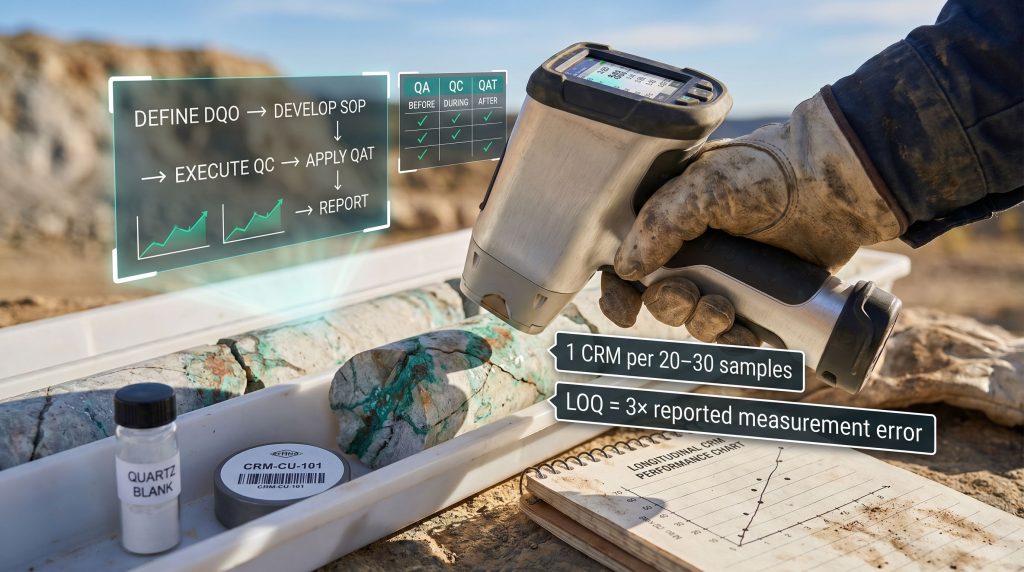
| Quality Acceptance Testing (QAT) | After data collection is complete | Statistically validates whether the collected dataset meets the pre-defined DQOs | Comparing final calibrated outputs against certified reference material targets |
Why a QAQC Sample Is a Conceptual Contradiction
The phrase "QAQC sample" is technically meaningless, and understanding why reveals something important about analytical rigour. QA is a pre-collection process. QC is an in-process monitoring function. Neither operates retrospectively on a completed dataset. A sample inserted after data collection is complete cannot perform quality control because there is no longer a live process to control.
The common practice of sending a dataset for "QC review" months after collection is a postmortem, not quality control. It can describe how a dataset failed, but it cannot correct a process that has already concluded. In addition, geological logging codes play an equally important role in maintaining dataset integrity across field programs.
The SOP as a Variance Reduction Tool
A Standard Operating Procedure is the primary mechanism through which QA operates. Its purpose is to suppress systematic bias and random variance before measurement begins. An SOP that is vague, incomplete, or internally inconsistent introduces the same class of error as a poorly calibrated instrument. The analogy of instructing someone to make a sandwich without specifying the sequence of steps captures this precisely: ambiguous instructions produce inconsistent outcomes regardless of the capability of the person following them.
Framework Note: A Standard Operating Procedure is not administrative paperwork. It is the primary mechanism for suppressing systematic bias and random variance before a single measurement is taken. An SOP that is too vague introduces the same class of error as a poorly calibrated instrument.
What Quality Control Measures Should Be Running During pXRF Data Collection?
The Two Non-Negotiable QC Checks for Every Field Program
1. Blank Analysis: Contamination Monitoring
- Analyse a quartz or process blank at the start of each operational session
- Compare elemental readings against the previous session's baseline
- Apply binary pass/fail logic: have new elements appeared on the detector window relative to yesterday?
- Recommended frequency: one blank per analytical run or at session commencement
2. Reference Material Performance Monitoring: Instrument Stability Gates
- Designate at least one reference material for continuous analysis regardless of sample matrix
- Recommended insertion rate: one certified reference material (CRM) per 20 to 30 samples
- Track performance longitudinally across days, not just within a single session
- Use multiple CRMs spanning the expected concentration range for target elements where resource-level decisions are involved
Setting Performance Gates That Are Fit for Purpose
The most important word in any performance threshold is "appropriate." Applying laboratory-grade three-sigma control limits to portable XRF programs will generate constant false-positive alerts, rendering the QC system operationally unusable. A handheld instrument sitting in a field holster is not a fixed-laboratory atomic emission spectrometry (AES) machine. Expecting identical statistical behaviour from both instruments produces a QC framework that fails in practice before the first day of sampling is complete.
Performance thresholds for portable XRF must be calibrated to the instrument's inherent operating characteristics and the program's DQOs. The relevant distinction is between two fundamentally different types of variation:
- Common-cause variation: Expected day-to-day instrument fluctuation operating within acceptable limits, representing the natural noise of the measurement system
- Special-cause variation: Statistically disproportionate step changes in reference material readings that signal a genuine process failure requiring immediate investigation
Critical Warning: Applying laboratory-grade three-sigma control limits directly to portable XRF programs will generate constant false-positive alerts, rendering the QC system operationally useless. Performance thresholds must be calibrated to the instrument's inherent characteristics and the program's DQOs, not inherited from fixed-laboratory AES or fire assay protocols.
A practical field rule: a factor-of-two or greater step change in a CRM reading warrants an immediate investigation and a process halt. Single-point deviations that return to baseline on the next analysis are more likely to represent common-cause noise than a genuine instrument failure. Consequently, tips for collecting quality portable XRF data from the field strongly reinforce this approach to threshold calibration.
Recommended QC Insertion Schedule
| Control Material | Recommended Frequency | Primary Purpose |
|---|---|---|
| Quartz blank | Start of each session | Contamination detection |
| CRM (primary) | Every 20 to 30 samples | Accuracy validation and drift monitoring |
| Field duplicate | Every 20 samples (minimum) | Precision and heterogeneity assessment |
| Replicate measurement | 7 times per day on a site sample | Instrument repeatability quantification |
| NIST-traceable calibration standard | Before each operational period | Baseline calibration verification (±20% tolerance) |
Understanding Detection Limits and Quantification Thresholds in pXRF Data
How to Interpret pXRF Readings Against Instrument Detection Limits
Portable XRF instruments report values against two critical thresholds that govern how results should be interpreted and used:
- Limit of Detection (LOD): Defined as three standard deviations above the mean blank concentration. Readings below this threshold must be treated as non-detects and should not be used in quantitative analysis.
- Limit of Quantification (LOQ): A reported value is considered reliably quantifiable when it exceeds three times the instrument's reported measurement error. Values between LOD and LOQ carry elevated uncertainty and should be flagged in any dataset used for resource-level decisions.
- Practical implication: Geologists working with portable XRF data for resource-adjacent applications must understand that values sitting between LOD and LOQ are not reliable quantitative measurements. They can indicate the presence of an element but should not be used for grade calculations or interpolation.
Moisture, Heterogeneity, and Environmental Variables
Field conditions introduce measurement uncertainty that laboratory settings eliminate by design. Variables that systematically degrade portable XRF data quality include:
- Sample heterogeneity: Coarse particle size, mixed lithologies, and uneven surface texture all reduce measurement representativeness
- Moisture content: Elevated moisture systematically suppresses elemental readings, particularly for lighter elements, and is a known source of downward bias in soil and weathered rock surveys
- Organic and ferruginous horizons: Thick soil profiles or iron-rich horizons can attenuate signal for target elements, producing readings that underrepresent true concentrations
- Detector window contamination: Residual material on the window creates cumulative bias that compounds across a session unless blanks are run regularly
What Is Quality Acceptance Testing and How Does It Differ from QC?
The Statistical Logic Behind QAT
Quality Acceptance Testing is a formal statistical process applied to a completed dataset to determine whether it meets the pre-defined DQOs. It can only be validly performed on data generated by a process that remained in statistical control throughout collection. Running QAT on a dataset with unresolved QC failures produces results that are statistically meaningless because the underlying population is not internally consistent.
The conceptual foundation of QAT is population integrity: data generated under a controlled process come from a single statistical population, which means standard statistical tools can be applied to assess accuracy and precision. Data generated under a process that experienced unaddressed control failures may represent multiple populations and cannot be validly compared.
Applying QAT to a Calibrated pXRF Dataset
- Confirm the dataset was generated under a process that remained in statistical control throughout collection
- Assess the mean and variance of CRM recovery data against pre-defined acceptance criteria
- Apply Fischer tests or equivalent statistical tools to evaluate whether the dataset population is internally consistent
- Determine whether any bias correction or calibration adjustment is warranted before downstream use
- Document the basis for any correction factor applied, including the reference materials used and the correlation strength supporting the adjustment
Analytical Distinction: QAT is not a retrospective QC exercise. It is a formal statistical acceptance decision that can only be validly performed on data generated by a controlled process. Running QAT on a dataset with unresolved QC failures produces meaningless results.
Comparing pXRF Calibrated Data Against Laboratory Results
Sending a representative subset of portable XRF samples to an umpire laboratory adds genuine analytical value under specific conditions. For elements like copper, where instrument performance is relatively strong and scatter plot correlations between portable XRF and laboratory data tend to be consistent, a well-documented calibration correction can bring portable XRF data significantly closer to laboratory-grade accuracy. Where the correlation is weak, inconsistent, or element-dependent, applying correction factors introduces its own form of bias.
The critical point is that laboratory comparison only adds value when the portable XRF dataset was generated under a controlled process. Comparing a poorly controlled portable XRF dataset against laboratory data produces a correction that is itself unreliable. Furthermore, mineral exploration results from conventional assay programs provide a useful benchmark against which portable XRF performance can be contextualised.
The next major ASX story will hit our subscribers first
Can Portable XRF Data Be Reported to the Stock Exchange or Used in Mineral Resource Estimates?
The Regulatory and Reporting Landscape
The central issue is not whether portable XRF data can be collected or disclosed to the market. It is whether the prominence, framing, and supporting disclosure of that data accurately represent its analytical limitations. Featuring portable XRF-derived intervals in headline announcements while burying methodology disclaimers in footnotes creates a material disclosure risk, regardless of whether the technical language used is technically accurate.
Regulatory Note: The issue is not whether pXRF data can be collected or disclosed. It is whether the prominence, framing, and supporting disclosure of that data accurately represent its analytical limitations. Burying methodology disclaimers in footnotes while featuring pXRF-derived intervals in headline announcements creates material disclosure risk.
Reporting portable XRF data in ASX announcements requires clear identification of the measurement method, unambiguous disclosure of the instrument's analytical limitations, and sufficient contextual information for a technically informed reader to assess data quality without access to the original field documentation.
The Path Toward Resource-Level pXRF Data
Industry practitioners have noted that the analytical gap between portable XRF capabilities and resource-estimation-grade data is narrowing, but a completed precedent case for a JORC-compliant mineral resource estimate based primarily on portable XRF data has not yet been achieved. The closest analogue in current practice is uranium downhole radiometric logging, where a calibrated instrument-derived measurement makes its way into a mineral resource through a documented adjustment process.
Copper is widely regarded as the most analytically tractable candidate for near-term portable XRF-based resource estimation, given its relatively strong instrument response and the consistency of laboratory correlation data. However, understanding true vs apparent widths remains equally important when contextualising portable XRF interval data within a broader resource framework. The barriers that remain are not primarily technical; they are structural: industry conservatism, peer review expectations, and the absence of a fully documented, publicly validated workflow that has survived competent person scrutiny.
How Should a Portable XRF QAQC Program Be Structured from Start to Finish?
A Practical Framework: From DQO Setting to Data Acceptance
- Define the DQO – articulate purpose, target elements, acceptable precision and accuracy, and end-use before mobilisation
- Develop the SOP – document all measurement procedures, sample preparation requirements, insertion rates for control materials, and stop conditions in language a field technician can follow without specialist knowledge
- Conduct a pre-program orientation survey – characterise instrument performance on representative project samples before full deployment to establish baseline behaviour
- Execute QC during collection – run blanks, CRMs, and duplicates at prescribed frequencies; apply performance gates in real time
- Compile and review QC charts – plot CRM performance longitudinally; identify and investigate any step changes or trends before the dataset grows large enough that remediation becomes impractical
- Apply QAT to the completed dataset – statistically validate population consistency and assess accuracy and precision against DQO thresholds
- Apply calibration corrections where justified – document the basis for any correction factor applied to the dataset, including supporting scatter plot analysis
- Report with full methodological transparency – include measurement geometry, sample preparation, QC summary statistics, and metadata in all technical outputs
Common Failure Modes in pXRF QAQC Programs
| Failure Mode | Root Cause | Consequence |
|---|---|---|
| No pre-defined DQO | Program initiated without analytical purpose statement | QC thresholds cannot be set; data utility is undefined |
| CRMs inserted too infrequently | Cost or time pressure | Instrument drift goes undetected across large sample batches |
| Laboratory-standard control limits applied | Misapplication of fixed-lab protocols | Constant false-positive alerts; QC system abandoned in the field |
| QC performed retrospectively | Misunderstanding of QC timing | Out-of-control data cannot be corrected after collection |
| Missing metadata | Field documentation not prioritised | Dataset becomes uninterpretable for downstream users |
Frequently Asked Questions: Portable XRF QAQC and Data Quality
What is a Data Quality Objective in the context of portable XRF?
A DQO is a formally defined statement of the purpose, target elements, acceptable precision and accuracy, and intended downstream use of a portable XRF dataset. It must be established before any data collection begins and forms the logical basis for all subsequent QA, QC, and QAT decisions.
How often should certified reference materials be analysed during a pXRF program?
A general guideline for programs where data will inform exploration or resource-adjacent decisions is one CRM per 20 to 30 samples. For binary screening programs with limited downstream use, insertion rates can be relaxed, provided the DQO explicitly acknowledges this decision.
What is the difference between QA, QC, and QAT in a portable XRF workflow?
QA operates before data collection and suppresses variance through SOPs and calibration protocols. QC operates during data collection and detects process failures in real time. QAT operates after data collection and statistically validates whether the dataset meets the pre-defined DQOs. They are temporally distinct and non-interchangeable.
Can portable XRF data be used to support a JORC-compliant mineral resource estimate?
Not yet in a documented public precedent, although the technical pathway exists. Copper is the most tractable candidate. The barriers are structural rather than purely technical, and the uranium downhole radiometric analogue demonstrates that instrument-derived measurements can, under the right conditions, find their way into compliant resource statements. The drill results interpretation challenges associated with portable XRF data mirror those encountered with any non-standard analytical method entering a formal resource workflow.
What metadata should be recorded alongside every pXRF measurement?
At minimum: measurement geometry (bagged, surface, or core), sample preparation state, moisture condition at time of measurement, operator identity, instrument serial number, and session date and time. Metadata is not optional. Its absence transforms a valid dataset into an unverifiable one. Researchers assessing QA/QC of pXRF data from CRMs have consistently highlighted metadata completeness as a defining factor in dataset defensibility.
Key Takeaways: Building a Defensible Portable XRF Data Quality System
- Portable XRF QAQC and data quality objectives without a formally defined DQO have no valid basis for threshold-setting or data acceptance decisions
- QA, QC, and QAT are temporally distinct functions; conflating them produces systematic analytical failures that cannot be remediated after the fact
- Performance gates must be purpose-built for portable instruments and calibrated to the program's DQOs, not inherited from fixed-laboratory control frameworks
- Metadata and transparent reporting are structural components of a defensible dataset, not optional additions
- The analytical gap between current portable XRF QAQC and data quality objectives best practice and resource-estimation-grade data is narrowing, but closing it requires rigorous process documentation and a completed public precedent case
- Copper represents the most viable near-term candidate for portable XRF-based resource estimation, with uranium radiometric logging providing the closest existing industry analogue
This article contains references to technical frameworks, field practices, and regulatory considerations in portable XRF data collection. It is intended for educational purposes only and does not constitute investment advice. Readers should consult qualified competent persons when making decisions that rely on portable XRF data for resource estimation or public market disclosure.
Want to Identify the Next Major ASX Mineral Discovery Before the Market Does?
Discovery Alert's proprietary Discovery IQ model delivers real-time alerts the moment significant mineral discoveries are announced on the ASX, transforming complex geological data into clear, actionable investment insights — explore historic discoveries and their returns to understand what's possible, then begin your 14-day free trial at Discovery Alert to position yourself ahead of the broader market.