July 7, 2026
The Persistent Gaps in Mineral Sampling Science That No Conference Has Yet Closed
Sampling science occupies a curious position in the mining industry. Decades of theoretical development, international conferences, and published research have advanced the discipline considerably, yet practitioners in the field regularly encounter the same unresolved problems their predecessors faced. The gap between what the literature prescribes and what actually happens at the drill collar or laboratory bench remains wide, and closing it requires more than repeating established frameworks at industry gatherings.
Understanding why those gaps persist, and what the most forward-thinking researchers are now doing about them, is increasingly relevant for anyone working in resource estimation, exploration geology, or laboratory quality control. The upcoming return of the premier mineral sampling conference in Johannesburg offers a useful lens through which to examine both the state of the discipline and its most productive emerging directions.
When big ASX news breaks, our subscribers know first
What Is the World Conference on Sampling and Blending?
A Brief History and South Africa's Central Role
The World Conference on Sampling and Blending (WCSB) is the leading international scientific forum dedicated to sampling theory and practice across the mineral industry, grain and food sectors, and related fields. Held approximately every two years and rotating between global locations, it has become the primary venue where researchers, practitioners, and industry professionals test ideas, challenge established methods, and present new findings.
South Africa has hosted multiple editions of the conference, and Johannesburg in particular occupies a natural position within this ecosystem. The city is home to major mining engineering academic institutions, the Southern African Institute of Mining and Metallurgy (SAIMM), and proximity to large-scale bulk commodity operations that serve as real-world testing grounds for applied sampling research.
The 11th World Conference: Key Facts
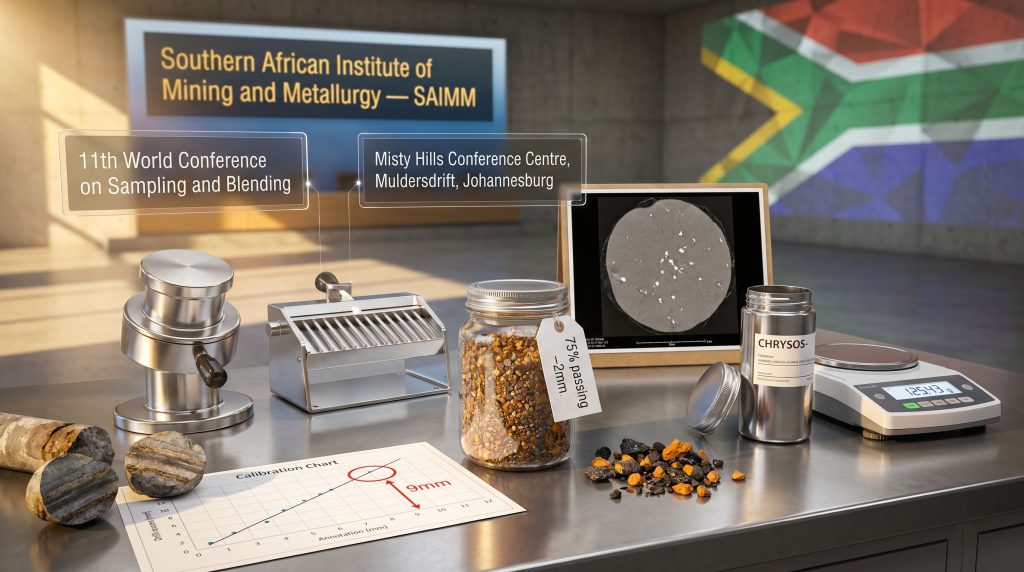
The 11th WCSB was held in May 2024 at the Misty Hills Conference Centre in Muldersdrift, situated in the Johannesburg metropolitan area. The event was organised by SAIMM, with a technical visit component hosted at Anglo American Technical Solutions in Johannesburg. The conference brought together researchers and practitioners focused on sampling theory, laboratory practice, and analytical innovation across global industries.
The conference format continues to evolve, with organising committees now deliberately seeking to shift away from established keynote circuits toward younger, more diverse researchers whose work is reframing long-standing assumptions in the discipline.
Other Major Mineral Industry Conferences in Johannesburg for 2026
For those tracking the mineral sampling conference in Johannesburg landscape more broadly, the following events are scheduled:
| Conference | Date | Location | Primary Focus |
|---|---|---|---|
| African Critical Minerals Summit 2026 | August 25–26, 2026 | Indaba Hotel, Johannesburg | Critical minerals policy, investment, extraction |
| International Commodity Summit 2026 | November 18–19, 2026 | Sandton, Johannesburg | Full mining and commodity supply chain |
| World Conference on Sampling and Blending (Historical) | Various | Johannesburg (SAIMM) | Sampling theory and practice |
Who Is Driving Sampling Science Forward?
The Shift Away from Established Keynote Circuits
One of the most significant structural changes underway in the WCSB format is a deliberate effort to move beyond the familiar rotation of well-known keynote presenters. The co-chairs of the organising committee for the most recent Johannesburg edition made an explicit decision to seek out younger researchers and emerging voices, with the aim of bringing genuinely new perspectives to the stage rather than revisiting the same frameworks through the same speakers.
This is not a dismissal of prior contributions. The work of foundational researchers in sampling theory has been substantial and necessary. Rather, it reflects a recognition that breakthrough thinking in complex scientific disciplines tends to arrive from outside established circles, and that the most productive conferences create conditions for those outside perspectives to be heard and challenged properly.
Interdisciplinary Expansion and the African Constituency
The WCSB has steadily expanded its scope beyond hard rock and precious metals sampling. Grain and food sector sampling practitioners have become a growing presence at these events, introducing methodological approaches that occasionally illuminate blind spots in conventional mineral sampling protocols.
Equally significant is the growing participation of African researchers. As the conference returns periodically to Johannesburg, it draws in a regional constituency with direct exposure to the bulk commodity challenges that dominate sub-Saharan mining, including iron ore, manganese, chromite, and vanadium sampling problems that have distinct characteristics not fully addressed by protocols developed for gold and base metal environments.
The Unsolved Mathematics: Where Sampling Science Still Breaks Down
The Liberation Factor Problem
One of the most frequently cited unresolved areas in sampling theory involves the liberation factor within the Fundamental Sampling Error (FSE) formula. Significant research has been conducted on this variable, but mathematical modelling of liberation behaviour remains inadequate. The liberation factor represents how well a mineral of interest has been physically separated from its host matrix at a given particle size, and getting this component right is essential to any meaningful FSE calculation.
The difficulty is not simply a matter of needing more data. The underlying models used to describe liberation behaviour do not capture the real behaviour of ore types accurately enough for reliable use in field calculations. Furthermore, this remains an active research gap rather than a solved problem. Understanding check sampling methods becomes particularly important in this context.
Mineral Distribution Types and Why They Demand Different Approaches
A fundamental issue that gets insufficient attention in practice is the distribution type of the mineral being sampled. These differ significantly across commodity types, and charging into a sampling programme without accounting for them introduces structural error from the outset.
| Distribution Type | Typical Commodities | Sampling Implications |
|---|---|---|
| Negatively Skewed | Iron ore, chromite, manganese, vanadium | Requires careful handling of grade concentration at the upper end |
| Normal Distribution | Coal and comparable commodities | More predictable variance behaviour |
| Log-Normal Distribution | Base metals, precious metals, gold | High sensitivity to outlier samples; requires robust splitting protocols |
The assumption that a single sampling protocol can be applied across these distribution types without adjustment is one of the more persistent errors in practice. Each distribution type demands a different cognitive and methodological framework, and failing to account for this at the design stage creates problems that no amount of laboratory precision can later correct.
The Heterogeneity Test Debate: Essential or Overcomplicated?
What a Properly Designed Heterogeneity Test Actually Reveals
The heterogeneity test is one of the more misunderstood tools in the mineral sampling toolkit. It is not a solution to sampling problems, and it is not a definitive calibration exercise. What it does, when properly designed, is reveal the structure of variability within a material in ways that conventional single-point or two-point calibration approaches completely miss.
One approach that has shown particular value involves screening ore into distinct particle size fractions and analysing each fraction separately for grade variability and mean grade. This sieve-fraction methodology exposes heterogeneity patterns that would remain entirely invisible if a researcher simply plotted one or two data points and fitted a regression line through them.
Why Bulk Commodities Require More Detailed Testing
For bulk commodities including iron ore, manganese, vanadium, and chromite, detailed heterogeneity testing has surfaced issues that conventional approaches would never detect. The following practical steps define a robust sieve-fraction heterogeneity test:
- Screen a large representative mass of ore (approximately 300 kg) into distinct particle size fractions
- Analyse each size fraction independently for grade and variance
- Plot calibration curves using multiple data points across the full size range
- Examine the resulting curve for unexpected inflection points or non-linear behaviour
- Interpret findings in the context of the ore's mineralogy and crystal structure
- Use results to inform the design of primary sampling protocols, not to replace them
The Calibration Curve Anomaly: When a Kink Changes Everything
During heterogeneity testing of manganese ores using sieve-fraction separation, an unexpected inflection point appeared in calibration curves below a fragment size of approximately 9 millimetres. This inflection corresponds to the point at which the physical crystal structure of individual ore crystals begins to break down, a finding with significant implications for how bulk commodity sampling protocols are designed at the sub-centimetre scale.
This type of finding illustrates precisely why heterogeneity tests cannot be replaced by theoretical assumptions. The kink in the calibration curve was not predicted by existing models and would have been entirely missed if only a small number of data points had been used to construct the curve. It remains an area requiring further investigation, and the honest position is that the physical explanation, while plausible, has not yet been fully confirmed.
Experimental Determination of K and Alpha: A Practical Team Exercise
Reverse-engineering the FSE formula to extract the K and Alpha constants from real sample data is a valuable learning exercise for sampling teams. The process involves collecting experimental data across multiple particle sizes, constructing regression plots, and back-calculating the constants that define the FSE behaviour of a specific material.
The important caveats are:
- Four data points on a regression line can produce dangerously misleading results, particularly in gold ores where a single anomalous sample can distort the entire calibration
- The exercise is best framed as a team learning tool rather than a definitive characterisation of a material's sampling behaviour
- Results should be used to build institutional understanding of FSE structure, not to certify a sampling protocol as fit for purpose
The Grouping and Segregation Error: What CT Scanning Revealed
The Corner-Folding Practice That Persists Despite Documented Concerns
A laboratory practice that continues across major commercial assay operations involves spreading pulped material on a sheet and bringing the corners toward each other repeatedly to homogenise the sample before sub-sampling. This method is documented in the sampling literature as a potential source of grouping and segregation error, yet laboratory managers at large, well-resourced operations continue using it routinely.
The gap between field-level concern and laboratory behaviour reflects a broader problem: the absence of quantified, facility-specific evidence that the method introduces meaningful error. Arm-waving arguments based on theoretical concern do not convince laboratory managers who are under throughput pressure and working with familiar procedures.
What the Tomographic Investigation Actually Found
A computed tomography (CT) scanning investigation at a university laboratory facility embedded approximately 310 gold particles of 100 microns or less into a matrix material and subjected the mixture to repeated corner-folding cycles. A food-grade vacuum sealing process preserved the particle distribution before scanning. The tomographic results showed no measurable grouping or segregation developed through the folding process, a finding that challenges the conventional assumption that this method is inherently problematic.
This is a significant result that is not widely known in the exploration community. The implication is that the concern about corner-folding may have been misattributed. The homogenisation step itself does not appear to introduce grouping and segregation error. However, the problem, if one exists, lies in what happens next.
The Rice Experiment Extended: Proving That Splitting Method Is the Critical Variable
The original rice experiment, which used coloured rice grains and small steel fragments to test splitting methods, was extended using a broader range of materials: popcorn, maize meal, dolomite sand, and fragments of steel, lead, and tungsten carbide to introduce density contrast. Coefficient of variation was used as the measurement tool across all splitting methods.
The results demonstrated clearly that the splitting method, not the homogenisation method, is the critical variable in laboratory sub-sampling accuracy. Consequently, mineral drill results interpreted without accounting for splitting method quality can introduce structural errors into resource models.
Riffle Splitter vs. Rotary Splitter vs. Manual Scooping: A Comparative Framework
| Splitting Method | Grouping and Segregation Error Reduction | Bias Risk | Practical Accessibility |
|---|---|---|---|
| Manual scoop or brown paper bag | None | High | Very high |
| Corner-folding (quartering) | None demonstrated | Moderate | Very high |
| Ingamells rotary splitter (lab-based) | Significant | Low | Moderate |
| Desktop riffle splitter | Significant | Low | Moderate |
| Desktop rotary splitter | Significant | Low | Moderate to high |
The Ingamells splitter is worth particular attention as an underutilised design. It is a laboratory-based rotary splitter that has not been widely adopted despite performing well in comparative testing. Its relative obscurity in the commercial laboratory environment represents a gap between what the research supports and what operations actually use.
Why Laboratories With the Right Equipment Revert to Manual Methods
One of the more revealing observations from field audits is the sight of a desktop rotary splitter sitting unused on a laboratory bench while technicians revert to manual scooping with a brown paper bag. In at least one documented case, a laboratory had tested the rotary splitter, found the results inconclusive, and returned to manual methods on throughput grounds.
The problem here is not equipment availability. It is test design. Laboratories are better positioned than any external consultant to research their own preparation errors, yet the research is not being done. They have the equipment, the sample volumes, the analytical capacity, and the statistical tools to quantify splitting precision rigorously. The missing ingredient is the motivation and the methodological knowledge to design a test that would actually produce defensible answers.
The next major ASX story will hit our subscribers first
From Blast Holes to Bench Tops: Where Sampling Variance Actually Originates
The Primary Sampling Problem Dwarfs Everything Downstream
A point that often gets lost in laboratory audit discussions is the relative magnitude of variance introduced at different stages of the sampling chain. Errors introduced at the drill hole or blast hole stage are substantially larger than those introduced at the laboratory bench. This has direct implications for where quality control investment should be directed.
The only defensible position in a laboratory audit is a quantified one. If a manual splitting method produces a pulp split precision of 12% coefficient of variation versus 9% achievable with a mechanical splitter, that difference can be mathematically propagated back through the block model variance. In most cases, this analysis reveals that laboratory splitting precision contributes far less variance than primary sample collection. Understanding this hierarchy is essential for allocating quality control investment correctly.
The Sub-Drill Dilemma
One of the genuinely difficult problems in primary sampling involves the sub-drill, which is the additional drilling depth beyond the nominal bench floor required to ensure adequate fragmentation. Stopping a drill at exactly the correct bench height remains a technology problem as much as a protocol problem. The operational reasons for sub-drilling are legitimate: inadequately fragmented rock creates real problems for haulage equipment. Acknowledging this constraint honestly is more productive than prescribing solutions that ignore it.
The Fire Assay Mass Question
Doubling the aliquot mass from 50 grams to 100 grams in fire assay does not produce a proportional improvement in analytical precision. The fusion chemistry is affected by increased sample mass, as flux ratios and furnace behaviour change in ways that can degrade the quality of the melt. The cost-precision trade-off in modern fire assay pricing means that higher mass analysis is available for those who need greater precision, but the physical constraints of the fusion process must be understood before that decision is made.
Smart Splitting Technology and Photon-Based Assay Systems
What the CHRYSOS PhotonAssay System Requires From Sample Preparation
The CHRYSOS PhotonAssay system requires a precisely prepared 300-gram aliquot delivered into a standardised jar for analysis. Simply filling the jar to capacity without a calibrated split defeats the purpose of the analytical precision the technology offers. The preparation step is as important as the analytical step, and imprecise mass delivery introduces variance that the instrument cannot compensate for.
Early adoption of the technology in some operations involved technicians filling jars manually without a calibrated split, introducing preparation variance that undermined the analytical advantage the system was purchased to provide.
Scott Automation's Linear Splitter: Performance Testing Results
Testing of the ROCKLABS smart linear splitter integrated with the ROCKLABS crusher demonstrated outstanding accuracy in splitting crushed material into two equal CHRYSOS sample jars. The system pre-programmes both target mass and split ratio, producing a 75% passing-at-minus-2mm particle size distribution at a calibrated and consistent crushing rate. Calibration curves produced during testing showed strong linearity, and split accuracy between duplicate jars was described as exceptional.
This work originated from testing conducted on rotary splitters beginning in 2018, which led to a collaboration initiated at the 9th WCSB in Beijing. The formal test programme was completed in Australia in late 2022. The findings have not yet been published in peer-reviewed literature as of the time of this writing.
Crushing Rate, Particle Size Distribution, and Split Accuracy
| Performance Variable | Specification Target | Measurement Method |
|---|---|---|
| Particle size distribution | 75% passing minus 2mm | Sieve analysis |
| Split accuracy (duplicate jars) | Near-equal mass distribution | Gravimetric comparison |
| Crushing throughput rate | Kilograms per minute (calibrated) | Timed mass processing |
A critical point for large mining operations is that in-house testing of this equipment could substantially accelerate the establishment of validated performance specifications. The manufacturer currently does not publish formal tolerance specifications for split accuracy, which means users are working without a defined benchmark against which to assess performance.
What Exploration Geologists and Resource Consultants Should Do Differently
A Decision Framework for Laboratory Audit Scenarios
When standing at the pulp preparation station during a laboratory audit, the following sequence provides a practical and defensible framework:
- Confirm whether corner-folding or mechanical splitting is being used for sub-sampling
- Request the laboratory's internal precision data for their current splitting method
- Compare reported coefficient of variation against a mechanical splitting benchmark
- Assess whether the variance difference is material relative to primary sampling variance
- Escalate only when the splitting method introduces bias, not merely additional variance
- Recommend mechanical splitting (riffle or rotary) where photon-based assay systems are in use, given the preparation precision requirements those systems demand
In addition, interpreting drill results without first auditing the preparation chain risks drawing conclusions from data that carries unquantified preparation error. Furthermore, understanding true vs apparent widths remains essential when translating any drill data into resource estimates.
The Japanese Slab-Cake Method: Effectively Grab Sampling
The Japanese slab-cake method, which involves spreading material into a flat layer, dividing it into squares, and then extracting sub-portions from each square using a spatula, is effectively a form of grab sampling. Despite its structured appearance, it provides no meaningful protection against the sampling errors it is meant to address. Practitioners encountering this method in the field should treat it with the same scepticism they would apply to any manual grab sampling procedure.
Frequently Asked Questions: Mineral Sampling Conferences and Johannesburg
What Is the World Conference on Sampling and Blending?
The WCSB is the leading international scientific forum for sampling theory and practice across mining, mineral processing, food science, and related industries. It is held approximately every two years at rotating global locations. The 11th edition was held near Johannesburg in May 2024.
When Was the Last Major Mineral Sampling Conference Held in Johannesburg?
The 11th WCSB took place at the Misty Hills Conference Centre in Muldersdrift, just outside Johannesburg, in May 2024. A technical visit was included at Anglo American Technical Solutions in Johannesburg.
What Other Major Mining and Mineral Conferences Are Scheduled in Johannesburg in 2026?
The African Critical Minerals Summit 2026 is scheduled for August 25–26 at the Indaba Hotel, and the International Commodity Summit 2026 is confirmed for November 18–19 in Sandton, Johannesburg.
What Is the Theory of Sampling and Why Does It Matter?
The Theory of Sampling is the mathematical and scientific framework governing how representative samples are collected from heterogeneous materials. It defines error sources including the Fundamental Sampling Error, Grouping and Segregation Error, and Increment Delimitation Error, all of which directly affect the reliability of resource estimation and ore grade determination.
Is a Riffle Splitter or a Rotary Splitter Better for Laboratory Sub-Sampling?
Both outperform manual methods when it comes to reducing grouping and segregation error. Research using rice, maize, dolomite, and density-contrast materials has demonstrated that mechanical splitting significantly reduces coefficient of variation compared to manual scooping. The choice between riffle and rotary designs depends on material characteristics, available equipment, and throughput requirements. For further context on how these choices affect outputs, drilling results interpretation guides remain a useful reference for exploration teams.
Key Takeaways: What the Johannesburg Sampling Conference Signals for the Industry
The Three Structural Shifts Defining the Next Era of Sampling Science
- Generational transition in research leadership — deliberate elevation of emerging researchers over established keynote circuits is reshaping the intellectual agenda of the WCSB
- Technology integration — smart splitting systems aligned with photon-based assay platforms are establishing new preparation standards that manual methods cannot meet
- Quantified quality control — the industry is moving from qualitative audit commentary toward variance-propagation-based decision frameworks that can assign a numerical cost to each preparation choice
Why In-House Research Remains the Biggest Untapped Opportunity
Large mining companies and commercial laboratories are better positioned than any external researcher to investigate their own preparation errors. They have the sample volumes, the analytical capacity, the equipment, and the operational context to produce findings that would genuinely advance the discipline. The call from within the sampling research community is clear: do the work, quantify the results, and bring the findings to the conference. For those who want to engage more deeply with the broader industry, Mining Indaba remains one of the most significant forums for connecting sampling science with investment and operational decision-making across Africa.
This article discusses technical aspects of mineral sampling science and references findings from academic and industry research. Forward-looking statements regarding technology performance, research outcomes, and conference developments involve uncertainty and should not be interpreted as confirmed outcomes. Readers are encouraged to consult primary literature and qualified practitioners before making decisions based on any technical information presented here.
Want to Stay Ahead of Significant ASX Mineral Discoveries Before the Broader Market Does?
Discovery Alert's proprietary Discovery IQ model instantly scans ASX announcements across more than 30 commodities, delivering real-time alerts on significant mineral discoveries so subscribers can act on actionable opportunities without delay — explore the historic returns major discoveries have generated to understand what's at stake, then start your 14-day free trial at Discovery Alert and position yourself ahead of the market.