August 6, 2026
The Hidden Fault Lines Beneath South Africa's Most Controversial Energy Frontier
Unconventional gas development has a long history of arriving with enormous promise and leaving a trail of unresolved questions. From the Permian Basin to the Bowland Shale, the gap between resource potential and commercially viable, environmentally defensible extraction has proven wider than early estimates suggested. Nowhere is that gap more complex than beneath the semi-arid plains of South Africa Karoo shale gas development, where recently confirmed geological findings have added a fresh layer of uncertainty to a development debate already paralysed by regulatory dysfunction and scientific disagreement.
Understanding what the Karoo's subsurface actually contains, and what it might do under industrial pressure, is now among the most consequential geological questions in African energy development. The answers will shape South Africa's energy transition trajectory for generations.
When big ASX news breaks, our subscribers know first
Why South Africa Needs the Karoo to Work
South Africa's electricity system is under sustained structural stress. The country generates the overwhelming majority of its power from coal-fired stations, many of which are ageing, poorly maintained, and operating well below designed capacity. Scheduled and unscheduled outages, locally referred to as load-shedding, have cost the economy billions of rands annually and suppressed industrial output across key sectors.
Renewable energy is advancing, but intermittency challenges and grid infrastructure constraints limit how fast it can displace baseload coal generation. Natural gas, particularly domestically produced gas, is widely viewed by South African energy planners as a practical bridging fuel: cleaner than coal, dispatchable on demand, and capable of supporting grid stability during the transition to renewables. Understanding natural gas price trends is therefore directly relevant to evaluating whether Karoo gas could be commercially competitive.
The Karoo Basin represents the most significant potential domestic gas source on the continent's southern tip. If its shale formations can be developed safely and economically, the resource could reduce South Africa's dependence on imported gas and provide a firmer foundation for energy security. That conditional, however, is doing a great deal of work.
The Reserve Estimate Problem: When the Numbers Span a 30x Range
One of the first challenges any serious assessment of South Africa Karoo shale gas development encounters is the extraordinary divergence in resource estimates. This is not a minor methodological disagreement. The numbers span an interval so wide they represent fundamentally different development propositions.
| Estimate Source | Technically Recoverable Gas |
|---|---|
| South Africa's Petroleum Agency (PASA) | ~209 trillion cubic feet (tcf) |
| University of Johannesburg Study (2017) | ~13 tcf (lower bound) |
| Full Modelled Range | 13 tcf to 390 tcf |
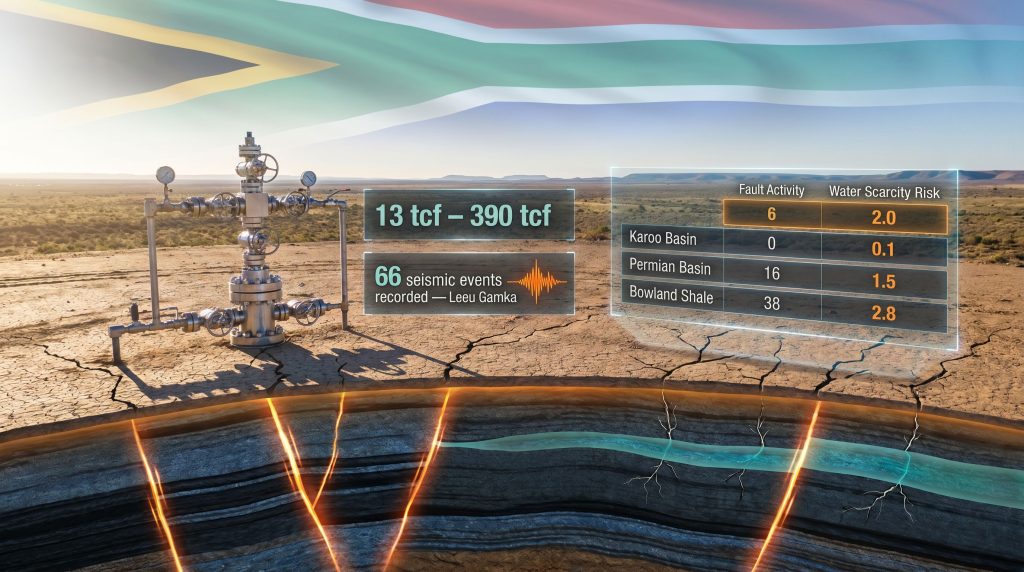
The Petroleum Agency of South Africa has historically cited figures around 209 tcf of technically recoverable gas, a number large enough to reframe the country's entire energy outlook. By contrast, a 2017 study from the University of Johannesburg placed the lower-bound estimate at roughly 13 tcf, with a full modelled range extending from 13 to 390 tcf. That is a thirty-fold spread between the conservative and optimistic scenarios.
This divergence matters for several interconnected reasons:
- Reserve estimates in shale plays are highly sensitive to assumed net pay thickness, meaning the proportion of the formation that is productive relative to total thickness
- Karoo shale thickness varies from less than a few metres to approximately 200 metres across the basin, making basin-wide recovery modelling inherently unreliable without extensive well data
- Fracture network characterisation, critical for estimating how much gas can actually be liberated, requires direct subsurface measurement rather than surface inference
- Wide estimate ranges signal data immaturity, not just geological variability, which directly elevates investor risk and complicates regulatory cost-benefit analysis
For context, even the lower-bound estimate of 13 tcf would be a significant resource. South Africa currently consumes roughly 170 billion cubic feet of gas per year, meaning 13 tcf represents approximately 75 years of supply at current consumption rates. The upper-bound scenario is simply transformative.
Four Geological Risks That Define the Karoo's Development Challenge
Risk One: Newly Confirmed Fault Systems Beneath the Basin
Research conducted at the University of Cape Town has identified previously unmapped fault structures within the Karoo Basin, adding a dimension of subsurface complexity that was not fully accounted for in earlier development assessments. The discovery emerged from analysis of a seismic sequence recorded near Leeu Gamka in the Western Cape province, a region previously classified as having relatively low seismic activity.
The recorded cluster includes at least 66 seismic events since 2007, culminating in a magnitude 4.8 earthquake, which is significant by any regional standard. Crucially, the research confirmed that all events were natural in origin. No hydraulic fracturing has been conducted anywhere in this part of the Karoo. Furthermore, a swarm of earthquakes in the Karoo Basin has raised additional questions about the suitability of the region for oil and gas development.
This last point carries a counterintuitive but critical implication. The absence of industrial activity does not reduce concern. It reinforces it. The basin's fault systems are demonstrably active under purely tectonic conditions, meaning they are already accumulating stress without any external pressure changes. Any future injection activity would be operating against this pre-loaded geological background.
Risk Two: Induced Seismicity and Critically Stressed Faults
The UCT research characterises some of the Karoo's identified faults as critically stressed, a specific geological classification indicating that a fault system is already close to the threshold at which it would slip under natural conditions. In engineering terms, a critically stressed fault requires only a modest perturbation to reach failure.
Hydraulic fracturing and associated wastewater injection provide exactly that kind of perturbation. The mechanism works as follows:
- High-pressure fluid is injected into the target formation to create or widen fractures
- If injected fluids migrate laterally or vertically to reach a pre-existing fault plane, they reduce effective normal stress on that surface
- Reduced normal stress lowers the friction holding the fault closed
- If the remaining friction is insufficient to prevent movement, the fault slips, generating seismic energy
- The resulting event magnitude depends on fault dimensions, stress state, and the energy released during slip
This process has been documented extensively in shale-producing regions globally. In the United States, the correlation between wastewater disposal from unconventional operations and elevated regional seismicity became a significant regulatory concern during the 2010s, particularly in Oklahoma and Kansas. The United Kingdom's experience with the Preston New Road shale well in Lancashire resulted in a formal moratorium after induced seismic events exceeded threshold limits under the country's traffic light protocol.
Risk Three: Fracture Propagation and Aquifer Vulnerability
Karoo shale is characterised by very low matrix permeability, meaning gas molecules do not move easily through the rock under natural conditions. Commercial extraction requires creating an artificial fracture network dense enough to allow gas to flow toward the wellbore. In practice, this means each well requires multiple hydraulic fracturing stages, potentially 30 or more per well in lower-permeability formations, at pressures sufficient to extend fractures tens of metres into the surrounding rock.
The cumulative risk profile of this repeated fracturing is qualitatively different from a single fracture event:
- Each successive fracture stage increases the probability that at least one induced fracture intersects a natural fault plane or pre-existing vertical fracture system
- Intersection pathways can create hydraulic continuity between the target shale formation and overlying geological units, including freshwater aquifers
- Upward fluid migration through such pathways can introduce methane or fracturing chemicals into drinking water systems
- Well casing integrity is also a long-term concern, particularly in formations subject to repeated pressure cycling, with failure risk increasing substantially after production ceases
The Karoo is home to important shallow karst aquifer systems that supply water to farming communities and small towns across the semi-arid region. These water sources exist in a context of structural scarcity where there are no practical alternatives, amplifying the consequence of any contamination event. Consequently, considerations around natural capital in mining and resource extraction are especially pertinent here.
Risk Four: Thickness Variability and the Limits of Environmental Modelling
The dramatic variability in shale thickness across the Karoo Basin is not merely an economic problem. It is an environmental modelling problem. Accurate fracture containment modelling, which predicts where induced fractures will propagate and where they will stop, depends critically on knowing the mechanical properties and thickness of the target formation and the layers immediately above and below it.
Where shale is thin and interbedded with other lithologies, fracture containment becomes far less predictable. Micro-seismic monitoring, the primary technology used to track fracture propagation in real time, also requires careful calibration to local geology. Across large portions of the Karoo, the baseline geological and hydrogeological data needed to perform this calibration reliably simply does not yet exist. In this respect, the importance of geological logging codes and standardised subsurface data collection cannot be overstated.
Water Scarcity as a Geological Risk Multiplier
The Karoo's semi-arid climate transforms hydrogeological risk from a manageable operational concern into a potentially existential one for local communities. In regions with abundant surface water and high aquifer recharge rates, a contained contamination event affecting one water source can be addressed by substitution. In the Karoo, there is no substitution.
Aquifer recharge rates in semi-arid systems are slow, measured in decades rather than years. Contamination of a shallow aquifer in this environment could render it unusable for a generation. The social and agricultural consequences of such an outcome would fall disproportionately on rural communities with no capacity to absorb them, a distributional risk that standard environmental impact assessments tend to underweight.
The Regulatory Paralysis: A Timeline of Delayed Decisions
The regulatory history of South Africa Karoo shale gas development is a sequence of unresolved interventions rather than a coherent policy progression:
- 2011: The South African government imposes a moratorium on new shale gas exploration permit applications, responding to public concern about hydraulic fracturing risks in a water-sensitive region
- 2017: The High Court invalidates the regulatory framework governing hydraulic fracturing, creating a legal vacuum with no clear mechanism for approving or overseeing operations
- Post-2017: Draft environmental regulations are developed but have not been finalised, meaning the moratorium has been effectively in place for over 13 years
- 2026: South Africa pursues technical cooperation with the United States focused on unconventional gas development and regulatory design
The legal reality as of mid-2026 is that even if every geological risk were fully mitigated, no functioning legal pathway exists through which commercial shale gas development in the Karoo could proceed. The court-invalidated framework and the unresolved moratorium together create a dual barrier that technical progress alone cannot dissolve.
In addition, the broader mining claims framework debates occurring in other jurisdictions offer instructive parallels for how regulatory vacuums can stall otherwise promising resource developments.
The next major ASX story will hit our subscribers first
How the Karoo Compares to Global Shale Analogues
Placing the Karoo's risk profile alongside other major shale basins provides useful context for assessing where the challenges are most acute:
| Risk Factor | Karoo Basin | Permian Basin (USA) | Bowland Shale (UK) |
|---|---|---|---|
| Known Fault Activity | Confirmed, critically stressed | Moderate | High (contributed to moratorium) |
| Induced Seismicity History | No fracking yet conducted | Extensively documented | Documented at Preston New Road |
| Water Scarcity Risk | High (semi-arid region) | Moderate | Low |
| Regulatory Framework | Invalidated and in development | Established and mature | Suspended |
| Reserve Estimate Certainty | Low (13 to 390 tcf range) | High | Moderate |
The UK's experience with the Bowland Shale is particularly instructive. Operations at the Preston New Road site were repeatedly suspended under the country's traffic light protocol after induced seismic events exceeded permitted thresholds, ultimately contributing to a national moratorium in 2019. The Bowland Shale sits within a geologically complex region, but the UK had far more baseline subsurface data than the Karoo currently possesses, and still found the induced seismicity problem unmanageable under existing technology and protocol constraints.
What Researchers Actually Recommend
The UCT study's contribution to the South Africa Karoo shale gas development debate is frequently mischaracterised in binary terms. The research does not conclude that shale gas development is impossible or should be permanently prohibited. Its recommendations are more nuanced and more demanding than either extreme suggests:
- Conduct comprehensive baseline seismic monitoring across all proposed exploration zones before any operations begin, establishing a pre-industrial reference dataset
- Complete high-resolution subsurface fault mapping to delineate which areas carry the highest reactivation risk and where development might proceed with reduced concern
- Develop and enforce targeted safety protocols specific to critically stressed fault zones, rather than applying uniform national standards to a geologically heterogeneous basin
- Continue and expand foundational research programs including the Karoo Deep Drilling Project, which aims to characterise the basin's stratigraphy and structural geology at depth
These recommendations share a common logic: the Karoo's geological complexity demands site-specific, data-intensive risk management rather than broad assumptions borrowed from other basins. Furthermore, mine reclamation importance and post-operational land stewardship must also be factored into any long-term development framework for the region.
Five Preconditions for Responsible Development
Any credible path forward for Karoo shale gas development would need to satisfy at minimum the following preconditions:
- Basin-wide fault mapping using modern high-resolution seismic reflection surveys to establish a complete structural picture of the subsurface
- Pre-operational seismic baseline documentation across all proposed exploration areas to allow induced seismicity to be distinguished from natural background activity
- Real-time micro-seismic monitoring networks with mandatory, legislated traffic light protocols that require operations to pause or cease when thresholds are crossed
- Comprehensive hydrogeological aquifer mapping to identify the location, recharge characteristics, and vulnerability of freshwater systems overlying the target formations
- A legally valid, independently overseen environmental regulatory framework that resolves the current legal vacuum and creates enforceable standards for operators
Frequently Asked Questions: Karoo Shale Gas Geological Risks
Is the Karoo Basin Prone to Natural Earthquakes?
The Karoo was historically classified as a low-seismic-risk region. The UCT research has revised that assessment for at least part of the basin, confirming that at least 66 natural seismic events have occurred near Leeu Gamka since 2007, including a magnitude 4.8 earthquake. Active tectonic stress is therefore demonstrably present in the basin without any industrial activity.
Can Hydraulic Fracturing Cause Earthquakes in the Karoo?
No fracking has yet been conducted in the Karoo, so there is no direct evidence of induced seismicity from operations. However, the presence of critically stressed faults means the geological conditions that enable fracking-related seismicity elsewhere are confirmed to be present. The theoretical risk is grounded in documented analogues from other jurisdictions.
How Much Shale Gas Does the Karoo Actually Contain?
Estimates range from approximately 13 tcf to 390 tcf of technically recoverable gas. The Petroleum Agency of South Africa has cited figures around 209 tcf. The wide range reflects data immaturity and significant geological variability across the basin rather than a settled scientific consensus.
What Is the Current Legal Status of Fracking in South Africa?
A moratorium on new exploration permit applications has been in place since 2011. A 2017 High Court ruling invalidated the existing regulatory framework governing hydraulic fracturing. As of mid-2026, no replacement framework has been legislated, meaning there is no functioning legal pathway for commercial shale gas development to proceed.
What Is the Biggest Geological Threat to Karoo Aquifers From Shale Gas Development?
The most significant threat is fracture propagation connecting the target shale formation to overlying freshwater aquifers, either through induced fractures intersecting natural fault planes or through well casing failures over time. In a semi-arid environment where aquifer recharge is slow, contamination events that might be manageable elsewhere could have multi-generational consequences.
Has Any Fracking Taken Place in the Karoo Basin?
No hydraulic fracturing operations have been conducted in the Karoo. The moratorium imposed in 2011 and the subsequent legal vacuum created by the 2017 High Court ruling have prevented any commercial development from advancing to the operational stage.
Geological Risk Is Not a Veto, But It Demands Rigorous Answers
The findings from University of Cape Town researchers do not close the door on South Africa Karoo shale gas development. They do, however, significantly raise the evidentiary bar that responsible development must clear before proceeding. A basin with confirmed critically stressed faults, dramatic reserve estimate uncertainty, legally invalidated regulations, and hydrogeologically sensitive overlying aquifers in a water-scarce landscape cannot be developed using the assumptions, monitoring standards, or regulatory shortcuts that proved inadequate in more forgiving geological environments.
South Africa's energy security challenge is real, urgent, and growing. The Karoo may ultimately hold a meaningful part of the answer to that challenge. However, arriving at that answer requires investing in the baseline science, the regulatory architecture, and the monitoring infrastructure that the basin's complexity demands. The alternative, proceeding on optimistic assumptions before that foundation is built, risks exchanging one energy crisis for an irreversible environmental one.
For ongoing coverage of African energy policy, resource development, and the regulatory debates shaping the continent's economic future, Ecofin Agency at ecofinagency.com provides detailed reporting across nine African economic sectors.
Want to Track the Next Major ASX Mineral Discovery the Moment It's Announced?
Discovery Alert's proprietary Discovery IQ model delivers real-time alerts on significant ASX mineral discoveries, transforming complex geological and commodity data into actionable investment insights for both short-term traders and long-term investors — explore historic discoveries and their returns to see what early positioning can mean, then begin a 14-day free trial to secure a market-leading edge.