August 22, 2026
The Engineering Puzzle That Has Blocked Uranium Recovery for Decades
Materials science has long wrestled with a contradiction at the heart of industrial water treatment: the environments most contaminated with hazardous and recoverable elements are also the environments most hostile to the materials designed to extract them. Acid mine drainage, nuclear processing effluents, and uranium mill tailings leachate share a common characteristic — they are aggressively acidic, and that acidity has historically dismantled the very nanomaterials researchers deploy to clean them up.
This is not a niche engineering inconvenience. It represents a fundamental barrier to unlocking what could be a substantial secondary supply of uranium and rare earth elements (REEs) from waste streams that currently represent only environmental liability. The IIT Roorkee uranium recovery nanomaterial, developed by researchers within the institution's Department of Hydrology and published in the Journal of Environmental Chemical Engineering, offers a credible engineering response to this decades-old impasse.
When big ASX news breaks, our subscribers know first
Why Conventional Nanomaterials Break Down Where They Are Needed Most
To appreciate what makes the IIT Roorkee design significant, it helps to understand why the problem has persisted for so long. Industrial wastewater from uranium mining and processing operations frequently registers pH levels well below 4, sometimes approaching pH 2 in the case of active acid mine drainage. At these pH levels, metallic nanoparticles — which are often the most chemically reactive candidates for ion adsorption — undergo rapid oxidative corrosion.
The degradation is not merely cosmetic. As the nanoparticle surface corrodes, its active adsorption sites are destroyed, extraction capacity drops sharply, and the material itself can leach secondary contaminants into the water it was meant to treat. The trade-off that has constrained nanomaterial design for decades is this: materials engineered to be highly reactive enough to capture uranium ions in dilute, complex solutions tend to be precisely the materials most vulnerable to acid-induced degradation.
Furthermore, understanding these uranium extraction methods highlights why conventional approaches fall short in real-world industrial settings. Several prior approaches have attempted to bridge this gap:
- Ion exchange resins offer moderate acid stability but suffer from low selectivity and limited reusability.
- Solvent extraction handles acidic conditions well and achieves high recovery rates, but requires significant chemical inputs, generates secondary waste streams, and is difficult to deploy in decentralised or remote settings.
- Conventional adsorption nanomaterials offer promising surface chemistry but degrade rapidly under the pH conditions most common in uranium-contaminated wastewater.
None of these approaches simultaneously resolves acid stability, high selectivity, strong recovery capacity, and regenerability in a single material architecture.
How the Core-Shell Nanocomposite Architecture Works
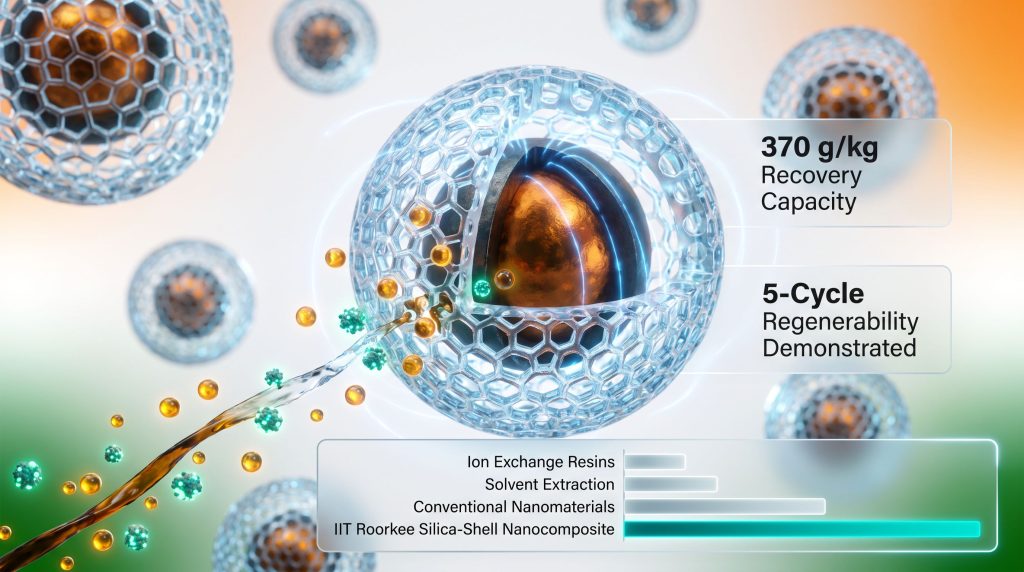
The IIT Roorkee uranium recovery nanomaterial addresses this challenge through a core-shell design principle that physically separates the material's protective function from its chemical extraction function. The architecture consists of two distinct components working in concert.
The magnetic nanoparticle core provides the chemical activity needed to attract and bind uranium ions and rare earth elements. Magnetic cores are particularly advantageous in industrial applications because they allow the loaded material to be separated from treated water using an external magnetic field, eliminating the need for energy-intensive filtration steps.
The porous silica encapsulation layer serves as a structural barrier between the reactive core and the corrosive external environment. Silica is chemically stable across a wide pH range, meaning it resists the acid-induced degradation that destroys unprotected metallic nanoparticles. Critically, the shell is porous rather than solid, which allows uranium ions and REE ions to diffuse through to the active core while physically blocking the bulk acid solution from directly attacking the nanoparticle surface.
This architecture resolves what Professor Nitin Khandelwal of IIT Roorkee's Department of Hydrology identified as the central challenge: most advanced metallic nanomaterials are forced to choose between chemical reactivity and structural stability under acidic conditions. The silica shell design decouples these two requirements, allowing each component to perform its specialised function without compromising the other. Research into magnetic nanoparticles for uranium recovery has demonstrated the broader potential of this class of materials across various aquatic environments.
pH-Dependent Selectivity: An Underappreciated Design Feature
One of the less-discussed but strategically important features of this nanomaterial is its tunable selectivity based on solution pH. This is not a fixed-function material that extracts the same elements regardless of conditions. Instead, the extraction profile shifts depending on the acidity of the target solution:
- Under near-neutral pH conditions, the material co-extracts uranium and rare earth elements simultaneously, making it applicable to mixed contamination streams.
- Under strongly acidic conditions, selectivity shifts preferentially toward uranium isolation, which is valuable when processing high-acidity nuclear effluents where uranium is the primary target.
This tunability gives process engineers a degree of operational flexibility that single-mode adsorbents cannot offer. By adjusting feed water pH before contacting the nanomaterial, operators can effectively programme the material's extraction output to match downstream processing requirements.
Key Performance Metrics at a Glance
The laboratory results published in the Journal of Environmental Chemical Engineering provide a concrete performance baseline for the IIT Roorkee uranium recovery nanomaterial.
| Performance Parameter | Reported Result |
|---|---|
| Maximum recovery capacity | 370 g of uranium + REEs per kg of nanomaterial |
| Operational pH range | Highly acidic to near-neutral |
| Selectivity (strongly acidic) | Preferential uranium capture |
| Selectivity (near-neutral) | Combined uranium + REE co-extraction |
| Regeneration cycles tested | 5 consecutive cycles |
| Efficiency retention after cycling | Near-complete performance maintained |
| Current research stage | Laboratory scale (pre-pilot) |
A recovery capacity of 370 grams per kilogram is a meaningful benchmark in the context of adsorption-based uranium recovery. For context, many conventional polymer-based adsorbents and ion exchange materials struggle to exceed 100–200 mg/g (equivalent to 100–200 g/kg) under comparable conditions, and their performance degrades significantly faster in acidic environments.
The five-cycle regeneration result is equally significant from a commercial viability standpoint. In industrial uranium recovery, the cost of the adsorbent material is amortised across its usable lifetime. A material that retains near-complete efficiency across repeated adsorption-desorption cycles dramatically reduces the per-gram cost of uranium recovered and lowers the volume of spent adsorbent material requiring disposal.
The fact that this research was funded by the Board of Research in Nuclear Sciences (BRNS), operating under India's Department of Atomic Energy, adds meaningful institutional credibility to the findings. BRNS funding is competitively allocated and typically reserved for research with direct relevance to India's nuclear fuel cycle priorities.
How This Technology Compares to Existing Approaches
Placing the IIT Roorkee design within the broader technology landscape helps clarify both its advantages and the gaps that remain before industrial deployment becomes realistic.
| Technology Type | Acid Stability | Selectivity | Regenerability | Recovery Capacity |
|---|---|---|---|---|
| Ion exchange resins | Moderate | Low to Medium | Limited | Variable |
| Solvent extraction | High | High | Moderate | High |
| Conventional nanomaterials | Low | Medium | Poor in acidic conditions | Variable |
| IIT Roorkee silica-shell nanocomposite | High | Tunable (pH-dependent) | High (5+ cycles demonstrated) | 370 g/kg |
The competitive advantage is clearest in the intersection of acid stability and regenerability. Solvent extraction achieves high recovery but involves significant chemical handling requirements and is difficult to scale for low-concentration, high-volume wastewater streams. The IIT Roorkee nanocomposite is designed for exactly those dilute, high-volume, acidic streams where solvent extraction becomes economically inefficient.
The Strategic Context: Why India Needs This Technology
India's nuclear energy programme operates under a well-documented constraint: the country has limited domestic uranium ore reserves relative to its long-term nuclear capacity ambitions. India's three-stage nuclear programme is designed to eventually transition toward thorium-based fuel cycles, but the intermediate stages depend heavily on uranium, much of which is currently sourced through imports. Understanding the broader uranium supply challenges facing the global market makes India's drive for domestic recovery solutions all the more pressing.
Technologies capable of recovering uranium from secondary sources, including mine drainage, nuclear processing effluents, and tailings leachate, represent a meaningful pathway toward supplementing primary ore-based supply chains. Even modest recovery contributions at scale could reduce import dependency and strengthen fuel cycle security.
Beyond nuclear fuel, the REE co-extraction capability addresses a separate but equally pressing strategic concern. Innovations like this are particularly relevant given growing pressure on rare earth supply chains worldwide. Rare earth elements are foundational materials for:
- Permanent magnets used in wind turbine generators and electric vehicle drivetrains.
- Phosphors for energy-efficient lighting and display technologies.
- Catalysts for petroleum refining and emissions control.
- Defence electronics, including guidance systems and radar components.
- Semiconductor manufacturing inputs requiring high-purity lanthanide compounds.
Global REE supply chains remain heavily concentrated, with processing capacity particularly centralised. Secondary recovery from contaminated wastewater streams, while not a near-term replacement for primary mining, represents a circular economy contribution that simultaneously addresses environmental remediation and critical mineral availability. This aligns closely with the rising critical minerals demand driven by the global energy transition.
The Dual-Purpose Economics of Waste-to-Resource Recovery
A dimension of this technology that deserves more attention is the shift it enables in how industrial wastewater treatment is economically framed. Conventionally, acid mine drainage treatment is a pure cost centre: water is cleaned, contaminants are neutralised or sequestered, and the treated water is discharged. The process generates no revenue.
A material capable of recovering 370 g/kg of uranium and REEs from the same wastewater stream converts that cost centre into a partial revenue stream. The economic calculus changes substantially when the treatment process yields marketable quantities of recoverable material. This is not hypothetical: uranium spot prices have experienced significant volatility in recent years, trading between approximately USD 48 and USD 107 per pound between 2023 and 2025, with supply security concerns sustaining elevated price sentiment among utilities securing long-term supply contracts. These shifts in the uranium market dynamics underscore why secondary recovery technologies are attracting renewed commercial interest.
The next major ASX story will hit our subscribers first
The Path from Laboratory to Industrial Deployment
It is important to be clear-eyed about where this technology currently sits in its development lifecycle. The results published represent laboratory-scale batch testing using controlled synthetic solutions. Several critical steps separate these results from industrial deployment.
Key scale-up challenges include:
- Synthesising the nanocomposite at kilogram-scale production volumes while maintaining the precise core-shell architecture demonstrated at gram scale.
- Transitioning from batch adsorption testing to continuous-flow column systems, which impose different hydrodynamic conditions on the material.
- Validating performance in real acid mine drainage and nuclear effluent samples, which contain complex matrices of competing ions, suspended solids, and organic compounds not present in synthetic test solutions.
- Demonstrating extended regeneration performance beyond five cycles, ideally to 20 or 50 cycles, to establish long-term operational viability.
- Assessing compatibility with existing mine water treatment and nuclear waste management infrastructure.
Disclaimer: The performance figures cited in this article reflect laboratory-scale findings published in peer-reviewed literature. They should not be interpreted as guaranteed performance benchmarks for pilot-scale or commercial-scale deployment. Significant engineering and regulatory work remains before this technology could be considered deployment-ready.
Frequently Asked Questions
What exactly did IIT Roorkee develop?
Researchers developed an acid-resistant magnetic nanocomposite material combining a magnetically active nanoparticle core with a porous silica protective shell, engineered to extract uranium and rare earth elements from highly acidic industrial wastewater streams.
How does the 370 g/kg recovery figure compare to conventional materials?
Many conventional adsorption materials achieve 100–200 g/kg under laboratory conditions, and their performance degrades faster in low-pH environments. The 370 g/kg figure, achieved while maintaining acid resistance, represents a meaningful step forward in the performance envelope for this class of material.
Why is magnetic separation relevant here?
Magnetic nanoparticle cores allow the loaded material to be rapidly separated from treated water using an external magnetic field. This eliminates the need for pressure filtration or centrifugation, which are energy-intensive and difficult to scale in remote mining environments.
Is this technology ready for industrial use?
Not yet. The research is at pre-pilot laboratory scale. Continuous-flow validation, real-world wastewater testing, and kilogram-scale synthesis are all required before commercial deployment becomes feasible.
Who funded this research?
The research was supported by the Board of Research in Nuclear Sciences, which operates under India's Department of Atomic Energy.
What Comes Next and Why It Matters
The IIT Roorkee uranium recovery nanomaterial resolves a genuine and longstanding engineering conflict in nanomaterial design for acidic environments. The silica-shell architecture is conceptually elegant, the published performance metrics are competitive, and the institutional backing from BRNS provides a credible pathway for further development funding.
However, what the technology cannot yet claim is proven industrial viability. The transition from controlled laboratory conditions to the chaotic complexity of real mine drainage or nuclear effluent is where many promising materials have historically stalled. Continuous-flow testing, extended regeneration cycling, and real-matrix validation are the milestones that will determine whether this nanomaterial graduates from academic achievement to industrial tool.
For observers tracking the intersection of critical mineral supply chain resilience and advanced materials science, this is precisely the kind of upstream research that shapes what becomes commercially possible five to ten years downstream. The fact that it addresses uranium recovery, REE extraction, and acid mine drainage remediation simultaneously — within a single tunable material platform — makes its progress worth following closely.
Want to Stay Ahead of the Next Major Uranium or Critical Minerals Discovery?
Discovery Alert's proprietary Discovery IQ model delivers real-time alerts the moment significant ASX mineral discoveries are announced — cutting through complex data across 30+ commodities to surface actionable opportunities in uranium, rare earths, and beyond. Explore Discovery Alert's dedicated discoveries page to see how historic ASX mineral discoveries have generated substantial returns, and begin your 14-day free trial today to position yourself ahead of the broader market.