August 22, 2026
The Hidden Energy Beneath Our Feet: Understanding Geologic Hydrogen Reserves
The global energy transition has a cost problem. For all the momentum behind wind, solar, and battery storage, certain industries remain stubbornly difficult to decarbonise using electricity alone. Steelmakers, cement producers, long-haul shippers, and high-temperature industrial processes need something different — a fuel with energy density comparable to fossil fuels but without the carbon footprint. Hydrogen has been the theoretical answer for decades. The gap between theory and reality, however, has always come down to one brutal constraint: the cost of production.
That constraint may be about to be tested in an entirely unexpected way. Beneath the Earth's surface, geological processes have been generating hydrogen gas for billions of years — independently of any human activity, any electrolyser, and any renewable energy grid. The emerging field of geologic hydrogen reserves is now attracting serious scientific attention, institutional research funding, and early-stage private capital in a way that was inconceivable even five years ago.
When big ASX news breaks, our subscribers know first
Natural Hydrogen vs. the Hydrogen Economy You Already Know
Most public discussion of hydrogen centres on its colour. Grey hydrogen, produced from natural gas via steam methane reforming, currently accounts for the vast majority of global supply. Blue hydrogen adds carbon capture to that process to reduce emissions. Green hydrogen uses renewable electricity to split water molecules through electrolysis, producing no direct carbon emissions but requiring enormous quantities of clean power to do so.
Geologic hydrogen — also called natural hydrogen, native hydrogen, or increasingly, gold hydrogen — sits outside this colour taxonomy entirely. It is hydrogen gas that forms within the Earth's crust through geological and geochemical processes, without any industrial input. In some contexts, researchers also discuss stimulated geologic hydrogen, where human activity deliberately triggers subsurface rock reactions to generate hydrogen in situ, though this remains even more experimental.
A critical distinction for anyone assessing this space: scientists carefully separate resource potential from proven, economically recoverable reserves. For geologic hydrogen reserves, no large-scale proven reserves have been formally established under any petroleum industry classification standard. All current estimates describe what may exist underground, not what can be reliably extracted at commercial scale and competitive cost. This distinction matters enormously for investors, policymakers, and energy planners. Furthermore, the white hydrogen discovery in France in 2025 has added fresh momentum to this growing field of research.
How the Earth Produces Hydrogen Without Human Help
The Geological Mechanisms Behind Subsurface Hydrogen Generation
Several distinct geological processes generate hydrogen underground, and understanding which mechanism dominates in a given setting shapes exploration strategy significantly.
-
Serpentinization is the most extensively studied pathway. When water migrates deep into the crust and contacts iron-rich ultramafic rocks such as olivine and peridotite, a chemical reaction releases hydrogen gas as a byproduct. This process operates continuously wherever the right rock types and fluid pathways coexist.
-
Radiolysis occurs when radioactive decay in ancient basement rocks provides enough energy to split water molecules, slowly generating hydrogen over geological timescales. This mechanism is particularly significant in Precambrian cratons — some of the oldest and most stable continental rock formations on Earth.
-
Deep crustal degassing involves hydrogen migrating upward from mantle-derived fluids through deep fault systems, sometimes reaching the surface as detectable seeps.
-
Thermogenic decomposition of organic matter at high temperatures and pressures within sedimentary basins can also generate hydrogen as part of a broader suite of hydrocarbon gases.
Where Geologic Hydrogen Tends to Accumulate
| Geological Setting | Primary Formation Mechanism | Known Global Examples |
|---|---|---|
| Cratonic basement | Radiolysis, serpentinization | West Africa (Mali), Scandinavia |
| Ophiolite belts | Serpentinization | Oman, Philippines, New Caledonia |
| Rift zones | Deep degassing, fault migration | East African Rift, Red Sea margins |
| Sedimentary basins | Thermogenic, radiolytic | Sichuan Basin (China), Kansas (USA) |
One underappreciated geological insight is that not all hydrogen generation leads to accumulation. Hydrogen is among the most chemically reactive and physically mobile gases in nature. Its tiny molecular size allows it to migrate through rock fractures rapidly, and significant volumes are consumed by subsurface microbial communities and chemical reactions long before they can concentrate into recoverable accumulations. Identifying geological trapping structures where hydrogen concentrates — rather than disperses — is one of the central challenges of exploration.
How Large Could the Global Geologic Hydrogen Resource Be?
Breaking Down the Science Behind the Estimates
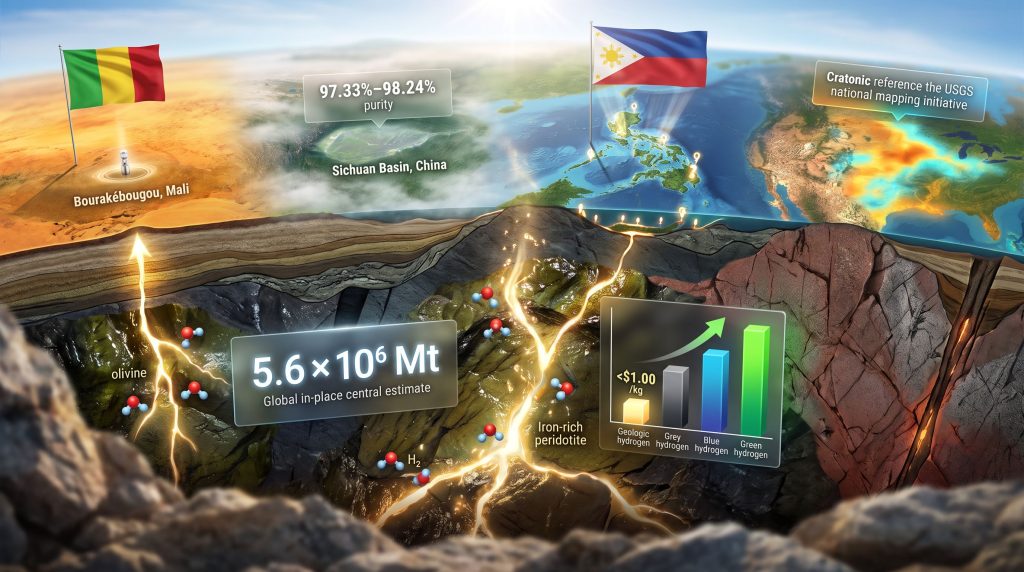
A landmark 2024 study published in Science Advances modelled global in-place geologic hydrogen at between 10³ and 10¹⁰ million metric tons (Mt), with a central estimate of approximately 5.6 × 10⁶ Mt. To put that figure in perspective, extracting just 2% of that central estimate would theoretically yield roughly twice the total energy contained within all proven global natural gas reserves, according to analysis by Interesting Engineering.
Additionally, scientific modelling estimates that natural hydrogen is being generated continuously at a rate of approximately 15 to 31 million metric tons per year — suggesting geologic hydrogen may function more like a replenishing flow resource than a finite deposit, at least in geological terms.
The uncertainty range in these estimates, however, spans seven orders of magnitude. That is not a rounding error — it reflects the genuine immaturity of the science. Variables including rock permeability, subsurface temperature gradients, fluid chemistry, and microbial activity all influence how much hydrogen actually accumulates in any given location.
Three fundamental unknowns shape every geologic hydrogen resource estimate: how much hydrogen is being generated at depth, how much is consumed by subsurface microbial and chemical processes before reaching a trap, and how effectively current exploration technology can locate and characterise what remains. Until these variables are constrained through systematic drilling programs, all global figures should be treated as indicative rather than definitive.
Why Large Estimates Do Not Automatically Mean Large Supply
The gap between in-place resource estimates and economically recoverable volumes is significant in any extractive industry, but it is particularly acute for geologic hydrogen reserves at this stage of scientific understanding.
-
Much of the modelled resource sits at depths, temperatures, or geological configurations that are technically challenging or economically impractical to access.
-
Hydrogen-consuming microorganisms, specifically hydrogenotrophic bacteria and archaea, are widespread in subsurface environments and can consume substantial proportions of generated hydrogen before accumulation occurs.
-
Trapping efficiency — the fraction of generated hydrogen that accumulates in concentrations high enough to be commercially interesting — remains poorly quantified.
-
The USGS has noted that discoveries of high-concentration subsurface hydrogen remain rare globally despite growing exploration interest.
The World's Most Promising Geologic Hydrogen Frontiers
China: Record Purity Levels in the Sichuan Basin
Recent scientific measurements from China's Sichuan Basin have documented hydrogen seepage purity levels ranging between 97.33% and 98.24% — the highest concentrations ever recorded in China and among the highest documented anywhere globally. Concentrations exceeding 98.00% purity place this discovery in a rare category that scientists regard as particularly significant, as high surface purity typically signals that a substantial and relatively clean subsurface accumulation exists at depth.
The Sichuan Basin's architecture is geologically compelling: deep sedimentary sequences overlying basement rocks create conditions favourable for both ongoing hydrogen generation and structural trapping. Whether the subsurface geometry supports commercial-scale extraction remains an open scientific question pending dedicated exploration drilling.
The Philippines: The Largest Known Natural Hydrogen Seeps on Earth
Private capital is converging on the Philippines following the identification of what is described as the largest natural hydrogen seep systems anywhere on the planet. Venture-backed energy startup Koloma, led by CEO Pete Johnson, has positioned the country as a potential global anchor for geologic hydrogen commercialisation, with Johnson indicating to Forbes that there is strong reason to believe the surface seeps connect to very large subsurface accumulations.
The geological rationale is well-founded. The Philippines sits atop extensive ophiolite sequences — ancient oceanic crust rich in the ultramafic rock types that drive serpentinization at scale. For a nation that has historically been a net energy importer with constrained fiscal resources, commercially viable geologic hydrogen reserves would represent a structural economic transformation of significant magnitude.
The United States: From Prospectivity Mapping to Cost Modelling
The USGS recently published the first national prospectivity map for naturally occurring geologic hydrogen — a meaningful step from academic curiosity toward systematic resource assessment. The U.S. Department of Energy has modelled potential geologic hydrogen production costs at below $1 per kilogram under optimistic extraction scenarios, a figure that would fundamentally disrupt the economics of the existing hydrogen sector. Documented hydrogen seeps and subsurface anomalies have been recorded across Kansas, Nebraska, and other parts of the cratonic interior.
Mali: The World's Only Operating Natural Hydrogen Well
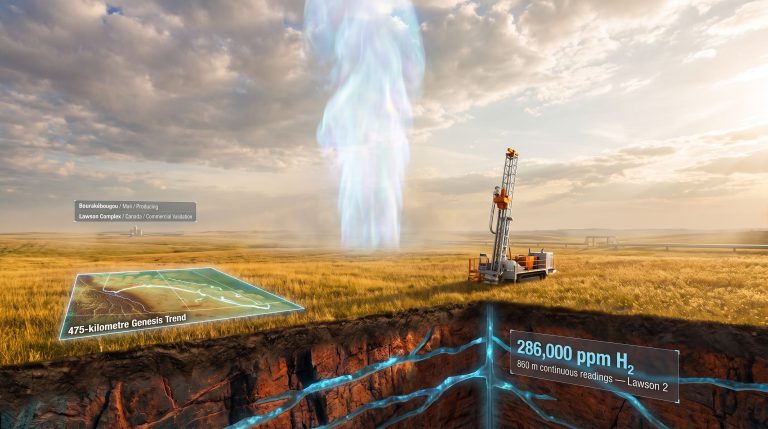
The village of Bourakébougou in Mali hosts what remains the only known commercial-scale natural hydrogen production operation globally. The well was discovered accidentally in 1987 during water well drilling and has since supplied electricity to the local community. Mali's experience is the closest thing the industry has to a real-world proof of concept for geologic hydrogen extraction, though it remains a single, small-scale, and technically unscaled operation.
| Country/Region | Geological Basis | Exploration Stage | Notable Development |
|---|---|---|---|
| China (Sichuan Basin) | Sedimentary basin over basement | Active scientific study | 97-98%+ purity seeps recorded |
| Philippines | Ophiolite sequences | Early commercial exploration | Largest known surface seeps globally |
| United States | Cratonic interior, multiple settings | Prospectivity mapping (USGS) | DoE cost modelling underway |
| Mali | West African craton | Small-scale production | Only known commercial well globally |
| Oman | Ophiolite belt | Research-stage | World-class serpentinization geology |
| Australia | Precambrian cratons | Early-stage exploration | Growing industry and scientific interest |
The Cost Equation That Could Reshape Hydrogen Economics
The economic case for geologic hydrogen rests on a straightforward but powerful argument: if the Earth has already done the work of generating the gas, the extraction cost can potentially undercut every manufactured hydrogen pathway by a substantial margin.
| Hydrogen Type | Production Method | Estimated Cost Range (per kg) | Carbon Intensity |
|---|---|---|---|
| Grey hydrogen | Steam methane reforming | ~$1.00 to $2.50 | High |
| Blue hydrogen | SMR with carbon capture | ~$1.50 to $3.50 | Medium |
| Green hydrogen | Renewable electrolysis | ~$3.50 to $6.00 | Near-zero |
| Geologic hydrogen | Direct subsurface extraction | Below $1.00 (DoE projection) | Near-zero |
At sub-$1 per kilogram, geologic hydrogen would undercut grey hydrogen on cost while matching green hydrogen on carbon intensity — a combination that no existing production pathway can currently offer. The DoE's modelling represents a projection, not a demonstrated commercial outcome, but the directional implication is significant enough to have attracted serious capital allocation.
Green hydrogen's structural weakness is instructive here. Electrolysis requires large volumes of renewable electricity, making it a competing use of clean power rather than an additive source of clean fuel. Infrastructure costs for electrolysers, compression systems, and distribution add further to delivered costs. Geologic hydrogen bypasses the energy input problem entirely. The subsurface chemical reactions that produced the gas are not competing with the electricity grid and do not require purpose-built manufacturing infrastructure at the surface.
In addition, the broader mining energy transition is already reshaping how industries think about clean fuel alternatives, and geologic hydrogen could play a meaningful role in that shift. For instance, hydrogen-powered mining trucks represent one early application where low-cost natural hydrogen could prove transformative.
The next major ASX story will hit our subscribers first
Technical Barriers That Stand Between Promise and Production
Exploration and Detection Challenges
Hydrogen's physical properties make it fundamentally difficult to find and characterise using conventional oil and gas exploration tools. Its molecules are the smallest in nature, migrating through rock fractures with ease and escaping detection by seismic surveys designed for much heavier hydrocarbon molecules. New geophysical detection methodologies are actively being developed, but none have yet been validated at commercial scale. Surface seep surveys can confirm subsurface presence but cannot reliably quantify the size or connectivity of underlying accumulations.
The Microbial Consumption Problem
One of the most underappreciated technical challenges in geologic hydrogen exploration is the role of subsurface microbiology. Hydrogenotrophic bacteria and archaea consume hydrogen as an energy source and are found throughout subsurface environments globally. These organisms can reduce available hydrogen concentrations dramatically before accumulation can occur, and their distribution and metabolic rates are poorly mapped across most prospective geological settings. Characterising microbial activity has consequently become a serious component of advanced exploration programs.
Materials Science and Wellbore Integrity
Hydrogen causes embrittlement in conventional carbon steel, a well-documented materials science phenomenon where hydrogen atoms diffuse into the metal lattice and reduce its ductility and fracture resistance. Standard oil and gas wellbore casings, pipelines, and surface equipment are not designed for sustained hydrogen exposure. Purpose-engineered materials, coatings, and completion designs will be required for safe long-term production — adding cost and engineering complexity that is not yet fully quantified at commercial scale.
Regulatory Frameworks Still in Development
Most jurisdictions globally lack dedicated regulatory frameworks for geologic hydrogen exploration and production. Hydrogen occupies a legal grey zone in many countries — it is not a conventional hydrocarbon under most petroleum legislation, nor is it a mineral in the traditional sense. The United States, Australia, and several European nations are developing regulatory pathways, but timelines remain uncertain and jurisdiction-specific. This regulatory ambiguity creates permitting risk for early movers and adds to the list of non-geological uncertainties investors must price.
Geopolitical Dimensions: Who Gains Unexpected Energy Leverage?
The distribution of geologically prospective hydrogen settings does not map neatly onto the existing energy power hierarchy. Countries with significant ophiolite geology, ancient cratonic basement, or deep rift systems — many of which are currently energy importers — could theoretically become hydrogen exporters if commercial extraction proves viable.
Sub-Saharan Africa, building on Mali's proof-of-concept, contains extensive cratonic geology across the West African craton that may host similar hydrogen accumulations. The Philippines example illustrates how a developing economy sitting atop world-class ophiolite sequences could find itself at the centre of a new energy resource class that current energy geopolitics have not yet accounted for.
Conversely, fossil fuel producers with limited geologic hydrogen prospectivity face a longer-term strategic risk if natural hydrogen scales successfully. Furthermore, the push toward renewable energy in mining and heavy industry means that demand-side pressure for low-cost clean fuels is already building from multiple directions. The broader adoption of hydrogen in mining fleets is one such example of how industrial demand could accelerate if geologic hydrogen proves commercially viable.
A Milestone-Based Framework for Evaluating Progress
Given the high uncertainty across technical, regulatory, and commercial dimensions, investors and analysts tracking this sector are best served by a milestone framework rather than absolute projections.
Near-term indicators to watch (1 to 3 years):
- Completion of national prospectivity assessments in the United States, Australia, and European countries
- First dedicated commercial exploration wells drilled in the Philippines and Sichuan Basin
- Publication of standardised exploration methodologies by geological survey organisations
Medium-term milestones (3 to 7 years):
- Demonstration-scale production projects at multiple geological settings
- First independent resource estimates produced using petroleum industry reserve classification frameworks
- Regulatory frameworks established in at least several leading exploration jurisdictions
Long-term outcomes (7 to 15 years):
- Commercial-scale production if demonstration projects prove both technically and economically viable
- Integration of geologic hydrogen into national hydrogen strategies and clean energy roadmaps
- Potential impact on global hydrogen pricing benchmarks if volumes become material
The central uncertainty for geologic hydrogen is not whether the resource exists — the geological evidence from Mali, the Sichuan Basin, the Philippines, and numerous other locations confirms that it does. The defining question is whether it can be found in sufficient concentrations, at accessible depths, in jurisdictions with workable regulatory frameworks, and at costs that justify the capital required to develop it. The next five years of systematic exploration drilling will be decisive.
Frequently Asked Questions About Geologic Hydrogen
What is the difference between geologic hydrogen and green hydrogen?
Geologic hydrogen is naturally occurring hydrogen gas extracted directly from underground accumulations formed by geological processes over millions of years. Green hydrogen is manufactured at the surface using electrolysis powered by renewable electricity. The fundamental difference is that geologic hydrogen requires no energy input to generate the gas itself — the Earth has already completed that step.
Has geologic hydrogen ever been commercially produced?
The village of Bourakébougou in Mali operates what is widely considered the world's only sustained commercial-scale natural hydrogen well, discovered accidentally in 1987. It remains a single, small-scale operation and has not been replicated at larger commercial scale anywhere else globally. However, researchers and analysts continue to study Mali's well as the most tangible real-world reference point for what commercial extraction might eventually look like at greater scale.
How much geologic hydrogen exists underground?
The most widely cited scientific modelling estimates in-place geologic hydrogen at approximately 5.6 × 10⁶ million metric tons, with an uncertainty range spanning seven orders of magnitude. Only a small and currently unknown fraction of this total is considered likely to be technically and economically recoverable under realistic extraction scenarios.
What would geologic hydrogen cost to produce?
The U.S. Department of Energy has modelled potential extraction costs below $1 per kilogram under optimistic conditions — significantly cheaper than green hydrogen at $3.50 to $6.00 per kilogram, and potentially cheaper than grey hydrogen at $1.00 to $2.50 per kilogram. These remain projections, not demonstrated commercial costs.
What are the main risks to geologic hydrogen development?
- Subsurface microbial consumption of hydrogen before it can accumulate in recoverable concentrations
- Difficulty detecting and sizing underground deposits using existing exploration technology
- Hydrogen embrittlement of conventional drilling and production equipment
- Absence of dedicated regulatory frameworks in most jurisdictions
- The risk that recoverable volumes are far smaller than in-place resource estimates suggest
This article is intended for informational and educational purposes only. It does not constitute financial or investment advice. All forecasts, cost projections, and resource estimates referenced are subject to significant uncertainty and should not be relied upon for investment decision-making without independent professional assessment.
Ready to Catch the Next Major Energy or Mineral Discovery Before the Market Does?
Discovery Alert's proprietary Discovery IQ model scans ASX announcements in real time, instantly identifying high-potential opportunities across emerging sectors — from geologic hydrogen plays to major mineral discoveries — so subscribers can act before the broader market catches on. Explore Discovery Alert's discoveries page to see the historic returns that early discovery investors have captured, and begin your 14-day free trial today to secure your market-leading edge.