August 21, 2026
The Energy Source That Was Always There, Hiding Underground
For most of modern history, the global energy industry has organised itself around a simple assumption: hydrogen must be made. Whether through steam methane reforming, coal gasification, or electrolysis powered by renewables, hydrogen has been treated as an energy carrier that requires industrial manufacture before it can be used. That assumption is now under serious challenge, with the large scale hydrogen reserve discovered in Saskatchewan forcing a fundamental rethink.
The emerging science of geologic hydrogen, sometimes called gold hydrogen, suggests that significant volumes of molecular hydrogen gas form naturally within ancient crustal rock systems and accumulate in subsurface reservoirs over geological timescales. If that hydrogen can be extracted at commercial scale, it would represent something genuinely unprecedented: a primary energy source with no upstream manufacturing requirement and a potentially very low carbon intensity.
Understanding what has been discovered in Saskatchewan, and what it could mean, requires separating confirmed geology from commercial aspiration. Both matter. However, they are not the same thing.
When big ASX news breaks, our subscribers know first
How Natural Hydrogen Forms: The Geology Behind the Discovery
Serpentinisation, Radiolysis, and the Precambrian Basement
Natural hydrogen generation within the Earth's crust occurs through two principal mechanisms that are well-established in geoscience literature, even if their commercial implications have only recently attracted serious attention.
The first is serpentinisation, a geochemical reaction in which water interacts with iron- and magnesium-rich silicate minerals, particularly olivine and pyroxene, within ultramafic rocks. This reaction produces serpentine minerals and releases molecular hydrogen as a byproduct. It is not a fast process, but across geological timescales it can generate substantial volumes of gas.
The second mechanism is radiolysis, the splitting of water molecules by ionising radiation emitted from radioactive elements within ancient crystalline basement rocks. Precambrian shields, which are among the oldest and most stable geological formations on Earth, contain elevated concentrations of uranium, thorium, and potassium-40, all of which drive this process over billions of years.
What makes these processes relevant to Saskatchewan is the character of the Canadian Shield beneath the province. The Precambrian basement in this region provides both the geological machinery to generate hydrogen and the structural stability to trap it. Ancient crystalline basement terrains are geologically quiescent, meaning that once gas accumulates in a structural closure, it is far less likely to have been disturbed or dispersed than in tectonically active regions.
Geologists historically dismissed anomalous hydrogen readings in drill holes as instrument contamination or atmospheric ingress. In retrospect, some of those readings may have been genuine signals from subsurface accumulations that were never followed up.
This historical blind spot is significant. For decades, the energy industry lacked both the conceptual framework and the financial incentive to investigate hydrogen readings as resource signals. That is now changing, and Saskatchewan appears to have been hiding a major system in plain sight. Furthermore, the mineral exploration importance of properly investigating such geological signals is now being more widely recognised across the industry.
The Genesis Trend and the Lawson Complex: Scale and Structure
A 475-Kilometre Exploration Corridor Anchoring the Thesis
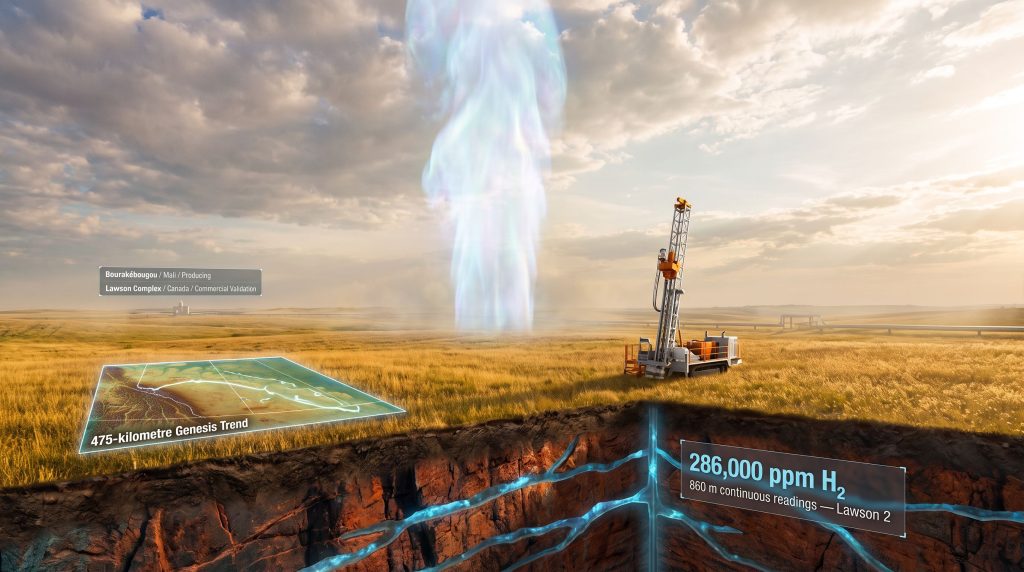
The Genesis Trend is the name given to a 475-kilometre geological exploration corridor across Saskatchewan that Max Power Mining has identified as prospective for natural hydrogen. The scale of this corridor is important context: it represents a regional structural concept, not a single drill target.
Within the Genesis Trend, the Lawson Complex in south-central Saskatchewan near Central Butte has emerged as the primary focus of active drilling. The complex covers approximately 28 square kilometres as mapped through 3D geological modelling and seismic data, and within that area, a 14.2 km² subsurface structural closure has been identified. This closure represents the geometric trap where hydrogen-bearing fluids may have accumulated.
The distinction between the Genesis Trend as a regional concept and the Lawson Complex as a specific drill target is worth understanding clearly. The trend provides the broader exploration thesis. The Lawson Complex is where that thesis is being tested with real wells and real data.
What the Drilling Has Actually Returned
The first well, Lawson 2, produced results that are genuinely unusual by any measure of subsurface gas exploration. The key findings include:
| Metric | Reported Finding |
|---|---|
| Peak hydrogen concentration | Up to 286,000 ppm (28.6%) |
| Continuous elevated H₂ readings | 860 metres of vertical section |
| Structural complex area (seismic) | 28 km² |
| Subsurface structural closure | 14.2 km² |
| Initial test well | Lawson 2 |
| Current drill programme | Lawson 3 |
| Multi-well programme start | Mid-July 2026 |
| First drilling activity | Late 2025 |
A hydrogen concentration of 28.6% sustained over 860 continuous vertical metres is an extraordinary reading. For comparison, natural gas wells are typically characterised by their methane fraction as a percentage of total gas volume, and a well yielding 28.6% of any target gas over that vertical extent would be considered a significant result in any conventional upstream context.
Critically, the Lawson 2 well also confirmed free-flowing gas to surface and reservoir drive pressure, meaning the system is not merely showing trace hydrogen but is actively pressurised and capable of delivering gas to the wellhead. This is a fundamental distinction between a geological curiosity and a potential extraction target.
The Lawson 3 well is currently underway and is designed to provide a third spatial data point across the system, essential for beginning to understand the three-dimensional geometry of the accumulation. In addition, petrophysical analysis of core samples, gas composition studies, and high-resolution seismic interpretation are all running in parallel to build what Max Power Mining describes as an increasingly detailed model of how this large system behaves.
Situating Saskatchewan on the Global Natural Hydrogen Map
How the Lawson Complex Compares to Known Global Discoveries
Natural hydrogen exploration is still in its earliest commercial stages globally, with only a handful of sites generating serious scientific or investor interest. The table below places the Lawson Complex in that global context:
| Discovery Location | Country | Status | Notable Characteristics |
|---|---|---|---|
| Bourakébougou | Mali | Small-scale production | First commercially producing natural H₂ well globally |
| Pederneiras Basin | Brazil | Early-stage exploration | Significant structural interest, pre-drilling |
| Oman ophiolites | Oman | Academic research | Well-studied geochemically, no commercial pathway |
| Yorke Peninsula | Australia | Exploration | Elevated H₂ readings, early delineation |
| Lawson Complex | Canada (Saskatchewan) | Commercial validation | 286,000 ppm H₂, 860m continuous, 28 km² system, reservoir drive confirmed |
The Bourakébougou field in Mali remains the world's only commercially producing natural hydrogen well, though it operates at a very modest scale, supplying a small local generator. Its existence has been critical in demonstrating that natural hydrogen can be extracted and used, but it does not constitute a scalable commercial model.
What distinguishes the large scale hydrogen reserve discovered in Saskatchewan is the combination of factors present simultaneously: high concentration, substantial vertical continuity, confirmed reservoir pressure, a mapped structural closure of meaningful size, and proximity to existing energy infrastructure. No other known natural hydrogen discovery has presented all of these characteristics together at this stage of evaluation.
The Helium Co-Occurrence: A Secondary Value Driver
One of the less widely discussed aspects of the Lawson Complex discovery is the potential presence of helium within the same system. Helium is a critical industrial gas with highly constrained global supply. It cannot be synthesised and is primarily recovered as a byproduct of natural gas processing. The ongoing helium supply crisis has seen global markets experience repeated shortages, and the United States Bureau of Land Management's Federal Helium Reserve, long a stabilising force in the market, has been winding down.
A natural hydrogen accumulation that also carries a meaningful helium fraction would represent a substantially more valuable resource on a per-unit extraction basis. The Precambrian basement geology of Saskatchewan is known to be helium-generative, given the long-lived radioactive decay processes in ancient crystalline rocks that produce helium-4 as a decay product. Whether the Lawson Complex contains commercially relevant helium concentrations alongside hydrogen is still being characterised, but the geological logic is sound.
The Commercial Validation Process: What Comes Next
Why Delineation Requires Multiple Wells
A single well, regardless of how impressive its readings are, cannot establish the three-dimensional extent of a subsurface accumulation. Volumetric estimation requires multiple spatial data points to constrain the geometry of the reservoir, its thickness variations, porosity distribution, and pressure behaviour across the structure.
The multi-well programme that commenced in mid-July 2026 is specifically designed to address this requirement. Lawson 3 adds a third data point to complement the information from Lawson 2 and the initial test-of-concept well. Each successive well narrows the range of uncertainty around the system's geometry and helps calibrate the 3D seismic model against actual subsurface conditions.
Commercial validation in the context of a genuinely novel resource type requires more than just confirming that gas exists. It requires demonstrating that the system can sustain production rates, that reservoir behaviour is predictable, and that extraction economics are viable at the relevant hydrogen price.
There is currently no established industry benchmark for what a commercial natural hydrogen project looks like at scale. The extraction, compression, and transport of naturally occurring hydrogen presents engineering challenges that the oil and gas industry has not fully addressed because the context has never previously existed. This is both a risk and, for early movers, a potential structural advantage.
Saskatchewan's Infrastructure Advantage
One of the practical advantages of the Lawson Complex's location is the existing energy infrastructure base in Saskatchewan. The province has decades of oil and gas development history, which means it possesses pipeline networks, compression facilities, well-servicing expertise, and a regulatory body with established processes for subsurface resource management.
This matters commercially because the capital intensity of bringing a natural resource to market is dramatically influenced by infrastructure proximity. A greenfield natural hydrogen project in a remote location with no existing pipeline access would face a fundamentally different economic challenge than one located within reach of established transmission and processing infrastructure.
Saskatchewan also has an established base of technical expertise in subsurface resource development, drawn from the province's oil, potash, and uranium industries. That human capital is directly applicable to natural hydrogen development in ways that may not be immediately obvious but are practically significant. Furthermore, the broader critical minerals demand driven by the global energy transition positions Saskatchewan favourably as a multi-resource jurisdiction.
Scenario Analysis: From Discovery to Industry
Three Pathways from Exploration Asset to Commercial Resource
Scenario 1: Niche Regional Supplier
In this pathway, confirmed hydrogen volumes are modest but economically viable at local scale. Hydrogen is extracted and supplied directly to regional industrial consumers, including fertiliser manufacturers, petroleum refiners, or potentially steel producers transitioning away from coal-based reduction processes. This scenario requires the least capital and offers the fastest potential path to cash flow, but limits the overall scale of the opportunity.
Scenario 2: Provincial Resource Diversification
Saskatchewan has a well-established model of exporting primary resources at scale, with potash and uranium as the clearest examples. In this scenario, natural hydrogen joins that roster as a third major resource export. This would require more substantial infrastructure investment and a longer development timeline, but would position the province as a significant contributor to North American hydrogen supply.
Scenario 3: Continental Clean Energy Integration
The most ambitious pathway involves integration with broader North American hydrogen infrastructure, including potential pipeline connectivity and long-term supply agreements with industrial and utility customers across the continent. This scenario is contingent on a definitive feasibility study, significant capital deployment, and the maturation of hydrogen transport and pricing markets, none of which are guaranteed on any specific timeline.
The next major ASX story will hit our subscribers first
Key Risks and the Discovery vs. Reserve Distinction
What Has Been Confirmed and What Remains Unknown
Accurate public understanding of this discovery requires a clear separation between what geology has confirmed and what commercial analysis has yet to establish.
Confirmed as of August 2026:
- Canada's first subsurface natural hydrogen system has been geologically validated at the Lawson Complex
- Hydrogen concentrations up to 286,000 ppm have been recorded
- 860 metres of continuous elevated hydrogen readings confirmed in Lawson 2
- Free-flowing gas to surface and reservoir drive pressure confirmed
- A 28 km² structural complex with a 14.2 km² closure has been mapped via 3D seismic
- A multi-well commercial validation programme is active as of mid-2026
Not yet established:
- Total recoverable hydrogen volume (no formal reserve estimate disclosed)
- Economic cost of extraction per kilogram at commercial scale
- Regulatory pathway for a commercial natural hydrogen operation in Canada
- Infrastructure investment requirements for market delivery
- Production timeline
The risks associated with this stage of development include:
- Geological risk: System continuity across the broader Genesis Trend remains unproven beyond the Lawson Complex
- Volumetric risk: Without a reserve estimate, the system cannot be financed as a conventional upstream asset
- Regulatory risk: Canada has no established natural hydrogen-specific regulatory framework
- Technical risk: Engineering solutions for sustained natural hydrogen extraction at commercial rates are novel and untested at scale
- Market risk: Hydrogen pricing and demand infrastructure globally remain in early development
Disclaimer: This article contains forward-looking analysis and scenario projections that involve uncertainty. Nothing in this article constitutes financial advice. Investors should conduct independent due diligence before making any investment decisions related to companies or assets discussed herein.
Frequently Asked Questions
Is this the world's largest natural hydrogen discovery?
No confirmed reserve size has been publicly disclosed. The discovery is notable for its hydrogen concentration levels and the vertical continuity of elevated readings, but no volumetric estimate meeting industry reporting standards has been released. Claims framing this as the world's largest should be understood as exploratory thesis rather than confirmed data. Canada's confirmation of this as its first natural hydrogen drilling discovery, however, is formally established.
How does natural hydrogen differ from green hydrogen?
Green hydrogen is manufactured through electrolysis powered by renewable electricity, a process with significant energy input requirements and associated infrastructure costs. Natural hydrogen is geologically generated over millions to billions of years and accumulates in subsurface formations. If commercially extractable, natural hydrogen could theoretically be produced at a fraction of the cost of any manufactured hydrogen pathway, though this has not yet been demonstrated at meaningful scale.
What is the carbon footprint of natural hydrogen extraction?
Extraction would involve drilling, compression, and transport, all of which carry associated emissions. However, no combustion of fossil fuels is required in the production process itself. Early lifecycle modelling by researchers at institutions including the University of New South Wales has suggested that geologic hydrogen could carry very low cradle-to-gate carbon intensity, though these assessments are preliminary and site-specific data is still limited.
Why does the helium component matter commercially?
Helium is a non-renewable, non-synthesisable industrial gas used in semiconductor manufacturing, medical imaging, aerospace, and scientific research. Global supply is tightly constrained, and helium commands a significant market premium. A dual hydrogen-helium resource within the same geological system could materially improve the economics of extraction by generating revenue from two separate product streams.
When could commercial production begin?
No production timeline has been formally announced. Industry analogues from conventional upstream exploration suggest a minimum pathway of three to seven years from confirmed discovery to first commercial production, contingent on reserve certification, regulatory approval, and infrastructure development. The current programme is focused on generating the data necessary for commercial validation, which is the prerequisite for all subsequent steps. As the CBC has reported on natural hydrogen, public and scientific interest in this emerging resource category continues to grow considerably.
Want to Know When the Next Major Resource Discovery Hits the ASX?
Discovery Alert's proprietary Discovery IQ model scans ASX announcements in real time, instantly identifying significant mineral and energy resource discoveries — just as geological breakthroughs like Saskatchewan's natural hydrogen system are reshaping what investors consider a viable resource play. Explore how historic discoveries have generated substantial returns for early movers, and begin your 14-day free trial today to ensure you're positioned ahead of the broader market.