August 21, 2026
India's Molecular Import Crisis and the Underground Answer Beneath Andhra Pradesh
Few industrial challenges expose a nation's structural vulnerabilities quite like molecular dependency. While the global energy conversation fixates on electrons, kilowatts, and battery storage, the more consequential and less visible problem for an industrialising economy like India involves molecules: the hydrogen, ammonia, methanol, and synthetic gas that underpin fertilisers, chemicals, steel, and refined fuels. These are not optional inputs. They are the biological and industrial lifeblood of a growing economy, and India currently sources enormous quantities of all of them from overseas.
The Reliance underground coal gasification project in Andhra Pradesh, if it progresses from proposal to production, represents one of the most ambitious attempts in Indian industrial history to convert a geological liability into a molecular supply chain. Understanding why this project matters requires moving beyond the headline investment figure and examining what the technology actually does, what the reserves contain, and what the risks genuinely look like underground.
When big ASX news breaks, our subscribers know first
What Underground Coal Gasification Actually Does Differently
The Reactor That Never Leaves the Ground
Conventional energy thinking treats coal as a solid fuel to be extracted, transported, and burned. Underground coal gasification operates on an entirely different logic. Rather than mining the coal seam and processing it at the surface, UCG transforms the seam itself into a subsurface chemical reactor.
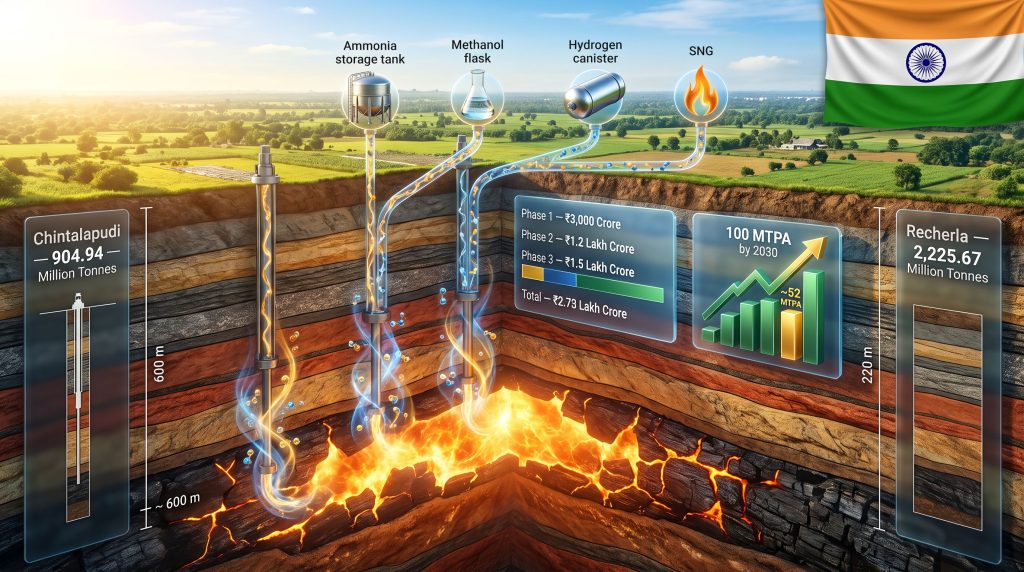
The process involves drilling two or more wells into the coal deposit. An oxidising agent, typically a combination of oxygen and steam, is injected through one well. This initiates a controlled partial combustion reaction within the seam. The heat and chemical reactions convert the solid coal into a gaseous mixture, which travels through the geology to a production well and rises to the surface as syngas.
What makes this commercially significant is what syngas can become:
| Syngas Derivative | Primary Industrial Use | India's Current Import Exposure |
|---|---|---|
| Synthetic Natural Gas (SNG) | LNG substitute for industrial and household use | Over 50% of LNG demand met by imports |
| Hydrogen | Ammonia and fertiliser feedstock | Significant indirect import exposure |
| Ammonia | Fertiliser manufacturing, chemical processing | Near-total import dependence |
| Methanol | Fuel blending, chemicals, plastics | 80-90% of demand met by imports |
| Reducing Gas | Direct reduced iron for steelmaking | Substantial coking coal import exposure |
The platform nature of syngas is what separates UCG from a simple energy extraction play. A company with downstream processing capability can route syngas into whichever product market offers the best economics at any given time, creating a flexibility that a single-product energy project cannot replicate.
Why Coal Grade Matters Less Underground Than at the Surface
A less commonly understood aspect of UCG is that lower-grade coals, which would be commercially marginal for surface mining and combustion, can still function effectively as gasification feedstocks. The Chintalapudi block contains G-12 grade coal and the Recherla block holds G-13 grade material. In India's grading system, G-12 and G-13 represent lower calorific value coals that would attract limited interest from conventional power utilities.
For UCG, however, the chemistry of gasification is less sensitive to calorific value classification than combustion is. What matters more is seam geometry, permeability, and subsurface pressure conditions. This means the grade classification that reduces the conventional mining appeal of these deposits does not necessarily diminish their UCG potential, a distinction that most surface-focused coal analysis overlooks.
The Chintalapudi and Recherla Blocks: What the Geology Reveals
Block-Level Resource Profile
| Coal Block | Location | Approximate Area | Estimated Reserves | Coal Grade |
|---|---|---|---|---|
| Chintalapudi | Eluru District, Andhra Pradesh | ~3,000 acres | 904.94 million tonnes | G-12 |
| Recherla | Eluru District, Andhra Pradesh | ~5,500 acres | 2,225.67 million tonnes | G-13 |
| Combined | Andhra Pradesh | ~8,500 acres | ~3.13 billion tonnes | Mixed |
Both blocks were acquired through India's 14th round of commercial coal mining e-auctions conducted by the Ministry of Coal, with UCG provisions embedded into the block development agreements. The deposits are reported to lie more than 500 to 600 metres below the surface, a depth that renders conventional underground longwall mining economically challenging and surface mining entirely non-viable.
The Depth Paradox: Why 600 Metres Is an Advantage for UCG
This is where UCG thinking inverts conventional mining logic. At 600 metres, the geological pressure conditions can actually assist in maintaining the integrity of the gasification cavity. Elevated confining pressures help keep the reaction zone stable and can reduce the risk of uncontrolled gas migration in certain geological configurations.
The depth that makes conventional extraction prohibitively expensive becomes a structural feature that UCG can potentially exploit. This does not eliminate risk. At these depths, groundwater interaction becomes more complex, and the movement of gasification by-products through fracture networks requires rigorous pre-project characterisation. However, the fundamental premise, that depth works against conventional mining while potentially supporting UCG, represents a meaningful reversal of the usual resource evaluation framework.
How ₹2.73 Lakh Crore Gets Deployed Over Three Decades
Phased Capital Architecture
Reliance Industries has proposed a structured investment gated behind demonstrated technical success. This is not a single capital commitment but a sequenced deployment strategy where each phase is contingent on the outcomes of the phase preceding it.
Phase 1: Exploration and Pilot Validation (Q3 2026 to Q4 2027)
- Capital outlay: approximately ₹3,000 crore
- Primary objective: establish whether a stable, commercially consistent gasification reaction can be sustained in the Eluru district seams
- Key technical deliverables: well drilling and completion, oxidant injection trials, syngas composition measurement, subsurface pressure and temperature monitoring, groundwater baseline assessment
- Decision function: this phase determines whether the subsequent ₹2.7 lakh crore is deployed or withheld
Phase 2: Development and Infrastructure Build-Out (2028-2030)
- Capital outlay: approximately ₹1.2 lakh crore
- Objective: scale the validated pilot configuration into commercial production infrastructure, including surface syngas processing, upgrading facilities, and downstream conversion pathways
- Integration of hydrogen, methanol, SNG, and ammonia production units depending on market economics
Phase 3: Full Production and Downstream Integration (2030 onward)
- Capital outlay: approximately ₹1.5 lakh crore
- Objective: sustained commercial-scale syngas production with active downstream chemical and fuel manufacturing
- Potential integration with existing Reliance refining and petrochemical infrastructure
The ₹2.73 lakh crore headline figure covers a 30-year conditional commitment. Every rupee beyond the initial ₹3,000 crore pilot depends entirely on what the subsurface geology and gasification chemistry reveal during the exploration phase.
India's Import Bill and the Strategic Logic of Domestic Gasification
Mapping the Molecular Dependency Problem
India's government data from May 2026 quantifies the import exposure with uncomfortable precision. Furthermore, India's LNG import structure illustrates precisely how deep this dependency runs across multiple molecular categories:
- More than 50% of India's LNG demand is met through imports
- Approximately 20% of urea requirements are sourced internationally
- Near-total dependence on imports for ammonia
- 80 to 90% of methanol demand is imported
The aggregate import bill for LNG, urea, ammonium nitrate, ammonia, coking coal, and methanol reached approximately ₹2.77 lakh crore in FY2025 according to government figures. This number carries a striking symmetry with the Reliance UCG investment proposal, which totals ₹2.73 lakh crore over 30 years. In other words, a single year's import bill for these molecular categories is roughly equivalent to the entire proposed capital commitment for a domestic alternative that could address multiple categories simultaneously.
The Geopolitical Dimension of Molecular Supply Chains
Import dependence in molecular supply chains creates layered risk that pure commodity price analysis understates. Consequently, energy security in the transition period becomes increasingly critical for nations that are simultaneously industrialising and decarbonising. A country reliant on imported LNG, ammonia, and methanol is simultaneously exposed to:
- Commodity price cycles driven by supply disruptions in producing regions
- Shipping route vulnerabilities, including chokepoint congestion and insurance cost escalation
- Currency depreciation risk on dollar-denominated import contracts
- Geopolitical supply interruptions when relationships between producing and transit nations deteriorate
A domestic syngas platform capable of producing SNG, ammonia, and methanol would not eliminate these exposures. However, it would introduce a domestic buffer that functions independently of international commodity markets during periods of disruption. The distinction between eliminating vulnerability and creating resilience is important: the case for UCG rests on the latter, not the former.
India's Policy Architecture for Coal Gasification
Two Tracks, One Ambition
India's coal gasification policy operates along two distinct tracks, and understanding the difference is critical for assessing how the Reliance underground coal gasification project in Andhra Pradesh fits within the incentive landscape.
Track 1: Surface Coal Gasification Incentives
- January 2024: Union government approved an ₹8,500 crore financial incentive scheme covering PSUs, private companies, and demonstration projects in surface gasification
- May 2026: Cabinet approved an expanded ₹37,500 crore scheme for surface coal and lignite gasification, expected to support projects consuming approximately 75 million tonnes of coal and lignite
- Incentive mechanism: up to 20% of eligible plant and machinery costs, subject to scheme caps
- Critical limitation: this scheme is specifically designed for surface gasification operations and does not automatically extend to underground projects
Track 2: Underground Coal Gasification Policy
- A dedicated UCG policy framework has been operational since 2016
- April 2026: Ministry of Coal announced the first tranche of coal mine development agreements carrying embedded UCG provisions, the mechanism through which the Chintalapudi and Recherla blocks were secured
- A 50% rebate on revenue share for coal used in gasification under specified conditions may be applicable to Reliance's blocks depending on project configuration
Policy risk is real here. Reliance's UCG project sits at the intersection of two incentive frameworks without guaranteed access to the most financially substantial one. The ₹37,500 crore surface gasification scheme does not automatically apply to underground operations. Regulatory clarity on incentive eligibility will materially affect project economics.
National Gasification Ecosystem Participants
| Organisation | Role in India's Gasification Programme |
|---|---|
| Coal India | Primary coal supplier for surface gasification projects |
| BHEL | Technology provision and project development |
| GAIL | Gas infrastructure and downstream distribution |
| BPCL | Refining integration and fuel applications |
| Talcher Fertilisers | Fertiliser production via coal gasification |
| Reliance Industries | Proposed UCG with integrated downstream chemical production |
India's national target of 100 million tonnes per annum of coal gasification by 2030 represents an ambitious trajectory. The sector remains well short of that target today, making large-scale projects like the Reliance UCG proposal strategically significant to national policy ambitions, though the project's timeline extends well beyond the 2030 benchmark.
The next major ASX story will hit our subscribers first
Scenario Modelling: What Could the Project Realistically Produce?
Reliance has not published production forecasts. The following scenarios are illustrative modelling exercises based on the disclosed reserve estimates and are not company guidance.
| Utilisation Scenario | Annual Gasification Rate | Share of India's 100-MT Target |
|---|---|---|
| Full resource over 30 years (theoretical maximum) | ~104 MTPA | ~104% |
| Optimistic (50% resource utilisation) | ~52 MTPA | ~52% |
| Moderate (25% resource utilisation) | ~26 MTPA | ~26% |
| Conservative (10% resource utilisation) | ~10.4 MTPA | ~10% |
Even the conservative scenario, representing 10% resource utilisation over 30 years, would contribute approximately 10.4 MTPA to India's gasification capacity. That is a material contribution to national feedstock security, particularly given that this volume would be generated from reserves currently inaccessible by any conventional extraction method.
The Underground Risk Matrix: Where the Project Could Fail
Technical Risk Categories at 600-Metre Depth
UCG's fundamental challenge is operational: the gasification process occurs in an environment that cannot be directly observed or intervened upon in real time. At depths exceeding 600 metres, risk categories multiply considerably.
Geological Risks
- Seam continuity and thickness variations can disrupt the spatial progression of the gasification cavity
- Fault zones and natural fractures in the surrounding rock create pathways for uncontrolled gas migration
- Coal permeability determines how effectively the oxidant distributes through the seam; uneven permeability produces uneven reactions
Groundwater Risks
- Migration of gasification by-products, including phenols, benzene, toluene, and polycyclic aromatic compounds, into surrounding aquifer systems is a documented risk from global UCG experience
- Water table interaction at these depths requires comprehensive pre-project hydrogeological mapping and continuous operational monitoring
- Aquifer contamination, once established, is extremely difficult to remediate at depth
Operational and Commercial Risks
- Maintaining consistent syngas composition, specifically a stable hydrogen-to-carbon monoxide ratio, is technically demanding at commercial throughput levels
- Surface subsidence above the gasification cavity, while less likely at 600+ metres than at shallower depths, remains a monitoring requirement throughout the project life
- Global methane project networks highlight that commercial-scale UCG experience remains limited, meaning site-specific surprises are a genuine possibility
The ₹3,000 crore pilot phase is not a minor preliminary exercise. It is the entire evidentiary basis upon which a ₹2.7 lakh crore capital decision will eventually rest. If the pilot cannot demonstrate stable, consistent syngas production at acceptable cost, the development and production phases are unlikely to proceed.
Reliance's Strategic Interest: Feedstock, Not Mining
Why This Is a Downstream Play Disguised as an Upstream Investment
Reliance Industries operates one of Asia's largest integrated refining and petrochemical complexes. Its strategic calculus in pursuing UCG is almost certainly not about becoming a coal producer. It is about securing a domestic molecular feedstock that reduces dependence on imported gas and chemical inputs across its existing operational ecosystem.
Syngas produced from UCG could serve as a direct input into operations the company already runs: hydrogen for refinery hydrotreating, methanol for chemical processing, SNG as an energy source for industrial heating, and ammonia for downstream fertiliser or chemical applications. In addition, the project has potential synergies with green iron production pathways, as reducing gas derived from syngas can partially substitute for coking coal in direct reduced iron processes, easing Indian steel market challenges around input costs.
This feedstock integration thesis creates an economic advantage that standalone UCG projects cannot replicate. The ability to route syngas into multiple existing downstream processes means the project's economic viability does not depend on any single product market. This flexibility is built into the molecular platform that UCG provides, but it is only accessible to an operator with the downstream infrastructure to use it.
What Determines Success or Failure: A Three-Scenario Framework
Scenario A: Pilot Succeeds, Full Development Proceeds
Exploration confirms seam continuity and adequate permeability. Groundwater conditions are manageable. Pilot gasification produces consistent syngas at commercially competitive cost. Development spending of ₹1.2 lakh crore commences in 2028, with production from 2030. India gains a domestic syngas platform capable of materially reducing LNG, ammonia, and methanol import exposure.
Scenario B: Partial Success, Scaled-Down Development
Exploration reveals geological heterogeneity that limits recoverable resource. Syngas is viable but at higher cost than baseline projections. Development proceeds at reduced scale, perhaps 20 to 30% of projected utilisation. Project economics require incentive support to remain commercially sustainable. A modest but meaningful contribution to national gasification targets is achieved.
Scenario C: Pilot Fails, Project Halted
Subsurface conditions prove incompatible with controlled commercial-scale UCG. Groundwater management costs or gas migration risks make the project economically or environmentally unviable at this location. The ₹3,000 crore pilot cost is absorbed. Furthermore, the ₹2.7 lakh crore in subsequent capital is not deployed. Completing a thorough definitive feasibility study beforehand could meaningfully reduce the probability of arriving at this outcome. The Reliance underground coal gasification project in Andhra Pradesh would, in this scenario, suffer a credibility setback at commercial scale.
Probability weighting across these scenarios cannot be assigned without pilot data. That is precisely the function the exploration phase is designed to perform.
Disclaimer: This article contains forward-looking scenario analysis and illustrative modelling that does not constitute financial advice or investment recommendation. Production scenarios are illustrative exercises based on disclosed geological estimates and are not company guidance. All investment and capital deployment figures are conditional proposals subject to feasibility confirmation. Readers should conduct independent research and seek professional advice before making any investment decisions.
Want to Track the Next Major ASX Mineral Discovery Before the Market Does?
Discovery Alert's proprietary Discovery IQ model scans ASX announcements in real time, instantly converting complex geological data across 30+ commodities into clear, actionable investment insights — the same kind of edge that turned discoveries like De Grey Mining and WA1 Resources into extraordinary returns. Explore Discovery Alert's dedicated discoveries page to see the historic outcomes major mineral discoveries have delivered, and begin your 14-day free trial to position yourself ahead of the broader market.