August 20, 2026
The Geopolitical Gamble Beneath the Gulf: Understanding the World's Most Ambitious Frontier Exploration Play
Deepwater oil exploration has always been defined by asymmetric risk. The cost of failure is catastrophic; the reward for success is transformational. Nowhere is that asymmetry more pronounced today than in the waters off Mexico's Campeche state, where Petrobras and Pemex pre-salt oil exploration offshore Mexico has moved from geological hypothesis to active technical evaluation. This is not a story about incremental reserve additions or mature field optimisation. It is a story about whether the most complex frontier play in the Western Hemisphere conceals a hydrocarbon system capable of reshaping Latin American energy for generations.
Understanding what is actually at stake requires moving beyond the headlines and examining the subsurface geology, the structural limitations each company brings to the table, the lessons from failed pre-salt analogues elsewhere, and the extraordinary technical barriers that stand between a promising dataset and a commercially viable discovery. Furthermore, geopolitical trade tensions and shifting global oil benchmarks add additional layers of complexity to an already demanding frontier play.
When big ASX news breaks, our subscribers know first
Defining the Pre-Salt Frontier: Why Geology at 160 Million Years Old Changes Everything
Pre-salt exploration is, at its core, a geological detective story. Salt deposits formed through the evaporation of ancient seas create impermeable barriers that trap hydrocarbons migrating upward from source rocks below. When those source rocks are ancient enough, organically rich enough, and thermally mature enough to have generated petroleum at scale, the result can be extraordinary accumulations of oil beneath the salt canopy.
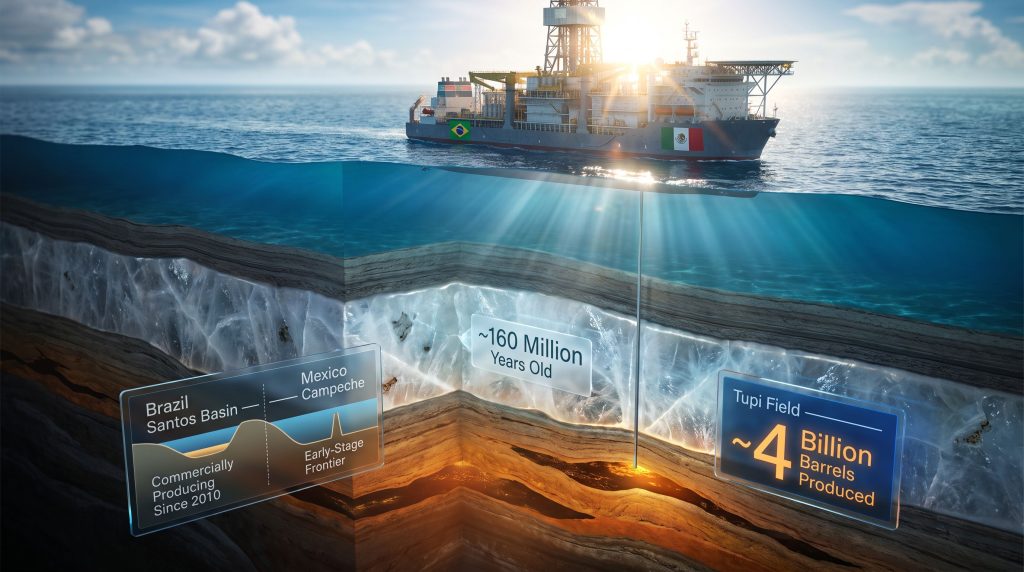
Brazil's Santos Basin established the commercial template. The formations targeted there are approximately 120 to 130 million years old, Cretaceous in age, with carbonate reservoir rock of exceptional quality. The Tupi field, discovered by Petrobras in 2006 and producing since 2010, has now delivered roughly 4 billion barrels of crude oil — a figure that single-handedly repositioned Brazil as a tier-one global producer.
The Campeche target is categorically different, and in some respects more geologically intriguing. The rocks under evaluation are Jurassic in age, approximately 160 million years old — roughly 40 million years older than Brazil's producing formations. Age alone does not determine prospectivity. What matters is whether those ancient sequences contain the organic richness and thermal history required to generate petroleum, and whether structural traps beneath the salt are capable of accumulating it at commercial scale.
| Geological Feature | Brazil Pre-Salt (Santos Basin) | Mexico Pre-Salt (Campeche, Gulf of Mexico) |
|---|---|---|
| Rock Age | ~120–130 million years (Cretaceous) | ~160 million years (Jurassic) |
| Formation Type | Carbonate reservoirs beneath salt | Jurassic source rocks beneath salt |
| Exploration Status | Commercially producing since 2010 | Early-stage frontier assessment |
| Key Operator | Petrobras | Pemex + Petrobras (cooperation) |
| Benchmark Discovery | Tupi Field (~4 billion barrels produced) | No commercial discovery confirmed |
| Water Depth Category | Deepwater / Ultra-deepwater | Deepwater / Ultra-deepwater |
Pedro Zalan, a geologist with 34 years of experience working on Petrobras exploration projects, has assessed the structural setting of the Mexican Gulf as particularly conducive to oil accumulation — a significant professional endorsement given his direct familiarity with pre-salt systems across multiple basins (World Oil, August 2026).
What makes Jurassic source rocks especially significant from a petroleum systems perspective is their potential organic richness. Older sedimentary sequences, deposited during periods of high biological productivity and restricted ocean circulation, can preserve substantial quantities of organic material. Over geological time, heat and pressure transform that material into liquid and gaseous hydrocarbons. The question for the Campeche play is whether the structural geometry above those source rocks is capable of concentrating those hydrocarbons into a drillable target.
The Petrobras-Pemex Cooperation Framework: Structure, Scope, and What It Does Not Guarantee
The agreement formalised between the two state-owned producers in June 2026 is deliberately structured as a non-binding cooperation framework. This distinction carries significant practical implications for how the initiative should be interpreted. In addition, OPEC's market influence on global supply dynamics adds further context to why frontier exploration of this scale has become strategically compelling for both nations.
Key Structural Elements of the Agreement
Key structural elements of the agreement include:
- Agreement type: Non-binding cooperation framework, not a joint venture or capital commitment
- Signed: June 2026
- Duration: Two-year initial term with renewal provisions
- Scope: Technical cooperation across exploration and production, seismic data reprocessing, deepwater and ultra-deepwater geological assessment, plus adjacent energy sectors including refining, petrochemicals, and gas processing
- Primary offshore focus: Pre-salt play evaluation in Mexican Gulf of Mexico waters, with particular emphasis on the Campeche region
Critical Distinction: This agreement establishes a structured framework for geological study and data sharing. It does not obligate either company to drill wells, commit capital, or form a commercial partnership. Near-term operational impact is limited; the strategic significance lies in what future seismic analysis may reveal.
Beyond the headline pre-salt focus, Petrobras exploration and production chief Sylvia Anjos confirmed during an August 7, 2026 media briefing that the evaluation scope extends to three distinct play types: the Jurassic pre-salt target, deepwater turbidite systems, and sub-salt plays beneath younger, shallower salt formations (World Oil, August 2026). This multi-play architecture is strategically important — it means both companies can generate geological value from lower-risk targets while pursuing the transformational pre-salt opportunity.
The cooperation framework also covers mature field revitalisation strategies for ageing Pemex assets, refinery optimisation, gas processing infrastructure, and broader offshore acreage evaluation. The breadth of scope reflects the depth of Pemex's structural challenges and the range of capabilities Petrobras can offer. For a deeper overview of this landmark agreement, the Petrobras-Pemex deepwater collaboration analysis provides further technical context.
Pemex's Strategic Imperative: Why This Play Cannot Be Ignored
To understand why Pemex is pursuing one of the most technically demanding frontier plays in offshore history, it is necessary to understand the company's production trajectory. Mexico's state oil producer has experienced a sustained period of declining crude output driven by the maturation of its core shallow-water assets in the Bay of Campeche. Those fields, developed over decades, are now in natural decline.
Pemex lacks both the proprietary deepwater technology and the financial capacity to independently pursue ultra-deepwater pre-salt targets. As Colorado-based geologist and deep Gulf of Mexico specialist Mark Rowan observed, Pemex does not possess the independent technological or capital resources required for a play of this complexity. However, the absence of those resources does not diminish the geological potential of the acreage itself (World Oil, August 2026).
What Did Pemex's 2018 Drilling Campaign Reveal?
Pemex's 2018 drilling campaign in the Campeche region provides the only direct subsurface data point available. That well reached a depth exceeding 7,800 metres (approximately 25,600 feet) below the seabed and successfully penetrated the Campeche salt layer. The well was formally declared unproductive. Critically, however, the full dataset from that campaign has never been publicly disclosed.
Analytical Insight: Jon Blickwede, a geologist and owner of Houston-based Teyra GeoConsulting, has noted that the confidential nature of the 2018 well results is itself analytically significant. If the well encountered any hydrocarbon shows beneath the salt, even trace quantities of gas or oil, that result would carry extraordinary implications for assessing the play's commercial potential (World Oil, August 2026).
The logic extends further. Rowan's assessment suggests that Petrobras's willingness to engage in a formal technical cooperation framework implies the 2018 data contained no definitive geological dealbreaker. In the language of exploration geology, the absence of a confirmed "play-killer" result in a frontier well is not the same as a negative result — it means the hypothesis remains open.
Petrobras's Technical Playbook: Translating Brazilian Pre-Salt Expertise to Mexican Waters
Petrobras occupies a singular position in global deepwater exploration. Its two decades of pre-salt operations offshore Brazil generated proprietary drilling technologies, subsalt seismic imaging capabilities, and operational workflows specifically designed for the extreme conditions encountered beneath thick salt formations.
Core Technical Competencies
The core technical competencies Petrobras brings to Mexican waters include:
- Advanced salt mechanics understanding, including the management of salt plasticity under high-pressure, high-temperature conditions
- Proprietary casing design protocols for preventing wellbore collapse in plastic salt formations
- Full-waveform inversion seismic processing, which substantially improves subsurface imaging beneath salt canopies compared to conventional techniques
- High-pressure, high-temperature (HPHT) well engineering experience accumulated across dozens of Santos Basin wells
- Subsea production system design optimised for ultra-deepwater pre-salt environments
Salt plasticity is perhaps the least appreciated technical challenge in pre-salt drilling. At the extreme depths and temperatures encountered in deepwater pre-salt wells, salt formations behave more like a viscous fluid than a rigid solid. This behaviour causes wellbore walls to deform inward over time, creating severe operational risks if not managed with specialised mud programmes, casing designs, and drilling protocols. Petrobras developed and refined these protocols through direct operational experience in the Santos Basin — experience that cannot be replicated through desktop study alone.
Why Pre-Salt Replication Outside Brazil Has Historically Underperformed
| Region | Pre-Salt Exploration Outcome | Key Limiting Factor |
|---|---|---|
| Brazil (Santos Basin) | Commercially successful — billions of barrels produced | Favourable carbonate reservoir quality |
| Angola | Mixed results — limited commercial success | Reservoir quality and structural complexity |
| Gabon | Largely subcommercial | Thin reservoir intervals |
| Republic of Congo | Modest discoveries, limited development | Capital constraints and reservoir heterogeneity |
| Mexico (Gulf of Mexico) | Early-stage — no commercial result confirmed | Geological uncertainty; data still being assessed |
The consistent limiting factor across failed pre-salt analogues has been reservoir quality rather than source rock presence. West African pre-salt plays generally confirmed the presence of hydrocarbons beneath salt, but encountered reservoir rocks too thin, tight, or heterogeneous to support commercial flow rates. The Campeche play is geologically distinct from those West African systems, but the lesson is clear: source rock presence is a necessary but insufficient condition for commercial success.
Three Play Types, One Strategic Logic: Why a Multi-Target Approach Matters
The decision to evaluate three distinct subsurface play types simultaneously reflects sound frontier exploration practice and reduces the binary risk profile of a single-target campaign.
The three play types under active evaluation are:
- Jurassic pre-salt carbonates and source rocks — the primary high-risk, high-reward target, representing the transformational upside scenario
- Deepwater turbidite systems — sedimentary sequences deposited by underwater sediment gravity flows, which host numerous producing fields across the U.S. Gulf of Mexico and offer established geological analogues
- Sub-salt plays beneath younger, shallower salt formations — analogous to decades of successful production from Chevron and Shell assets on the U.S. side of the Gulf, representing the lowest geological risk among the three targets
This tiered risk architecture allows both companies to generate near-term technical value from the lower-risk turbidite and sub-salt targets while building the geological case for a potential pre-salt exploratory well. From a capital allocation perspective, the phased approach is the only defensible strategy. Deepwater exploratory wells targeting pre-salt intervals can cost several hundred million dollars per well, with no guarantee of commercial discovery.
The next major ASX story will hit our subscribers first
Scenario Analysis: What a Discovery Would Actually Mean
| Scenario | Probability Assessment | Potential Impact |
|---|---|---|
| No commercial discovery confirmed | Moderate-to-high (frontier basin, limited data) | Limited direct impact; seismic data retains value for future campaigns |
| Sub-commercial hydrocarbon shows identified | Moderate | Justifies further appraisal drilling; keeps play open |
| Commercial pre-salt discovery (moderate scale) | Low-to-moderate | Significant reserve addition for Pemex; potential to attract international capital |
| Major pre-salt discovery (Brazil-scale analogue) | Low (frontier risk) | Transformational for Mexico's oil output trajectory and energy sovereignty narrative |
A material reserve addition would directly improve Pemex's balance sheet metrics, which have been under sustained pressure from accumulated debt obligations and declining production revenues. New deepwater production would also diversify the company's asset base away from shallow-water fields facing structural decline.
Beyond the corporate balance sheet, a confirmed pre-salt play could attract third-party international operators to adjacent acreage, revitalising Mexico's offshore licensing framework and generating royalty and tax revenues for the Mexican government. The intra-regional dimension is equally significant. A successful collaboration would represent the most consequential Latin American upstream energy partnership of the deepwater era, reinforcing Brazil's emergence as a net exporter of petroleum engineering expertise across the hemisphere.
However, it is worth noting that crude oil price volatility and shifting sanctions on oil trade could influence the broader commercial environment in which any future discovery would be monetised.
FAQ: Petrobras and Pemex Pre-Salt Oil Exploration Offshore Mexico
What is pre-salt oil exploration?
Pre-salt exploration refers to the search for oil and gas reservoirs located beneath thick layers of underground salt formations. These salt layers, deposited millions of years ago through the evaporation of ancient inland seas, can trap hydrocarbons in the rock formations below them. Pre-salt reservoirs are typically found at extreme depths and require specialised drilling technology, subsalt seismic imaging, and high-pressure well engineering to access successfully.
Why is the Campeche region significant for pre-salt exploration?
The Campeche region offshore Mexico's Yucatan Peninsula contains Jurassic-age geological structures that petroleum scientists have independently assessed as potentially favourable for oil accumulation beneath salt layers. Pemex's 2018 drilling campaign, which reached depths exceeding 7,800 metres, confirmed the physical presence of a salt layer in the area — a necessary geological precondition for any pre-salt play to exist.
Is the Petrobras-Pemex agreement a joint venture?
No. The agreement signed in June 2026 is a non-binding cooperation framework. It creates a structure for technical collaboration, seismic data sharing, and joint geological assessment, but does not constitute a financial investment commitment, equity joint venture, or exploratory drilling obligation. Any decision to drill would require separate commercial and regulatory processes.
How long will the pre-salt assessment process take?
Frontier basin evaluation of this geological complexity typically requires multiple years. The initial two-year agreement covers the geological assessment phase, including seismic reprocessing and integrated subsurface analysis. Any decision to drill an exploratory well would follow the completion of that assessment and would require separate commercial justification and regulatory approval.
What is Petrobras's track record in pre-salt development?
Petrobras is recognised globally as the benchmark operator for pre-salt oil development. Its discovery programme offshore Brazil beginning in 2006, culminating in the development of the Tupi field and subsequent Santos Basin fields, produced approximately 4 billion barrels of crude oil from the Tupi field alone since production began in 2010 and transformed Brazil into a top-five global oil producer.
Have other companies attempted to replicate Brazil's pre-salt success elsewhere?
Yes. Operators have pursued pre-salt exploration across West African basins including Angola, Gabon, and the Republic of Congo. Results have largely been subcommercial, with thin or heterogeneous reservoir rock limiting the scale of discoveries. The Mexican pre-salt play is geologically distinct from those West African systems and involves older Jurassic source rocks rather than the Cretaceous carbonate reservoirs that define Brazil's producing fields.
Key Takeaways: What the Data Tells Us and What Remains Unknown
- The June 2026 cooperation agreement is an early-stage technical framework, not a commercial commitment or drilling obligation
- Petrobras brings unmatched pre-salt operational expertise and seismic imaging capability; Pemex provides access to frontier acreage and the confidential 2018 well dataset
- The Campeche pre-salt target involves Jurassic-age rocks approximately 160 million years old, older and geologically distinct from Brazil's producing pre-salt formations
- Pemex's 2018 well reached more than 7,800 metres depth and penetrated the salt layer without a declared commercial result, but the full dataset has never been publicly disclosed
- Three play types are under simultaneous evaluation: Jurassic pre-salt, deepwater turbidites, and sub-salt plays beneath younger formations
- The structural logic of the cooperation agreement, combined with Petrobras's willingness to engage, suggests the 2018 data contained no definitive play-killer result
- Salt plasticity, subsalt seismic imaging limitations, and deepwater well costs of potentially hundreds of millions of dollars per well represent the primary technical and financial barriers
Bottom Line: The Petrobras and Pemex pre-salt oil exploration offshore Mexico represents one of the most geologically ambitious frontier exploration programmes in the Western Hemisphere. Whether it delivers a transformational discovery or defines the limits of pre-salt prospectivity in Mexican waters, the data generated will reshape understanding of the Gulf of Mexico's deepest hydrocarbon systems for decades to come.
This article contains forward-looking assessments based on publicly available geological and industry information. Frontier exploration involves substantial geological, technical, and financial uncertainty. No commercial discovery has been confirmed in the Campeche pre-salt play, and past exploration success in analogous basins does not guarantee equivalent results in Mexican waters. Readers should not interpret this analysis as investment advice.
Want to Stay Ahead of the Next Major Mineral Discovery?
While frontier plays like the Petrobras-Pemex pre-salt programme capture the imagination of long-term investors, Discovery Alert's proprietary Discovery IQ model delivers real-time alerts on significant ASX mineral discoveries — instantly translating complex geological data into actionable investment opportunities for both short-term traders and long-term investors. Explore historic discoveries and their remarkable returns, then begin your 14-day free trial today to position yourself ahead of the broader market.