August 20, 2026
Engineering for Complexity: How Polymetallic Processing Shapes Equipment Selection
Designing a mineral processing plant for a polymetallic sulphide deposit is fundamentally different from engineering a single-commodity operation. When a resource contains copper, zinc, and silver in close mineralogical association, every stage of the processing circuit must be engineered with the downstream separation challenge in mind. The ore cannot simply be crushed and floated as a single product stream — each metal demands its own liberation pathway, its own chemical environment, and its own recovery logic.
The equipment choices made at the front end of the flowsheet cascade directly into the metallurgical outcomes achieved at the back end. This engineering reality sits at the core of the Metso Yitirrti project processing equipment selection — a comprehensive technology package assembled to serve one of Western Australia's more technically demanding polymetallic concentrators currently moving through its construction phase.
When big ASX news breaks, our subscribers know first
The Yitirrti Deposit: Geology, History, and Development Context
From Sulphur Springs to Yitirrti: Understanding the Resource
The project now known as Yitirrti carries a history that stretches back to its earlier identity as the Sulphur Springs deposit, a name that reflected the hydrothermal geological processes that formed it. Located in the Pilbara region of Western Australia, the deposit sits within a terrain more commonly associated in the popular imagination with iron ore than with base metals. However, the Pilbara hosts a diverse range of mineralisation styles, and the Yitirrti copper-zinc-silver system represents the kind of high-grade volcanogenic massive sulphide deposits that demand sophisticated processing infrastructure.
The mineralogy of copper-zinc-silver sulphide deposits presents a core challenge that shapes every engineering decision in the plant design. Copper sulphides such as chalcopyrite and zinc sulphides such as sphalerite are often finely intergrown, meaning that crushing and grinding must achieve sufficient liberation before flotation can selectively recover each metal. Silver in such systems frequently occurs as inclusions within both copper and zinc sulphide minerals, meaning its recovery is tied directly to the efficiency of the primary flotation circuits.
Develop Global holds the project through its wholly-owned subsidiary, Venturex Sulphur Springs Pty Ltd, which entered into an engineering, procurement and construction contract with GR Engineering Services (GRES) for the 1.5 million tonne per annum (Mtpa) processing plant. At that capacity, Yitirrti sits firmly in the mid-tier concentrator category for Australian polymetallic operations — large enough to deliver meaningful production volumes, but requiring precision engineering rather than the brute-force approach that suits very large-scale porphyry copper systems.
Breaking Down the Metso Yitirrti Project Processing Equipment Package
Full Flowsheet Coverage: Equipment, Function, and Engineering Rationale
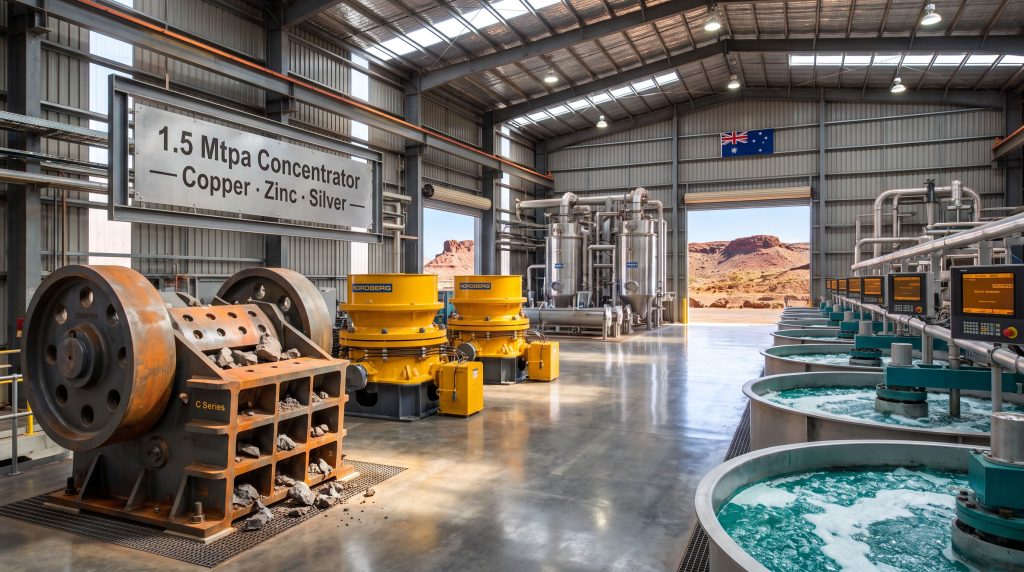
Metso's equipment scope for the Yitirrti concentrator spans the complete processing circuit, from primary ore size reduction through to final dewatering and process monitoring. The following table summarises the equipment categories, specific technology, and their functional role in the flowsheet:
| Equipment Category | Specific Technology | Flowsheet Function |
|---|---|---|
| Primary Crushing | Nordberg® C Series™ Jaw Crusher | Initial run-of-mine ore size reduction |
| Secondary/Tertiary Crushing | Nordberg HP450e™ Cone Crushers | Controlled particle sizing ahead of milling |
| Material Handling | Apron Feeder | Regulated feed rate delivery into crushing circuit |
| Flotation | TankCell® Flotation Cells | Selective copper and zinc sulphide separation |
| Regrinding | Stirred Media Detritor (SMD) Mills | Ultra-fine liberation of locked sulphide minerals |
| Solid-Liquid Separation | Thickeners | Concentrate and tailings dewatering |
| Process Monitoring | Slurry Analysers | Real-time elemental circuit optimisation |
This breadth of scope is significant. Rather than supplying equipment for one stage of the process, Metso's package covers the full processing arc — a characteristic that influences both construction management and long-term operational accountability.
Crushing Circuit Design: Why the Nordberg Series Suits Pilbara Geology
The Nordberg C Series jaw crusher is engineered for the variable hardness conditions typical of Pilbara ore bodies, where feed material can shift in hardness and abrasivity across different ore zones. At the primary crushing stage, feed size consistency directly determines the efficiency of downstream milling, making the reliability of jaw crusher performance under variable ROM feed a critical design consideration.
The HP450e cone crusher, used in secondary and tertiary crushing stages, incorporates hydraulic adjustment systems that allow operators to maintain a consistent product particle size even as ore characteristics change. In abrasive sulphide ore environments, maintaining tight control over the crushed product's P80 — the particle size at which 80% of material passes — is essential to protecting mill throughput and avoiding over-grinding, which wastes energy and can reduce flotation selectivity.
The apron feeder within this circuit performs a function that is sometimes underestimated: regulating the feed rate into the crusher to prevent surging, which can cause mechanical stress and throughput losses. In a 1.5 Mtpa operation, even minor inefficiencies at the crushing stage can compound into significant tonnage losses over time.
TankCell® Flotation: The Engineering Logic of Selective Sulphide Separation
Copper-zinc flotation is one of the more technically demanding separation challenges in sulphide metallurgy. The two minerals respond differently to flotation reagents, but their separation requires careful sequencing — typically floating copper minerals first while chemically depressing zinc, then reactivating zinc in a subsequent circuit. If the flotation equipment does not provide the correct hydrodynamic environment for froth stability and mineral attachment, the separation efficiency deteriorates and concentrate grades fall below marketable thresholds.
TankCell® flotation technology is designed around precise control of froth depth, air dispersion, and pulp agitation — the three variables that most directly influence mineral recovery rates and selectivity. The geometry of the tank and the design of the rotor-stator mechanism create a hydrodynamic environment that favours the attachment of target mineral particles to air bubbles while allowing gangue material to remain in the pulp. At 1.5 Mtpa throughput, cell sizing must account for adequate residence time to ensure sufficient mineral contact with the air-bubble interface before the froth overflows into the concentrate launder.
Flotation cell residence time is a frequently underappreciated variable in concentrator design. Undersizing flotation cells relative to throughput is one of the more common sources of recovery underperformance in operating polymetallic plants, where the metallurgical consequences only become fully apparent once the plant is running at nameplate capacity.
Stirred Media Detritors: Solving the Fine Grinding Challenge in Polymetallic Sulphides
One of the least publicly visible but metallurgically critical pieces of equipment in the Yitirrti package is the Stirred Media Detritor (SMD) regrind mill. Understanding why SMD technology is specified for this flowsheet requires understanding the liberation problem in fine-grained sulphide deposits.
What is an SMD mill? A Stirred Media Detritor uses a rotating agitator to transfer energy into a slurry containing very fine grinding media, typically ceramic beads. The resulting attrition between media and mineral particles achieves particle sizes well below what conventional ball milling can efficiently reach — often in the range of 10 to 30 microns. At these ultra-fine sizes, mineral grains that were previously locked within gangue particles or intergrown with other sulphides become physically separated and available for flotation recovery.
In polymetallic sulphide deposits where copper and zinc minerals are finely intergrown, primary grinding alone cannot liberate all of the valuable mineral surface area. Some particles exit the primary mill as composite grains — part sulphide, part gangue — and without further grinding, these composite particles float poorly, reducing both recovery and concentrate grade. SMD regrind mills are positioned within the flotation circuit, typically after a rougher flotation stage, to regrind the rougher concentrate and improve liberation before cleaning flotation.
Energy efficiency is a key advantage of SMD technology at fine grind targets. Compared to conventional ball mills attempting to achieve similar particle sizes, stirred mills consume significantly less energy per tonne of material ground to the target P80. In remote Western Australian operations where energy costs are elevated, this efficiency advantage has a material impact on operating cost per tonne processed. Furthermore, when interpreting drill results from polymetallic deposits, the fine-grained nature of the mineralisation is often an early indicator that SMD-style regrinding will ultimately be required in the processing plant design.
Slurry Analysers: The Intelligence Layer of the Processing Circuit
Real-time elemental monitoring through slurry analysers represents the process control intelligence that ties the physical processing circuit together. By continuously measuring the elemental composition of slurry streams at key points in the circuit, operators can detect grade variations in the feed, identify reagent consumption inefficiencies, and adjust circuit parameters before small deviations become significant recovery losses.
In a copper-zinc concentrator, the value of online analysis is compounded by the complexity of managing two separate flotation circuits simultaneously. Variations in feed grade or mineralogy that would take hours to detect through conventional laboratory sampling can be identified and responded to within minutes using continuous slurry analysis. This reduces reagent overconsumption and improves the consistency of both concentrate grades. Integration with the plant's distributed control system allows these measurements to feed directly into automated circuit control loops.
Integrated OEM Strategy Versus Multi-Vendor Procurement: A Technical Comparison
The decision to source the Yitirrti concentrator's equipment from a single integrated technology provider rather than assembling a multi-vendor package reflects a broader trend in EPC-delivered processing plant construction.
| Procurement Model | Core Advantages | Key Risk Factors |
|---|---|---|
| Integrated OEM Package | Unified process performance accountability, simplified commissioning interfaces, coordinated aftermarket support | Reduced price competition on individual equipment lines |
| Multi-Vendor Approach | Competitive pricing across equipment categories, flexibility to select best-in-class items | Interface management complexity, fragmented warranty structures |
| Hybrid Model | Optimisation of key equipment items with single-source for core circuits | Requires strong in-house procurement capability and technical oversight |
For EPC contractors such as GRES, the integrated OEM model reduces the interface risk that arises when equipment from different suppliers must function as a single system. When crushing, flotation, and dewatering equipment all come from one technology provider, the responsibility for demonstrating that those systems work together as designed sits with a single accountable party. This simplifies the contractual structure and reduces the project schedule risk associated with interface disputes during commissioning.
Metso's scope at Yitirrti covers design, manufacture, testing, and delivery — meaning the performance accountability extends from the engineering drawings through to site-ready equipment. For Develop Global, this delivery model provides a cleaner performance guarantee framework than a multi-vendor approach would allow. Consequently, the cut-off grade economics for a project of this type are also better served by an integrated approach, since maximising plant availability directly affects the volume of ore processed above economic thresholds.
The Karratha Service Centre: Aftermarket Support as an Operational Risk Mitigation Tool
In remote processing environments, equipment downtime is not measured purely in repair hours. It is measured in lost concentrate production, and in a 1.5 Mtpa copper-zinc operation, unplanned downtime on critical equipment can represent a significant revenue impact per day.
Metso's Karratha Service Centre provides geographically proximate aftermarket support for the Yitirrti project. The Pilbara's remoteness from major capital city supply chains means that spare parts availability and rapid field service response are not simply commercial conveniences — they are operational risk management tools. Shorter mean time to repair on critical equipment such as flotation cells, crushers, and regrind mills directly affects the plant's availability factor and, by extension, its annual production tonnage and revenue profile.
The presence of an established service hub in Karratha also affects the long-term total cost of ownership calculation for the processing plant. Aftermarket parts and service costs over a mine's operational life often rival or exceed the initial capital cost of the equipment itself, making proximity-based support a material factor in OEM selection for remote Australian operations.
Yitirrti's Role in Australia's Copper-Zinc Production Landscape
Dual-Demand Commodities and the Case for Mid-Tier Polymetallic Concentrators
Copper and zinc occupy distinct but complementary positions in the global commodity demand picture. The prevailing copper market trends point to sustained demand driven by electrical wiring, transformers, and electric vehicle components that make it central to electrification infrastructure investment. Zinc's primary demand driver remains galvanising steel for corrosion protection, though its emerging applications in battery chemistry are attracting increasing attention from investors and project developers.
Silver's dual demand as both an industrial metal in electronics manufacturing and a monetary asset that responds to macroeconomic sentiment makes it a compelling co-product at Yitirrti, adding a third revenue stream that can materially improve project economics. In polymetallic operations, silver is typically recovered through the copper concentrate circuit, as its mineralogical association with copper sulphides makes it a natural co-product of copper flotation.
At 1.5 Mtpa, Yitirrti is appropriately scaled for the grade and geometry of the deposit. Mid-tier concentrators at this throughput level require more precise metallurgical engineering than large-scale bulk mining operations, because the economic margin for recovery inefficiency is narrower. Every percentage point of improved copper or zinc recovery translates directly into additional concentrate tonnes and additional revenue — which is precisely why the equipment selection decisions covered in this analysis carry operational and financial weight well beyond the procurement announcement itself.
The next major ASX story will hit our subscribers first
Frequently Asked Questions: Metso Yitirrti Project Processing Equipment
What processing equipment has Metso been contracted to supply for the Yitirrti project?
Metso's equipment scope for the Metso Yitirrti project processing equipment package includes Nordberg C Series jaw crushers, Nordberg HP450e cone crushers, an apron feeder, TankCell flotation cells, thickeners, Stirred Media Detritor regrind mills, and slurry analysers, covering the full crushing, flotation, regrinding, and dewatering circuit for copper and zinc concentrate production.
What is the designed processing capacity of the Yitirrti plant?
The Yitirrti processing facility is designed to process approximately 1.5 million tonnes of ore per annum, positioning it as a mid-tier concentrator within the Western Australian minerals processing landscape.
Who holds the EPC contract for the Yitirrti processing plant?
GR Engineering Services (GRES) holds the engineering, procurement and construction contract for the 1.5 Mtpa Yitirrti processing plant, with the contract placed through Develop Global's wholly-owned subsidiary, Venturex Sulphur Springs Pty Ltd.
Why is a Stirred Media Detritor specified in the Yitirrti flowsheet?
SMD regrind mills are incorporated into the Yitirrti flowsheet to achieve ultra-fine particle liberation of copper and zinc sulphide minerals that cannot be efficiently liberated through primary grinding alone. This improves downstream flotation recovery rates and concentrate grade, while consuming less energy per tonne ground compared to conventional ball milling at equivalent fine grind targets.
What is the significance of Metso's Karratha Service Centre for the Yitirrti operation?
The Karratha Service Centre provides geographically proximate aftermarket support for the Yitirrti project site in the Pilbara, enabling faster spare parts delivery, field service response, and technical assistance during plant operations — reducing mean time to repair on critical equipment and supporting plant availability targets.
Key Takeaways
- Integrated flowsheet coverage: Metso's Yitirrti project processing equipment scope spans primary crushing through to final dewatering and real-time process monitoring, providing unified technology accountability across the full circuit.
- Polymetallic complexity demands specialised technology: The combination of selective TankCell flotation, SMD regrind mills, and continuous slurry analysis is a direct engineering response to the mineralogical challenges of separating copper and zinc sulphides from a high-grade Pilbara ore body.
- SMD technology addresses a critical liberation gap: Ultra-fine regrinding of locked sulphide particles after primary flotation is essential to achieving commercially acceptable concentrate grades and recovery rates in fine-grained polymetallic deposits.
- The integrated OEM model reduces EPC interface risk: Sourcing the full equipment package from a single technology provider simplifies commissioning accountability and performance guarantee structures for both GRES and Develop Global.
- Proximity-based aftermarket support is a material operational factor: The Karratha Service Centre's geographic alignment with the Yitirrti site reduces the logistical exposure that remote Pilbara processing operations typically face with equipment maintenance and spare parts supply.
- 1.5 Mtpa throughput is appropriately scaled for a high-grade polymetallic sulphide deposit where recovery precision drives more value than bulk processing volume.
Disclaimer: This article contains forward-looking context regarding project development timelines and commodity demand trends. These perspectives involve inherent uncertainties and should not be construed as financial or investment advice. Readers should conduct independent due diligence before making investment decisions related to any companies or projects referenced herein.
Want to Spot the Next Major Polymetallic Discovery Before the Market Does?
Discovery Alert's proprietary Discovery IQ model delivers real-time alerts the moment significant mineral discoveries — including copper, zinc, and silver systems like Yitirrti — are announced on the ASX, translating complex geological data into actionable investment insights for both short-term traders and long-term investors. Explore how major mineral discoveries have historically generated substantial returns by visiting Discovery Alert's dedicated discoveries page, and begin your 14-day free trial today to position yourself ahead of the broader market.