August 22, 2026
Why Copper Exploration Geology Is More Complex Than Most Investors Realise
Most discussions about copper exploration focus on headline drill results and resource estimates. Far fewer examine the geological architecture that determines whether a project has genuine scale potential or whether surface-level anomalies reflect something far more limited at depth. Understanding the distinction between deposit styles, drilling methodologies, and mineralisation continuity is essential for evaluating any early-stage copper-gold programme with intellectual honesty.
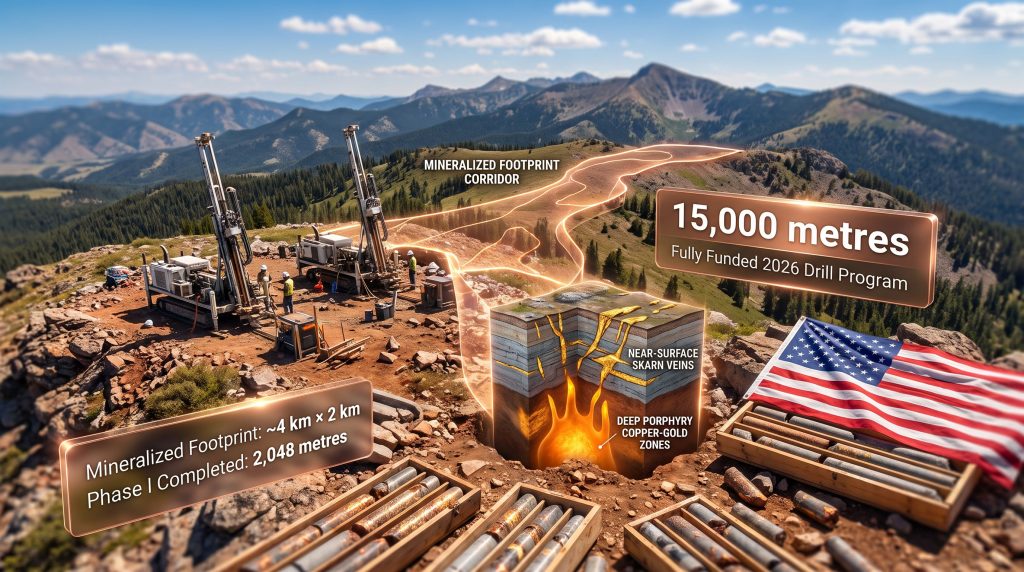
The American Pacific Madison copper gold drilling program in Montana offers a useful lens through which to examine these dynamics. With a fully funded 15,000-metre campaign underway and Phase I already delivering 2,048 metres of data, the project is progressing through one of the most data-intensive periods in its exploration history.
When big ASX news breaks, our subscribers know first
The Geological Architecture Behind the Madison Project
Not all copper-gold deposits are created equal. The Madison project targets two distinct but genetically related mineralisation styles that together define its exploration thesis.
Porphyry Systems: Large-Scale, Depth-Dependent Copper-Gold
Porphyry copper-gold deposits form through the emplacement of magmatic intrusions at depth, which release copper- and gold-bearing fluids that permeate surrounding rock over geological timescales. These systems are characteristically large in volume but relatively lower in grade, making them the backbone of global copper supply. Many of the world's largest producing copper mines, including those across the South American copper belt and the southwestern United States, are porphyry-type systems.
The defining characteristic of porphyry exploration is depth continuity. Mineralisation that begins at surface must be confirmed to persist with meaningful grades through systematic core drilling. This is precisely what the 1,620 metres of diamond core drilling completed during Phase I at Madison was designed to test.
Skarn Zones: Higher-Grade Targets With Different Risk Profiles
Skarn deposits form where intrusive magmatic rocks make contact with carbonate host rocks such as limestone or dolomite. The chemical reaction between these rock types creates replacement zones that can host copper and gold at significantly higher grades than the surrounding porphyry system, though typically in smaller, more structurally complex bodies.
The 428 metres of reverse circulation drilling conducted during Phase I focused specifically on near-surface skarn zones and high-grade vein structures. This dual-methodology approach is an important technical distinction: core drilling provides oriented, continuous samples ideal for structural interpretation at depth, while reverse circulation drilling offers faster, cost-effective coverage of shallower targets where sample contamination risks are lower.
Furthermore, IOCG deposit features share some genetic similarities with the skarn-porphyry systems seen at Madison, making cross-deposit comparisons useful for contextualising the mineralisation styles being tested.
The combination of porphyry and skarn targets within a single project creates optionality that single-style deposits simply cannot offer. Early-stage drill programmes that test both simultaneously generate disproportionately more geological information per metre drilled.
Key Project Metrics at a Glance
The following table summarises the core fundamentals of the Madison project as the 2026 drill campaign progresses:
| Metric | Detail |
|---|---|
| Project Location | Madison County, Montana, USA |
| Ownership Structure | 100% (American Pacific Mining) |
| Cumulative Exploration Spend (since 2019) | US$6.8 million |
| 2026 Drill Program Scale | 15,000 metres (fully funded) |
| Phase I Metres Completed | 2,048 metres |
| Core Drilling (Phase I) | 1,620 metres |
| RC Drilling (Phase I) | 428 metres |
| Mineralized Footprint | approximately 4 km x 2 km |
| First Resource Estimate Target | 2027 |
Why Fully Funded Programs Matter in a Capital-Constrained Market
The current junior mining financing environment is significantly more challenging than the exploration booms of the early 2000s or the post-financial crisis recovery period. Rising interest rates, compressed risk appetite among retail investors, and tighter institutional allocation to pre-resource exploration assets have made mid-programme capital raises both dilutive and reputationally costly.
Against this backdrop, the fact that the 15,000-metre Madison campaign is described as fully funded is a material signal. Companies that secure their exploration capital upfront avoid the operational disruptions and share price pressure associated with raising equity mid-drill. It also provides a signal about the conviction levels of those backing the programme, whether that reflects strong institutional participation, strategic investor support, or strong treasury management.
Dual-Rig Deployment as an Operational Signal
The mobilisation of a second drill rig to the Madison site in July 2026 carries operational significance that goes beyond simple acceleration of metres drilled. In exploration, the decision to add a second rig mid-programme typically reflects one or more of the following:
- Phase I results that were sufficiently encouraging to justify accelerated capital deployment
- Geological continuity across the mineralised footprint that supports broader spatial testing
- Management confidence in the structural interpretation developed from initial core data
- A strategic decision to compress the timeline toward resource definition ahead of a market window
The approximately 4 km by 2 km interpreted mineralised footprint provides the spatial basis for this decision. By North American porphyry exploration standards, an 8 square kilometre mineralised envelope is a meaningful target corridor, comparable in scale to systems that have gone on to define significant resource inventories across the western United States.
Comparing Madison to Early-Stage Porphyry Exploration Benchmarks
| Exploration Metric | Madison (2026) | Industry Benchmark (Early-Stage Porphyry) |
|---|---|---|
| Drill Program Scale | 15,000 metres | 10,000 to 20,000 metres (typical) |
| Mineralized Footprint | approximately 4 km x 2 km | 2 to 6 km across (variable) |
| Drilling Methodology | Core and RC dual-method | Commonly single-method |
| Resource Estimate Timeline | 2027 (targeted) | 2 to 5 years post-discovery |
| Program Funding Status | Fully funded | Often requires staged capital raises |
The U.S. Copper Supply Gap and Why Domestic Exploration Is Accelerating
The structural demand case for copper has been extensively documented, but the supply side receives comparatively little attention from generalist investors. The ongoing copper supply crunch creates supply chain dependencies that are increasingly scrutinised within the context of domestic industrial policy.
Electrification is the primary demand driver, but its scale is often underappreciated. A single electric vehicle contains roughly two to four times the copper content of an equivalent internal combustion engine vehicle. Grid-scale battery storage systems, offshore wind installations, and industrial heat pump rollouts all carry similarly elevated copper intensity relative to the technologies they replace.
Federal Investment Frameworks and the Critical Minerals Policy Environment
The U.S. Department of Energy's Office of Critical Minerals and Energy has announced plans to invest more than US$160 million across nine targeted recovery and extraction projects. This allocation forms part of a broader US$1 billion DOE investment framework aimed at scaling mining, processing, and manufacturing capabilities across the domestic critical minerals supply chain. Copper is explicitly listed among the priority elements alongside scandium, antimony, and rare earth elements.
It is important to note that this federal framework represents a policy environment and funding mechanism directed at the sector broadly. Individual exploration projects must navigate their own regulatory and permitting processes independently, and proximity to favourable policy settings does not constitute project-specific government endorsement or support.
Domestic copper exploration projects operating within established mining jurisdictions benefit from the broader regulatory momentum created by critical minerals policy, but investors should distinguish between sector-level tailwinds and project-specific catalysts when assessing individual investment cases.
Montana's position as a historically productive mineral jurisdiction with established mining regulatory frameworks makes it a relevant operating environment for this type of exploration. The Madison County location sits within a region that has hosted significant historic mineral production, adding geological context to the modern exploration hypothesis.
The next major ASX story will hit our subscribers first
Milestones That Will Define the Madison Investment Narrative
For investors and analysts tracking the American Pacific Madison copper gold drilling programme, the following catalysts represent the key value inflection points through 2027:
- Phase II assay results from near-surface skarn targets drilled by the second rig, which will test whether higher-grade mineralisation exists in zones accessible to lower-cost mining methods
- Porphyry depth continuity data from core assay results confirming whether copper-gold grades persist at the depths required to define a large-tonnage resource
- Mineralised footprint extension confirming or expanding the interpreted 4 km by 2 km envelope through systematic step-out drilling
- Completion of the 15,000-metre campaign, generating the geological dataset required to commission formal resource modelling
- Maiden Mineral Resource Estimate targeted for 2027, which will represent the first formal economic quantification of the project's potential and is likely to function as a significant re-rating catalyst
What a Maiden Resource Estimate Actually Signals to the Market
Many retail investors treat the publication of a first resource estimate as the end of a project's early-stage narrative. In reality, it marks the beginning of a new phase of scrutiny. The grade profile, geological confidence classification (Inferred versus Indicated), and the cut-off grade significance used to define the resource boundary all carry material implications for economic viability.
For porphyry-skarn systems specifically, a maiden resource that demonstrates:
- A large Inferred tonnage base from the porphyry component
- A smaller but higher-grade Indicated resource from the skarn zones
- Shallow geometry amenable to open-cut mining scenarios
…would represent the optimal combination for advancing toward a preliminary economic assessment. This configuration allows developers to present a large resource while simultaneously highlighting the higher-margin skarn material as a potential early cash flow source.
Frequently Asked Questions About the Madison Copper-Gold Project
What exactly is the American Pacific Madison project?
The Madison Copper-Gold Project is a 100% owned exploration asset located in Madison County, Montana. American Pacific Mining has invested US$6.8 million in exploration since 2019 and is currently executing its largest drill programme to date — a fully funded 15,000-metre campaign targeting both porphyry-style and skarn-hosted copper-gold mineralisation.
How much drilling has been completed so far?
Phase I totalled 2,048 metres, comprising 1,620 metres of diamond core drilling targeting the porphyry system at depth and 428 metres of reverse circulation drilling testing shallow skarn and vein targets. Mining Weekly's coverage of the programme launch provides additional context on how this phased approach was structured from the outset.
Why does the size of the mineralized footprint matter?
The approximately 4 km by 2 km interpreted mineralised footprint defines the spatial boundary within which drilling targets are being prioritised. In porphyry exploration, footprint scale is a primary predictor of resource tonnage potential. Systems with larger surface expressions have historically yielded larger resource inventories at depth, though this relationship is not deterministic and requires confirmation through systematic drilling.
What is reverse circulation drilling and how does it differ from core drilling?
Reverse circulation drilling uses compressed air to return rock chips to surface through the drill rods, providing fast and cost-effective sample recovery from shallow depths. Diamond core drilling extracts a continuous cylinder of intact rock, allowing structural analysis and oriented sampling of mineralised intervals. Consequently, the two methods are complementary rather than interchangeable — understanding true vs apparent widths is particularly important when evaluating results from both methods simultaneously.
When is the maiden resource estimate expected?
American Pacific Mining has indicated a target of 2027 for completion of its first Mineral Resource Estimate at Madison, contingent on the results of the ongoing 15,000-metre drill programme providing sufficient data density for JORC or NI 43-101 compliant resource modelling. Investors tracking the programme should focus on interpreting drill results carefully as assay data is released ahead of that milestone.
From Exploration Concept to Resource Definition: What the Madison Timeline Reveals
The Madison project has followed a disciplined exploration maturation pathway since systematic work began in 2019. The progression from initial surface sampling and geophysical surveys through to a 15,000-metre drill campaign across a confirmed multi-kilometre mineralised footprint reflects a structured approach to de-risking the geological thesis before committing to resource-definition scale expenditure.
The addition of a second drill rig in mid-2026 and the targeting of a 2027 maiden resource estimate suggest the American Pacific Madison copper gold drilling programme is entering its most information-intensive phase. For the broader copper exploration sector in the United States, the Madison project represents the type of systematic, well-funded domestic exploration that the current critical minerals policy environment is designed to encourage — even if the project itself must earn its resource credentials on purely geological and technical merit.
This article is intended for informational purposes only and does not constitute financial advice. Mining exploration is inherently speculative and early-stage projects carry significant geological and financial risks. Readers should conduct their own due diligence before making any investment decisions.
Want to Stay Ahead of Significant Copper Discoveries on the ASX?
Discovery Alert's proprietary Discovery IQ model delivers real-time alerts the moment significant mineral discoveries — including copper-gold — are announced on the ASX, transforming complex geological data into actionable investment insights for both short-term traders and long-term investors. Explore historic examples of major mineral discoveries and their market returns on Discovery Alert's dedicated discoveries page, and begin your 14-day free trial today to position yourself ahead of the broader market.